

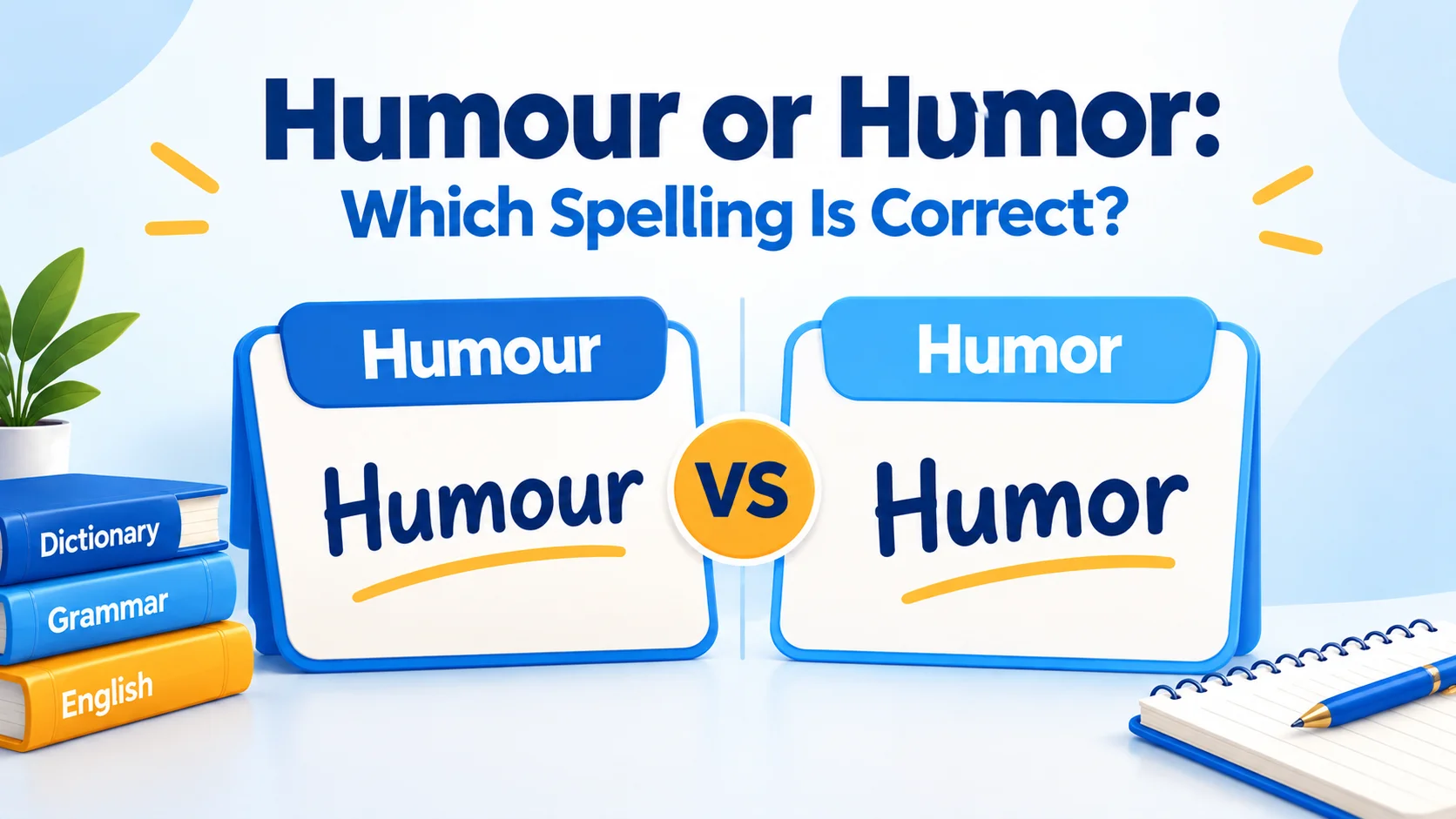
Humour or humor is a common spelling dilemma for writers who move between British and American English. Both spellings are correct, and neither changes the word’s meaning. The difference comes down to regional spelling conventions: humour is the standard form in British English, while humor is preferred in American English. Choosing the right version matters when you are writing an essay, preparing a professional report, publishing a blog post, or editing content for a particular audience. Once you understand the regional distinction, you can make the right choice without second-guessing yourself every time the word appears.
Although the difference involves just one letter, it reflects a broader pattern in English spelling. Words such as colour/color, favour/favor, and labour/labor follow a similar British-American distinction. These variations developed through different spelling conventions and became established in different English-speaking regions. The important point is that British and American spellings are both legitimate forms of standard English. The correct choice depends on your audience, publication requirements, and preferred style guide—not on which version looks more familiar or seems more logical.
This guide explains the difference between humour and humor, identifies where each spelling is used, and shows how to apply the distinction consistently. You will also learn why humorous is generally the correct adjective in both varieties, whether humourous is acceptable, and how related words change across regional conventions. Practical examples, comparison tables, and answers to common questions will help you choose confidently in academic, professional, and everyday writing. By the end, you will have a simple method for deciding which spelling to use and keeping your writing consistent.
Humour or Humor: The Quick Answer
Both humour and humor are correct spellings of the same noun. The difference is regional rather than grammatical or semantic.
- Humour: Standard British English spelling, also commonly used in Australian and New Zealand English.
- Humor: Standard American English spelling.
- Meaning: The quality of being amusing, the ability to recognize what is funny, or a particular style of comedy.
- Pronunciation: Generally the same in both varieties.
- Adjective: Humorous is the standard form in both British and American English.
For example:
- British English: Her dry humour made the meeting more enjoyable.
- American English: Her dry humor made the meeting more enjoyable.
Both sentences are correct. The only difference is the spelling convention being followed.
| Feature | Humour | Humor |
| Standard spelling | British English | American English |
| Commonly used in | United Kingdom, Australia, New Zealand | United States |
| Meaning | The same | The same |
| Pronunciation | Generally the same | Generally the same |
| Example | His humour eased the tension. | His humor eased the tension. |
| Related adjective | Humorous | Humorous |
Quick rule: Use humour for British English and humor for American English. If you are writing for a publication, employer, university, or client, follow its preferred style guide.
What Does Humour Mean?
Humour is the British English spelling of a noun that refers to the ability to find something funny, the quality that makes something amusing, or a particular kind of comedy. It can describe a person’s personality, a joke, a situation, or the general tone of a piece of writing.
The word is flexible because humour can appear in many forms. A clever remark may demonstrate humour, a comedian may use humour to entertain an audience, and a friend may use humour to make an uncomfortable situation easier to handle.
Common uses of humour
1. The ability to recognize or appreciate what is funny
This meaning describes someone’s capacity to enjoy jokes or see the amusing side of situations.
- He has a wonderful sense of humour.
- A good sense of humour can make long journeys more enjoyable.
2. Something that causes amusement
Humour can also describe the amusing quality of a remark, story, performance, or situation.
- The writer uses humour to make a difficult subject easier to understand.
- There was plenty of humour in the teacher’s explanation.
3. A particular style of comedy
People have different tastes in comedy. The word can describe a style that someone enjoys or uses.
- Her humour is subtle rather than loud or exaggerated.
- The programme relies on observational humour.
4. A way of responding to a situation
Humour can help people manage awkward moments, although it is not appropriate in every circumstance.
- He used humour to ease the tension during the discussion.
- She responded to the minor mistake with good humour.
In all these examples, humour is the preferred spelling in British English. An American writer would use humor without changing the meaning.
What Does Humor Mean?
Humor has the same meaning as humour. It is the standard American English spelling and appears in everyday conversations, newspapers, books, academic writing, business communication, and online content produced for American readers.
For example:
- The comedian’s humor appealed to a wide audience.
- She has a sharp sense of humor.
- The film balances humor with serious themes.
- He used humor to make his presentation more engaging.
The American spelling is not a shortened or informal version of the British spelling. It is the established standard in American English.
How Americans use humor
In American writing, humor appears in several familiar expressions:
- Sense of humor: The ability to recognize and appreciate what is funny.
- Dry humor: Comedy delivered in a restrained or serious manner.
- Dark humor: Comedy that addresses serious, uncomfortable, or distressing subjects.
- Self-deprecating humor: Comedy in which someone makes light of their own shortcomings or experiences.
- Humor writing: Writing intended to entertain through jokes, amusing observations, or comic situations.
For example, an American publication might write, The author’s dry humor makes the memoir both entertaining and thoughtful.
A British publication would normally write, The author’s dry humour makes the memoir both entertaining and thoughtful.
The spelling changes, but the sentence communicates exactly the same idea.
Why Are Humour and Humor Spelled Differently?
The difference between humour and humor is part of the wider history of English spelling. English developed over centuries through influences from several languages, including French and Latin. Spelling conventions were not always standardized, and different writers and publishers used different forms.
In the early modern period, English spelling gradually became more consistent through dictionaries, printing practices, education, and publishing. However, British and American English did not always settle on the same conventions.
American spelling was influenced by efforts to simplify or regularize certain written forms. American lexicographer Noah Webster helped popularize several spellings that became characteristic of American English, including forms such as color and labor. The broader history is more complex than one person’s preferences, but Webster’s dictionaries played an important role in establishing American conventions.
The spelling humor became standard in the United States, while humour remained the conventional form in British English.
Is one spelling older or more correct?
It is misleading to treat one spelling as correct and the other as a mistake. Correctness depends on the variety of English being used.
A British newspaper that consistently uses humour is following its regional convention. An American newspaper that uses humor is doing the same. Problems arise when a writer mixes conventions without a reason, especially in formal or edited work.
This distinction matters because English has no single spelling system that every English-speaking country follows in every detail. British, American, Canadian, Australian, and other English varieties share a great deal of vocabulary and grammar while retaining some differences in spelling and usage.
The practical lesson is straightforward: identify your audience first, then apply the spelling convention appropriate to that audience.
Humour vs. Humor in British, American, Australian, and Canadian English
The most useful way to choose between the two spellings is to consider the country or publication you are writing for. However, regional patterns are not absolute rules for every individual or organization.
| Region | Common spelling | Practical guidance |
| United Kingdom | Humour | Use the British spelling in general British English writing. |
| United States | Humor | Use the American spelling for American readers. |
| Australia | Humour | British-style spelling is commonly used. |
| New Zealand | Humour | British-style spelling is commonly used. |
| Canada | Often humour | Canadian usage often retains the -our spelling, but check the relevant style guide. |
| International audience | Depends on the target | Choose one variety and apply it consistently. |
British English: humour
British English generally retains the -our ending in words such as humour, colour, favour, and neighbour.
Examples:
- The article combines humour with practical advice.
- A little humour can make a presentation more memorable.
- The novel’s humour is understated and intelligent.
These spellings are standard in British publications and in many educational settings that follow British English conventions.
American English: humor
American English generally uses the shorter -or spelling.
Examples:
- The article combines humor with practical advice.
- A little humor can make a presentation more memorable.
- The novel’s humor is understated and intelligent.
These are standard forms for American audiences. Using humour in an otherwise American document may look inconsistent, even though readers will understand it.
Australian and New Zealand English
Australian and New Zealand English generally follow British-style spelling for this word, so humour is the usual choice.
For example:
- The speaker used humour to connect with the audience.
- Her sense of humour is well known among her colleagues.
If you are writing for a specific Australian or New Zealand organization, use its house style where one is available.
Canadian English
Canadian English can combine British and American spelling patterns, depending on the word and the publication’s conventions. Humour is common in Canadian usage, but it is sensible to check a Canadian dictionary or the style guide used by your employer, university, or publisher.
Do not assume that every Canadian spelling follows British English or that every Canadian publication follows American English. Canadian English has its own established conventions.
What if your readers live in several countries?
For international websites, blogs, and digital publications, consistency is usually more important than choosing one spelling as universally superior.
Use this approach:
- Identify your main audience. Decide whether your content primarily serves British, American, or another English-speaking readership.
- Choose a spelling system. Use humour or humor according to your target variety.
- Check related words. Look for other regional differences, such as colour/color and favour/favor.
- Apply the choice throughout the content. Avoid switching between varieties without a clear reason.
- Follow the publication’s rules. A company or publisher’s style guide takes priority over personal preference.
For example, a website serving American teachers should normally use humor throughout its articles, while a UK-based educational website would generally use humour.
Humorous or Humourous: Which Spelling Is Correct?
This is an important distinction because the regional spelling rule does not mean that every related word follows the same pattern.
The standard adjective is humorous in both British and American English. The spelling humourous appears occasionally, but it is uncommon and is generally best avoided in standard edited writing.
Compare these examples:
- British English: The book contains several humorous stories.
- American English: The book contains several humorous stories.
Both sentences use humorous, even though the corresponding noun differs between humour and humor.
Why doesn’t humorous change to humourous in British English?
English spelling patterns are not always perfectly symmetrical. Some words retain forms that cannot be predicted simply by adding or removing a letter from a related noun.
Although humour is standard in British English, its usual adjective is still humorous. Therefore, writers should learn the adjective as a separate spelling rather than automatically adding -ous to the noun.
A similar point applies to editing: a spell-checker may flag a word based on its selected dictionary, but its suggestion should be considered in context. A British English dictionary can accept humour while identifying humorous as the standard adjective.
Examples of correct usage
| Word | British English | American English |
| Noun | Humour | Humor |
| Adjective | Humorous | Humorous |
| Adverb | Humorously is widely used; check house style | Humorously |
| Person who creates or writes comedy | Humourist | Humorist |
| Without humour or humor | Humourless | Humorless |
Some related forms may show additional regional variation or differences between dictionaries. If a less familiar derivative is important to your article, consult a reliable dictionary rather than assuming it follows the noun mechanically.
Writing tip: If you remember only one exception, remember this: British English uses humour, but the standard adjective remains humorous.
Humour and Humor in Real Sentences
Seeing both spellings in context makes the distinction easier to apply. The following pairs use the same sentence structure so you can see exactly what changes.
Everyday conversation
British English: My grandfather has a wonderful sense of humour.
American English: My grandfather has a wonderful sense of humor.
Both sentences describe someone’s ability to appreciate or create amusing moments.
School and academic writing
British English: The author uses humour to explore serious social issues.
American English: The author uses humor to explore serious social issues.
The spelling should follow the English variety expected by the school, instructor, or publisher.
Business communication
British English: A little humour helped the team relax during the workshop.
American English: A little humor helped the team relax during the workshop.
Humour can make workplace communication feel more approachable, but the appropriateness of a joke depends on the audience and situation. A spelling choice will not make an unsuitable joke appropriate.
Reviews and entertainment writing
British English: The film mixes physical comedy with dry humour.
American English: The film mixes physical comedy with dry humor.
The noun remains the same in meaning even when it appears alongside a different type of comedy.
Creative writing
British English: Her humour was gentle, observant, and never cruel.
American English: Her humor was gentle, observant, and never cruel.
The choice of spelling does not change a character’s voice, personality, or comic style. It simply aligns the manuscript with the spelling conventions of its intended readership.
Editing a document with mixed spelling
Imagine that you are proofreading an article for a British website and find these sentences:
- The writer’s humour makes the story engaging.
- His humor is subtle rather than obvious.
- The humorous scenes are especially effective.
The first and third sentences are consistent with standard British usage. The second uses the American noun spelling and may need to be changed to humour to maintain consistency.
The adjective humorous, however, should remain as it is.
This is the kind of small editorial decision that makes a document feel carefully prepared rather than assembled from sources that follow different conventions.
What Are the Different Types of Humour?
Understanding the word also means recognizing how it is used to describe different styles of comedy. The categories below are useful when writing reviews, analysing literature, discussing entertainment, or describing someone’s sense of humour.
| Type of humour | Meaning | Example |
| Dry humour | Comedy delivered in a restrained or serious manner | Someone responds to a minor inconvenience with an understated remark. |
| Dark humour | Comedy involving serious, uncomfortable, or distressing subjects | A fictional story uses irony to examine an unsettling situation. |
| Self-deprecating humour | Comedy in which a person jokes about their own experiences or shortcomings | A presenter makes a lighthearted joke about getting lost on the way to the venue. |
| Observational humour | Comedy based on everyday behaviour or familiar experiences | A comedian jokes about how people behave in supermarket queues. |
| Situational humour | Comedy arising from the circumstances of a scene | Two characters misunderstand the same instruction in different ways. |
| Slapstick humour | Physical comedy involving exaggerated movements or mishaps | A character struggles comically with an umbrella in a strong wind. |
| Satirical humour | Comedy used to criticize behaviour, institutions, or social problems | A sketch exaggerates bureaucratic rules to expose their absurdity. |
These categories can overlap. A satirical story may use dry humour, while a film can combine slapstick with situational comedy.
The word humour or humor does not itself identify a particular type of comedy. Descriptive words such as dry, dark, observational, and satirical provide that extra information.
Is humour always meant to make people laugh?
Not necessarily. Humour can entertain, but it can also create irony, reveal a character’s personality, make criticism more accessible, or help people discuss an awkward subject.
A humorous passage may produce a smile rather than loud laughter. It may also be uncomfortable or deliberately provocative. Whether that approach works depends on context, audience expectations, and how the material is presented.
In professional writing, describing a piece as humorous is often more precise than simply calling it funny, particularly when you want to discuss its tone rather than guarantee a reader’s reaction.
Humour vs. Humor: Common Mistakes to Avoid
The spelling difference is easy to learn, but several related mistakes can still occur.
1. Treating one spelling as universally correct
Writing humor in an American publication is correct. Writing humour in a British publication is also correct.
The mistake is assuming that the spelling preferred in one variety must be used everywhere. English spelling depends partly on regional convention.
Better approach: Identify the target audience and follow its spelling system.
2. Mixing British and American spellings
A document that uses humour, color, favour, and organisation may contain a mixture of conventions, depending on the style being followed.
Mixing forms is not always a grammatical error, but unexplained inconsistency can distract readers and create extra work for editors.
Better approach: Use your word processor’s language settings and proofread regional spellings together, not just one word at a time.
3. Writing “humourous” when you mean “humorous”
Because humour is the British noun spelling, it may seem logical to write humourous. However, humorous is the standard adjective in both British and American English.
Better approach: Memorize the noun and adjective as separate forms: humour/humor and humorous.
4. Assuming the spelling changes pronunciation
The difference between humour and humor is primarily written. The two forms are generally pronounced alike within a given English variety.
Better approach: Choose the spelling based on your writing conventions, not an imagined difference in meaning or pronunciation.
5. Changing a quotation to match your style
If you quote an American author who writes humor, do not silently alter the spelling to humour merely because the rest of your British English article uses British spelling. Direct quotations should preserve the source’s wording, apart from clearly indicated editorial changes.
Better approach: Keep the original spelling in quotations and maintain your chosen convention in your own prose.
6. Ignoring a publication’s house style
A publication may have specific rules for spelling, punctuation, capitalization, and word choice. Those rules can be more important than a writer’s personal preference.
Better approach: Check the relevant style guide before finalizing a manuscript, report, or submission.
Which Spelling Should You Use? A Practical Decision Guide
When you are unsure whether to write humour or humor, you do not need to memorize every regional variation in English. A short decision process is enough.
| Your writing situation | Recommended choice |
| Article for a British audience | Humour |
| Essay following American English conventions | Humor |
| Content for an Australian or New Zealand audience | Usually humour |
| Canadian publication | Check its style guide; humour is common |
| International website with a defined American style | Humor |
| International website with a defined British style | Humour |
| Direct quotation from a source | Preserve the source’s spelling |
| Adjective describing something amusing | Humorous in both standard varieties |
A simple editing checklist
Before publishing your work, ask yourself:
- Who is the primary audience?
- Does the publisher or organization specify British or American English?
- Have I used humour or humor consistently in my own writing?
- Have I kept humour as the standard adjective?
- Have I preserved the spelling in direct quotations?
- Have I checked related regional spellings in the same document?
This checklist is especially useful for websites that publish many articles. A single spelling convention applied consistently across the site helps establish a recognizable editorial standard.
What if a spell-checker recommends the other spelling?
Spell-checkers often use a selected language variety. If your software is set to American English, it may flag humour; if it is set to British English, it may flag humor.
That does not necessarily mean the word is wrong. It may simply be inconsistent with the selected dictionary.
Set the document language correctly before accepting spelling suggestions. If you edit for clients in different countries, consider maintaining separate proofreading settings or using a style sheet that records each client’s preferences.
Conclusion:
The choice between humour and humor is straightforward once you know which English variety you are using. British English generally prefers humour, while American English uses humor. Both spellings are correct, and neither changes the word’s meaning. Australian and New Zealand English commonly follow the British form, while Canadian usage should be checked against the relevant style guide. Remember, too, that humorous is the standard adjective in both British and American English.One final actionable tip: Before editing a document, identify its target audience and set your spelling preferences accordingly. This small step can prevent a surprising number of inconsistencies. A common mistake to avoid is assuming that every related word follows the same regional pattern. English spelling has exceptions, so check unfamiliar forms rather than guessing. The goal is not to declare one variety superior; it is to communicate clearly and consistently with the readers you want to reach.
FAQs
Q1. Is humour or humor correct in English?
Both humour and humor are correct. Humour is the standard British English spelling, while humor is standard in American English. The meaning remains the same, so your choice should depend on your audience, publication requirements, and the spelling conventions used throughout your document.
Q2. Does Canada use humour or humor?
Canadian English commonly uses humour, although Canadian spelling conventions combine British and American influences. Usage can vary by publication and style guide. If you are preparing work for a Canadian organization, consult its editorial guidelines rather than assuming that every word follows either British or American spelling.
Q3. Is “humourous” ever correct?
Humourous appears occasionally, but humorous is the standard adjective in both British and American English. In formal, academic, and professional writing, choose humour. The noun may be spelled humour or humor, but the adjective does not ordinarily change to match that regional difference.
Q4. Do humour and humor have different pronunciations?
Generally, humour and humor are pronounced the same within the relevant English variety. The difference is primarily a spelling convention, not a change in meaning or grammar. Pronunciation can vary by accent, but the additional u in the British spelling does not create a separate pronunciation.
Q5. Should I use British or American spelling on an international website?
Choose the spelling convention that best suits your main audience or your organization’s editorial policy. If the website has no established preference, select one variety and apply it consistently. Search engines do not require you to mix spellings; clear, useful content and a consistent reader experience are better priorities.