

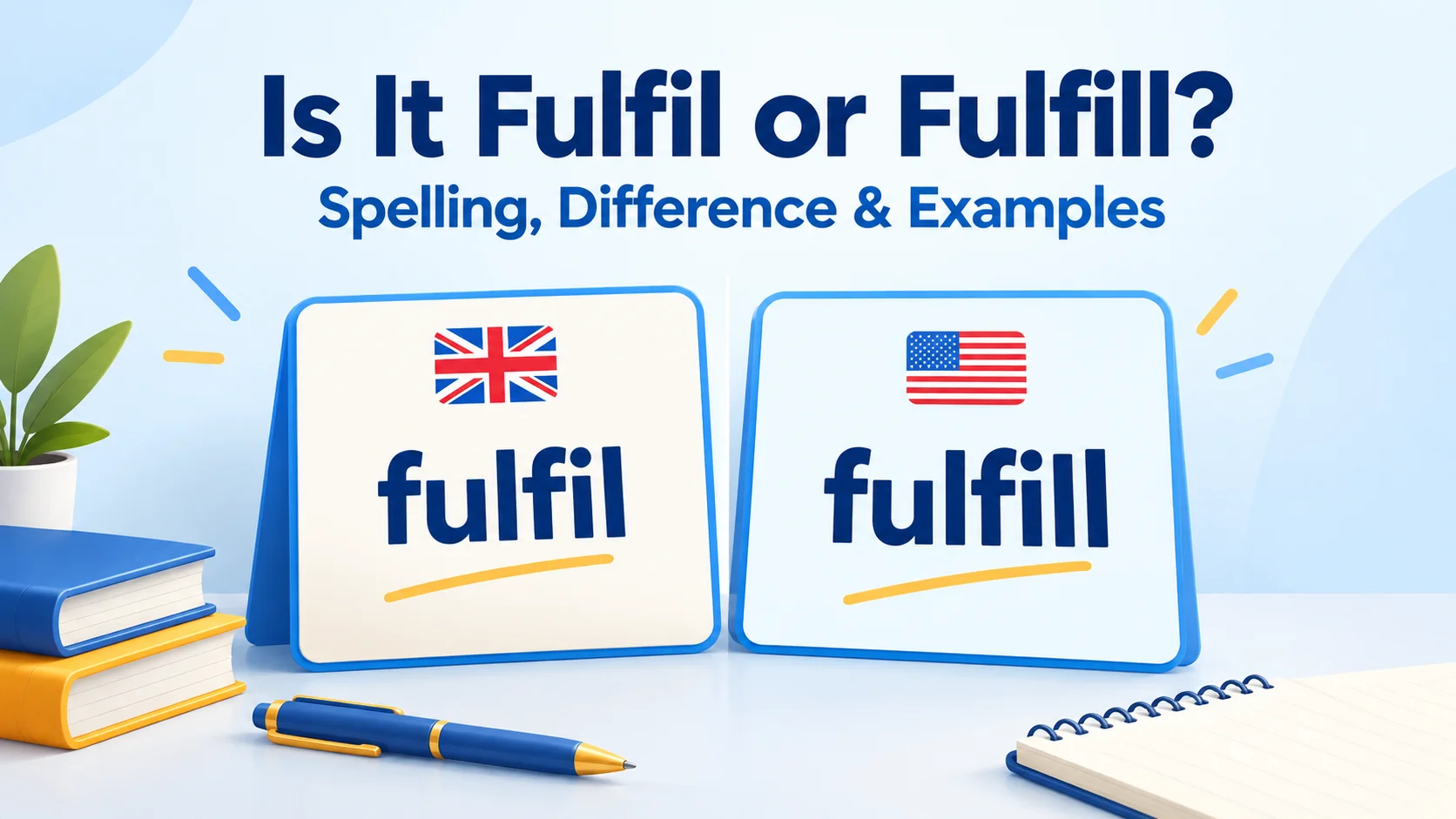
If you are unsure whether to write fulfil or fulfill, the correct choice depends on the variety of English you use. Both spellings are correct, and both mean to carry out a promise, meet an obligation, satisfy a requirement, or achieve a goal. The main difference is regional: fulfil is the standard spelling in British English, while fulfill is the standard spelling in American English. Neither spelling is more correct than the other in every situation. Choosing the appropriate form depends on your audience, location, and preferred writing style.
The difference becomes easier to remember when you look at related words. British English generally uses fulfilment, whereas American English uses fulfillment. However, the past tense and past participle are spelled fulfilled in both varieties, and the present participle is fulfilling in both. These forms can seem inconsistent at first, especially because the final consonant is doubled in fulfilled and fulfilling. Learning the pattern will help you spell the word correctly in emails, essays, professional documents, and everyday conversations.
In this guide, you will learn when to use fulfil or fulfill, what each spelling means, how to form related words, and how to avoid common spelling mistakes. You will also find practical examples, a side-by-side comparison, and guidance for choosing the right form in academic and professional writing. Whether you follow British or American English, the goal is the same: to communicate clearly and use consistent spelling throughout your work. Once you understand the regional distinction, choosing between fulfil and fulfill becomes straightforward.
Fulfil or Fulfill: Which Spelling Is Correct?
Both fulfil and fulfill are correct spellings of the same verb. The difference is based on regional spelling conventions rather than meaning.
- Fulfil is the standard spelling in British English.
- Fulfill is the standard spelling in American English.
For example:
- British English: She worked hard to fulfil her ambition.
- American English: She worked hard to fulfill her ambition.
Both sentences mean exactly the same thing. The spelling changes, but the meaning, pronunciation, and grammatical function remain unchanged.
Quick Comparison: Fulfil vs. Fulfill
| Feature | Fulfil | Fulfill |
| Standard variety | British English | American English |
| Meaning | To carry out, satisfy, or achieve | To carry out, satisfy, or achieve |
| Present tense | fulfil | fulfill |
| Past tense | fulfilled | fulfilled |
| Present participle | fulfilling | fulfilling |
| Related noun | fulfilment | fulfillment |
| Example | He hopes to fulfil his promise. | He hopes to fulfill his promise. |
The easiest rule to remember: use fulfil when following British English conventions and fulfill when following American English conventions. If you are writing for an international audience, either form can work, provided you use it consistently and follow any relevant style guide.
What Does Fulfil Mean?
Fulfil is a verb that means to carry out something that is expected, promised, required, or desired. It can refer to meeting a responsibility, satisfying a need, achieving an ambition, or making something happen as intended.
The spelling fulfil is standard in British English and is also used in other varieties that follow British spelling conventions.
Common Meanings of Fulfil
1. To Carry Out a Promise or Commitment
When you fulfil a promise, you do what you said you would do.
Examples:
- She always tries to fulfil her promises.
- The company failed to fulfil its commitment to customers.
- He fulfilled his promise to help his colleague.
Notice that the past-tense form is fulfilled, even when the base verb is written as fulfil.
2. To Meet a Requirement or Obligation
Fulfil can describe meeting a condition, responsibility, duty, or formal requirement.
Examples:
- Applicants must fulfil all eligibility requirements.
- The supplier fulfilled its contractual obligations.
- You must fulfil the necessary conditions before applying.
This usage is common in legal, administrative, academic, and professional writing.
3. To Achieve a Goal or Ambition
The verb can also describe achieving something you have wanted or worked toward.
Examples:
- She hopes to fulfil her dream of becoming a teacher.
- Travelling abroad helped him fulfil a lifelong ambition.
- The scholarship allowed the student to fulfil an important educational goal.
In these examples, fulfil emphasizes achieving something meaningful rather than simply completing a task.
4. To Satisfy a Need or Expectation
You can use fulfil when something meets a need, expectation, or particular purpose.
Examples:
- The new service fulfils an important need in the community.
- The book fulfilled my expectations.
- This position fulfils both practical and professional needs.
The exact meaning depends on the context, but the central idea is always meeting or satisfying something.
What Does Fulfill Mean?
Fulfill has the same meaning as fulfil. It is the standard American English spelling and can describe carrying out a promise, meeting a requirement, achieving a goal, or satisfying a need.
American writers use fulfilment in everyday communication, education, business, journalism, and formal documents.
Common Meanings of Fulfill
1. To Keep a Promise
Examples:
- She promised to fulfill her responsibilities.
- The organization fulfilled its pledge to support local students.
- He fulfilled his promise to return the borrowed book.
2. To Meet a Requirement
Examples:
- You must fulfill the course requirements before graduation.
- The business fulfilled its obligations under the agreement.
- Every applicant must fulfill the stated conditions.
3. To Achieve a Dream
Examples:
- He wants to fulfill his dream of opening a restaurant.
- She finally fulfilled her lifelong ambition.
- The opportunity helped them fulfill their personal goals.
4. To Satisfy an Expectation or Need
Examples:
- The program fulfills an important educational need.
- The product fulfills the customer’s basic requirements.
- The new role fulfilled her expectations.
In every example, fulfill means the same thing as fulfil. The American spelling simply contains a double l in its base form.
Why Are There Two Spellings?
English spelling developed through different historical influences, and spelling conventions gradually became standardized in different regions. British and American English retained or adopted different forms of many words.
The distinction between fulfil and fulfill is one example of this regional variation. British English generally uses the single-l form in the base verb, while American English uses the double-l form.
Similar differences appear in other words:
| British English | American English |
| fulfil | fulfill |
| fulfilment | fulfillment |
| travelled | traveled |
| travelling | traveling |
| cancelled | canceled |
| cancelling | canceling |
These examples illustrate common spelling differences, although English spelling conventions include exceptions and variations. For fulfil and fulfill, the key point is that the preferred base spelling differs by region, while the forms fulfilled and fulfilling are shared.
Is One Spelling More Correct Than the Other?
No. Neither spelling is universally more correct.
Using fulfill in an American English document is standard, just as using fulfil in a document that follows British English is standard. Problems arise mainly when writers mix conventions without a reason or ignore a publication’s required style.
For example, a British publication might prefer fulfil, fulfilment, and organise. An American publication might prefer fulfill, fulfillment, and organisation.
Consistency matters more than choosing one regional spelling for every situation.
Fulfil vs. Fulfill: Examples in Sentences
Seeing both spellings in context makes the distinction easier to remember. The following examples show how the verb works in common situations.
Everyday Examples
| British English | American English |
| I want to fulfil my dream. | I want to fulfill my dream. |
| She promised to fulfil her duties. | She promised to fulfill her duties. |
| We must fulfil the requirements. | We must fulfill the requirements. |
| He hopes to fulfil his potential. | He hopes to fulfill his potential. |
| The service should fulfil your needs. | The service should fulfill your needs. |
The sentences have identical meanings. Only the regional spelling changes.
Examples in Professional Writing
The verb frequently appears in workplace communication because employees and organizations must meet obligations, expectations, and goals.
British English examples
- The contractor must fulfil the terms of the agreement.
- The team worked together to fulfil the client’s requirements.
- Employees are expected to fulfil their professional responsibilities.
American English examples
- The contractor must fulfill the terms of the agreement.
- The team worked together to fulfill the client’s requirements.
- Employees are expected to fulfill their professional responsibilities.
In contracts and other formal documents, follow the spelling conventions specified by the organization or governing style guide. If the document uses a prescribed template, maintaining its terminology and spelling may be more important than making independent changes.
Examples in Academic Writing
Students and researchers may use the verb to discuss research objectives, academic requirements, and personal or institutional goals.
- The study aims to fulfil an important research objective. (British English)
- The study aims to fulfill an important research objective. (American English)
- Students must fulfil all graduation requirements. (British English)
- Students must fulfill all graduation requirements. (American English)
Choose the spelling appropriate for your institution, publication, or intended readership.
Examples in Personal Contexts
The verb is also useful when describing relationships, ambitions, and personal satisfaction.
- She hopes to fulfil her childhood dream.
- He found a career that fulfilled his interests.
- Volunteering helped them fulfil a desire to serve their community.
- The experience was fulfilling in ways she had not expected.
The last example uses fulfilling, a form that is spelled the same way in British and American English.
Fulfilment vs. Fulfillment: What Is the Difference?
The noun form follows the same regional distinction as the base verb.
- Fulfilment is the standard British English spelling.
- Fulfillment is the standard American English spelling.
Both nouns refer to the act of fulfilling something or the state of having a need, responsibility, or ambition satisfied.
Examples:
- British English: She found fulfilment in helping others.
- American English: She found fulfillment in helping others.
Another example:
- British English: The fulfilment of the agreement took several months.
- American English: The fulfillment of the agreement took several months.
The noun can describe personal satisfaction, the completion of a duty, or the process of meeting an obligation. In retail and logistics, order fulfilment or order fulfillment refers to the process of preparing and delivering customer orders.
Fulfilment or Fulfillment in Business?
Use the spelling that matches the English variety used by your business or audience.
For example:
- A UK-based company may use order fulfilment.
- A US-based company may use order fulfillment.
Both expressions describe the same business process. If you are preparing website content for customers in a particular country, using that audience’s familiar spelling can improve consistency and readability.
Fulfilled vs. Fulfiled: Which Is Correct?
Fulfilled is the correct spelling. Fulfiled is incorrect.
This rule applies whether your writing follows British or American English. Although the base verb differs between fulfil and fulfill, both varieties use fulfilled for the past tense and past participle.
Correct examples:
- She fulfilled her promise.
- The organization fulfilled its responsibilities.
- They have fulfilled all the requirements.
- His work fulfilled an important need.
Incorrect example:
- She fulfiled her promise.
Why Is the L Doubled in Fulfilled?
The spelling pattern can seem unusual because the base verb has one l in British English and two in American English. However, the standard past-tense form is fulfilled in both.
Think of it as a shared spelling pattern rather than a reason to change the regional base form.
| Base verb | Correct past tense | Incorrect form |
| fulfil | fulfilled | fulfiled |
| fulfill | fulfilled | fulfiled |
When forming the past tense, do not simply add -ed to produce fulfiled. Memorizing fulfilled as the standard form will prevent this common error.
Fulfilling vs. Fulfiling: Which Is Correct?
Fulfilling is correct in both British and American English. The spelling fulfiling is not standard.
Examples:
- She is fulfilling her responsibilities.
- The project is fulfilling its original purpose.
- Teaching can be a fulfilling career.
- They are fulfilling the terms of the contract.
The form fulfilling can function as a verb form or as an adjective describing something that provides satisfaction or a sense of purpose.
For example:
- Verb: The company is fulfilling its obligations.
- Adjective: Volunteering was a fulfilling experience.
Although the base forms differ regionally, the present participle is the same in both varieties.
Common Mistakes to Avoid
Writers often confuse fulfil and fulfill because the related forms do not all follow the same visible pattern. The following mistakes are worth watching for.
1. Treating One Regional Spelling as Incorrect
Incorrect assumption: Fulfil is wrong because fulfill has two l’s.
Correction: Both are standard spellings, but they belong to different regional conventions.
2. Writing Fulfiled Instead of Fulfilled
Incorrect: The team fulfiled its obligations.
Correct: The team fulfilled its obligations.
Use fulfilled regardless of whether the base verb in your chosen English variety is fulfil or fulfill.
3. Writing Fulfiling Instead of Fulfilling
Incorrect: She is fulfiling her ambitions.
Correct: She is fulfilling her ambitions.
Remember that the standard present participle has two l’s.
4. Mixing Fulfilment and Fulfillment Without a Reason
Using fulfilment in one paragraph and fulfillment in the next can make an article look inconsistent.
Choose the spelling that matches your target audience, then apply it throughout the document unless a quotation, official name, or required source spelling needs to remain unchanged.
5. Assuming the Meaning Changes
Fulfil and fulfill do not have different meanings. The choice is about spelling, not the action being described.
For instance, fulfil a promise and fulfill a promise both mean to do what was promised.
How to Choose the Right Spelling
The best way to decide between fulfil and fulfill is to consider your audience and the spelling conventions you are expected to follow.
Use Fulfil for British English
Choose fulfil when writing according to British English conventions. This is usually appropriate for content aimed at readers in the UK or for publications that specify British spelling.
Examples:
- fulfil a promise
- fulfil a requirement
- fulfil an ambition
- fulfilment of a duty
Use Fulfill for American English
Choose fulfill when following American English conventions, particularly for US-focused publications, websites, and business documents.
Examples:
- fulfill a promise
- fulfill a requirement
- fulfill an ambition
- fulfillment of a duty
Follow Your Organization’s Style Guide
If you write for a company, university, journal, or website, check its style guide before making a decision. A publication may specify British English, American English, or another established house style.
If no guidance is available, choose the variety that best suits your readers and apply it consistently.
Check Your Spell-Checker Settings
A spell-checker may flag fulfil or fulfill depending on the language setting. If you use British English settings, fulfill may be marked as a regional mismatch; with American English settings, fulfil may be flagged.
A spelling warning does not always mean a word is universally incorrect. Check the intended English variety before changing a correctly spelled word.
Conclusion
Choosing between fulfil or fulfill is simple once you understand the regional spelling difference. Fulfil is standard in British English, while fulfill is standard in American English. Both words mean to carry out a promise, meet an obligation, satisfy a requirement, or achieve a goal. Their noun forms follow the same pattern: fulfilment in British English and fulfillment in American English. However, fulfilled and fulfilling are standard in both varieties. One final actionable tip: check your audience and style guide before choosing a spelling, then use it consistently throughout your writing. A common mistake to avoid is assuming that one form is universally wrong. Both spellings are correct in their appropriate regional contexts, so focus on clarity, consistency, and the expectations of your readers.
FAQs
Q1. Is fulfil or fulfill correct in British English?
Fulfil is the standard spelling in British English. The related noun is usually fulfilment. The past-tense form remains fulfilled, and the present participle is fulfilling. If you are writing for a British audience, use these forms consistently and follow any publication-specific style requirements.
Q2. Is fulfill or fulfil correct in American English?
Fulfill is the standard American English spelling. Its noun form is fulfillment. Both forms have the same meanings as their British English counterparts: carrying out a promise, meeting a requirement, achieving a goal, or satisfying a need. American writers generally use fulfilled and fulfilling as well.
Q3. Is there a difference in meaning between fulfil and fulfill?
No. Fulfil and fulfill mean the same thing. Both can refer to keeping a promise, meeting an obligation, satisfying a requirement, or achieving an ambition. The difference is regional spelling: British English generally uses fulfil, while American English generally uses fulfill.
Q4. Is fulfilled spelled with one L or two?
Fulfilled is spelled with two l’s at the end in both British and American English. It is the correct past-tense and past-participle form of both fulfil and fulfill. Avoid fulfiled, which is not the standard spelling.
Q5. Should I write fulfilment or fulfillment on my website?
Use fulfilment for British English content and fulfillment for American English content. Consider the location of your target audience and any editorial style guide you follow. If your website serves readers internationally, select a consistent spelling convention rather than switching between the two forms without a clear reason.