

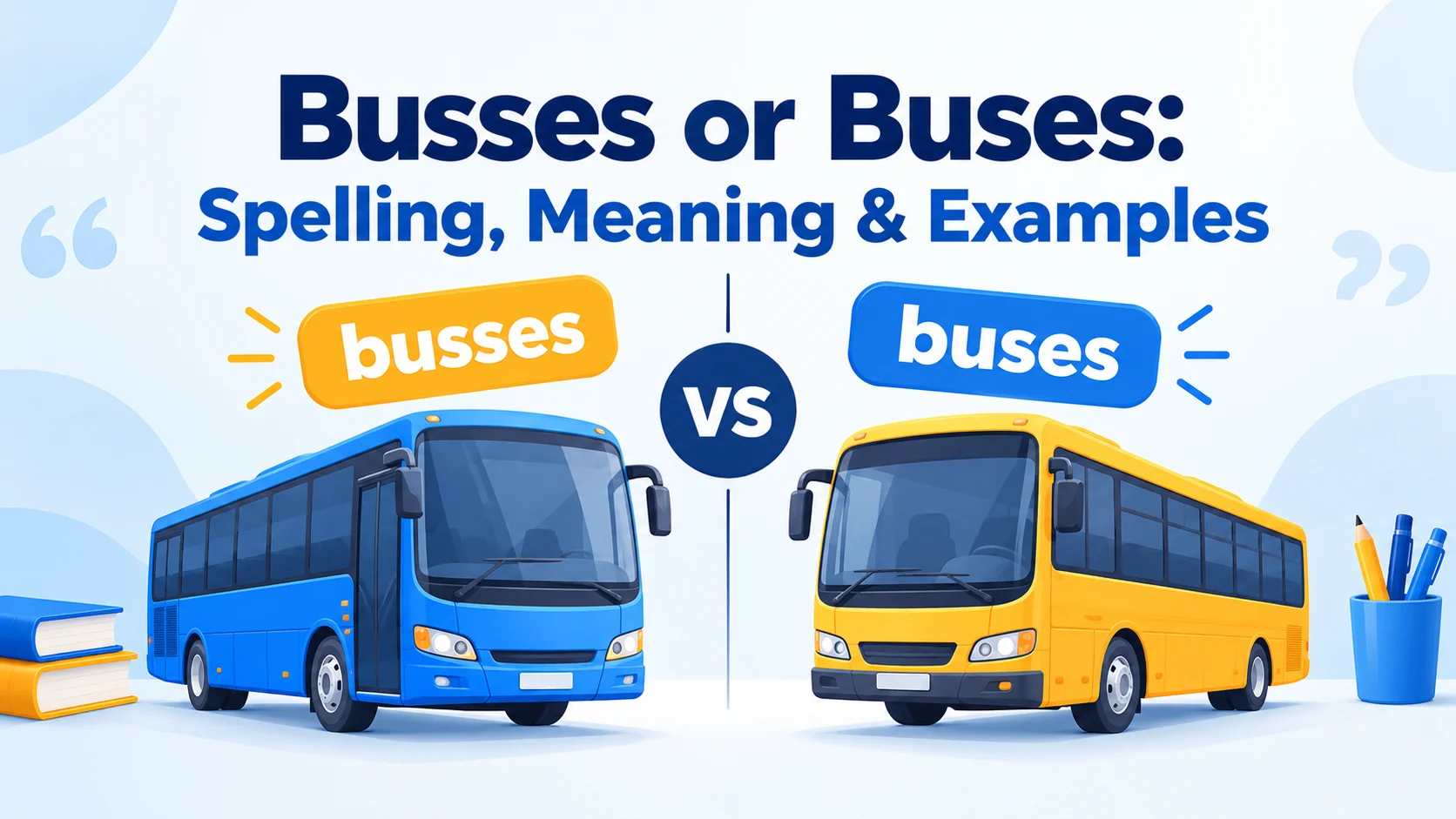
Busses or buses is a common spelling question, especially when writing about public transportation, school transportation, or everyday travel. Although both spellings exist in English, buses is the standard and widely preferred plural of bus when referring to vehicles. The word busses has a different traditional meaning and can also appear as a less common variant. Choosing the right form depends on what you mean and how you are using the word in a sentence. A small spelling difference can change the meaning or make otherwise clear writing look inconsistent.
The confusion becomes easier to understand when you look at how English forms plurals and past-tense verbs. Words ending in s do not always follow the same pattern, and similar-looking forms can serve entirely different grammatical purposes. For example, buses is usually a plural noun, while bused and bussed are verb forms found in contexts such as transporting passengers or clearing restaurant tables. Recognizing these distinctions helps you avoid spelling mistakes in emails, school assignments, reports, articles, and professional documents.
In this guide, you will learn when to use buses and when busses may be appropriate, why the standard plural takes -es, and whether American and British English follow different rules. You will also see practical examples, a comparison of bused and bussed, and explanations of common errors. By the end, you will have a straightforward way to choose the correct spelling without relying on guesswork. The goal is not simply to memorize one form, but to understand the meaning, grammar, and context behind each choice.
Busses or Buses: Which Spelling Is Correct?
When you are talking about more than one vehicle, buses is the standard spelling.
For example:
- The buses leave the terminal every twenty minutes.
- Three school buses arrived before the first bell.
- The city plans to introduce electric buses next year.
The word bus forms its usual plural by adding -es, producing buses. This follows a familiar English spelling pattern: many nouns ending in a sibilant sound take -es in the plural.
The spelling busses also exists, but it is much less common for transportation vehicles. It may be used as a variant plural of bus in some dictionaries or publications. It is also the plural of buss, an older word meaning a kiss.
For most modern writing, the practical rule is simple: write buses when you mean vehicles. Use busses only when the intended meaning or a particular source’s spelling convention makes it appropriate.
When to Use “Buses”
Use buses when referring to two or more vehicles that transport passengers.
This includes:
- Public transportation: City buses connect residential areas with business districts.
- School transportation: The school ordered four new buses.
- Tourism: Tourists boarded the buses outside the hotel.
- Long-distance travel: Several buses were delayed because of road construction.
- Special services: Shuttle buses will run between the airport and the conference center.
The spelling remains buses regardless of the vehicle’s size, purpose, or route.
Example in context:
The transportation department inspected all the buses before the new school term began.
Here, buses is a plural noun referring to several vehicles. The sentence follows standard contemporary English usage.
When to Use “Busses”
The spelling busses has two relevant uses.
First, it can be the plural of buss, a noun meaning a kiss. This meaning is now uncommon and may sound old-fashioned or literary.
For example:
- The poem described affectionate busses exchanged before the journey.
- The historical novel used the word busses to describe the characters’ kisses.
Second, busses sometimes appear as a less common variant of bus when referring to transportation vehicles. However, this is not the usual choice in contemporary general writing.
If you encounter busses in a book, newspaper archive, or older text, do not automatically assume it is a typographical error. Check the date, context, and intended meaning.
Writing recommendation: Unless you are discussing kisses or reproducing a source that uses a particular variant, choose buses for transportation.
Buses vs. Busses: Key Differences at a Glance
The main difference is not that one spelling is universally valid and the other universally wrong. Instead, the spellings have different levels of acceptance and different uses.
| Feature | Buses | Busses |
| Standard plural of bus | Yes | Less common variant |
| Usual meaning in transport writing | Two or more vehicles | Occasionally the same meaning |
| Plural of buss, meaning a kiss | No | Yes |
| Recommended for general modern writing | Yes | Only when context warrants it |
| Typical example | The buses are full. | The poem mentions their busses. |
Compare the Words in Sentences
Buses — standard transportation usage
The buses were parked outside the stadium.
The word refers to multiple vehicles.
Busses — literary or historical usage
The old-fashioned poem referred to the lovers’ busses.
In this sentence, busses means kisses.
Busses — uncommon transportation variant
The source used the spelling busses for passenger vehicles.
This may be encountered in particular publications, but it is not the usual spelling to choose when writing a new article or report.
Does “Busses” Always Mean Kisses?
No. Although busses is the plural of buss, meaning a kiss, it can also appear as a variant spelling of the transportation noun’s plural. Context determines the meaning.
For example, a sentence about a bus station almost certainly concerns vehicles. A sentence in a historical romance that refers to affectionate gestures may concern kisses. When the meaning is unclear, examine the surrounding words rather than relying on the spelling alone.
Why Is the Plural of “Bus” Usually “Buses”?
English uses several patterns to form plural nouns. Most nouns take -s, but many nouns ending in sounds such as /s/, /z/, /ʃ/ or /tʃ/ add -es in writing.
For example:
| Singular | Plural | Example |
| Bus | Buses | The buses are waiting. |
| Class | Classes | Two classes meet today. |
| Glass | Glasses | The glasses are clean. |
| Dish | Dishes | The dishes need washing. |
| Watch | Watches | Both watches stopped. |
| Box | Boxes | The boxes arrived. |
The ending helps represent the extra syllable heard when these words are spoken. Bus has one syllable, while buses is commonly pronounced with two.
Why Not “Bus’s” or “Bus’”?
These forms serve different grammatical purposes.
- Buses: The usual plural of bus.
- Bus’s: A singular possessive form in many style systems.
- Buses’: A plural possessive form when referring to something belonging to multiple buses.
Examples:
- The buses arrived early.
- The bus’s engine needs repair.
- The buses’ departure times are displayed on the board.
Apostrophes generally indicate possession or omitted letters, not ordinary plurals. Writing bus’s when you simply mean multiple vehicles is therefore incorrect.
Is “Busses” a Spelling Rule Exception?
It is better understood as a less common variant rather than a rule that writers should routinely apply. English contains historical spellings, alternative forms, and words that happen to look alike. Knowing the standard pattern is useful, but it does not eliminate every variation in actual usage.
For everyday writing, the clearest approach is to learn the standard form first and consult a reputable dictionary when an unusual spelling appears.
Buses or Busses in American and British English
Buses is the usual spelling in both American and British English when referring to transportation vehicles. The distinction is not comparable to familiar regional differences such as color and colour.
| Context | American English | British English |
| Standard plural of bus | Buses | Buses |
| Example | The buses are running late. | The buses are running late. |
| Usual spelling of the past-tense transport verb | Bused is common | Bused may occur; conventions vary |
| Restaurant verb meaning to clear tables | Bussed and bused both occur | Usage and house style may vary |
Regional and editorial preferences can affect some verb forms, particularly bused and bussed. However, they do not establish busses as the standard British plural of the vehicle noun.
Why Do Writers Sometimes Assume “Busses” Is British?
Writers may encounter busses in older British texts or in sources that use a less common variant. They may then assume it is the regional equivalent of American buses.
That conclusion is unreliable. A spelling found in a particular publication does not automatically represent the standard practice of an entire English-speaking country.
If you are writing for an American or British audience, use buses for vehicles unless a publisher’s explicit style guide requires something different.
Bused or Bussed: What Is the Difference?
The words bused and bussed are verb forms, not alternative ways to write the plural noun buses. They can be connected with the verb bus, which has more than one meaning.
One meaning is to transport people by bus. Another, especially in restaurant contexts, is to clear tables or remove used dishes. Spelling preferences for these verbs can vary by meaning, dialect, dictionary, and editorial style.
“Bused” as a Verb
Bused is a common spelling of the past tense and past participle of bus when it means transporting people by bus.
Examples:
- The students were bused to the science museum.
- Residents were bused to a temporary shelter during the evacuation.
- The organizers bused guests between the hotel and the event venue.
In each example, the word describes an action. It does not name multiple vehicles.
The distinction matters because the noun and verb forms occupy different grammatical positions:
- The buses arrived at noon. (Buses is a noun.)
- The students were bused to the venue. (Bused is a verb form.)
“Bussed” as a Verb
Bussed is also used as a past-tense or past-participle form of bus. It is particularly familiar in restaurant writing, where to bus a table means to clear away used dishes, glasses, and other items.
Examples:
- The staff bussed the tables after the lunch rush.
- A restaurant worker bussed the booth before the next customers arrived.
- The team bussed the visitors to the conference center.
The third example uses the transportation meaning. Both bused and bussed can occur in that sense, although preferred forms vary across editorial sources.
When writing for a business, school, or publication, follow its preferred dictionary or house style and use the chosen form consistently.
Bused vs. Bussed: Comparison Table
| Form | Grammatical role | Common meaning | Example |
| Buses | Plural noun | Multiple vehicles | The buses are ready. |
| Bused | Past-tense or participial verb | Transported by bus | The children were bused to school. |
| Bussed | Past-tense or participial verb | Cleared tables; also transported by bus in some usage | The staff bussed the tables. |
| Bus | Singular noun or base verb | One vehicle; transport or clear tables | The bus is late. |
Remember: Use buses for the plural noun in ordinary transport writing. Choose between bused and bussed according to the intended verb meaning and the spelling convention you are following.
How to Use “Buses” Correctly in a Sentence
Seeing the word in different contexts is one of the easiest ways to make its spelling familiar. The following examples show how buses work in everyday and professional writing.
Everyday Transportation
- The buses stop outside the shopping center.
- Several buses were waiting at the terminal.
- We took two buses to reach the university.
These sentences use buses as the subject or object of a sentence. Each refers to more than one vehicle.
Schools and Public Services
- The school purchased new buses for its growing student population.
- Extra buses will operate during the festival.
- The city provides accessible buses for passengers with mobility needs.
These examples are useful for school notices, public information, and administrative reports.
News and Business Writing
- The transport authority plans to replace older buses with electric vehicles.
- Heavy rain delayed several buses across the region.
- The company operates a fleet of buses for employee transportation.
In formal writing, the standard spelling is particularly useful because it keeps reports, announcements, and published material consistent.
Singular and Plural Forms in Context
Compare these sentences:
- A bus is parked outside.
- Two buses are parked outside.
- The bus’s door is open.
- The buses’ doors are open.
The first sentence uses a singular noun. The second uses its plural. The third uses a singular possessive, and the fourth uses a plural possessive.
A quick grammatical check can help: if you are simply counting vehicles, you almost certainly need buses.
Common Mistakes to Avoid
Even writers who know the standard spelling can confuse buses, busses, bused, and bussed. Most errors happen because the forms look similar or because the writer focuses on the letters rather than the grammatical role.
1. Using “Busses” as the Default Transportation Plural
Incorrect for standard general usage: The busses are waiting outside.
Preferred: The buses are waiting outside.
The first spelling may appear as a variant, but buses is the clearer and more widely accepted choice for contemporary transportation writing.
2. Treating “Busses” as Exclusively British
The spelling is not simply a British alternative to the American buses. Both American and British English generally use buses for vehicles.
3. Confusing a Plural Noun With a Verb
Compare:
- The buses were delayed.
- The passengers were bused to another terminal.
The first word identifies vehicles. The second describes an action performed on passengers. They are not interchangeable.
4. Adding an Apostrophe to Form a Plural
Incorrect: The bus’s are full.
Correct: The buses are full.
The apostrophe in bus’s normally marks possession in this context, not plurality.
5. Changing a Quotation Without Checking the Source
If you are quoting a historical document or reproducing an organization’s official wording, do not silently change every occurrence of busses. Verify whether the spelling is part of the original text, a stylistic preference, or an error.
In ordinary prose, however, there is usually no reason to choose the less common form for vehicles.
A Simple Way to Remember the Correct Spelling
Use this short checklist whenever you are unsure:
- Are you talking about multiple vehicles? Write buses.
- Are you referring to kisses in a literary or historical context? Busses may be the appropriate plural of bus.
- Are you describing an action involving transportation? Consider bused or bussed, depending on your chosen convention.
- Are you talking about clearing restaurant tables? Bussed and bused both occur; follow the relevant style guide.
- Are you writing for a particular publication? Check its preferred dictionary or editorial guidelines.
A Quick Decision Guide
| If you mean… | Use… |
| More than one passenger vehicle | Buses |
| A less common or historical plural of buss, meaning a kiss | Busses |
| People transported by bus | Bused or, in some conventions, bussed |
| Tables cleared in a restaurant | Bussed or bused, depending on convention |
| Something belonging to one bus | Bus’s |
| Something belonging to multiple buses | Buses’ |
The most useful habit is to identify the word’s job before checking its spelling. Ask whether it names vehicles, describes an action, or shows possession. That single step resolves many errors.
Conclusion
When deciding between busses or buses, focus first on what the sentence means. For two or more transportation vehicles, buses is the standard spelling in both American and British English. Busses has legitimate but less common uses, including as the plural of the older word buss, meaning a kiss. The verb forms bused and bussed introduce a separate question because their spelling depends on meaning and editorial convention. One final actionable tip: before publishing, identify whether the word is a noun, a verb, or a possessive, then check a trusted dictionary if the form seems unusual. A common mistake to avoid is assuming that similar-looking words are interchangeable. Precise spelling makes your meaning clearer and your writing more dependable.
FAQs
Q1. Is “busses” ever grammatically correct?
Yes. Busses can be the plural of buss, an uncommon word meaning a kiss, and it also appears as a less common variant plural of bus. However, when writing about transportation vehicles in contemporary English, buses is the standard choice and is generally preferred in formal writing.
Q2. Why is “buses” spelled with one “s” in the middle?
The singular noun is bus, and its standard plural is formed by adding -es, producing buses. The resulting spelling contains one s before the ending. English uses this pattern with several nouns, including class/classes and glass/glasses, making buses the conventional plural.
Q3. Is “busses” the correct plural of “school bus”?
The standard plural is school buses. For example, “The school buses arrived before the students.” Although busses may occur as a variant spelling, it is not the usual choice in school notices, educational materials, transportation reports, or other contemporary writing about school vehicles.
Q4. Should I write “bused” or “bussed” in a formal report?
Choose according to the meaning and the style guide your organization follows. Bused is common for transporting people by bus, while bussed is familiar in restaurant writing about clearing tables. Both forms occur in some overlapping contexts, so consistency and the intended meaning matter more than a blanket rule.
Q5. How can I check whether “busses” is a typo?
Read the sentence for context. If it describes public transportation, buses is usually the intended standard spelling. If the text is literary, historical, or uses buses as a variant, the form may be deliberate. When accuracy matters, check a reputable dictionary and preserve original spellings in direct quotations.