

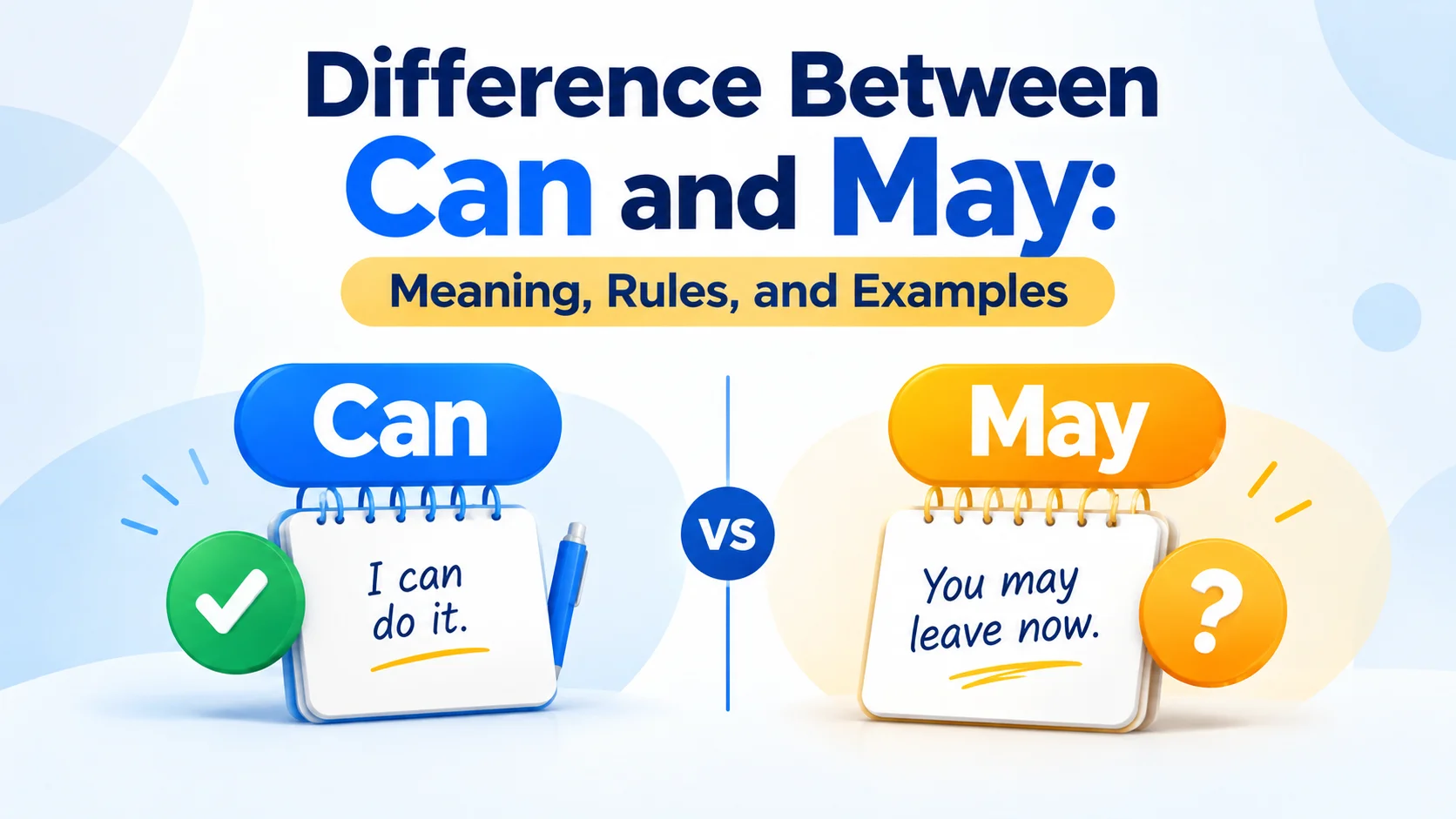
The difference between can and may depends on what you want to communicate: ability, permission, or possibility. Although these two modal verbs sometimes express the same general idea, they are not interchangeable in every sentence. For example, “I can speak French” describes an ability, while “I may speak at the meeting” could mean that speaking is permitted or that it is a possibility, depending on the context. Understanding this distinction helps you choose words that express your meaning accurately without making everyday English sound unnecessarily formal. The key is to look beyond simple grammar rules and consider what your sentence actually means.
One reason learners struggle with can vs. may is that traditional grammar lessons often present a neat division: can express ability, and may express permission. That distinction is useful, but modern English is more flexible. People routinely ask, “Can I borrow your pen?” without making a grammatical mistake. In more formal situations, however, “May I borrow your pen?” can sound more deferential. Both sentences request permission, but their tone and social effect may differ. Knowing when that difference matters is especially helpful when writing professional emails, speaking to teachers, making requests, or communicating with people you do not know well.
This guide explains how to use can and may, how their meanings overlap, and how to distinguish permission from possibility in statements, questions, and negative sentences. You will find practical examples, comparison tables, common mistakes, and guidance on related modal verbs such as could and might. You will also learn why certain traditional grammar rules are better understood as recommendations than absolute restrictions. By the end, you should be able to choose the more natural expression for a particular situation, whether you are having a casual conversation, writing a formal notice, or describing something that might happen in the future.
What Is the Difference Between Can and May?
The main difference is that can commonly expresses ability, permission, and general possibility, whereas may commonly expresses permission and possibility. The best choice depends on the intended meaning and the context.
Consider these examples:
- Ability: “Nadia can solve difficult puzzles.”
- Permission: “May I leave the room?”
- Everyday permission: “Can I leave the room?”
- Possibility: “The meeting may finish early.”
- General possibility: “Meetings can finish early when everyone is prepared.”
The first sentence uses can to describe a skill. The next two ask for permission, although may sound more formal in many contexts. The final examples express different kinds of possibility: one concerns a particular meeting, while the other describes something that can happen generally.
Can vs. May: Quick Comparison Table
| Feature | Can | May |
| Ability or skill | Yes: “I can drive.” | Not normally used for ability |
| Everyday permission | Yes: “Can I sit here?” | Yes: “May I sit here?” |
| Formal permission | Possible, depending on context | Often preferred |
| General possibility | Yes: “Errors can occur.” | Possible, though often less general |
| Specific possibility | Sometimes, depending on the sentence | Common: “It may rain.” |
| Requests | Common and conversational | Polite when requesting permission |
| Wishes | Not normally used in the same way | Yes: “May you succeed.” |
Remember: These are common patterns, not rigid rules. A word’s meaning can change according to the sentence in which it appears.
The Simplest Way to Choose Between Can and May
Before choosing a modal verb, ask yourself three questions:
- Am I talking about ability? Use can in most ordinary sentences.
- Am I asking for or granting permission? Either may work; may often sound more formal.
- Am I describing something that might happen? Both can express possibility, but their usual patterns differ.
For example, if you want to describe someone’s language skills, write, “He can speak Arabic.” If you want to ask a teacher for permission to leave, “May I leave early?” may suit the situation. If you are predicting an uncertain outcome, “The package may arrive tomorrow” is natural.
This approach is more reliable than memorizing the oversimplified rule that can is always about ability and may is always about permission.
How to Use Can in English
Can is a modal verb. It helps the main verb express ideas such as ability, permission, possibility, and willingness. It is especially common in everyday conversation because it is direct and natural without necessarily sounding impolite.
Can to Express Ability or Skill
Use can to describe something a person or thing is capable of doing.
Examples:
- “My cousin can play the violin.”
- “I can understand written Spanish.”
- “This printer can handle large documents.”
- “She can finish the assignment independently.”
Ability can be physical, intellectual, learned, or related to how a system works.
For a past ability, English often uses could: “When I was younger, I could run for hours.” However, when describing a successful achievement on one particular occasion, it may be more appropriate: “Despite the delay, she was able to catch the last train.”
Practical tip: If your sentence answers “What is someone capable of doing?”, can is usually a strong starting point.
Can to Ask for and Give Permission
In everyday English, can is widely used to request or grant permission.
Examples:
- “Can I use your charger?”
- “Can we sit by the window?”
- “You can borrow my notes.”
- “You can leave your bags here.”
A common misconception is that asking “Can I use your charger?” is incorrect because it technically relates to ability. That argument overlooks established modern usage. In ordinary conversation, the question is understood as a request for permission, not a question about physical capability.
Compare these sentences:
- “Can I open the window?” — natural and conversational.
- “May I open the window?” — often more formal or deferential.
Both are grammatically acceptable. The choice depends on the relationship between speakers, the setting, and the tone you want.
Can to Express General Possibility
Can can describe something that is possible under certain circumstances or that sometimes happens.
Examples:
- “Strong winds can damage young trees.”
- “Learning a new language can be challenging.”
- “A short delay can affect the entire schedule.”
- “Even experienced cooks can make mistakes.”
These statements do not necessarily predict that something will happen on a particular occasion. They describe a general possibility.
Compare:
- “Traffic can be heavy on Fridays.” — a general observation.
- “Traffic may be heavy this Friday.” — a possibility concerning a particular day.
This distinction is useful in explanatory writing, advice, instructions, and discussions of risks.
Can in Requests, Offers, and Suggestions
Can also appear in everyday requests and offers.
| Purpose | Example | What it communicates |
| Request | “Can you check this paragraph?” | Asking someone to help |
| Offer | “I can carry that box.” | Offering assistance |
| Suggestion | “We can try another route.” | Proposing an option |
| Availability | “I can meet you after lunch.” | Stating when you are free |
A question such as “Can you help me?” may technically ask about ability, but in most situations it functions as a request. The listener understands that the speaker wants assistance, not merely information about their capabilities.
For a more tentative or especially courteous request, it may be a better choice: “Could you check this paragraph when you have a moment?”
How to Use May in English
May is another modal verb. Its most common uses include expressing permission, possibility, and wishes. It is particularly useful when you want to sound formal, cautious, or respectful, although the precise effect depends on context.
May to Ask for or Grant Permission
Use may when asking for permission or formally authorizing an action.
Examples:
- “May I ask a question?”
- “May we enter the building now?”
- “Students may use the library until 5 p.m.”
- “You may begin the examination.”
In these examples, many signals that an action is permitted. It is common in formal instructions, official notices, school settings, and carefully phrased requests.
Compare the tone:
- “Can I speak with you for a moment?” — natural and conversational.
- “May I speak with you for a moment?” — often more formal or deferential.
Neither sentence is automatically better. A conversation with a close friend usually does not require the formality of may. In a formal meeting or when addressing someone you do not know well, it may be appropriate.
May to Express Possibility
Use may when something is possible but not certain.
Examples:
- “The results may arrive this afternoon.”
- “Our team may need additional time.”
- “The new policy may affect small businesses.”
- “She may already know about the change.”
These sentences describe uncertain situations. They do not guarantee that the events will occur.
The difference between may and can is often clearest when you compare a specific possibility with a general one:
- “This road can flood during heavy rain.” — flooding is a general possibility.
- “This road may flood tonight.” — flooding is a possibility on a particular night.
This is a useful tendency, not a universal formula. Context can make can and may overlap, and neither word automatically assigns a precise probability to an event.
May in Formal Writing and Professional Communication
May is often useful in policies, reports, notices, and professional communication because it can express permission or qualify a statement.
Examples:
- “Applicants may submit supporting documents by email.”
- “Additional verification may be required.”
- “The revised schedule may affect delivery times.”
- “Employees may request further clarification.”
Pay attention to the meaning of each sentence. ✅In the first example, may grant permission. In the second and third, it expresses possibility. In the fourth, it indicates an allowed action.
When writing workplace instructions, choose the modal verb that communicates the intended policy accurately. For instance, “Employees may work remotely on Fridays” normally indicates permission, while “Employees can work remotely on Fridays” may describe their practical ability or available arrangement. In some workplaces, both communicate the same policy.
May in Wishes and Fixed Expressions
May can also introduce a wish, blessing, or hope.
Examples:
- “May your efforts bring you success.”
- “May the best team win.”
- “May you enjoy your time here.”
- “May peace prevail.”
This use is different from asking permission or predicting an event. It expresses a desired outcome, often in a formal, ceremonial, literary, or warm personal style.
You would not normally replace may with can in these expressions without changing the meaning or making the sentence sound unnatural. “Can the best team win” is not the conventional way to express the wish.
When Can and May Both Work
The trickiest cases are those in which both modal verbs are grammatically possible. Instead of asking which word is always correct, consider whether the sentence expresses general ability, permission, a general possibility, or a specific uncertainty.
Asking for Permission: “Can I” vs. “May I”
Both forms are correct when requesting permission.
| Situation | Natural wording | Typical tone |
| Asking a friend | “Can I borrow your book?” | Casual |
| Asking a teacher | “May I leave a little early?” | More formal |
| Asking a colleague | “Can I share my screen?” | Conversational |
| Addressing a formal gathering | “May I have your attention?” | Formal |
| Asking a host | “Can I help with dinner?” | Everyday offer |
These examples illustrate tendencies rather than strict rules. A student can appropriately ask, “Can I go to the library?” A professional can also use “Can I add something?” in a meeting without sounding uneducated.
The old correction “You should say May I, not Can I” treats a convention of politeness as if it were an absolute grammar rule. In contemporary English, can is firmly established for permission.
Expert recommendation: Match the level of formality to the situation instead of avoiding it simply because someone once told you it was wrong.
Expressing Possibility: “Can Happen” vs. “May Happen”
The two modal verbs can describe possible events, but the way they frame the event often differs.
- “Unexpected delays can happen.” — delays are possible in general.
- “Unexpected delays may happen today.” — delays are possible on this particular day.
- “A small error can cause a major problem.” — a general cause-and-effect possibility.
- “A small error may have caused the problem.” — a possible explanation for a specific event.
Notice that the last example uses may have caused. This structure refers to a possible past explanation. The modal verb is followed by have and the past participle.
These distinctions help writers communicate accurately when explaining risks, diagnosing a problem, or discussing uncertain outcomes.
How Context Changes the Meaning
The same modal verb can carry different meanings in different sentences.
Consider these examples:
- “You may leave now.” — permission.
- “You may leave later.” — permission or a possibility about what will happen, depending on context.
- “This device can overheat.” — general possibility.
- “This device may be overheating.” — a possible explanation of what is happening now.
In technical and professional writing, these distinctions matter. A safety manual that says a machine can overheat describes a possible hazard. A technician who says it may be overheating is offering a possible diagnosis.
When a sentence could be interpreted in two ways, add context rather than relying on the modal verb alone.
Can vs. May in Questions and Negative Sentences
Questions and negatives introduce a few additional distinctions worth learning. The modal verbs themselves do not change form for different subjects: you say she can, not she cans, and he may, not he may.
How to Form Questions With Can and May
Place the modal verb before the subject.
- “Can they attend the workshop?”
- “May I ask another question?”
- “Can your brother drive?”
- “May we use this room?”
The basic structure is:
Can/May + subject + base form of the main verb?
For example, “Can she speak Italian?” is correct, while “Can she speak Italian?” is incorrect. After a modal verb, the main verb takes its base form.
Short answers follow the same pattern:
- “Can I sit here?” — “Yes, you can.”
- “May I sit here?” — “Yes, you may.”
In everyday speech, people often answer a permission request with “Sure,” “Of course,” or “Go ahead.” These are natural conversational responses, even though they do not repeat the modal verb.
Cannot, Can’t, May Not, and Mayn’t
The negative forms are not identical in meaning.
| Form | Common meanings | Example |
| Cannot / can’t | Inability, prohibition, or impossibility | “I can’t attend the meeting.” |
| May not | Lack of permission or possibility that something will not happen | “Visitors may not enter.” |
| Mayn’t | A negative form of may, now uncommon | Rare in everyday modern English |
Cannot and can’t are often interchangeable, though cannot be preferred in formal writing. The contraction can’t is common in conversation and informal prose.
Mayn’t is grammatically possible but uncommon in contemporary English. Most writers use another construction, such as may not, depending on the intended meaning.
Why “May Not” Can Have Two Meanings
The phrase may not be especially easy to misinterpret because it can express either prohibition or uncertainty.
Meaning 1: Prohibition
“You may not enter this room.”
The speaker is saying that entry is not permitted.
Meaning 2: Possibility
“She may not attend the event.”
The speaker is saying that it is possible she will not attend.
How can you tell which meaning is intended? Look at the subject, the situation, and the surrounding sentences. A notice on a locked laboratory door strongly suggests prohibition. A conversation about someone’s travel plans usually suggests uncertainty.
When precision matters, rewrite ambiguous sentences:
- Prohibition: “Entry is prohibited.”
- Uncertainty: “It is possible that she will not attend.”
This is particularly useful in policies and instructions, where an ambiguous negative could lead to confusion.
Common Mistakes When Choosing Between Can and May
Understanding the basic definitions is only the first step. These are the mistakes most likely to make a sentence sound unnatural or communicate the wrong idea.
Assuming Can Is Incorrect for Permission
Incorrect advice: “Never say Can I borrow this?”
Better understanding: Can I borrow this? is standard, natural English. May I borrow this? is also correct and may sound more formal.
The difference is mainly one of tone and context, not a simple division between correct and incorrect grammar.
Using May to Describe Ability
If you want to say that someone has a skill, use can or an appropriate form of be able to.
- Natural: “He can repair bicycles.”
- Usually not the intended meaning: “He may repair bicycles.”
The second sentence normally suggests that he is permitted to repair bicycles or that he might do so, rather than stating that he possesses the skill.
Treating May as a Guarantee
“Your application may be approved” does not mean that approval is certain. It communicates a possibility.
If the outcome is definite, choose wording that reflects that certainty. If the decision is still pending, may is appropriate.
Similarly, do not assume that may always sound more uncertain than can. The distinction depends on the kind of possibility being described and the wider context.
Confusing Grammar With Politeness
A sentence can be grammatically correct but unsuitable for a particular social situation. For example, “Give me your notes” is grammatically possible, but it is much more direct than “Could I borrow your notes?”
Likewise, may is not automatically the politest choice in every situation. Tone also depends on word choice, sentence structure, relationship, and delivery.
Practical rule: If you want to make a request sound less direct, consider could, would you mind, or a brief polite phrase—not just switching can to may.
Can vs. May and Other Related Modal Verbs
Understanding nearby modal verbs makes it easier to express subtle differences in meaning.
Can vs. Could
Can commonly describe present ability or ask a direct question. Could describe past ability, a possible option, or a more tentative request.
- “I can help you now.” — present ability or availability.
- “I could help you tomorrow.” — a possible future option.
- “Could you check this sentence?” — a polite request.
For past ability, could often work well: “She could read fluently at age six.” For a particular successful action, however, it is often clearer: “She was able to solve the final problem.”
May vs. Might
Both may and might express possibility.
- “The train may be delayed.”
- “The train might be delayed.”
The two sentences are often interchangeable. In some contexts, might sounds more tentative, but it is not reliable to assign fixed probability percentages to either word. The surrounding information and the speaker’s intention matter more than a supposed numerical difference.
Can vs. Be Able To
Can is concise and natural in the present: “I can attend the meeting.”
However, be able to is useful when you need a tense or grammatical structure that can not readily provide.
- Present: “I am able to attend.”
- Future: “I will be able to attend.”
- Present perfect: “I have been able to attend every session.”
Choose the structure that fits the sentence rather than trying to force can into every tense.
May vs. Must
These verbs express different ideas.
- “You may leave.” — permission.
- “You must leave.” — obligation or necessity.
- “She may be at home.” — possibility.
- “She must be at home.” — a strong conclusion based on available evidence.
This contrast matters in instructions and professional documents. Replacing may with must can change a permitted action into a required one, so modal verbs should be chosen carefully in policies, contracts, and formal directions.
A Practical Guide to Choosing Can or May
Use this decision table when you are unsure which word fits your sentence.
| If you want to express… | Usually choose… | Example |
| A skill or ability | Can | “I can speak Urdu.” |
| Everyday permission | Can or may | “Can I sit here?” |
| Formal permission | May | “May I enter?” |
| A general possibility | Can | “Mistakes can occur.” |
| A specific uncertain event | May | “The meeting may be delayed.” |
| A wish | May | “May you find success.” |
| A polite request for help | Could is often suitable | “Could you help me?” |
Can or May? Quick Practice
Choose the best option for each sentence. In some situations, more than one answer may be grammatically possible, but one may better fit the intended meaning.
- “___ I borrowed your phone for a moment?” — a request for permission.
- “Amira ___ speaks three languages.” — ability.
- “The weather ___ change by evening.” — a specific possibility.
- “Visitors ___ do not enter this area.” — a formal prohibition.
- “___ your new project will be successful.” — a wish.
Answers and explanations
- Can or May — both are correct; may sounds more formal.
- Can — it describes a skill.
- May — it naturally expresses a specific uncertain event. Can could work in a different context about general possibility.
- May — in a formal notice, may not clearly communicate that entry is prohibited.
- May — this is a conventional way to express a wish.
The important lesson is not to memorize one answer for every situation. Identify the intended meaning first, then choose the modal verb that communicates it naturally.
Conclusion:
The difference between can and may becomes easier to understand when you focus on meaning instead of memorizing a rigid rule. Use can for ability, everyday permission, and many forms of general possibility. Use may when expressing permission in a more formal tone, describing a specific possibility, or offering a wish. Remember that the two verbs overlap, especially in permission questions, so context matters more than outdated claims about what is always correct. One final actionable tip: when editing a sentence, identify whether you mean ability, permission, or uncertainty before choosing the modal verb. A common mistake to avoid is assuming that can I is grammatically wrong. Good English is not about choosing the most formal word every time; it is about making your intended meaning clear, natural, and appropriate for the situation.
FAQs
Q1. Is It More Correct to Say “May I” or “Can I”?
Both are grammatically correct when asking permission. May I often sounds more formal or deferential, while can I is common in everyday conversation. Choose according to your setting and relationship with the listener rather than assuming one form is always correct.
Q2. Does Can Mean Ability and May Mean Permission?
That is a useful starting point, but it is not the complete rule. Can commonly expresses ability and can also express permission or possibility. May commonly expresses permission and possibility. The intended meaning, context, and tone determine which verb fits best.
Q3. Can May and Might Be Used Interchangeably?
Often, yes. Both modal verbs can express uncertainty about an event. For example, “It may snow tonight” and “It might snow tonight” are both natural. In some contexts, might sounds more tentative, but the difference is not a fixed rule.
Q4. Does May Express a Higher Chance of Something Happening Than Might?
Not reliably. English does not assign universal probability percentages to may and might. Their interpretation depends on context, emphasis, and the speaker’s intention. Avoid treating one as a mathematical measure of certainty unless the writer explicitly defines a special convention.
Q5. What Is the Difference Between “You Cannot Go” and “You May Not Go”?
“You cannot go” can mean that going is impossible, that someone is unable to go, or that permission is denied. “You may not go” often indicates prohibition, although may not can also express uncertainty in other sentences.