

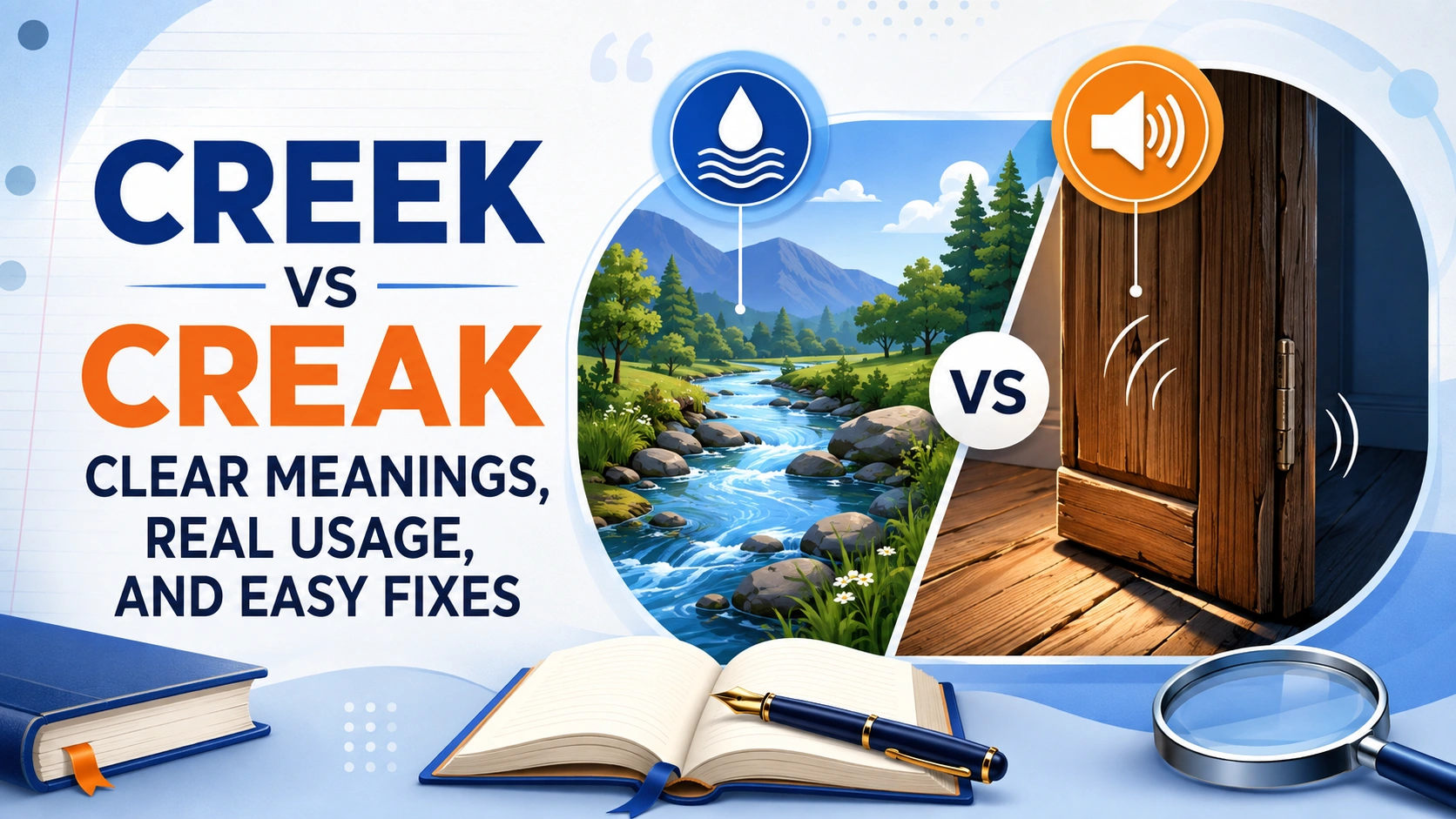
Creek vs creak is a classic English spelling problem because the two words are pronounced alike in many varieties of English but refer to completely different things. Creek is generally a word for a small stream or, in British English, a narrow coastal inlet, while creak describes a characteristic sound or the act of making that sound.
The confusion becomes easier to solve once you stop relying on pronunciation and focus on meaning and context. If you are writing about water, a landscape, a river branch, or an outdoor location, you almost certainly need a creek. If you are describing an old door, wooden floor, stairs, hinge, chair, or another object making a squeaky or groaning noise, creak is the right choice. The words are homophones, but they are not interchangeable.
This guide explains creek and creak from spelling to grammar, pronunciation, regional usage, word history, common mistakes, creative writing, and practical proofreading. You will also see paired examples, comparison tables, memory tricks, and a quick decision method that makes choosing between these two words almost automatic.
Creek vs. Creak: Quick Answer
The simplest distinction is:
Creek = water. Creak = sound.
But that shortcut needs one important qualification: creek does not always mean a stream. In British English, it can also mean a narrow area of water extending inland from the sea or another larger body of water. In North American, Australian, and New Zealand English, creek commonly refers to a small river or stream.
Creak, meanwhile, is associated with sound. As a verb, it means to make a characteristic squeaking, scraping, or groaning noise, often when something moves. As a noun, it refers to the sound itself.
| If you mean… | Use |
| A small stream | creek |
| A narrow coastal inlet | creek |
| Water flowing through a landscape | creek |
| A squeaky door | creak |
| A noisy wooden floor | creak |
| A sound made by an old chair | creak |
| Something making a long squeaky/groaning noise | creak |
Fast test: Can you replace the word with “stream” or “inlet”? Choose a creek. Can you replace it with “squeak” or “groaning sound”? Choose creak.
Creek and Creak at a Glance
Although the words look almost identical, their grammatical and semantic roles are quite different.
| Feature | Creek | Creak |
| Pronunciation | /kriːk/ in standard UK/US dictionary pronunciation | /kriːk/ in standard UK/US dictionary pronunciation |
| Main meaning | Small stream or narrow waterway; also coastal inlet in some varieties | A squeaking, scraping, or groaning sound |
| Main part of speech | Noun | Noun and verb |
| Typical subject | Water or a geographical feature | Door, floor, stairs, furniture, structure, etc. |
| Common setting | Nature, geography, travel, outdoor writing | Buildings, furniture, movement, storytelling |
| Example | “We crossed the creek.” | “The stairs creaked.” |
Cambridge gives both words the pronunciation /kriːk/ in its UK and US entries, which explains why hearing the distinction is difficult.
That is why spelling and context matter more than sound when you are proofreading.
What Does “Creek” Mean?
Creek as a noun: a small stream or waterway
In much of North American English, creek commonly means a small river or stream. It may be shallow, seasonal, narrow, or connected to a larger river system.
For example:
- We followed the creek through the woods.
- The children played beside the creek.
- Heavy rain caused the creek to rise.
- A narrow bridge crosses the creek.
- The trail runs along the creek bank.
Notice that the creek names a geographical feature. It is not describing a noise.
Creek in British English: a different geographical sense
One of the details that simple spelling guides often overlook is the regional meaning of creek.
In British English, creek can mean a narrow area of water where the sea or another large body of water flows into the land. Oxford and Cambridge both identify this sense as British English.
For example:
The fishing boats were anchored in a sheltered creek.
That does not necessarily mean a small freshwater stream. It can describe a coastal inlet.
In other varieties of English, particularly North American English, creek more commonly means a small stream.
How “creek” is used in geography and everyday speech
You will often encounter creek alongside words such as:
- creek bank
- creek bed
- creek bottom
- creek crossing
- creek water
- creek mouth
- tidal creek
The exact meaning depends on geography and local usage.
A tidal creek, for example, is associated with tidal water rather than simply being a little freshwater stream.
Creek in place names
Creek frequently appears in geographical names:
- Pine Creek
- Willow Creek
- Clear Creek
- Ten Mile Creek
When it is part of an official place name, it is normally capitalized.
We stopped near Willow Creek.
But when you are using the word generically, lowercase is appropriate:
We stopped near a creek.
Common collocations with creek
Natural combinations help reinforce the meaning:
| Expression | Meaning |
| creek bed | The ground or channel occupied by a creek |
| creek bank | Land bordering a creek |
| creek crossing | A point where a path or road crosses a creek |
| creek mouth | The point where a creek enters another body of water |
| along the creek | Following or beside the waterway |
| across the creek | On the opposite side of the waterway |
A useful editing clue is that words such as bank, bed, bridge, water, trail, fishing, flood, and stream strongly suggest creek.
What Does “Creak” Mean?
Creak as a verb
Creak as a verb means to make a characteristic long, squeaky, scraping, or groaning sound, especially when something moves or is moved. Doors, floorboards, stairs, and wooden objects are common examples.
Examples:
- The old door creaked open.
- The floorboards creaked beneath my feet.
- The wooden stairs creak at night.
- The chair creaked when he sat down.
- The gate creaked on its hinges.
The important grammatical clue is that the object does the action.
The door creaked.
Here, creaked is the verb.
Creak as a noun
Creak can also be a noun meaning the sound itself.
I heard a creak from upstairs.
The old chair made a loud creak.
Compare:
- Verb: The door creaked.
- Noun: We heard a creak.
This distinction is useful when editing because the surrounding grammar can help you identify the correct word.
Objects and places that commonly creak
Creaking is especially associated with objects that move, bend, rub, or bear weight. Common examples include:
- doors
- hinges
- floorboards
- stairs
- wooden chairs
- beds
- gates
- old buildings
- tree branches
- swings
- wooden boats
The word does not require an object to be literally old. A newer object can creak if its construction or movement produces the characteristic sound.
Creaking caused by movement, age, or pressure
Consider these examples:
The wooden bridge creaked under the hikers’ weight.
The door creaked when the wind pushed it.
The old staircase creaked with every step.
The underlying situation changes, but the word remains connected to sound produced by movement or mechanical stress.
Creek vs. Creak: The Meaning Difference That Matters
The most reliable distinction is semantic rather than visual.
Creek identifies something. Creak describes a sound or sound-producing action.
Consider:
We sat beside the creek.
The word identifies a physical feature of the landscape.
Now compare:
We heard the floor creak.
The word describes what the floor did acoustically.
A simple substitution test
When proofreading, replace the uncertain word mentally.
If the sentence works with:
- stream
- small river
- waterway
- inlet
→ use a creek.
If it works with:
- squeak
- groan
- scraping noise
- noise made by movement
→ use creak.
This method is more dependable than trying to remember which spelling “looks right.”
Creek vs. Creak in Real Sentences
Everyday examples with “creek”
- We walked beside the creek after lunch.
- The storm flooded the creek.
- A wooden bridge crosses the creek.
- They built their campsite near the creek.
- Fish were swimming in the shallow creek.
Everyday examples with “creak”
- The front door began to creak.
- I heard a creak from the hallway.
- The old stairs creaked under his weight.
- The chair gave a loud creak when she moved it.
- The gate creaked open in the wind.
When both words appear together
The two words can comfortably occur in the same sentence:
We sat beside the creek and listened to the old wooden bridge creak.
Here, the context makes the distinction unmistakable:
- creek = waterway
- creak = sound
Another example:
At night, the cabin beside the creek seemed to creak whenever the wind rose.
This is an excellent way to remember the pair because the words can belong naturally to the same scene while performing completely different jobs.
Creek vs. Creak in Creative Writing
These words are especially useful in descriptive writing because they activate different senses.
Using “creek” to establish setting
Creek gives the reader a visual and geographical anchor.
A narrow creek wound between the trees.
The reader can picture a landscape.
You can then build details around it:
A narrow creek wound between the trees, reflecting fragments of afternoon light.
The word provides the setting; the surrounding language supplies atmosphere.
Using “creak” to create sound
Creak works differently. It adds an auditory detail.
The door creaked behind her.
That single verb can suggest movement and make a scene feel more immediate.
In fiction, creak is particularly useful when the writer wants the reader to notice an otherwise subtle movement:
A floorboard creaked somewhere in the dark.
The word itself contributes a recognizable sound without requiring a long explanation.
Sensory writing: place versus sound
A useful distinction for writers is:
- Creek → where something is
- Creak → what something sounds like
That makes the words complementary rather than competing.
Creek vs. Creak in Figurative and Extended Usage
Creak has an important extended use that learners sometimes miss.
It can describe a system, institution, or organization that is struggling under pressure or showing signs of age.
For example:
The outdated system is beginning to creak under the pressure of increased demand.
Nothing is literally making a wooden noise. The writer is using creak metaphorically to suggest that the system is strained, old, inefficient, or close to needing repair. Cambridge’s corpus examples include similar figurative uses involving systems and institutions.
This is a useful advanced distinction:
The door creaks.
The system is creaking.
The first is literal. The second is figurative.
Creek, by contrast, is overwhelmingly associated with its geographical meanings in ordinary modern usage. It is not normally a substitute for creak simply because both words sound alike.
The Origins of Creek and Creak
The two words do not come from the same meaning merely because they now sound alike.
Where “creek” comes from
Merriam-Webster traces creek to Middle English forms such as crike and creke, connected with Old Norse kriki, meaning a bend. Etymological sources describe its early sense as a narrow coastal inlet and trace later developments toward waterways and streams.
Its meaning developed over time. The word was associated with bends, inlets, and branches of waterways, and later acquired the familiar small-stream sense in American English.
Where “creak” comes from
Creak has a completely different history. Merriam-Webster traces the verb to Middle English creken, meaning “to croak,” and identifies its origin as imitative. Etymonline likewise connects the early word with harsh or croaking sounds.
That history makes intuitive sense: sound-related words are sometimes shaped by attempts to imitate or represent noises.
So although creek and creak are homophones, their histories point in different directions:
| Word | Historical association |
| Creek | Bends, nooks, inlets, waterways |
| Creak | Harsh or squeaking sounds |
Creek vs. Creak in British and American English
Regional English is one area where simplistic definitions can cause trouble.
Creek in British English
British English commonly uses a creek for a narrow coastal inlet. Oxford gives this as its British English sense.
Creek in American English
American English commonly uses creek for a small stream or river, which is also reflected in major American dictionaries.
The word can also have a regional pronunciation resembling “crick” in American usage, although the standard spelling remains “creek. Cambridge explicitly notes this pronunciation variation.
Does “creak” change between British and American English?
The meaning and spelling of creak remain essentially consistent: it refers to the characteristic sound or the action of producing it. Cambridge lists the same core sense in British and American entries.
So regional differences matter much more for creek’s geographical meaning and pronunciation than for creak.
Common Mistakes with Creek and Creak
Mistake 1: Writing “creak” for a stream
Incorrect:
We walked beside the creak.
Correct:
We walked beside the creek.
The sentence is about a waterway, so a creek is required.
Mistake 2: Writing “creek” for a sound
Incorrect:
The old floorboards creek when I walk across them.
Correct:
The old floorboards creak when I walk across them.
The floorboards are producing a sound, so the verb is creak.
Mistake 3: Choosing by pronunciation
This is the most understandable mistake because the words are homophones.
If you only hear:
“The door ___.”
you cannot determine the spelling from sound alone.
You need to know the meaning.
Mistake 4: Treating “creek” as always meaning exactly the same thing
A learner who memorizes “creek = small stream” may struggle with British English examples involving coastal inlets.
The better rule is:
Creek is a water-related geographical noun whose precise sense depends partly on regional English.
Mistake 5: Confusing “creak” with every type of noise
Creak is not a universal replacement for sound.
Depending on the situation, you may need:
- squeak for a short, high-pitched sound
- creak for a characteristic long, squeaky/groaning sound
- crack for a sharp breaking or snapping sound
- groan for a deeper, prolonged sound
- rattle for repeated small impacts or shaking sounds
- screech for a harsh, high-pitched sound
Choosing the more precise sound word makes descriptive writing stronger.
How to Choose the Right Word in Seconds
Use this three-step method.
Step 1: Identify the subject
Ask:
Am I talking about water or a sound?
- Water → creek
- Sound → creak
Step 2: Check the grammar
If the word describes an action:
The door creaked.
you need the verb creak.
If it names a thing:
We crossed the creek.
you need the noun creek.
Remember that creek is primarily a noun, while creak can function as both a noun and a verb.
Step 3: Substitute a simpler word
Try:
stream → creek
or:
squeak/groaning noise → creak
If the replacement makes sense, your spelling choice is probably clear.
We crossed the stream. → We crossed the creek.
The floorboards squeaked. → The floorboards creaked.
A Practical Proofreading Checklist
| Question | If “yes” | Choose |
| Is it a small stream or waterway? | Water | creek |
| Is it a coastal inlet? | Water/geography | creek |
| Is an object producing a squeaky or groaning noise? | Sound | creak |
| Is the word functioning as a verb meaning “make this sound”? | Action | creak |
| Does the sentence mention a creek bank or creek bed? | Geography | creek |
| Does the sentence mention a door, floor, hinge, or stairs making noise? | Sound | creak |
Editing tip: When proofreading homophones, do not ask “Which spelling sounds right?” Ask “What does this word mean in this sentence?” Meaning is the more reliable test.
Practice: Can You Choose Creek or Creak?
Fill in each blank with a creek or creak.
- We followed the narrow ______ through the forest.
- The old gate began to ______ in the wind.
- A wooden bridge crossed the ______.
- I heard a strange ______ from upstairs.
- The floorboards ______ whenever someone walks across them.
- Heavy rain caused the ______ to overflow.
- The chair gave a loud ______.
- They built a campsite beside the ______.
Answers
- creek — a waterway
- creak — the gate makes a sound
- creek — a stream or waterway
- creak — the sound itself
- creak — the verb describing the sound
- creek — a waterway
- creak — a noun naming the sound
- creek — a waterway
The key is not memorizing eight individual answers. It is recognizing the underlying distinction: geographical water feature versus characteristic sound.
Conclusion:
Creek and creak sound alike, but their meanings point in entirely different directions. Creek is a geographical noun associated with a small stream, river branch, or—particularly in British English—a narrow coastal inlet. Creak is connected to sound: it can name a squeaky or groaning noise or describe an object making that noise.One final actionable tip: when you encounter either word during editing, replace it mentally with “stream” or “sound.” That quick semantic check is more reliable than pronunciation. A common mistake to avoid is assuming that homophones must share spelling or meaning; English contains many pairs that sound identical while behaving differently in writing.Once you train yourself to identify the meaning before the spelling, creek vs. creak stops being a memorization problem. You simply ask what the sentence is actually describing—and the correct word follows naturally.
FAQs
Q1. Are “creek” and “creak” homophones?
Yes. In standard dictionary pronunciations, creek and creak are pronounced alike, generally /kriːk/. Their identical pronunciation does not make them interchangeable because their meanings and grammatical functions are different. Creek refers to a water feature, while creak refers to a sound or making that sound.
Q2. Is a creek the same as a river?
Not necessarily. In North American English, a creek is generally a smaller stream or waterway, although there is no universal size rule that cleanly separates every creek from every river. In British English, creek can instead refer to a narrow coastal inlet. Local geographical terminology varies.
Q3. Is “creak” a noun or a verb?
Creak can be both a noun and a verb. As a verb, it means to make the characteristic sound: “The door creaked.” As a noun, it names the sound: “We heard a creak.” Its related adjective is creaky, as in “a creaky staircase.”
Q4. Is “crick” another spelling of “creek”?
In some regional English, particularly in the United States, crick is used as a pronunciation or dialectal spelling for a small stream. Standard written English normally uses a creek for the waterway. This should not be confused with crick meaning a painful stiffness or muscle problem, which is a separate word.
Q5. Can “creak” be used figuratively?
Yes. Beyond literal sounds, creak can describe a system, institution, or organization that is struggling, aging, or operating under pressure. For example, “The outdated system is creaking under the strain” uses the word metaphorically. This extended sense preserves the basic idea of something showing signs of stress.