

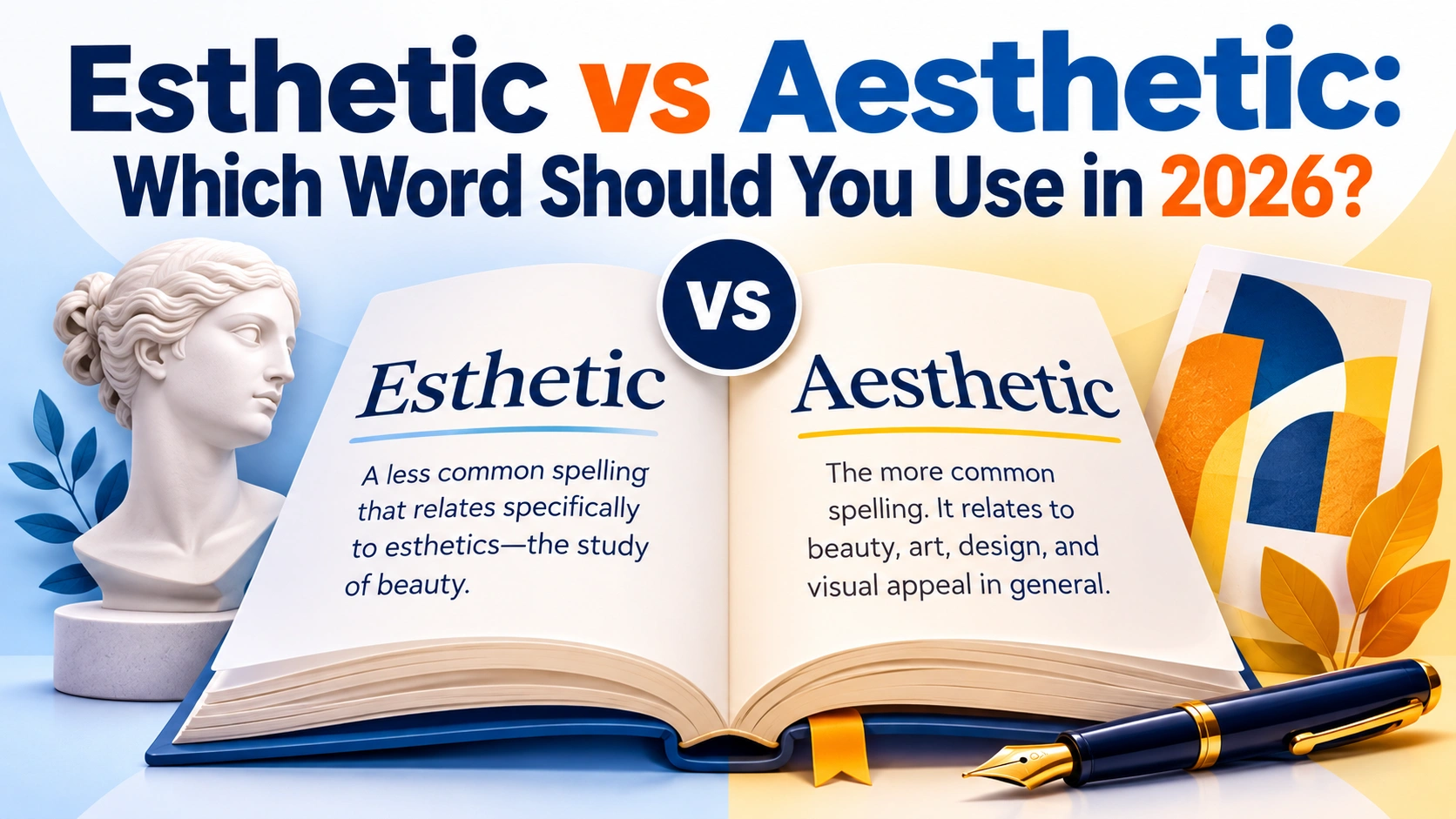
Esthetic vs aesthetic is a spelling question that looks deceptively simple. Both forms are legitimate English words, and both refer to beauty, artistic qualities, visual appeal, or the study of aesthetics. The real difference is not that one means “beautiful” and the other means something else. Instead, the choice depends largely on regional preference, audience, field, and established terminology.
For most general writing, aesthetic is the safest and most widely recognizable choice. It works naturally in discussions of art, architecture, fashion, branding, photography, literature, design, appearance, and personal style. Esthetic, however, is not a misspelling. It is an established variant, particularly associated with American English, and it appears regularly in professional terminology related to beauty and appearance. Major dictionaries recognize this relationship rather than treating the two forms as unrelated words.
The interesting part is knowing when the shorter spelling actually makes sense. This guide explains the meaning, pronunciation, history, regional usage, noun and adjective forms, beauty-industry terminology, common mistakes, and practical situations in which one spelling may be preferable. By the end, you should be able to decide quickly whether aesthetic or esthetic is the better choice for an email, essay, website, design brief, professional document, or everyday sentence.
Quick Answer: Esthetic vs Aesthetic
If you need the answer quickly, use this rule:
Choose “aesthetic” for general, international, academic, artistic, and most professional writing. “Esthetic” is a legitimate variant, especially in American English and in some beauty-related professional terminology.
The two spellings have essentially the same core meaning. Cambridge explicitly identifies esthetic as the US spelling of aesthetic, while Merriam-Webster lists esthetic as a US variant of aesthetic.
Here is the practical distinction:
| Situation | Better choice |
| General English | aesthetic |
| International audience | aesthetic |
| British English | aesthetic |
| Academic writing | aesthetic |
| Art and literary criticism | aesthetic |
| Architecture and design | aesthetic |
| General website or blog | aesthetic |
| American English | aesthetic or esthetic |
| Beauty-industry terminology | esthetic may be appropriate |
| An organization’s established terminology | Follow its preferred spelling |
| Unsure which one to choose | aesthetic |
The important point is that “esthetic” is not wrong simply because it is less familiar. Conversely, using aesthetic in American English is not a mistake simply because esthetic exists.
Aesthetic vs Esthetic: What Is the Actual Difference?
The simplest way to understand the pair is to treat esthetic as a variant spelling of aesthetic, not as a separate concept.
Both can describe:
- beauty or attractiveness
- artistic qualities
- visual appeal
- taste or style
- principles concerning beauty and art
- the appearance-related aspect of a treatment or procedure
For example, these sentences communicate essentially the same idea:
- The building has strong aesthetic appeal.
- The building has a strong aesthetic appeal.
Likewise:
- The designer considered the aesthetic effect.
- The designer considered the aesthetic effect.
The difference becomes more noticeable when professional terminology or regional conventions enter the picture. In general prose, aesthetic is the more familiar form. In some American professional contexts, especially beauty and skincare, esthetics appear naturally.
That distinction matters because spelling decisions should be based on usage and audience, not on the assumption that the shorter spelling is either “more correct” or “less correct.”
Aesthetic vs Esthetic: Comparison Table
| Feature | Aesthetic | Esthetic |
| Basic meaning | Related to beauty, art, taste, or appearance | Same basic meaning |
| Grammatical use | Adjective and noun | Adjective and noun |
| General recognition | Very high | Lower outside particular contexts |
| British English | Standard/preferred form | Uncommon |
| American English | Standard and very common | Established variant |
| Academic writing | Usually preferred | Possible, but less conventional |
| Art and design | Very common | Less common |
| Beauty terminology | Common | Common in some professional contexts |
| Related noun | aesthetics | esthetics |
| Related adverb | aesthetically | esthetically |
| Best default for broad audiences | Yes | Usually no |
| Incorrect spelling? | No | No |
Cambridge lists aesthetic as the main entry and identifies esthetic as the US spelling. Merriam-Webster likewise treats esthetic as a variant.
That means a spell-checker or reader who is unfamiliar with esthetic should not automatically assume that it is an error.
What Does Aesthetic Mean?
Aesthetic as an Adjective
As an adjective, aesthetic describes something connected with beauty, artistic quality, visual appeal, taste, or the study of beauty.
Consider these examples:
- The architect made several aesthetic changes to the building.
- The website has a clean, modern aesthetic design.
- The painting has considerable aesthetic value.
- The company changed its packaging for aesthetic reasons.
- The room is functional as well as aesthetically pleasing.
The word can therefore operate at several levels. It can describe something that is beautiful, something connected with artistic judgment, or something concerned with appearance rather than practical function alone.
Merriam-Webster also recognizes an appearance-related sense, including phrases such as aesthetic treatments, aesthetic medicine, and aesthetic plastic surgery.
Aesthetic as a Noun
Modern English also commonly uses aesthetic as a noun.
In this form, it can mean a distinctive style or visual character:
- The restaurant has a minimalist aesthetic.
- Her photography has a distinctly nostalgic aesthetic.
- The brand is developing a new visual aesthetic.
- The film’s dark aesthetic supports its story.
This noun use is particularly common in design, fashion, photography, branding, entertainment, and online culture.
There is also a more specialized meaning connected with a particular philosophy or conception of beauty and art. Merriam-Webster defines the noun in terms of a particular theory, taste, or approach to what is pleasing to the senses.
Aesthetic in Philosophy
The word has a more technical meaning in aesthetics, the branch of philosophy concerned with questions surrounding beauty, art, taste, perception, and artistic value.
That is why expressions such as these sound natural in academic writing:
- aesthetic judgment
- aesthetic theory
- aesthetic experience
- aesthetic value
- aesthetic philosophy
This meaning is broader than simply saying that something “looks nice.”
What Does Esthetic Mean?
Esthetic carries essentially the same meaning as aesthetic. The important difference is its usage pattern, not its basic definition.
Cambridge labels esthetic as the US spelling of aesthetic, while Merriam-Webster describes it as a US variant.
For example:
- The designer considered the esthetic impact of the building.
- The procedure was selected for both functional and esthetic reasons.
- The product was evaluated for its aesthetic qualities.
These sentences are understandable and grammatically sound.
Why Does “Esthetic” Look Unusual?
Many English speakers encounter aesthetics much more often. The extra a gives the word a distinctive appearance, and it is the form most readers expect in general writing.
That familiarity can create a false assumption:
Unfamiliar does not mean incorrect.
Esthetic is a legitimate variant. The practical question is whether it is the most suitable spelling for your audience and context.
Esthetic and Professional Terminology
The spelling becomes especially noticeable in the beauty and skincare field, where terms such as esthetician and esthetics are established in American usage.
That does not mean every beauty professional uses esthetics. Terminology varies by country, institution, employer, and professional context. But it explains why someone working in skincare may encounter aesthetics much more frequently than someone studying literature or architecture.
Aesthetic vs Esthetic: Pronunciation
The pronunciation is broadly similar because the two spellings represent the same word family.
Common pronunciations include forms beginning approximately with:
es-THET-ik
or, in some varieties of English:
ees-THET-ik
Cambridge gives pronunciation information for both British and American English and lists esthetic as the US spelling.
The spelling does not create a major difference in meaning or pronunciation. Regional pronunciation can vary, so it is better to learn the word as it is spoken in the variety of English you are using rather than trying to derive the pronunciation entirely from the letters.
Aesthetic vs Esthetic in British and American English
Regional usage is one of the most useful clues when choosing between the two.
British English
Aesthetic is the normal spelling in British English.
If you are writing for:
- a British university
- a UK publication
- a British client
- an international audience accustomed to British conventions
then aesthetic is the straightforward choice.
American English
American English accepts both aesthetic and esthetic.
However, this does not mean that Americans generally have to use esthetics. Aesthetics remain completely standard and extremely familiar in American writing. Merriam-Webster explicitly lists esthetic as a US variant rather than replacing aesthetic with it.
So this is an important distinction:
“Esthetic is American” does not mean “aesthetic is not American.”
Both can occur in American English.
International English
For an international audience, aesthetics is usually the safer option because readers across different English varieties are more likely to recognize it immediately.
This matters particularly for:
- educational websites
- international publications
- software documentation
- global brands
- academic resources
- multilingual audiences
When no house style or technical terminology dictates otherwise, familiarity is a useful editorial consideration.
When Should You Use Aesthetic?
For most writers, aesthetics should be the default.
General English
Use aesthetic when talking about the appearance or beauty of something:
The renovation improved the building’s aesthetic appeal.
Art and Literature
It is especially natural in discussions of artistic quality:
The novel combines political themes with a distinctive aesthetic style.
Architecture and Interior Design
The architect wanted to preserve the building’s original aesthetic.
Fashion and Photography
The collection has a minimalist aesthetic.
Branding and Marketing
The company is trying to create a more premium aesthetic.
Academic Writing
The study examines the aesthetic dimensions of public architecture.
In all these contexts, aesthetic is immediately recognizable and fits comfortably into established terminology.
When Should You Use an Esthetic?
There are situations in which aesthetics are perfectly reasonable.
American English
If your publication or organization follows American spelling and routinely uses esthetic, there is no grammatical problem with retaining it.
Beauty and Skincare Contexts
Esthetic can be particularly appropriate when it is part of established professional terminology.
For example:
The school offers courses in esthetics.
or:
The program prepares students for careers in professional esthetics.
The related noun esthetics is also recognized as a US spelling of aesthetics. Cambridge explicitly identifies it as such.
Matching an Organization’s Terminology
Consistency sometimes matters more than personal preference.
Suppose a training institution consistently uses:
Esthetics Program
Changing every instance to Aesthetics Program may make the copy look inconsistent with the institution’s official name.
In that situation, follow the organization’s established terminology.
This is a useful professional editing principle: proper names, program titles, credentials, and branded terminology should not be “corrected” simply because another spelling is more common.
Aesthetic vs Esthetic in the Beauty Industry
The beauty industry is where this spelling question becomes more complicated.
A general writer might naturally say:
aesthetic treatment
while a professional program may use:
esthetic training
Both are possible because the words belong to the same family.
Aesthetician vs Esthetician
You may encounter both:
- aesthetician
- esthetician
The second form follows the spelling pattern of esthetic.
This is one reason people who search for careers or education in skincare may encounter esthetics more often than readers in other fields.
The safest approach is to preserve the terminology used by the relevant school, licensing authority, employer, or professional organization rather than assuming that one spelling must replace the other everywhere.
Aesthetic Medicine
Medical and cosmetic contexts frequently use aesthetic:
- aesthetic medicine
- aesthetic dentistry
- aesthetic procedures
- aesthetic treatments
Merriam-Webster includes appearance-enhancement senses under aesthetic, including aesthetic medicine and aesthetic treatments.
This demonstrates an important point: professional context does not automatically mean “esthetic.”
Both forms have legitimate professional uses.
Aesthetic vs Esthetic in Real Sentences
Seeing the words in context makes the distinction easier.
Aesthetic Examples
The museum’s modern aesthetic contrasts with the historic building around it.
The designer chose natural materials for both practical and aesthetic reasons.
The website has a clean aesthetic that makes the information easier to navigate.
The filmmaker developed a distinctive visual aesthetic.
The furniture combines aesthetic appeal with durability.
Esthetic Examples
The designer considered the esthetic qualities of the new product.
The program includes introductory courses in esthetics.
The architect evaluated both structural and esthetic considerations.
The clinic offers a range of esthetic services.
In many of these examples, replacing one spelling with the other would not fundamentally change the meaning. The surrounding context determines which form feels natural.
Aesthetic vs Esthetic: Which Is More Common?
There is an important difference between being correct and being common.
Aesthetic is the more broadly familiar form. It appears extensively in general English, academic writing, art criticism, design, fashion, architecture, marketing, and everyday discussions of style.
The esthetic is established but has a narrower distribution. It is especially associated with American spelling and particular professional contexts.
Merriam-Webster currently lists esthetic as a variant of aesthetic, while Cambridge labels it the US spelling.
That gives writers a practical hierarchy:
- Correctness: both are legitimate.
- Broad familiarity: aesthetic has the advantage.
- Regional terminology: esthetic may be preferred in some American contexts.
- Institutional terminology: use the organization’s established form.
You therefore should not tell a writer that esthetic is “wrong.” A better editorial recommendation is that aesthetic is normally the more versatile default.
Why Do We Have Both Aesthetic and Esthetic?
The two forms have a shared history.
Merriam-Webster traces aesthetic through German and New Latin to Greek aisthētikós, associated with sense perception and sensitivity. It records the adjective in English from the early 19th century.
The word originally had a more philosophical connection with sensory perception and the appreciation of beauty. Over time, its meaning expanded into discussions of art, taste, artistic movements, visual style, and appearance.
The simplified spelling esthetic developed as an alternative form.
Etymological sources likewise treat esthetic as an alternative form of aesthetic, rather than tracing the two to unrelated words.
That shared origin explains why the meanings remain so closely connected today.
Aesthetic vs Esthetic: Common Mistakes
Mistake 1: Calling Esthetic a Misspelling
This is the biggest error.
Esthetic is a legitimate English variant. Major dictionaries recognize it.
Mistake 2: Assuming Americans Must Use Esthetic
American English permits esthetic, but aesthetic is also standard American English.
Do not “Americanize” every occurrence of aesthetic into esthetic.
Mistake 3: Assuming Aesthetic Is Only About Physical Beauty
The word can describe:
- artistic principles
- philosophical ideas
- visual style
- sensory experience
- design choices
- appearance-related treatments
Its meaning is considerably broader than “pretty.”
Mistake 4: Confusing Aesthetic With Aesthetics
These are related but not interchangeable.
Compare:
- aesthetic — an adjective or singular noun
- aesthetics — the study/principles of beauty and art, or the qualities of something considered beautiful
- esthetic — a variant of aesthetic
- esthetics — a variant of aesthetics
Cambridge defines aesthetics as the formal study of art and beauty, while also recognizing esthetics as its US spelling.
Mistake 5: Writing “An Aesthetic Painting”
This can be awkward when the intended meaning is simply “beautiful.”
For example:
The museum displayed an aesthetic painting.
is less precise than:
The museum displayed a beautiful painting.
or:
The museum displayed a painting with strong aesthetic qualities.
The adjective aesthetic usually works best when the writer is talking about beauty, artistic quality, or visual principles as a dimension of the object.
Aesthetic vs Esthetic: A Practical Decision Table
| If you are writing… | Recommended spelling | Why |
| A school essay | Aesthetic | Widely recognized |
| An academic paper | Aesthetic | Conventional scholarly usage |
| A UK publication | Aesthetic | Standard British form |
| An international website | Aesthetic | Broadest recognition |
| A design brief | Aesthetic | Established design vocabulary |
| A fashion article | Aesthetic | Common industry usage |
| A branding guide | Aesthetic | Clear to broad audiences |
| An American beauty program | Esthetic may fit | Professional terminology may use it |
| A company called “Esthetics Center” | Esthetics | Preserve the official name |
| A general American article | Aesthetic or Esthetic | Both are legitimate |
| A document with an established house style | Follow house style | Consistency matters |
Is “Esthetic” More American Than “Aesthetic”?
Yes, in the sense that esthetic is particularly associated with American spelling. Cambridge explicitly labels it the US spelling of aesthetic.
But “more American” should not be interpreted as “the American version.”
American English commonly uses aesthetics as well.
Think of the relationship this way:
British English: aesthetic
American English: aesthetic / esthetic
That is more accurate than:
British English: aesthetic
American English: esthetic
The second version creates a false either/or distinction.
Is Aesthetic More Formal Than Esthetic?
Not necessarily.
Aesthetics may feel more formal to some readers simply because it is more familiar in academic and literary contexts. That does not establish a grammatical rule that makes esthetic informal.
Context determines the register.
For example:
The sculpture has considerable aesthetic value.
sounds perfectly appropriate in an academic article.
Meanwhile:
The clinic offers esthetic services.
may be entirely professional within a specialized American beauty context.
The spelling itself does not determine the professionalism of the sentence.
Aesthetic vs Esthetic in Academic Writing
For academic writing, aesthetic is generally the safer choice, especially when the paper concerns:
- philosophy
- art history
- literature
- architecture
- cultural studies
- design
- film
- music
- visual culture
There is no rule that prohibits aesthetics. However, academic writing benefits from consistency and audience awareness.
If the source literature, department, journal, or style guide consistently uses esthetics, follow that convention. Otherwise, aesthetic is the more broadly recognizable option.
A good editor does not change terminology merely to make it look different. The goal is clarity, consistency, and conformity with the intended publication context.
Aesthetic vs Esthetic: Three Real-World Scenarios
Scenario 1: Writing a Design Article
You are writing:
“The new chair has a minimalist ___.”
Choose:
aesthetic
It is the natural noun meaning the chair’s overall visual style.
Scenario 2: Writing About a Beauty Training Program
The program officially calls itself an:
“Esthetics Training Program”
Keep Esthetics.
Changing the official name to Aesthetics Training Program could create an inaccurate title even though the words are closely related.
Scenario 3: Writing for an International Audience
You write:
“The website was redesigned to improve its visual ___.”
Choose:
aesthetic
It is familiar to readers across English varieties and creates no unnecessary regional ambiguity.
A Quick Editing Checklist
Before publishing, ask:
- What country or English variety is my audience using?
- Am I discussing general beauty, style, or artistic quality?
- Is the word part of an official professional title?
- Does my publication have a house style?
- Have I used the spelling consistently?
- Am I confusing the adjective with the noun “aesthetics”?
- Would the more familiar form make the sentence clearer for my audience?
For most general-purpose writing, the answer is straightforward:
Use aesthetics unless you have a specific reason to use esthetics.
That reason might be American regional usage, established professional terminology, an official name, or a publication’s house style.
✅Aesthetic vs Esthetic: Related Words You Should Know
Aesthetic vs Aesthetics
Aesthetic can be an adjective or a noun referring to a particular style or conception of beauty.
Aesthetics is commonly used for the broader study or principles of beauty and art.
The building has a distinctive aesthetic.
The course covers the philosophy of aesthetics.
Esthetic vs Esthetics
These are the corresponding variants:
The product has strong aesthetic appeal.
The program teaches aesthetics.
Aesthetician vs Esthetician
Both spellings exist, with estheticians following the simplified esthetic form.
Because professional titles can be jurisdiction-specific, do not assume that changing one spelling to the other will preserve the official name of a license, course, organization, or credential.
Aesthetic vs Cosmetic
These words overlap in appearance-related contexts but are not identical.
Cosmetic generally concerns products, procedures, or changes intended to improve appearance.
Aesthetics can describe the appearance itself, artistic qualities, visual style, or broader ideas about beauty.
For example:
The designer made an aesthetic decision.
does not mean the same thing as:
The doctor recommended a cosmetic procedure.
The words can overlap, but they serve different purposes.
Conclusion
When choosing between esthetic vs aesthetic, the most useful rule is not “one is correct and one is wrong.” Both are legitimate forms, but aesthetic is the stronger all-purpose choice because it is broadly recognized across English varieties and fits naturally in academic, artistic, design, business, and everyday writing. Esthetic remains useful where American spelling or established professional terminology makes it appropriate.One final actionable tip: if you’re writing for a broad audience and nobody has specified a house style, choose aesthetic and use it consistently. If you’re reproducing an official name, credential, program, or professional term, preserve the spelling used by that organization.A common mistake to avoid: do not “correct” esthetic simply because it looks unusual. Check the context first. Good word choice is not about choosing the spelling that looks most familiar; it is about choosing the form that best fits your audience, your field, and your purpose.
FAQs
Q1. Is “esthetic” a correct spelling?
Yes. Esthetic is a legitimate variant of aesthetic, not simply a spelling mistake. Major dictionaries recognize it, with Cambridge identifying it specifically as the US spelling of aesthetic. It can be appropriate in American English and in certain professional contexts, particularly terminology connected with beauty and skincare.
Q2. Which is more common: aesthetic or esthetic?
Aesthetic is generally the more familiar and broadly used form, particularly in international, British, academic, artistic, and general-purpose writing. Esthetics are also established, especially in American English. If you have no contextual reason to choose otherwise, aesthetic is the safer default.
Q3. Should I use aesthetic or esthetic in American English?
Either can be correct. American English recognizes both forms, so the decision depends on context. Use aesthetic for broad readability, or esthetic when it matches established American professional terminology, an organization’s preferred wording, or a specific house style.
Q4. Is “esthetician” different from “aesthetician”?
They are closely related professional terms, and the spelling varies by region and institution. Esthetician follows the esthetic spelling and is especially familiar in American beauty terminology. When referring to a formal qualification, license, course, or job title, use the exact terminology recognized by the relevant organization.
Q5. Are aesthetic and esthetic pronounced the same?
They are essentially the same word in pronunciation, although pronunciation can vary by English variety. Cambridge gives both British and American pronunciation information and treats esthetic as the US spelling of aesthetic. The spelling difference therefore does not normally signal a difference in meaning or pronunciation.