

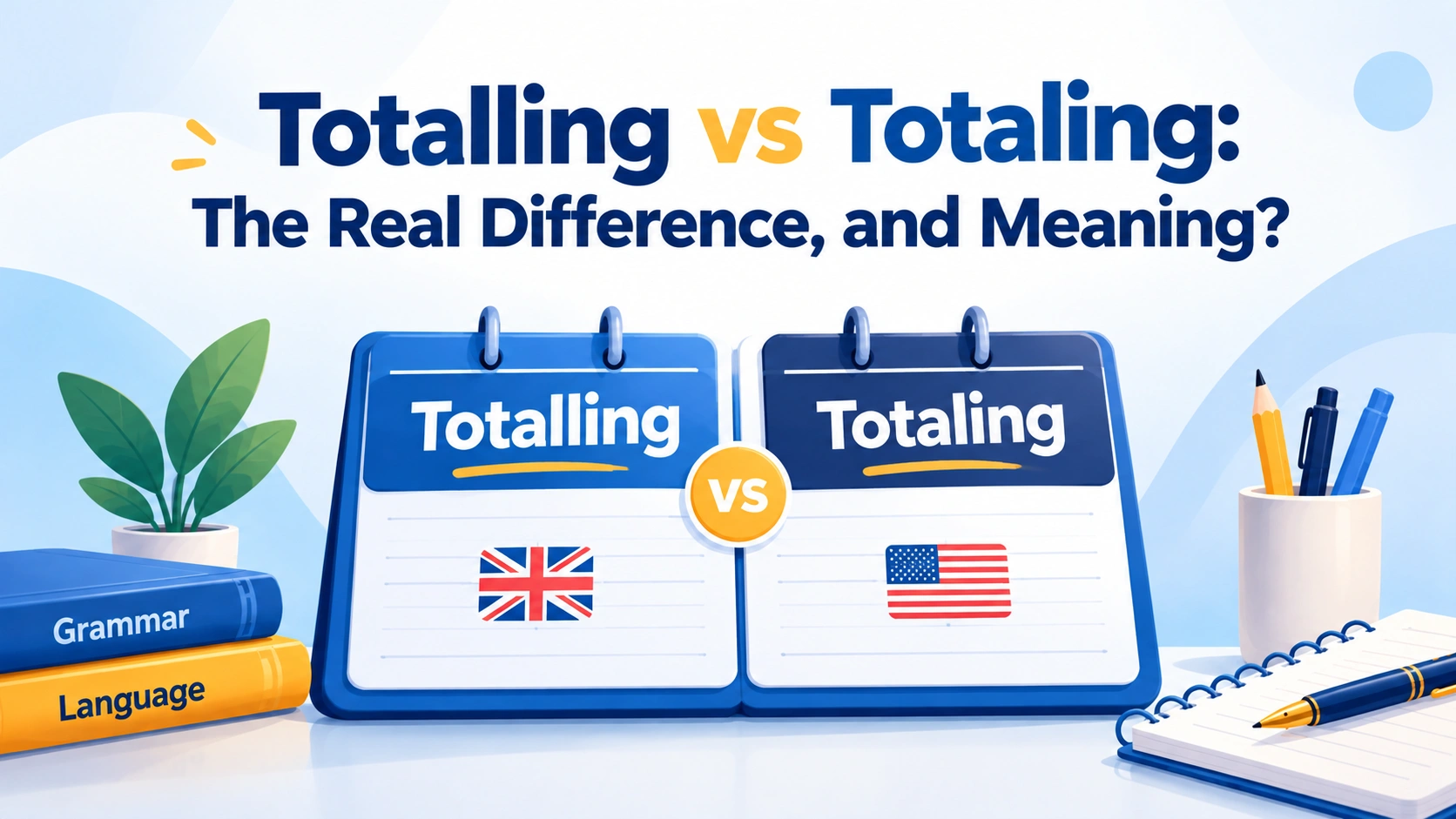
Totalling vs totaling is a spelling difference that can make an otherwise simple sentence look questionable, especially when a spell-checker marks one version as wrong. The good news is that both spellings are correct. The difference is mainly regional: totalling is the standard form associated with British English, while totaling is the usual American English form. They have the same pronunciation and the same basic meaning.
The confusion becomes easier to resolve once you look at the word behind both forms: total. As a verb, total can mean to add amounts together or to reach a particular amount. Adding the -ing ending produces totalling or totaling, depending on the spelling convention being followed. This distinction also connects with totalled vs totaled, so learning one pair helps you handle the other confidently.
In this guide, you’ll learn what totalling and totaling mean, why two spellings exist, which version to use in British and American English, how the spelling rule works, and where writers commonly go wrong. You’ll also see the words in practical sentences involving expenses, scores, reports, invoices, donations, and other situations where precise writing matters.
Quick Answer: Totalling vs Totaling
Totalling and totaling mean the same thing. Both are forms of the verb total, meaning to add amounts together or to reach a particular total.
The main difference is regional spelling:
- Totalling — standard British English spelling
- Totaling — standard American English spelling
For example:
- British English: The expenses are totalling £4,500.
- American English: The expenses are totaling $4,500.
The difference does not change the meaning, grammar, or pronunciation.
| Question | Answer |
| Do totalling and totaling mean the same thing? | Yes |
| Which is British English? | Totalling |
| Which is American English? | Totaling |
| Is either spelling wrong? | Not in the appropriate English variety |
| Do they sound different? | No |
| Is it totally related? | Yes, but it has a different grammatical function and meaning |
| Related past form | totalled / totaled |
Cambridge lists totalling as the present participle of total, while its dictionary entry for total notes the -ll- spelling alongside the US -l- form. Oxford likewise gives totalling and identifies totaling as the US form.
What Does “Totalling” or “Totaling” Mean?
To understand the difference, start with total.
“Total” as a verb
As a verb, total can mean to calculate the complete amount of several numbers or quantities.
For example:
The five invoices total £3,200.
Here, total means that the combined amount is £3,200.
It can also describe the act of calculating the combined amount:
The accountant totalled the receipts.
In American English, this would normally be:
The accountant totaled the receipts.
Cambridge defines the verb total in this sense as having or calculating a complete amount. Oxford similarly gives two closely related uses: reaching a particular total and adding numbers to obtain a total.
“Totalling” and “totaling” as -ing forms
Both spellings are the present participle/gerund form of total.
That means they can appear in progressive constructions:
The costs are totalling £8,000.
or:
The costs are totaling $8,000.
They can also appear in constructions where the -ing form describes an amount:
The project involves three phases, totalling 18 months.
The project involves three phases, totaling 18 months.
The grammar is the same. Only the spelling convention changes.
What does “totalling up” mean?
You may also encounter totalling up or totaling up.
This simply emphasizes the process of adding separate figures together:
She was totalling up the receipts.
He was totaling up the scores.
The simpler totalling or totaling is often enough, particularly in formal writing.
The Core Difference Between Totalling and Totaling
The most important point is surprisingly simple:
Totalling and totaling are different spellings of the same word form, not different words with different meanings.
Consider these two sentences:
- The donations are totalling £25,000.
- The donations are totaling $25,000.
Nothing about the underlying action changes. In both cases, the writer is saying that the donations amount to the stated figure.
The spelling changes because English has developed different conventions in different regions.
A useful comparison
| British English | American English |
| totalling | totaling |
| totalled | totaled |
| travelling | traveling |
| labelling | labeling |
| cancelled | canceled |
These examples illustrate a broader pattern, although the rules are not perfectly uniform across all words. Cambridge’s spelling guidance notes that British English commonly doubles certain final consonants before suffixes and specifically observes that American English generally favors the single-consonant forms in words such as labelling/labeling and traveller/traveler.
That is why it is better to learn totalling vs totaling as a regional spelling convention rather than trying to force every English word into one mechanical formula.
Why Does “Totalling” Have Two Ls?
The extra l is part of the spelling convention used in British English.
When English words take endings such as -ing or -ed, consonant doubling sometimes occurs. The details depend on the word’s structure, pronunciation, stress, and established spelling. Cambridge describes this as a consonant-doubling pattern and also points out that some words are exceptions to the most straightforward rule.
With total, the established forms are:
- British English: total → totalling → totalled
- American English: total → totaling → totaled
The difference is therefore not caused by a different pronunciation or a different meaning.
Why the simple “double the last letter” rule is misleading
A beginner might reason:
Total ends in l, so adding -ing must always produce totalling.
That does not explain why American English normally uses totaling.
Likewise, it would be misleading to claim that British English simply doubles every final consonant before -ing. English spelling has numerous exceptions and historical conventions.
The safer rule for practical writing is:
Follow the spelling convention of the English variety you are using.
Totalling vs Totaling by Region
British English: “totalling”
Totalling is the normal British English spelling.
You are likely to see it in:
- UK business writing
- British newspapers
- academic writing
- government documents
- financial reports
- school and university work
- everyday correspondence
Examples:
The repairs are totalling £6,400.
The three payments, totalling £1,250, were received yesterday.
The survey recorded 850 responses, totalling 92% of the target sample.
Oxford lists totalling as the standard -ing form and gives totaling as the US English alternative.
American English: “totaling”
Totaling is the normal American English spelling.
It commonly appears in:
- US business documents
- American journalism
- financial statements
- reports
- invoices
- academic writing
- everyday communication
Examples:
The repairs are totaling $6,400.
The three payments, totaling $1,250, were received yesterday.
The project includes four contracts totaling $2 million.
Oxford’s American English dictionary gives totaling as the -ing form and totaled as the past form.
What about Canadian English?
Canadian usage deserves a little caution.
Canadian English can follow conventions associated with both British and American English, depending on the word, publication, institution, and style guide. Oxford specifically identifies totalling as a Canadian English variant in its American-English entry.
So if you’re writing for a Canadian audience, don’t assume that the UK-versus-US distinction alone settles every spelling question. Follow the style guide used by the organization or publication whenever one exists.
Totalling vs Totaling in Real Sentences
The easiest way to understand the distinction is to see the same idea written in both varieties.
Expenses
British English:
The company’s expenses are totalling £18,000 this quarter.
American English:
The company’s expenses are totaling $18,000 this quarter.
Donations
British English:
The campaign has received donations totalling £75,000.
American English:
The campaign has received donations totaling $75,000.
Scores
British English:
The two teams finished with scores totalling 150 points.
American English:
The two teams finished with scores totaling 150 points.
Contracts
British English:
The company signed three contracts totalling £2.4 million.
American English:
The company signed three contracts totaling $2.4 million.
Survey results
British English:
The study included 12 groups, totalling more than 4,000 participants.
American English:
The study included 12 groups, totaling more than 4,000 participants.
Notice what remains unchanged: the sentence structure and meaning. Only the spelling of the -ing form changes.
When “Total” Is Better Than “Totalling” or “Totaling”
Not every sentence needs the longer -ing form.
Sometimes the simple verb total is cleaner:
The five invoices total £8,000.
This is often more direct than:
The five invoices are totalling £8,000.
The second sentence is grammatical, but it emphasizes an ongoing or developing amount.
Compare:
- The invoices total £8,000. → states the complete amount.
- The invoices are totalling £8,000. → presents the amount as part of an ongoing calculation or developing situation.
- The invoices totaled £8,000. → reports a completed past total.
- The invoices are totaling £8,000. → American spelling of the corresponding -ing form.
This distinction is useful in professional writing because choosing the right verb form can make a sentence more precise than simply choosing the right spelling.
Totalling vs Totaling in Different Grammatical Contexts
As a present participle
The form can follow a form of be:
The costs are totalling £10,000.
The costs are totaling $10,000.
The spelling depends on the English variety.
As a modifier
The -ing form can describe an amount:
The company announced two investments totalling £4 million.
The company announced two investments totaling $4 million.
This construction is particularly common in news, financial, and business writing.
As a gerund
The form can function as a noun-like activity:
Totalling the receipts took longer than expected.
Totaling the receipts took longer than expected.
Here, the activity itself is the subject of the sentence.
With “total up”
The phrasal verb total up also means to add figures together.
She totalled up the day’s sales.
She totaled up the day’s sales.
Cambridge identifies total up as having the same basic meaning as add up.
Total, Totally, Totaled, Totalling, and Totaling: What’s the Difference?
These forms are related, but they do different grammatical jobs.
| Form | Typical function | Basic meaning | Example |
| total | noun | complete amount | The total was £500. |
| total | verb | add up/reach an amount | The costs total £500. |
| total | adjective | complete/whole | The total cost was £500. |
| totally | adverb | completely | The plan was totally different. |
| totalled | past form | added up/reached an amount | The costs totalled £500. |
| totaled | US past form | added up/reached an amount | The costs totaled $500. |
| totalling | British -ing form | adding up/reaching an amount | Costs totalling £500 were recorded. |
| totaling | US -ing form | adding up/reaching an amount | Costs totaling $500 were recorded. |
Why “totally” is different
One of the easiest mistakes is confusing totally with totaling.
Totally is an adverb meaning completely or entirely.
For example:
I totally agree.
Here, it totally has nothing to do with adding numbers.
By contrast:
The invoices are totaling $4,000.
Here, totaling refers to the combined monetary amount.
So:
- totally = completely
- totaling/totalling = adding up or reaching a total
“Totalled” vs “Totaled”: The Same Pattern in the Past Tense
If you understand totalling vs totaling, you can apply the same regional distinction to the past tense.
British English
The repairs totalled £12,000.
American English
The repairs totaled $12,000.
Oxford lists totalled as the standard form and totaled as the US English form.
This is useful when editing an entire document. If you’ve chosen British English and written totalling, you will generally also expect totalled rather than totaled.
| British English | American English |
| totalling | totaling |
| totalled | totaled |
The two pairs belong together stylistically.
Common Mistakes With Totalling and Totaling
Mistake 1: Calling one spelling “wrong”
A US writer may see totalling and assume it is misspelled. A British writer may see totaling and make the opposite assumption.
Neither conclusion is generally justified.
The spelling needs to be judged within its English variety.
Mistake 2: Mixing regional spellings
A document might contain:
The costs are totalling £10,000.
and later:
The expenses totaled £2,000.
The second sentence introduces the American spelling into otherwise British-style writing.
This may not prevent understanding, but consistent editorial style is preferable.
Mistake 3: Confusing “totaling” with “totally”
These words are not interchangeable.
Incorrect:
The expenses are totally $5,000.
Correct:
The expenses are totaling $5,000.
Mistake 4: Assuming the extra “l” changes pronunciation
It doesn’t.
Totalling and totaling represent the same pronunciation in ordinary English usage. The difference is written rather than spoken.
Mistake 5: Fighting your spell-checker
If your document is set to US English, totalling may be flagged. If it is set to UK English, totaling may be flagged.
That does not automatically mean the writer has made a grammatical error.
Check the document’s language setting before changing the word.
How to Choose the Right Spelling
Use this simple decision process.
| Your situation | Recommended spelling |
| Writing for readers in the UK | totalling |
| Using British English | totalling |
| Writing for a US publication | totaling |
| Using American English | totaling |
| Following a company style guide | Use its specified variety |
| Editing an existing document | Match the document’s established variety |
| Quoting a source | Preserve the original spelling when appropriate |
| Writing for an international audience | Choose one consistent convention |
Step 1: Identify your English variety
Before worrying about the individual word, determine whether the document uses British, American, Canadian, or another English convention.
Step 2: Check the style guide
Professional publications may have their own preferred spelling conventions.
If a style guide says to use American English, totaling is the sensible choice. If it requires British English, use totalling.
Step 3: Look at nearby spelling choices
If the document already uses:
- travelling
- labelling
- cancelled
then totalling will probably fit a British spelling system.
If it uses:
- traveling
- labeling
- canceled
then totaling is likely the consistent American choice.
This is not an absolute test, but it is a useful editorial clue.
Step 4: Keep the choice consistent
Once the variety is established, don’t alternate between forms simply because both are technically recognizable.
Consistency makes professional writing easier to edit and easier to trust.
When “Adding Up to” Is Better Than “Totalling” or “Totaling”
There are legitimate alternatives, but they are not perfect substitutes in every sentence.
“Adding up to”
This is straightforward and conversational:
The individual charges are adding up to $900.
“Amounting to”
This can sound more formal:
The losses are amounting to $2 million.
“Coming to”
This is especially natural for bills and final costs:
The bill came to $450.
“Reaching”
This works well when emphasizing a figure being approached:
The campaign is reaching a total of £100,000.
“Making a total of”
This is explicit and easy to understand:
The four payments made a total of $2,500.
“Total”
Often, the best alternative is simply the base verb:
The four payments total $2,500.
That sentence is shorter and more direct than many longer alternatives.
A Better Way to Write About Totals
Good writing is not just about picking, totalling or totaling. It is also about choosing the construction that expresses the intended meaning most efficiently.
Consider these examples:
The three invoices total $4,500.
This simply states the combined amount.
The three invoices are totaling $4,500.
This presents the total as part of an ongoing calculation or developing figure.
The three invoices, totaling $4,500, were submitted yesterday.
This uses the -ing form to provide additional information about the invoices.
The three invoices totaled $4,500.
This reports a completed past amount.
The spelling question is only one part of the decision. Tense, aspect, sentence structure, and emphasis matter too.
Does Totalling or Totaling Change the Pronunciation?
No.
The extra l in totalling does not give the word a different pronunciation from totaling. Oxford lists the two -ing forms with the same pronunciation notation.
That makes this a purely orthographic difference—a difference in written form.
This is useful to remember because it separates the issue from words where spelling differences can signal different pronunciations. Here, a reader hearing the word aloud cannot normally tell whether the speaker would write totalling or totaling.
A Note About the Other Meaning of “Total”
There is another verb sense of total, particularly familiar in North American English: to damage a vehicle so badly that it is considered beyond economical repair.
For example:
The insurance company said the car was totaled.
Oxford identifies this as an informal, especially North American use of total.
This meaning is unrelated to the calculation sense discussed throughout most of this article.
So context matters:
- The invoices are totaling $20,000. → adding up to $20,000
- The car was totaled in the accident. → severely damaged
The shared spelling comes from the same verb, but the meanings are different.
Is “Totalling” More Correct Than “Totaling”?
No.
There is no universal rule that makes totalling inherently more correct.
The appropriate form depends on the English variety.
For a British English document:
totalling is the expected choice.
For an American English document:
totaling is the expected choice.
Cambridge explicitly presents the verb with -ll- and identifies the US spelling as usually -l-, while Oxford lists totalling and totaling according to English variety.
The better question is therefore not:
“Which spelling is correct?”
It is:
“Which spelling matches the English convention I’m using?”
That shift in perspective resolves most of the confusion immediately.
A Simple Memory Trick for Totalling vs Totaling
Use this shortcut:
British English → totalling
American English → totaling
Then connect the forms:
British: totalled → totalling
American: totaled → totaling
If you’re still unsure, check two things:
- Who is going to read the document?
- Which English variety does the document already use?
That is more reliable than trying to remember a complicated spelling formula.
Quick Reference Cheat Sheet
| If you are… | Use | Example |
| Writing British English | totalling | Costs totalling £5,000 |
| Writing American English | totaling | Costs totaling $5,000 |
| Using British past tense | totalled | Costs totalled £5,000 |
| Using American past tense | totaled | Costs totaled $5,000 |
| Describing completeness | totally | The plan was totally different |
| Stating a final amount | total | The costs total $5,000 |
| Saying the amount came to a figure | came to | The bill came to $500 |
| Informally adding figures | total up | Total up the scores |
Editorial tip: Don’t change totalling to totaling merely because a spell-checker highlights it. First check the document’s language setting and intended audience.
Conclusion
Totalling vs totaling is ultimately a question of regional spelling, not different meaning. British English normally uses totalling, while American English normally uses totaling; both describe adding amounts together or reaching a particular total. The same regional distinction appears in totalled vs totaled, which makes the pattern easier to recognize once you’ve seen it. When choosing between the forms, focus on your audience, document language, and style guide rather than treating one spelling as universally correct.One final actionable tip: check a document’s existing spelling conventions before changing an unfamiliar form. If it consistently follows British English, keep totalling; if it follows American English, use totaling.A common mistake to avoid: don’t confuse either form with totally, which means “completely.” The best spelling is the one that fits the English variety your writing has already chosen—and consistency is what makes that choice look professional.
FAQs
Q1. Is “totalling” correct in British English?
Yes. Totalling is the standard British English -ing form of total when the word means adding amounts together or reaching a particular total. For example, The expenses are totalling £5,000. Oxford and Cambridge both recognize this spelling.
Q2. Is “totaling” correct in American English?
Yes. Totaling is the standard American English spelling of the -ing form. For example, The expenses are totaling $5,000. American dictionaries and Oxford’s American English entry recognize this form. It has the same meaning and pronunciation as British totalling.
Q3. Can “totalling” and “totaling” be used interchangeably?
They are interchangeable in meaning, but not always interchangeable stylistically. Both mean adding amounts together or reaching a total. However, a document using British English should generally use totalling, while American English normally uses totaling. Consistency matters.
Q4. Is “totalling up” grammatically correct?
Yes. Totalling up is a valid construction meaning to add separate figures together. For example, She was totalling up the receipts. In American English, totaling up is normally used. The shorter totalling or totaling may be preferable when up adds no useful emphasis.
Q5. What is the difference between “totally” and “totaling”?
Totally is an adverb meaning completely or entirely, while totaling/totalling is an -ing form of the verb total, meaning adding amounts together or reaching a total. Totally unexpected and totaling $5,000 therefore have completely different grammatical functions.