

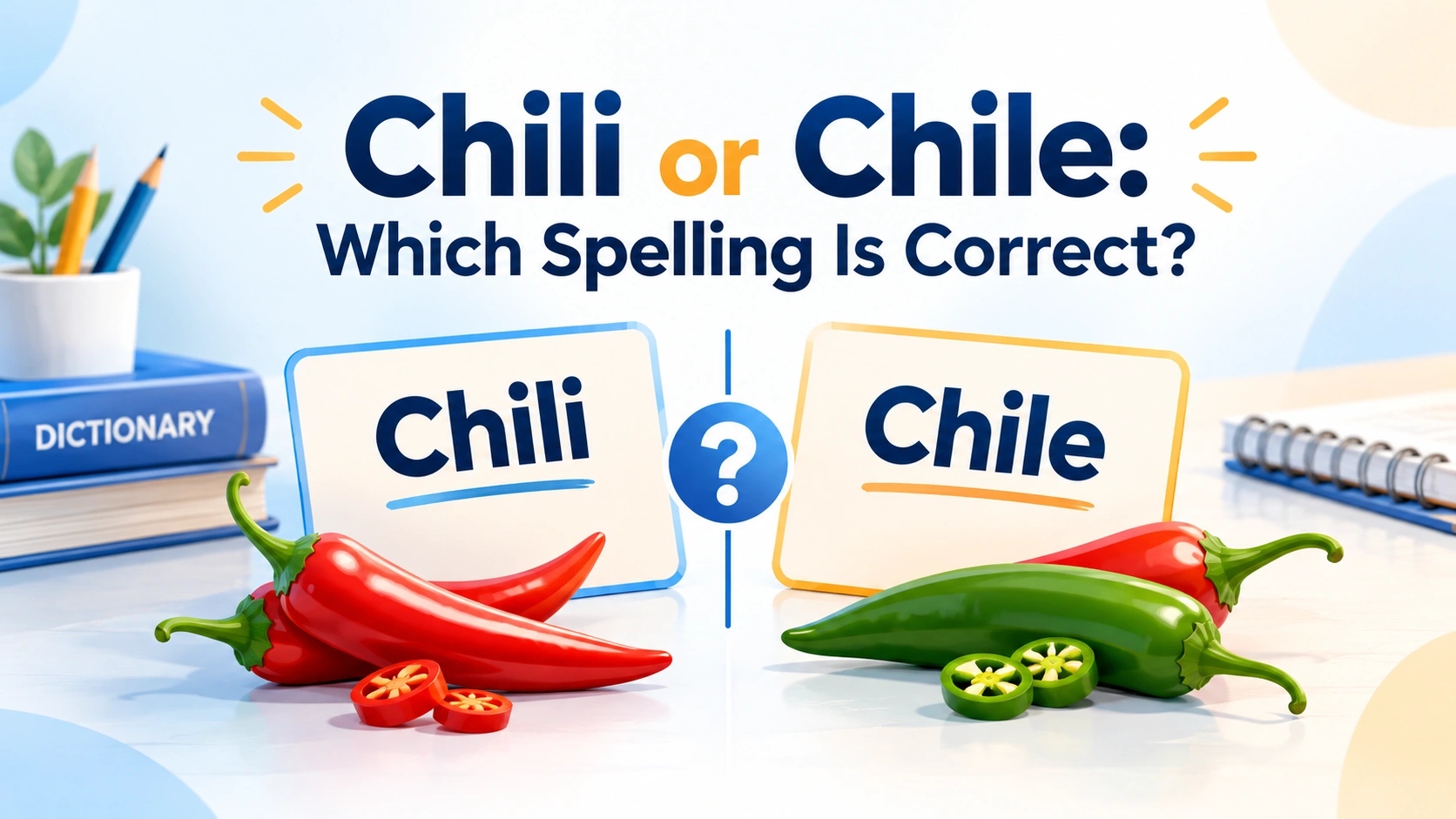
Chili or chile can both be correct, but the right choice depends on what you mean, where your English is used, and sometimes the culinary tradition you are describing. Add chilli to the mix, and the spelling question becomes even more confusing. The key distinction is that chile is widely used for a hot pepper, especially in Southwestern and Spanish-influenced culinary contexts, while chili is common in American English and is also the standard name for the familiar spicy dish. In British English, chilli is the usual spelling for the pepper. Meanwhile, Chile with a capital C means the South American country.
That variation matters because changing the spelling can occasionally change the reader’s interpretation. A sentence such as “I made chili” normally refers to the dish, not a fresh pepper. By contrast, “Add one chopped chile” clearly points to a pepper in many culinary contexts. Product labels create another complication: chili powder and chile powder can describe products made differently, so the spelling alone does not always tell you what is inside. This guide explains the distinctions, regional preferences, plural forms, pronunciation, history, and the practical rules writers, cooks, editors, and shoppers can actually use.
The goal is not to declare one spelling universally correct. English has absorbed this food vocabulary through different linguistic and regional traditions, so context is more useful than a one-word spelling rule. You will learn when chili, chile, and chilli are most appropriate, why established dish names sometimes retain their original spelling, how American and British usage differ, and how to avoid common editing mistakes. Whether you are writing a recipe, reading a menu, choosing a spice, editing a food article, or simply wondering which spelling belongs in a sentence, the practical answer is straightforward once you separate the pepper, the dish, the regional convention, and the country name.
Quick Answer: Chili or Chile?
Chili and chile are both correct spellings, but they do not have exactly the same distribution or associations.
Here is the simplest way to remember them:
- chile — commonly refers to a hot pepper, particularly in Southwestern U.S., Mexican, and Spanish-influenced culinary contexts.
- chili — commonly refers to a hot pepper in American English, but it is also the familiar word for the spicy dish.
- chilli — the standard spelling for the pepper in British English and several other varieties influenced by British English.
- Chile — the country in South America, always capitalized when used as the proper name.
So, if you write:
I added two chopped chiles to the sauce.
You are talking about peppers.
But:
We had chili for dinner.
normally means the cooked dish.
And:
She traveled to Chile last year.
refers to the country.
The important point is that “chile” is not simply a misspelling of “chili.” Likewise, chili is not wrong merely because chile is preferred in a particular culinary tradition.
Chili vs. Chile: The Key Difference
The most useful distinction is not simply American English versus British English. It is a combination of meaning, region, and context.
| Term | What it commonly means | Typical context | Example |
| chile | A hot pepper | Southwestern U.S., Mexican/Spanish-influenced cuisine | green chile |
| chili | A hot pepper or a spicy dish | American English | chili pepper / beef chili |
| chilli | A hot pepper | British English | red chilli |
| Chile | A country | Geography and international affairs | Chile is in South America |
This explains why arguments over the “correct” spelling often go nowhere. People may be following different regional conventions while both using legitimate English.
There is also an important editorial principle here: correctness is not the same as familiarity. A spelling may be more familiar to your audience without making competing regional spellings incorrect.
Why “chili” can be ambiguous
Suppose a recipe says:
Add one finely chopped chili.
An American reader may understand chili as the pepper because “chili pepper” is common. But if the same sentence appears near a recipe for a pot of chili, the reader may momentarily wonder whether the writer means the ingredient or the finished dish.
Using chile can sometimes remove that ambiguity in culinary writing:
Add one finely chopped chile.
The choice is therefore partly about precision, not merely spelling preference.
What Does “Chile” Mean?
Chile as a pepper
Lowercase chile is an established word for a hot pepper. It is particularly familiar in culinary contexts connected with Mexican and Southwestern U.S. food traditions.
Examples include:
- green chile
- red chile
- chile pepper
- chile sauce
- chile powder
- chile relleno
In these contexts, chile can carry more than a dictionary meaning. It may signal a regional culinary tradition and a particular way of naming peppers and dishes.
That is why mechanically changing every occurrence of chile to chili during editing can actually make an article less accurate or less faithful to its subject.
Chile in Southwestern and Mexican food
In Southwestern U.S. cuisine, green chile and red chile are familiar terms. A restaurant, cookbook, or local food publication may deliberately use chile because that is the established regional vocabulary.
For example:
The restaurant serves enchiladas with green chile sauce.
Here, chile is a natural culinary choice.
Similarly:
The recipe uses roasted green chiles.
The spelling communicates the pepper ingredient rather than the dish known as chili.
Chile pepper vs. chile
You will also see chile peppers.
At first glance, that might seem repetitive because chile already identifies the pepper. In practice, however, the longer phrase can be useful for readers who are unfamiliar with the term.
Compare:
Add two dried chiles.
with:
Add two dried chile peppers.
The second version is especially clear in explanatory writing.
For a specialized food audience, the shorter chile may be perfectly natural. For beginners, chile peppers can eliminate uncertainty.
What Does “Chili” Mean?
Chili as a hot pepper
Chili is also used for a hot pepper, particularly in American English.
You may encounter:
- chili pepper
- chili flakes
- chili sauce
- chili oil
- chili paste
For example:
Add a finely chopped chili pepper for extra heat.
There is nothing inherently incorrect about this usage.
Chili as a dish
The other major meaning of chili is the cooked dish.
In American English, chili commonly refers to a savory preparation made with ingredients such as meat, beans, tomatoes, and chili peppers, although recipes vary considerably by region and household.
Examples:
We made a large pot of chili for dinner.
The chili simmered for several hours.
She entered her chili in the neighborhood cook-off.
This meaning is one reason chili has a special place in American food vocabulary. When an American reader sees the word by itself, context determines whether it means the pepper or the dish.
Chili con carne
You may also encounter chili con carne, literally a Spanish phrase meaning “chili with meat.”
In English-language food writing, chili can function as the shortened name of the dish. Recipes differ substantially, particularly over ingredients such as beans, tomatoes, meat, and types of peppers.
The spelling of the dish should not be used as a rule for how every pepper must be spelled.
That is a common mistake: assuming that because the dish is called chili, every reference to a pepper should also use chili. English usage is more complicated than that.
Chili vs. Chile vs. Chilli: Which One Should You Use?
A practical decision depends on what you are writing and who will read it.
| Situation | Best choice | Why |
| American recipe for the dish | chili | Familiar name for the dish |
| Southwestern U.S. culinary writing | chile | Established regional terminology |
| Mexican-influenced culinary terminology | chile often fits naturally | Reflects Spanish-influenced usage |
| General American reference to a pepper | chili or chile | Both can occur |
| British English reference to a pepper | chilli | Standard British spelling |
| Country in South America | Chile | Proper geographical name |
| Established dish name | Preserve its established spelling | Avoid unnecessary alteration |
| Product label | Follow the manufacturer’s wording | Brand terminology may be deliberate |
Use “chile” when regional culinary terminology matters
Choose chile when you are discussing a culinary tradition in which that spelling is established.
This is especially useful for:
- Southwestern cuisine
- Mexican food terminology
- named regional peppers
- traditional dishes
- regional sauces and preparations
Use “chili” when referring to the American dish
If your meaning is the cooked dish, chili is usually the clearest choice for American readers.
We served vegetarian chili with cornbread.
There is little reason to substitute chile simply because the dish contains chile peppers.
Use “chilli” for British English
If you are writing specifically for a British audience, chilli is the natural choice for the pepper:
Add one red chilli and two cloves of garlic.
This is not an error that needs to be “corrected” to American chili.
Follow established names
Some culinary expressions have become fixed or semi-fixed names. If a restaurant, product, recipe, or traditional dish consistently uses a particular spelling, do not casually alter it just to impose your preferred regional form.
Editorial consistency should serve meaning rather than erase regional identity.
Chili or Chile in American and British English
American English
American English contains all three forms, but their uses are not identical.
Chili is especially familiar in general American writing and is strongly associated with the dish. Chile is also well established, particularly in Southwestern and Spanish-influenced food vocabulary.
That means a blanket rule such as “Americans use chili” is too simplistic.
A food writer in New Mexico, for example, may naturally write about green chile, while another American writer may use chili pepper in a general recipe.
Both can be legitimate.
British English
British English generally uses chilli for the pepper.
For example:
Slice two fresh chillies.
Add a pinch of chilli flakes.
A British publication that suddenly changes all of these forms to chili would be adopting American spelling rather than correcting a grammatical mistake.
International English
International publications face a slightly different problem. Their readers may be accustomed to different spellings.
The best approach is usually:
- Identify the publication’s main variety of English.
- Preserve established culinary names.
- Choose a consistent house style.
- Use a more explicit phrase such as chili pepper or chile pepper when ambiguity matters.
This approach is more useful than trying to establish one spelling as universally superior.
Chili Powder or Chile Powder?
This is one of the most practical questions because the two labels can sometimes refer to different products.
Chili powder
In American grocery and recipe contexts, chili powder can refer to a ground pepper product or, commonly, a seasoning blend containing ground chili peppers plus other spices.
The exact formulation varies by product.
Chile powder
Chile powder can refer to powder made from dried chile peppers and is particularly natural in culinary contexts where specific chile varieties or Southwestern/Mexican terminology are being emphasized.
For example, a product might identify the pepper variety used rather than simply calling itself a general chili seasoning.
Don’t judge the product by spelling alone
This is the key shopping rule:
Read the ingredient list rather than assuming that “chili” and “chile” identify identical products.
A package’s spelling does not by itself tell you whether the powder is:
- a single dried pepper that has been ground
- a mixture of spices
- a particular named chile variety
- a hot or mild seasoning blend
This distinction matters more to a cook than the spelling debate itself.
Chili vs. Chile in Recipes, Menus, and Food Writing
Recipes
Recipe writers should prioritize clarity and consistency.
If you are writing for Americans and the recipe uses a general hot pepper, chili pepper may be immediately recognizable.
If the recipe is specifically Southwestern or Mexican and the terminology is part of the culinary identity, chile may be the better choice.
Do not alternate randomly:
Add one chile. Later, add two chilies. Finally, sprinkle with chilli flakes.
Unless each spelling reflects a deliberate regional or product distinction, that looks like an editing problem.
Restaurant menus
Menus often preserve regional culinary vocabulary.
A menu might list:
- green chile stew
- chile relleno
- chili
- chili-lime dressing
These terms do not need to be standardized into one spelling simply because they all relate to peppers.
Food blogs
Food bloggers should decide whether their priority is regional authenticity, broad accessibility, or a particular publication style.
For a general audience, a brief clarification can help:
In this recipe, chile refers to the pepper, while chili refers to the finished dish.
That single sentence can prevent repeated confusion throughout the recipe.
Product packaging
Packaging presents another special case. Manufacturers may intentionally use a particular regional or culinary spelling.
When describing a branded product, preserve the product’s official wording rather than “correcting” it based on another dictionary convention.
The Country “Chile” Is Different
Capitalization solves an important part of the confusion.
Chile with a capital C is the proper name of the South American country.
Examples:
Chile is located along the western edge of South America.
Santiago is the capital of Chile.
By contrast:
Add one fresh chile to the sauce.
Here, chile is a food word and therefore lowercase.
Why context matters
Consider the sentence:
I bought Chile powder.
The capital C would make a careful reader wonder whether Chile refers to the country rather than the pepper.
In food writing, chile powder is the appropriate lowercase form unless Chile is part of a proper name or brand.
A useful editing rule is simple:
Country = Chile. Pepper = chile/chili/chilli, depending on context and regional spelling.
Chili, Chile, and Chilli: Grammar and Plural Forms
The spelling changes affect pluralization too.
| Singular | Common plural | Typical association |
| chili | chilis | American English |
| chile | chiles | Culinary/Southwestern usage |
| chilli | chillies | British English |
Examples:
- one chile, several chiles
- one chili, several chilis
- one chilli, several chillies
The important point is consistency.
If your article uses chilli as the singular, its plural should normally be chillies, not chilis.
Likewise, if you have adopted chile, do not switch to chillies simply because you are talking about multiple peppers.
Are Chili and Chile Pronounced the Same?
In most ordinary English usage, chili and chile have essentially the same pronunciation.
That means pronunciation is not a reliable way to decide which spelling belongs on the page.
The same applies to chilli: despite its extra letters, it is generally pronounced in the same basic way.
So if you hear someone say the word, you may not be able to tell whether they mean:
- chili
- chile
- chilli
The written context carries the distinction.
This is a useful reminder that English spelling is not always a direct representation of pronunciation.
Why Are There Three Spellings?
The variation has a long linguistic history.
The modern English forms are connected ultimately to the name for the pepper in Indigenous American languages and its transmission through Spanish into English. As the word moved among languages and regional varieties, different English spellings became established.
The form chile retains a particularly visible connection with Spanish-language culinary terminology. Chili developed as an English spelling, while chilli became established in British English.
There is no need to treat this as evidence that one group “misspelled” the word. English routinely develops regional spelling variants, especially for words borrowed from other languages.
That history also explains why culinary context remains important today.
Common Mistakes With Chili and Chile
Mistake 1: Calling “chile” a misspelling
This is probably the most basic error.
Chile is a legitimate spelling for the pepper. It is not merely an accidental variation of chili.
Mistake 2: Saying “chili” is wrong
The opposite claim is equally misleading.
Chili is also correct, including its use for peppers and its established use for the dish.
Mistake 3: Treating “chilli” as incorrect
If the publication follows British English, chilli is entirely appropriate.
Changing it to chili may simply replace British spelling with American spelling.
Mistake 4: Confusing the pepper and the dish
Compare:
The soup contains chopped chili.
and:
We ate chili for lunch.
The first sentence can refer to the pepper; the second normally refers to the dish.
When ambiguity is possible, chili pepper is a useful clarifying phrase.
Mistake 5: Capitalizing the pepper
Do not write:
Add one fresh Chile.
unless Chile is part of a proper name.
The pepper is normally lowercase:
Add one fresh chile.
Mistake 6: Mixing regional styles
An article can look careless when it moves between chili, chile, and chilli without explanation.
If the distinction is not meaningful in your article, establish one style and use it consistently.
Is “Chili” More Correct Than “Chile”?
No. There is no universal rule making chili more correct than chile.
A better question is:
Which spelling is appropriate for this audience and context?
Consider four factors:
- Meaning — pepper, dish, powder, or country?
- Region — American, British, or another English variety?
- Cuisine — general food writing or a specific culinary tradition?
- Consistency — what spelling does the surrounding publication already use?
This distinction between correctness and appropriateness is important in professional editing.
A spelling can be perfectly legitimate yet still be a poor choice for a particular audience.
For example, chilli is correct British English, but an American recipe site may reasonably use chili. Neither editorial decision requires declaring the other spelling wrong.
A Practical Decision Guide
When you encounter the spelling question, use this quick process.
Step 1: Ask what you mean
If you mean the country, write:
Chile
If you mean the pepper, continue to the next step.
If you mean the dish, American English normally uses:
chili
Step 2: Identify your regional English
- British English → chilli
- General American English → chili or chile, depending on context
- Southwestern/Mexican culinary context → chile is often especially appropriate
Step 3: Preserve established terminology
If a dish, product, restaurant, or regional food tradition uses chile, don’t automatically change it to chili.
Step 4: Check consistency
Once you have selected a spelling for general references, use it consistently throughout the article.
Editor’s tip: Consistency is more valuable than forcing every English-speaking audience into the same spelling.
Related Terms You May Encounter
Chili pepper
A common American English phrase for a hot pepper.
The recipe calls for one red chili pepper.
Chile pepper
A common alternative, especially where chile is the preferred culinary term.
Roast the chile peppers until the skin begins to blister.
Chilli pepper
The British spelling.
Remove the seeds from the chilli pepper.
Green chile and green chili
Both expressions occur, but green chile has particularly strong regional culinary associations in the American Southwest.
Chili flakes and chilli flakes
These reflect regional spelling:
- American English: chili flakes
- British English: chilli flakes
Chile flakes
This may appear in culinary contexts where chile is the preferred terminology.
Again, the surrounding product description is more informative than the spelling alone.
How Editors Should Handle Chili, Chile, and Chilli
For professional writing, the best approach is not to run a simple spellcheck and replace every variation.
Instead, ask:
| Editorial question | Recommended action |
| Is it the country? | Capitalize Chile |
| Is it an American dish? | Usually use chili |
| Is it a pepper in British English? | Use chilli |
| Is it Southwestern/Mexican culinary terminology? | Consider chile |
| Is it a traditional dish name? | Preserve the established form |
| Is it a product name? | Follow the official product wording |
| Is the meaning unclear? | Use chili pepper or chile pepper |
| Is the article inconsistent? | Choose a house style and standardize |
This is the kind of distinction that separates good editing from mechanical spelling correction.
Real Examples: Chili vs. Chile vs. Chilli
✅Examples using “chile”
- The recipe calls for two roasted green chiles.
- Serve the enchiladas with red chile sauce.
- The market sells several varieties of dried chile.
- We used a mild chilli pepper for the salsa.
- The stew gets its flavor from roasted green chile.
- Add the chopped chiles near the end of cooking.
Examples using “chili”
- We made vegetarian chili for dinner.
- The chili simmered on the stove all afternoon.
- Add one finely chopped chili pepper.
- The recipe uses smoked chili flakes.
- She served the chili with cornbread.
- A small amount of fresh chili adds heat to the sauce.
Examples using “chilli”
- Finely slice one red chilli.
- Add the chilli to the pan with the garlic.
- Sprinkle over a few chilli flakes.
- Remove the seeds if you prefer a milder chilli flavor.
- The curry uses fresh green chillies.
- Store the dried chillies in an airtight container.
Side-by-side comparison
| Sentence | What it means |
| I made chili for dinner. | The cooked dish |
| Add one chopped chilli. | A hot pepper |
| Add one chopped chilli. | A hot pepper in British English |
| The dish contains chili peppers. | A hot pepper |
| The recipe uses green chile. | Regional culinary terminology |
| She moved to Chile. | The South American country |
When One Spelling Sounds Wrong
A spelling can feel “wrong” simply because it clashes with the surrounding variety of English.
For example, chilli may look unusual to an American reader who normally sees chili. Conversely, chili may look distinctly American to a British reader.
That does not make either form incorrect.
The more serious problem occurs when the spelling conflicts with the intended meaning.
Consider:
The restaurant serves a bowl of chile.
That may confuse readers if the restaurant actually means the American dish chili.
Likewise:
Add two Chile peppers.
The capital letter can incorrectly suggest a geographical reference.
The expert approach is therefore to distinguish regional unfamiliarity from genuine semantic confusion.
A Common Sense Rule for Writers
If you need one rule to remember, use this:
Pepper: chili, chile, or chilli depending on region and culinary context.
Dish: chili in American English.
Country: Chile.
That rule handles the overwhelming majority of everyday cases.
When writing for a broad audience, you can add pepper after the word when clarity matters:
fresh chile pepper
or
fresh chili pepper
This is especially useful in educational content, recipes for beginners, and product descriptions.
Conclusion
The question of chili or chile has no single answer that works in every English-speaking context. Chili is the familiar American spelling for the dish and can also mean a pepper; chile is especially useful for peppers in Southwestern and Spanish-influenced culinary writing; and chilli is the standard British form. Chile, with a capital C, is the country. The smartest choice is therefore not to ask which spelling is “the real one,” but which form best fits your meaning, audience, regional English, and culinary context. One final actionable tip: when ambiguity matters, write chili pepper or chile pepper. A common mistake to avoid is treating legitimate regional spellings as errors. Good writing respects both meaning and established usage.
FAQs
Q1. Is “chile” a correct spelling for chili pepper?
Yes. Chile is an established spelling for a hot pepper and is especially common in Southwestern U.S. and Spanish-influenced culinary contexts. It should not be treated as a typographical error. The best choice depends on regional usage, culinary context, and the publication’s style.
Q2. Is “chili” or “chile” more common in American English?
Both occur in American English, but their contexts differ. Chili is especially familiar as the name of the cooked dish, while chile is strongly established in Southwestern and Mexican-influenced culinary terminology. Neither spelling is universally required for American writers.
Q3. Is “chilli” only a British spelling?
Chilli is the standard spelling for the pepper in British English and is also found in other English varieties influenced by British usage. It is a legitimate regional spelling, not an error. American publications commonly use chili instead.
Q4. Are chili powder and chile powder the same thing?
Not necessarily. The names can vary by region and manufacturer, and chili powder may be a spice blend rather than pure ground pepper. Chile powder can emphasize a particular dried chile. When buying one, check the ingredient list and product description, not the spelling alone.
Q5. Should “Chile” always be capitalized?
Only when it refers to the country of Chile or appears as part of a proper name. When it means a pepper, it is normally lowercase: fresh chile, green chile, or chile powder. Capitalization therefore provides an important clue about which meaning the writer intends.