

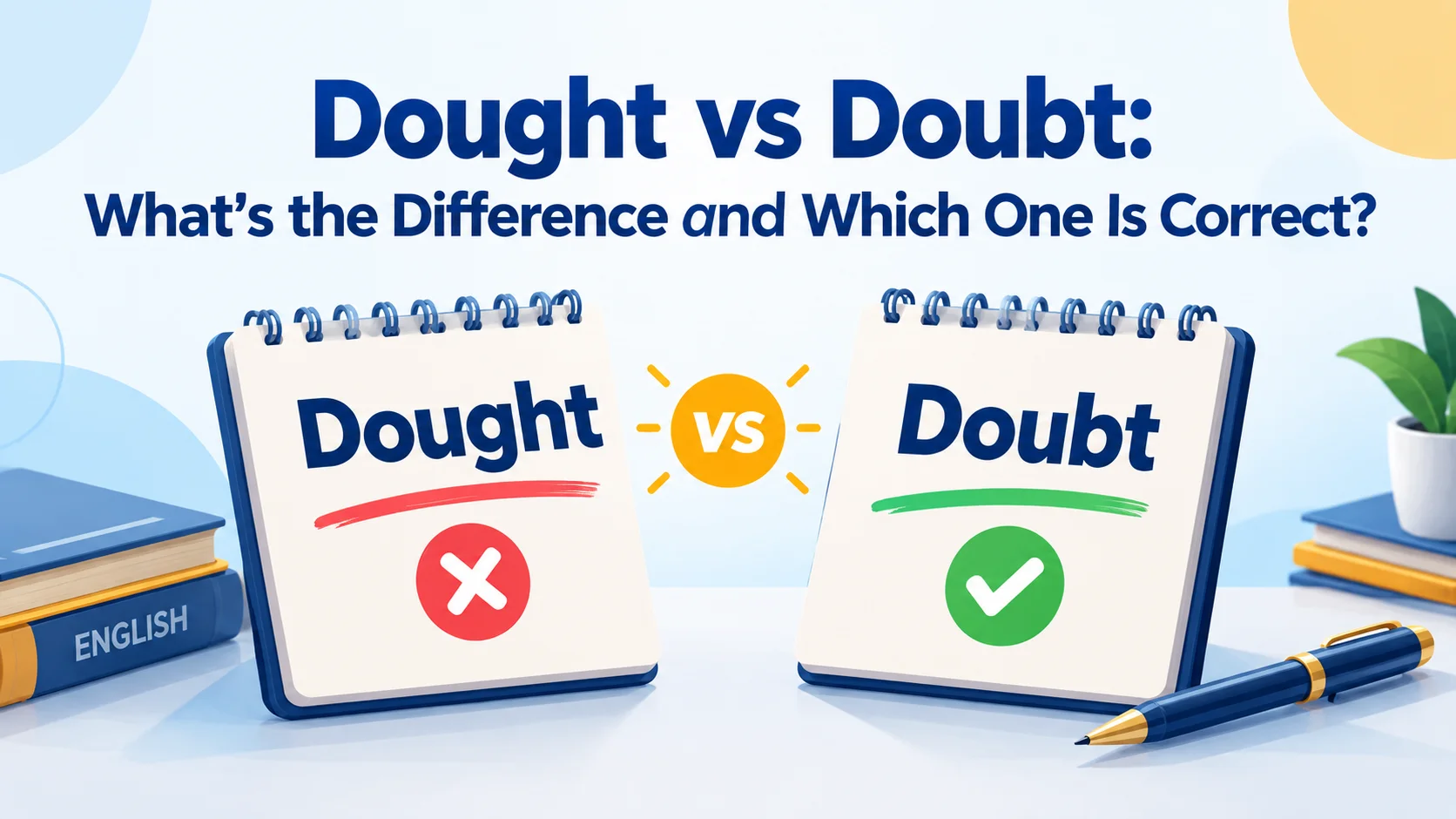
Dought vs doubt is a deceptively tricky spelling comparison because the two forms look closely related, yet they do not serve the same purpose in modern English. If you want to express uncertainty, hesitation, disbelief, or a lack of confidence, the correct modern word is doubt. The spelling doubt is not an alternative modern spelling of that word. It may appear in historical or dialectal English, but that is a separate matter.
The confusion is easy to understand. Doubt is pronounced /daʊt/, roughly like “dowt,” so the written b is completely silent. Someone spelling the word from its sound may naturally produce doubt or dought. English spelling is full of such traps, where pronunciation does not reveal every written letter. Learning the word as a complete spelling pattern is more reliable than trying to spell it phonetically.
There is also a worthwhile historical detail that many quick grammar articles overlook. Dought has genuine historical uses, including older forms connected with ability, worth, strength, or the dialectal verb dow. Historical Middle English sources record dought among forms of older vocabulary. That does not make it the right choice for a modern sentence such as “I dought his explanation.” In contemporary standard English, write “I doubt his explanation.”
Dought vs Doubt: The Quick Answer
If your sentence is about uncertainty or disbelief, use doubt.
Correct: I doubt that he will arrive on time.
Incorrect in modern standard English: I dought that he will arrive on time.
Doubt is a common modern English noun and verb. As a noun, it refers to uncertainty or lack of conviction. As a verb, it means to question whether something is true, likely, or reliable.
Dought, meanwhile, is not the modern spelling of doubt. Historical and dialect dictionaries record dought with other meanings and grammatical functions, particularly forms associated with the older verb down and with ideas such as ability, worth, power, or strength.
So the practical rule is simple:
Modern uncertainty = doubt.
If you encounter dought in an old poem, medieval text, historical dictionary, or regional source, do not automatically “correct” it. First examine the historical context.
Dought vs Doubt at a Glance
| Feature | Doubt | Dought |
| Modern standard usage | Common | Rare/archaic/dialectal |
| Main modern meaning | Uncertainty, disbelief, questioning | Not the modern word for uncertainty |
| Common part of speech | Noun and verb | Historical noun/verb/adjective forms |
| Pronunciation in modern usage | /daʊt/ | Historical forms vary; some dialectal uses rhyme with doubt |
| Appropriate for everyday writing? | Yes | Generally no |
| Example | I doubt the claim. | Historical/dialectal usage only |
| Best choice when meaning “uncertainty” | Doubt | Not dought |
The most important point is that doubt and doubt are not simply two modern spellings of the same word. Historical English is more complicated than modern English, and a spelling can be genuine in an older period without being appropriate in contemporary writing.
What Does “Doubt” Mean?
Doubt describes a lack of certainty about something. You may doubt whether a statement is true, whether a plan will succeed, whether someone is telling the truth, or whether a particular decision is correct.
It can be relatively mild:
I have some doubts about the schedule.
Or quite strong:
I doubt that the explanation is accurate.
The word can also describe a person’s lack of confidence in themselves:
She struggled with self-doubt before the presentation.
Dictionary definitions cover both uncertainty and questioning, and doubt can function as either a noun or a verb.
Doubt as a Noun
As a noun, doubt refers to the state or feeling of being uncertain.
Examples include:
- I have some doubts about the proposal.
- His answer left me with doubts.
- There is no doubt that the team prepared carefully.
- She had serious doubts about the decision.
The plural doubts is especially natural when referring to several concerns or reservations:
The investors expressed doubts about the company’s projections.
Doubt as a Verb
As a verb, doubt means to question something or consider it unlikely to be true.
For example:
- I doubt his story.
- We doubt the accuracy of those figures.
- She doubts whether the plan will work.
- They doubted that the project could be completed on time.
The verb can target a person, statement, prediction, explanation, result, or proposition.
A useful distinction is that doubt does not always mean total disbelief. Someone can doubt a claim while still considering it possible.
Is “Dought” a Real Word?
This is where a careful language article should avoid an overly simple answer.
Dought is a real historical English form, but it is not the modern standard spelling of “doubt.”
Historical dictionaries record dought in several contexts. The Concise Dictionary of Middle English lists dought under an older verb meaning roughly to get on well, be fitting, be worth, or avail, tracing it to Old English dugan. It also connects related vocabulary with doughty, an older adjective meaning brave or strong.
The Dictionary of the Older Scottish Tongue likewise records dought as a past-tense form associated with the Scottish verb dow, whose meanings included being of use, value, or worth.
Another modern dictionary-style reference records dought as a noun in Scotland and Northern England meaning power, strength, or ability, as well as a dialectal past form of dow.
“Dought” in Modern English
For ordinary modern writing, however, this historical information does not change the practical answer.
If you write:
I doubt his explanation.
A modern reader will almost certainly understand that you intended:
I doubt his explanation.
The first sentence does not communicate modern uncertainty correctly. The second does.
“Dought” in Historical or Dialectal English
If you are reading an older text and find doubt, the surrounding language matters.
It may relate to older vocabulary concerning ability, strength, worth, or usefulness, rather than uncertainty. Historical English had much less standardized spelling than modern English, and individual forms could differ considerably from today’s spelling.
This is why “Is doubt a word?” has two answers depending on what the question really means:
- Is it an attested historical English form? Yes.
- Can you use it as the modern spelling of doubt? No.
That distinction is more accurate than simply calling doubt “fake.”
Why Do People Write “Dought” Instead of “Doubt”?
The main reason is straightforward: English pronunciation does not always tell you how a word is spelled.
When people say doubt, the word sounds approximately like “dowt.” There is no audible /b/ sound. A writer who has primarily encountered the word through speech may therefore try to reconstruct the spelling from its pronunciation.
The Silent B Creates the Trap
The spelling is:
d-o-u-b-t
The pronunciation is approximately:
/daʊt/
The b is silent.
That creates a mismatch between what the eye sees and what the ear hears.
Someone who knows the sound but has not securely learned the spelling might produce:
- dout
- dought
- other phonetic approximations
Only doubt is the standard modern spelling for the meaning of uncertainty.
The “-ought” Pattern Looks Familiar
English contains many familiar words with -ought, including bought, thought, and brought. That spelling pattern may make doubt look plausible.
But visual similarity does not establish a word’s modern spelling.
In fact, doubt belongs to a different historical spelling family. Its written b was restored in French and English during the medieval period under the influence of the Latin form dubitare. English retained that letter even though it was not pronounced.
Typing Errors Make the Problem Worse
Fast typing can reinforce the mistake. If someone has heard doubt many times but rarely noticed its spelling, doubt can slip into a message without the writer consciously realizing that anything is wrong.
Spellcheck can catch many such errors, but it is better to recognize the underlying pattern:
Doubt = uncertainty + silent B.
Why Is the “B” Silent in “Doubt”?
The silent b is a historical spelling feature rather than a pronunciation rule you could logically predict from the modern word.
The history of doubt goes back through Middle English forms such as douten and Old French forms related to doter/douter, ultimately connected with Latin dubitare. The word originally carried senses associated with fear, uncertainty, hesitation, and wavering judgment.
The b was later restored in French and English spelling under the influence of Latin. English kept the letter even after it stopped representing a spoken consonant.
That gives us a useful lesson about English spelling:
Spelling can preserve history even when pronunciation has changed.
Similar Silent-B Words
English has several familiar words containing a written b that is not pronounced, including:
- debt
- subtle
- doubt
- thumb
These words should not be treated as one universal spelling rule. Their histories are different. The useful takeaway is simply that a silent letter can be part of a word’s established spelling.
How Do You Pronounce “Doubt”?
The standard pronunciation of doubt is /daʊt/.
For an English learner, an approximate pronunciation guide is:
dowt
It rhymes with words such as out and shout for speakers whose pronunciation has those vowel patterns.
The b is silent.
So do not pronounce doubt as though it were spelled doubt with a spoken /b/.
A Simple Pronunciation-and-Spelling Connection
Instead of trying to derive the spelling from the sound, learn the pair together:
doubt → /daʊt/ → silent b
That is more reliable than thinking:
“It sounds like dowt, so perhaps it should be spelled dought.”
English simply does not work that consistently.
Doubt as a Noun: How to Use It Naturally
The noun doubt appears in several common grammatical patterns.
“Doubt About”
Use doubt about when identifying the subject of uncertainty:
I have some doubts about the proposal.
She expressed doubt about the results.
“Doubt in”
This construction commonly appears when referring to confidence:
The setback created doubt in his mind.
It is also common in the expression self-doubt.
“No Doubt”
No doubt can express strong confidence:
There is no doubt that the policy changed the situation.
It can also be used more conversationally:
No doubt, they’ll arrive soon.
The exact tone depends on context and sentence structure.
“A Doubt” vs “Doubt”
English can use doubt with or without an article depending on what is being expressed.
Compare:
I have doubts about the proposal.
I have a doubt about one part of the proposal.
The second sentence identifies a particular reservation. The plural is also very common:
I have doubts about the plan.
Doubt as a Verb: Grammar Patterns That Matter
Doubt + Noun
This is one of the simplest structures:
I doubt his explanation.
They doubted the accuracy of the report.
The object is the person, claim, result, or thing being questioned.
Doubt + That-Clause
A that-clause can follow doubt:
I doubt that he will accept the offer.
We doubt that the figures are complete.
This construction is particularly useful when the uncertainty concerns an entire proposition.
Doubt Whether
Doubt whether is also standard:
I doubt whether the plan will succeed.
It explicitly frames the issue as uncertainty about whether something is true or will happen.
Doubt If
In informal modern English, doubt if also occurs:
I doubt if he’ll have enough time.
In more formal or carefully edited prose, whether can be preferable when the intended meaning is explicitly “whether or not.” The choice depends on register and context rather than a simple rule that one form is always grammatical and the other is always wrong.
Common Expressions With “Doubt”
Knowing common phrases is one of the easiest ways to reinforce the correct spelling.
Without a Doubt
Means certainly or with complete confidence.
She is, without a doubt, one of the strongest candidates.
Benefit of the Doubt
To give someone the benefit of the doubt means to choose to believe or trust them when the evidence is not conclusive.
I’ll give him the benefit of the doubt.
No Doubt
Can indicate certainty or strong expectation.
There is no doubt that the decision was difficult.
Beyond Doubt
Means something is considered certain or established.
The evidence placed his involvement beyond doubt.
In Doubt
Means uncertain, undecided, or questionable.
The project’s future remains in doubt.
Learning these expressions also helps prevent the spelling dought from feeling visually plausible.
✅Doubt vs Similar Words: Choosing the Precise Meaning
Doubt is related to several words, but they are not interchangeable in every context.
Doubt vs Uncertainty
Uncertainty is broader. It means a lack of certainty or knowledge.
Doubt often involves actively questioning something.
I have uncertainty about what will happen.
I doubt that the prediction is accurate.
Doubt vs Suspicion
Suspicion often suggests that you think something may be wrong, dishonest, or concealed.
I have doubts about the explanation.
I have a suspicion that something was deliberately hidden.
The second statement carries a stronger implication of possible wrongdoing.
Doubt vs Skepticism
Skepticism can describe a deliberate habit of questioning claims until there is adequate evidence.
Doubt can be much more personal or temporary:
Her skepticism made her examine the evidence carefully.
A single error caused her to doubt the result.
Doubt vs Disbelief
Disbelief generally indicates a stronger refusal or inability to accept something as true.
Doubt can occupy a middle position: you are not convinced, but you may not have rejected the claim entirely.
Dought vs Doubt: Common Mistakes to Avoid
Writing “Dought” Because It Sounds Right
Incorrect:
I dought the story is true.
Correct:
I doubt the story is true.
The sound does not contain the /b/, but the spelling does.
Pronouncing the B
Avoid turning doubt into a two-syllable or fully consonantal form. The normal pronunciation has a silent b:
doubt = /daʊt/
Assuming “Dought” Is Simply an Old Spelling of “Doubt”
This is where historical nuance matters.
Historical sources contain forms that look like dought, but documented dought also belongs to older vocabulary associated with ability, worth, strength, and dow.
So it is safer to say that dought is an historical/dialectal form with its own history, not simply “the old spelling of doubt.”
Confusing “Dought” With “Doughty”
Doughty is a separate word with a long literary history. It means brave, determined, or hardy, and it is related to the older vocabulary behind dought.
For example:
The doughty defender refused to retreat.
That does not mean dought is an alternative spelling of doubt.
Dought vs Doubt in Real Sentences
Correct Modern Examples With “Doubt”
Everyday conversation:
I doubt it will rain today.
Professional writing:
We doubt that the current figures provide a complete picture.
Academic writing:
The researchers expressed doubt about the reliability of the earlier results.
Personal context:
She began to question her decision because of self-doubt.
Fixed expression:
There is no doubt that the project required careful planning.
Incorrect Modern Uses of “Dought”
If the intended meaning is uncertainty, these should be corrected:
❌ I dought his explanation.
✅ I doubt his explanation.
❌ There is no dought about the result.
✅ There is no doubt about the result.
❌ She began to dought the evidence.
✅ She began to doubt the evidence.
Historical Uses of “Dought”
A historical text is different.
If an older source contains dought, don’t automatically replace it with doubt. Historical English contains forms that have disappeared from standard modern English, and doughty is documented in older vocabulary related to dugan/dow and doughty.
The surrounding sentence, date, dialect, and source determine what the writer meant.
How “Doubt” Changes Meaning Depending on Context
The same word can express different shades of uncertainty.
Doubting a Person
I doubt his honesty.
This questions a person’s reliability or truthfulness.
Doubting a Fact
Scientists should not doubt the evidence without examining it carefully.
Here, doubt concerns whether information is reliable or established.
Doubting a Decision
She began to doubt her decision.
This concerns confidence in a choice rather than necessarily questioning a factual claim.
Self-Doubt
Self-doubt means uncertainty about your own abilities, decisions, judgment, or worth.
He experienced self-doubt before giving the presentation.
This is a particularly common compound and reinforces why the spelling doubt matters beyond simple dictionary exercises.
Regional and Formal Usage of “Doubt”
There is no major modern English regional spelling in which dought replaces doubt for ordinary uncertainty.
Doubt is standard in both American and British English.
What can vary is the preferred wording around it. Formal writing may favor constructions such as:
There is considerable doubt regarding the validity of the conclusion.
Conversational English might simply say:
I’m not sure about that.
Both can communicate uncertainty, but the register differs.
Historical dought, by contrast, belongs to older or regional varieties rather than serving as an ordinary modern alternative. The Dictionary of the Older Scottish Tongue documents dought among historical forms of dow, especially in Scottish usage.
How to Remember the Correct Spelling of “Doubt”
Remember the Silent B
Use this simple association:
Doubt = uncertainty + silent B
You do not need to pronounce the b to remember that it belongs in the spelling.
Connect It With “Debt”
Both doubt and debt contain a written b that is not pronounced.
This is only a memory aid, not an indication that the two words have the same history.
Learn the Word in Phrases
Instead of memorizing doubt as an isolated spelling, learn familiar expressions:
- without a doubt
- no doubt
- benefit of the doubt
- beyond doubt
- in doubt
- self-doubt
Once these phrases become familiar, the silent b becomes much easier to remember.
Why Correct Spelling of “Doubt” Matters
A single spelling mistake rarely destroys the meaning of a sentence. A reader can usually infer what dought was supposed to mean.
The problem is that repeated errors can make writing look less carefully edited.
Clarity in Professional Writing
In an email, proposal, report, or application, doubt is the established form. Using dought can distract the reader because it looks like either a typo or an unfamiliar historical word.
Accuracy in Academic Writing
Academic writing depends heavily on precise vocabulary. If a student writes dought repeatedly when they mean doubt, the issue is not merely cosmetic: it signals that the writer has not yet mastered the spelling of a common word.
Credibility and Reader Trust
A single typo is normal. Everyone makes them.
But there is a difference between an isolated typing slip and repeatedly choosing a nonstandard spelling. In edited writing, using doubt correctly removes unnecessary friction for the reader.
Quick Decision Guide: Dought or Doubt?
Use this test before you type the word.
| What do you mean? | Correct choice | Example |
| You are uncertain | doubt | I doubt the claim. |
| You question whether something is true | doubt | She doubts his explanation. |
| You lack confidence in a decision | doubt | He has doubts about the plan. |
| You are reading an old text containing “dought” | dought may be historical | Check the surrounding context |
| You want to write modern standard English | doubt | There is no doubt about it. |
| You mean an old form related to ability or worth | dought may occur historically | Interpret according to the source |
A Three-Second Spelling Check
Ask yourself:
- Do I mean uncertainty?
- If yes, am I writing “doubt”?
- Have I remembered the silent B?
If the answer to the first question is yes, your modern spelling is doubtful.
Conclusion
Understanding dought vs doubt comes down to separating a modern English word from a historical one. Doubt is the correct and standard spelling when you mean uncertainty, hesitation, or a lack of confidence in something. Doubt, meanwhile, appears in older forms of English and historical or dialectal usage, with meanings connected to ability, worth, usefulness, or strength. That distinction matters when reading older texts because “dought” should not automatically be treated as a misspelling of “doubt.”One final actionable tip: if you are writing modern English, choose doubt whenever you mean uncertainty or disbelief. A common mistake to avoid is assuming that every unfamiliar historical spelling is simply an error. Checking the surrounding sentence, time period, and intended meaning can reveal why an older form was used. When in doubt, modern standard English favors doubt.
FAQs
Q1. Is “dought” the correct spelling of “doubt”?
No, not when you mean uncertainty, disbelief, or hesitation in modern English. The standard spelling is doubt. Historical sources do record dought as an older or dialectal form with different meanings, but that does not make it a modern spelling alternative for doubt.
Q2. Is “dought” ever a real English word?
Yes, but only in historical or dialectal contexts. Older sources record dought in connection with words expressing ability, worth, strength, or usefulness. It may also occur as an old grammatical form. Modern writers should not use it to mean uncertainty.
Q3. Why is the B silent in “doubt”?
The written b reflects the word’s historical development. Doubt entered English through French forms ultimately related to Latin dubitare. The b was restored under Latin influence even though English pronunciation did not retain the consonant.
Q4. How do you pronounce “doubt”?
Doubt is pronounced /daʊt/, approximately “dowt.” The b is silent, so you should not pronounce it as a separate /b/ sound. The word rhymes without for speakers whose pronunciation uses the same vowel pattern.
Q5. What is the difference between “doubt,” “uncertainty,” and “suspicion”?
Uncertainty is the broad condition of not being sure. Doubt often involves actively questioning a claim, decision, or possibility. Suspicion can imply that you think something is wrong, dishonest, or concealed. The three overlap, but their implications are not identical.