

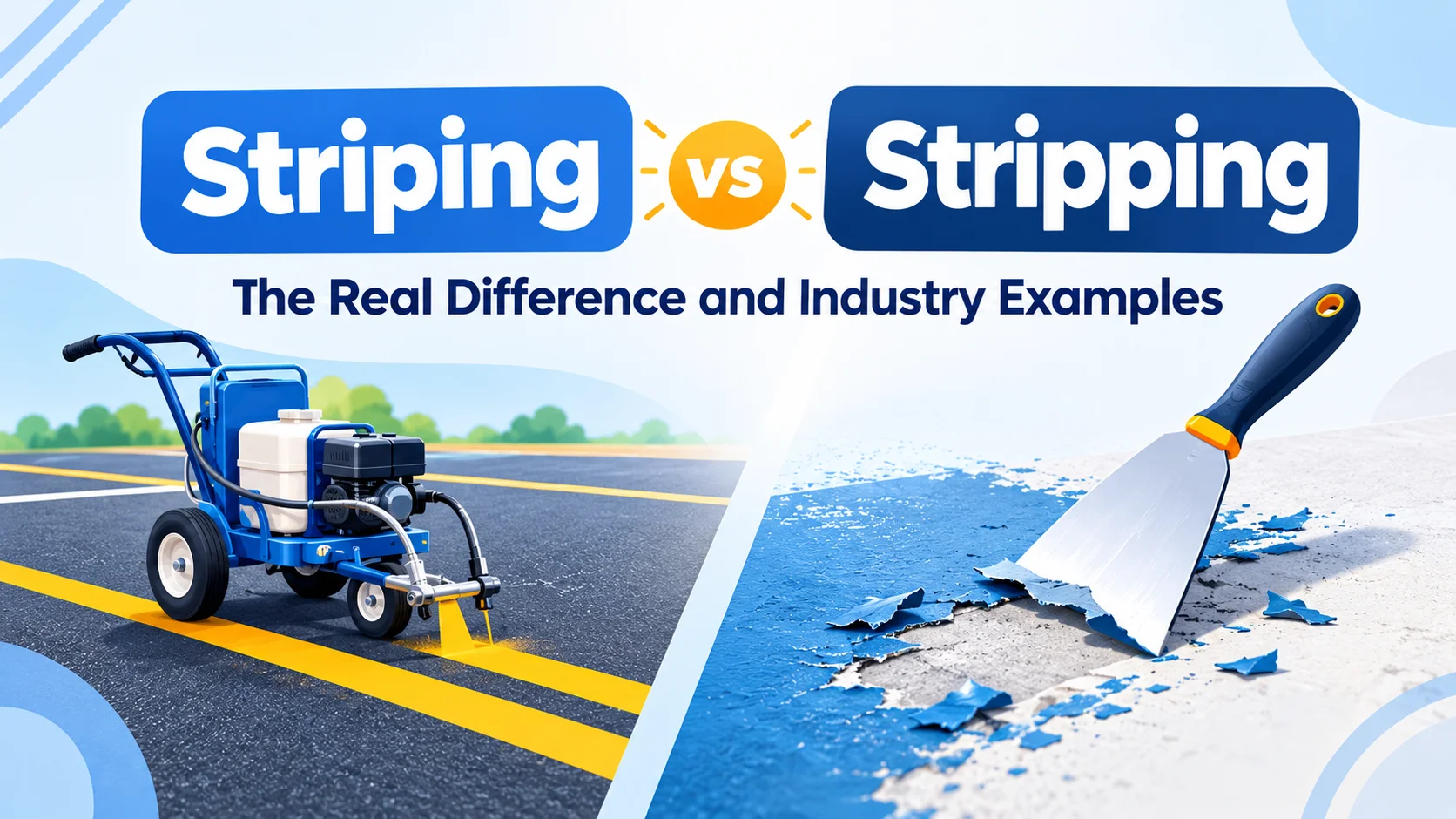
Striping and stripping differ by only one letter, but they describe two very different actions. If you are talking about painting parking spaces, marking road lanes, or adding lines to an athletic field, striping is usually the word you need. If you mean removing paint, insulation, a floor finish, or unwanted material, stripping is generally correct.
The confusion comes from the fact that both words are built around strips, and their spellings look almost identical. Yet they come from different base verbs: stripe → striping and strip → stripping. That small spelling difference carries a major difference in meaning. In professional settings, using the wrong form can make an instruction unclear or even describe the opposite process.
This guide explains the difference from both a grammar and industry perspective. You will learn how the words are formed, why stripping has two p’s while striping has one, and how the terms are used in roadwork, parking lots, construction, electrical work, flooring, manufacturing, sports facilities, and technology. By the end, the simple rule is easy to remember: striping puts markings on; stripping takes something away.
Striping vs Stripping: The Quick Answer
The fastest way to distinguish the two is to identify what is happening to the object.
- Striping means adding, creating, or marking with stripes or lines.
- Stripping means removing something, especially a covering, coating, layer, or unwanted material.
Consider these two sentences:
- The contractor is striping the parking lot.
- The contractor is adding or refreshing the lines that define parking spaces.
- The contractor is stripping the old coating from the floor.
- The contractor is removing an existing layer.
The difference is therefore not simply a matter of spelling. The words describe different actions.
Striping vs Stripping at a Glance
| Feature | Striping | Stripping |
| Base verb | stripe | strip |
| Main idea | Add or create stripes/markings | Remove something |
| Spelling | striping | stripping |
| Common contexts | Roads, parking lots, fields, warehouses | Paint, floors, wires, coatings, data |
| Typical question | “What are we marking?” | “What are we removing?” |
| Example | They are striping the parking lot. | They are stripping the old finish. |
The simplest memory trick
Think of the two words as opposites in many practical situations:
Striping = stripes go on.
Stripping = something comes off.
That rule will not explain every specialized meaning of strip or stripe, but it is an excellent working test for the everyday and industry uses covered here.
What Does “Striping” Mean?
Striping is the act of marking, decorating, or otherwise providing something with stripes or lines. The underlying verb is stripe, which means to mark something with a stripe or stripes.
The term can describe a visual pattern, such as stripes on fabric, but it also has important functional meanings. In transportation and facility maintenance, striping often refers to applying lines and markings that organize space or communicate information.
That is why a road crew can talk about lane striping, a property manager can discuss parking lot striping, and a sports-facility manager can refer to field striping.
Striping as Adding Lines or Markings
In practical contexts, striping can define:
- Traffic lanes
- Parking spaces
- Pedestrian crossings
- Warehouse aisles
- Restricted areas
- Athletic boundaries
- Directional paths
- Safety zones
The markings do more than make a surface look neat. They can organize movement, separate areas, identify boundaries, and communicate information.
For example:
The maintenance team completed the parking lot striping before the facility reopened.
Here, striping refers to the lines and markings being applied or refreshed.
Striping as a General Visual Pattern
The word is not limited to pavement.
You might also encounter:
- Decorative striping on vehicles
- Color striping on manufactured products
- Stripe patterns in textiles
- Striping in graphics or design
- Natural striping in animals
In these contexts, the central idea remains the same: a stripe or striped pattern is being created, displayed, or described.
What Does “Stripping” Mean?
Stripping is the -ing form of strip. The verb strip commonly means to remove a covering, outer layer, material, or other element from something.
For example:
The workers are stripping the old paint from the surface.
The paint is being removed.
The word also has broader figurative and technical uses. You can strip information from a document, strip unnecessary formatting from data, or strip equipment down for inspection or repair.
The common thread is removal.
Stripping Paint, Coatings, or Finishes
In renovation and maintenance, paint stripping means removing existing paint or another coating so the underlying surface can be treated, repaired, or refinished.
The exact removal method depends on the material and application, but the linguistic point is straightforward: the old layer is coming off, so the process is stripping.
Stripping Wires
Wire stripping refers to removing insulation or another covering from an electrical wire.
That is why a wire stripper is associated with stripping, not striping. The tool is used for a removal process.
Compare:
- Wire stripping → removing insulation
- Wire striping → a different expression that would normally suggest applying stripes or markings
In an electrical context, the intended meaning is usually obvious to professionals because stripping is established technical terminology.
Stripping Floors
Floor stripping is another established maintenance term. It generally involves removing an existing floor finish, sealer, coating, or accumulated buildup before a new finish or treatment is applied.
This creates a useful real-world contrast:
The crew is stripping the old floor finish.
Later:
The crew is striping the warehouse floor.
The first action removes a layer. The second creates markings.
Stripping in Technology and Data
The removal idea also appears in computing and data processing.
For example, software may strip formatting, remove unwanted characters, or strip metadata from information.
Here, no physical coating is involved. The concept is still removed: something unnecessary or unwanted is being taken out of the original material.
This is a useful reminder that stripping does not always mean physically scraping something from a surface.
Why Are “Striping” and “Stripping” Spelled Differently?
The spelling becomes much easier when you stop treating striping and stripping as two versions of the same word.
They come from different base verbs:
- stripe + -ing → striping
- strip + -ing → stripping
The difference in spelling follows ordinary English word-formation patterns.
Stripe + -ing = Striping
The verb stripe ends in a silent e. When -ing is added, the final e is normally dropped:
stripe → striping
The pronunciation also reflects the difference:
- stripe → /straɪp/
- striping → /ˈstraɪ.pɪŋ/
The vowel sound remains the long i sound associated with stripe.
This is the same broad spelling pattern seen in forms such as:
- make → making
- write → writing
- drive → driving
Strip + -ing = Stripping
Strip is a different word. It does not have a final silent e to remove.
Instead, its final consonant is doubled before -ing:
strip → stripping
This preserves the short vowel sound:
- strip → /strɪp/
- stripping → /ˈstrɪp.ɪŋ/
The double p is therefore not decorative. It is part of the standard spelling of the inflected form.
Compare:
| Base verb | -ing form | Meaning |
| stripe | striping | Adding stripes/markings |
| strip | stripping | Removing something |
| type | typing | Writing with a keyboard |
| shop | shopping | Buying goods |
| write | writing | Producing written material |
The crucial lesson is that striping and stripping are formed from different verbs.
Striping vs Stripping: Grammar and Word Formation
Both words can function as present participles and gerunds.
Striping Is the -ing Form of “Stripe”
Examples:
- The crew is striping the highway.
- Parking-lot striping needs to be refreshed.
- The contractor finished striping the warehouse floor.
In the first sentence, striping is part of the progressive verb phrase. In the second, it functions as a noun describing the activity.
Stripping Is the -ing Form of “Strip”
Examples:
- The crew is stripping the old coating.
- Paint stripping can be part of a renovation project.
- The technician is stripping the wire insulation.
Again, the grammatical form is similar, but the underlying verb—and therefore the meaning—is different.
Striped vs Stripped
The past forms make the distinction especially obvious.
Striped generally means marked with stripes:
The vehicle has a blue-and-white striped design.
Stripped generally means that something has been removed:
The old paint was stripped from the surface.
So:
- striped → marked with stripes
- stripped → deprived of or cleared of something
Confusing these forms can produce a sentence that means something very different from what you intended.
Striping vs Stripping in Real-World Industries
The most useful way to understand the difference is to see how professionals actually use the terms.
Construction and Roadwork
Roadwork is one of the clearest examples of striping as a technical term.
Transportation agencies use striping for pavement markings such as center lines, lane lines, edge lines, and other roadway markings. The Federal Highway Administration discusses pavement marking installation and restriping as part of roadway maintenance and design.
A project might therefore involve:
The contractor will restripe the roadway after resurfacing.
That means the existing roadway markings are being restored or replaced.
The word stripping would mean something else, such as removing a coating or material from a surface.
Parking Lots and Pavement Maintenance
Parking lot striping identifies spaces and organizes traffic within a parking area.
A property manager might say:
The parking lot needs new striping.
That does not mean the parking lot needs material removed. It means the existing lines need to be repainted or refreshed.
This distinction becomes particularly useful when discussing renovation:
- An old surface or coating may be stripped.
- The surface can then be prepared for the next stage.
- New parking markings can be striped.
The same project can therefore involve both words without either being interchangeable.
Electrical Work
Electrical work strongly favors stripping when the task involves removing insulation from wire.
For example:
The technician is stripping the insulation before making the connection.
Calling this wire striping would normally be a terminology error because the process is about removing a covering, not adding a stripe.
The practical rule is simple: when the object being discussed is insulation and the action is removal, stripping is the natural term.
Flooring and Building Maintenance
Flooring provides another excellent contrast.
Floor stripping involves removing an old finish, sealer, or buildup from a floor. Commercial floor-care products are explicitly described for stripping old finishes and coatings.
By contrast, floor striping can refer to adding lines or markings to a floor, particularly in warehouses, facilities, garages, or other spaces where marked zones are useful.
For example:
The old finish is being stripped from the floor.
versus:
The warehouse aisles are being striped for clearer organization.
Warehousing and Manufacturing
Industrial facilities frequently use floor markings to organize movement and work areas.
Striping may identify:
- Walkways
- Storage zones
- Equipment areas
- Traffic paths
- Boundaries
- Restricted spaces
If an old coating must be removed, that is a stripping operation instead.
The distinction matters because an instruction such as “strip the floor” can suggest removal, while “stripe the floor” suggests applying markings.
Sports and Athletic Facilities
Sports fields and courts provide another straightforward use of striping.
Field striping can establish:
- Boundaries
- Playing zones
- Yard lines
- Boxes or other marked areas
Here, the lines are being created, so striping is appropriate.
If an organization removes old paint before repainting a field, the removal process could be described as stripping, depending on the material and method.
Automotive and Industrial Work
In automotive and industrial settings, stripping often describes removing paint, coatings, components, or other material.
For example:
The old coating was stripped before the surface was refinished.
Meanwhile, striping can describe decorative or identifying stripes applied to a vehicle or product.
The distinction remains consistent even though the industries change: one creates a stripe; the other removes something.
Technology and Data Processing
Technology demonstrates why the core meaning should be learned rather than memorized through physical examples.
A program can strip unwanted characters, formatting, or other information from data. The process is still removed, even though no physical surface exists.
This is why a broad definition such as “stripping means taking off paint” is too narrow. The more useful definition is:
Stripping means removing something from something else, physically or conceptually.
Striping vs Stripping: Real Sentence Examples
Examples Using “Striping”
- The crew is striping the newly paved road.
- The parking lot needs fresh striping.
- Workers finished striping the warehouse floor.
- The athletic field is being stripped before the season begins.
- The vehicle has decorative striping along its sides.
Examples Using “Stripping”
- The contractor is stripping the old paint.
- The technician is stripping the insulation from the wire.
- The maintenance team is stripping the old floor finish.
- The software strips unnecessary formatting from the text.
- The machine was stripped down for inspection.
Side-by-Side Examples
| Situation | Correct wording | Why |
| Adding parking lines | striping the parking lot | Lines are being added or refreshed |
| Removing old paint | stripping the paint | Paint is being removed |
| Adding field markings | striping the field | Markings are being created |
| Removing floor finish | stripping the floor | Existing finish is being removed |
| Removing wire insulation | stripping the wire | Insulation is being removed |
| Adding decorative vehicle lines | striping the vehicle | Stripes are being applied |
Striping and Stripping Can Appear in the Same Project
One of the easiest ways to understand the distinction is to imagine a renovation project from beginning to end.
Suppose an aging commercial facility needs its floor updated.
First, the existing finish may be stripped. That removes the old layer.
The surface is then prepared for whatever new treatment is appropriate.
Finally, workers may stripe the floor to create new aisle boundaries or other markings.
The same project can therefore contain both actions:
Strip the old surface. Stripe the finished floor.
That sentence is useful because it reduces the distinction to two opposing actions: remove first, mark later.
Why Context Matters
Words should not be selected from spelling alone. Look at the verb’s object.
If the object is:
- paint
- insulation
- finish
- coating
- formatting
- unwanted information
then stripping may be appropriate because something is being removed.
If the object is:
- a road
- parking lot
- field
- warehouse floor
- vehicle
- surface
and the activity involves applying lines or stripes, striping is likely the intended term.
Context gives you the answer faster than memorizing isolated definitions.
Common Mistakes With Striping and Stripping
Using “Striping” When You Mean Removing Something
Incorrect:
The contractor is striping the old paint.
Better:
The contractor is stripping the old paint.
The first sentence suggests that stripes are being applied to the paint. The second clearly communicates removal.
Using “Stripping” When You Mean Adding Markings
Incorrect:
The crew is stripping the parking spaces.
Better:
The crew is striping the parking spaces.
If the workers are creating or refreshing the painted parking lines, striping is the appropriate term.
Confusing “Striped” and “Stripped”
Compare:
- The floor was striped with yellow safety lines.
- The floor received stripes.
- The floor was stripped of its old finish.
The finish was removed.
One letter changes the action and the meaning.
Assuming the Double “P” Is Optional
It is not.
For the verb strip:
strip → stripped → stripping
For the verb stripe:
stripe → striped → striping
Writing striping when you mean the removal process is not simply a minor spelling variation. It changes the underlying verb.
Are Striping and Stripping Ever Interchangeable?
In standard usage, no. They should not normally be treated as interchangeable forms.
There are specialized meanings of strip and stripe, and some technical fields may use related terminology in ways that require context. But the basic verbs remain distinct.
If you are unsure, identify the action:
Is something being marked with stripes?
Use stripe/striping.
Is something being removed?
Use strip/stripping.
This approach is more reliable than deciding based on which spelling “looks right.”
How to Choose the Right Word
Use “Striping” When You Are Adding or Creating Stripes
Look for words connected with:
- lines
- lanes
- markings
- spaces
- boundaries
- patterns
- decorative stripes
Example:
The city is striping the newly resurfaced road.
Use “Stripping” When Something Is Being Removed
Look for words connected with:
- paint
- coatings
- finishes
- insulation
- formatting
- unwanted material
- coverings
Example:
The contractor is stripping the damaged coating from the surface.
The One-Question Test
When you hesitate between the two, ask:
Am I putting stripes or markings on something, or am I taking something off it?
If you are putting markings on it, choose striping.
If you are taking something away, choose stripping.
That single question resolves most everyday usage problems.
Striping vs Stripping: Quick Reference Guide
| If you mean… | Use | Example |
| Adding road markings | striping | Road striping was completed overnight. |
| Repainting parking spaces | striping | The lot needs new striping. |
| Marking a sports field | striping | The field is being striped. |
| Applying decorative lines | striping | The car received new striping. |
| Removing paint | stripping | The surface needs paint stripping. |
| Removing floor finish | stripping | The floor requires stripping. |
| Removing wire insulation | stripping | Wire stripping is part of the preparation. |
| Removing unwanted data | stripping | The program strips unnecessary formatting. |
Conclusion:
The difference between striping vs stripping becomes much easier once you connect each word to its base verb. Striping comes from stripe and describes adding, creating, or marking with stripes or lines. Stripping comes from strip and describes removing a covering, coating, material, information, or other element. That distinction holds across roadwork, parking lots, flooring, electrical work, manufacturing, sports facilities, and technology.One final actionable tip: whenever the spelling feels uncertain, ignore the extra letter for a moment and identify the action. Are you creating a stripe, or removing something? A common mistake to avoid is treating striping and stripping as alternative spellings of one word. They are forms of different verbs. Once you remember “striping puts markings on; stripping takes something off,” the correct choice becomes almost automatic.
FAQs
Q1. Is “striping” the same as “stripping”?
No. Striping comes from stripe and generally means adding or creating stripes or markings. Stripping comes from strip and generally means removing something. They are different words with different base verbs, meanings, spellings, and common professional uses.
Q2. Why does “stripping” have two Ps but “striping” has one?
The difference comes from their base forms. Stripping is formed from strip + -ing, while striping comes from stripe + -ing. The silent e in stripe is dropped, whereas the final consonant in strip is doubled.
Q3. Is “striping” a real word?
Yes. Striping is the standard -ing form of stripe. It is common in both general and professional language, including road striping, parking-lot striping, field striping, and decorative striping. It can describe either the activity of adding stripes or the resulting striped pattern.
Q4. What is the difference between “striped” and “stripped”?
Striped generally means that something has been marked or decorated with stripes. Stripped generally means that something has had a covering, layer, material, or other element removed. For example, a striped floor has lines; a stripped floor has had something removed.
Q5. Is it “striping” or “stripping” a parking lot?
If you mean painting or refreshing parking-space lines, the correct term is striping. If you mean removing a coating or other material from the surface, stripping may be appropriate. The correct choice depends on whether the action involves adding markings or removing material.