

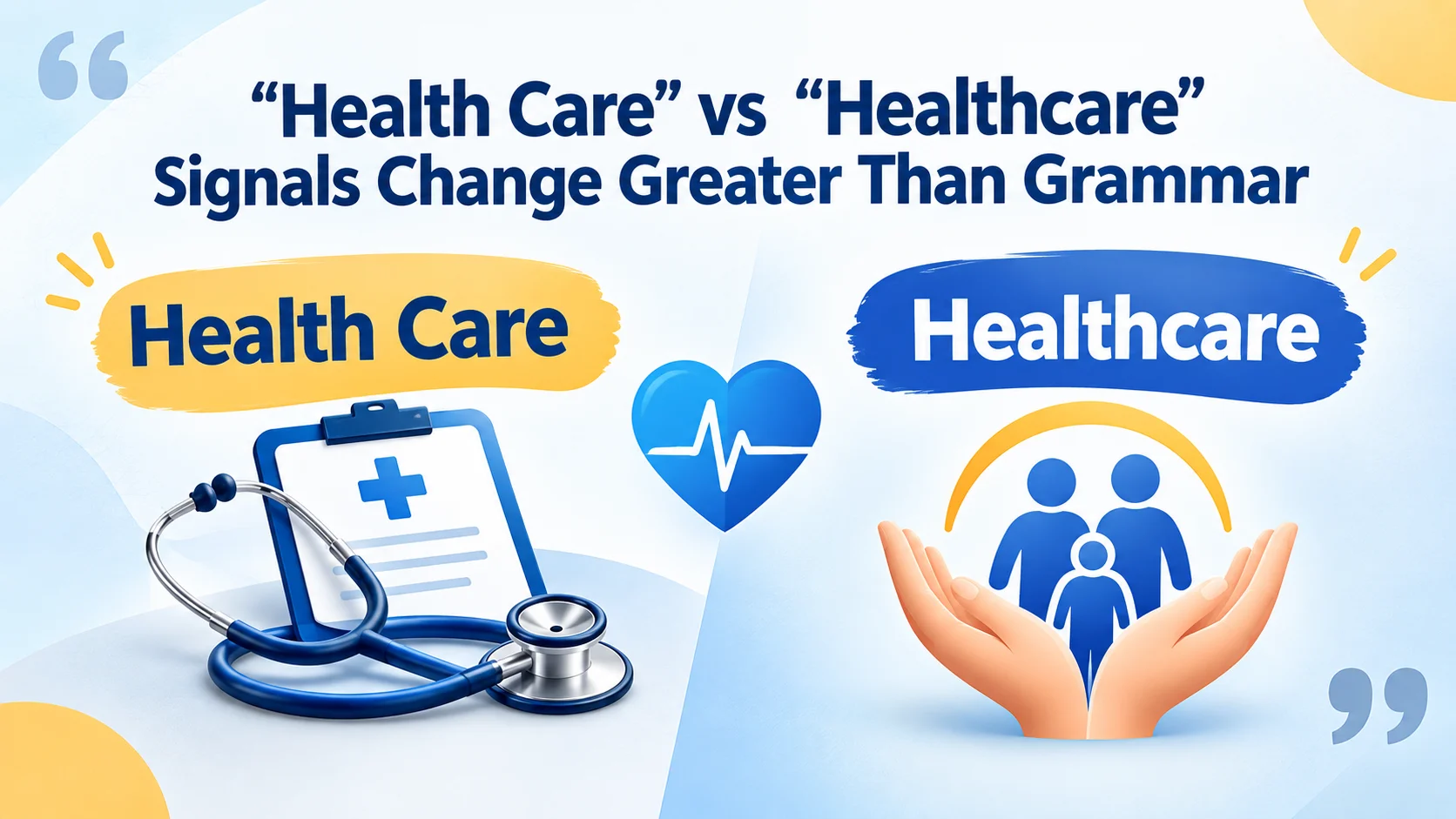
“Health care” vs. “healthcare” looks like a tiny spelling question, but the space between the words has become a surprisingly revealing marker of language change, professional convention, and institutional identity. Both forms are established in modern English, and major dictionaries recognize the same basic meaning. Yet in 2026, the choice is more interesting than a simple right-or-wrong grammar rule. The Associated Press Stylebook now recommends “healthcare” as one word, while some respected publications and government institutions continue using “health care.”
For ordinary readers, the practical question is straightforward: Which spelling should you use? The answer depends less on meaning than many people expect. Your choice can be shaped by a style guide, organization, publication, official name, regional convention, or the kind of writing you are producing. A medical journalist, government writer, university editor, and healthcare marketer can all make different choices without necessarily making a grammatical error. Understanding that distinction prevents unnecessary corrections and makes professional writing more consistent.
There is also a larger linguistic story here. Healthcare did not suddenly become a word because someone decided to remove a space. English regularly turns frequently used combinations into closed compounds, while older forms can remain perfectly understandable and legitimate. The history of health care goes back at least to the early 20th century, and both open and closed forms have coexisted for decades. This guide explains what each form means, why the spelling is changing, how major style authorities differ, when each form makes sense, what writers should do in professional and SEO content, and what the debate tells us about language itself.
What Is the Difference Between “Health Care” and “Healthcare”?
At the most basic level, “health care” and “healthcare refer to the same broad field or activity: providing services that maintain, improve, monitor, or restore people’s health.
Cambridge defines health care as services involving the care of people’s health and the treatment of illness, while its separate healthcare entry identifies it as the activity or business of providing medical services. Both entries explicitly recognize the other spelling. Oxford likewise lists healthcare, with health care as an alternative.
So the first important rule is simple:
The spelling difference does not create a universal difference in dictionary meaning.
The interesting differences emerge in usage and context.
“Health Care” as a Two-Word Expression
The traditional open form treats health and care as separate words working together as a noun phrase.
Consider:
- access to health care
- affordable health care
- receive health care
- improve health care
- barriers to health care
- quality of health care
This construction is especially easy to understand because its components remain visually separate. A reader can immediately see the underlying idea: care related to health.
The two-word form also remains strongly established in some editorial and institutional environments. For example, the National Institutes of Health’s style guidance says to use “health care” in accordance with AP style and specifically notes exceptions for official names such as the Agency for Healthcare Research and Quality.
“Healthcare” as a Closed Compound
Healthcare treats the combination as a single lexical unit.
It commonly appears in expressions such as:
- healthcare provider
- healthcare system
- healthcare professional
- healthcare industry
- healthcare technology
- healthcare organization
- healthcare workforce
This form is especially prominent in professional, commercial, institutional, and industry language.
The American Heritage Dictionary, for example, recognizes healthcare and defines it in terms of preventing, treating, and managing illness and preserving physical and mental well-being.
Are “Health Care” and “Healthcare” Different in Meaning?
Usually, no—not in the strict dictionary sense.
That point matters because writers sometimes create an artificial rule such as:
“Health care means the actual treatment of patients, while healthcare means the industry.”
That distinction can describe a particular organization’s preferred usage, but it is not a universal rule of English.
In real writing, healthcare can refer to services, providers, systems, or the broader sector, while health care can do the same. Cambridge’s examples demonstrate this overlap by using both forms for concepts such as affordable services, healthcare systems, workers, costs, and reform.
The more accurate distinction is:
Meaning overlaps; usage conventions differ.
Why Did “Health Care” Become “Healthcare”?
The movement from an open phrase to a closed compound is part of a broader pattern in English.
From Phrase to Compound
English frequently combines words that are repeatedly used together.
A familiar progression can look like:
two words → hyphenated form → one word
Not every compound follows this exact path, and the process can take decades or remain unsettled. But English has many examples of formerly separate combinations becoming established compounds.
The history of health-care itself illustrates that the expression is not a recent invention. Etymonline dates health-care to 1915, recording healthcare as an alternative form from the same period.
That means today’s debate is not about an entirely new word. It is about which established spelling should receive preference.
The Influence of Professional Language
A particularly important factor is institutional usage.
Words are not standardized only by dictionaries. They are also shaped by:
- hospitals
- medical organizations
- insurers
- universities
- government agencies
- journalists
- technology companies
- professional associations
- publishers
- marketing departments
Once a large sector consistently uses one form, that form becomes increasingly familiar.
This helps explain why healthcare has become so visible in professional terminology. It appears naturally in expressions describing an entire industry, system, workforce, or technology sector.
Is “Healthcare” a Modern Replacement for “Health Care”?
Not exactly.
It is better to describe the situation as coexisting conventions during a period of language change.
The 2026 AP change is an important milestone because AP had historically favored health care and now recommends healthcare as one word in all uses. AP announced the change in April 2026 and described it as a decision resulting from evolving language and common usage.
But AP’s decision does not instantly make every other style guide obsolete.
That is precisely what makes this topic more interesting than a basic spelling correction.
Why the 2026 AP Style Change Matters
If you have encountered older writing advice saying “health care is always two words in AP style,” it is now outdated.
The Associated Press announced in April 2026 that its style recommendation had changed to “healthcare” as one word. The 58th edition of the AP Stylebook, released in May 2026, includes healthcare among its language updates.
The AP itself later confirmed in September 2026 that the current guidance remains “Healthcare, as of April 2026.”
This is significant for writers because AP style influences a huge amount of journalism, communications, public relations, and institutional content.
But AP Is Not the Only Authority
A style guide is a convention-setting authority, not a universal grammar court.
Consider the contrast:
| Authority or publication | Current approach |
| Associated Press Stylebook | healthcare |
| Oxford Advanced Learner’s Dictionary | healthcare, also health care |
| Cambridge Dictionary | healthcare and health care |
| Johns Hopkins editorial style | healthcare |
| NIH style guidance | health care, with named exceptions |
| STAT | health care |
| Chicago Manual of Style guidance | Follows dictionary preference; recognizes health care and healthcare as variants |
These differences are not necessarily contradictions. They show that English usage can accommodate multiple editorial standards at the same time.
When Should You Use “Health Care” vs. “Healthcare”?
There is no single sentence-level rule that solves every case. The most reliable approach is to consider context first and style second.
Use “Healthcare” When Your Style Guide Requires It
If you are writing according to the current AP Stylebook, the answer is straightforward:
Use healthcare.
Johns Hopkins has also adopted healthcare as one word in all instances except where an official proper name uses two words.
This is a good example of why writers should check the style guide before relying on remembered grammar rules.
Use “Health Care” When Your Institution Requires It
If your organization follows a guide that specifies health care, use that form.
For example, NIH’s current style guidance tells writers to use health care and notes that official names can preserve a different form.
That means this:
The organization provides health care services.
may be completely correct within one institution, while:
The organization provides healthcare services.
may be the preferred version elsewhere.
Neither sentence needs to be “corrected” without knowing the relevant editorial standard.
Preserve Official Names
This is one of the most important practical rules.
If an organization, program, law, department, or institution officially uses a particular spelling, do not silently change it to match your preferred style.
For example, NIH specifically notes that the Agency for Healthcare Research and Quality retains Healthcare in its official name even though NIH’s general style uses health care.
The same principle applies to:
- organization names
- branded services
- program names
- official titles
- quoted material
- legal names
Official terminology is not something an editor should casually “fix.”
“Health Care” vs. “Healthcare” in Real-World Writing
The surrounding context often gives you a clue about which form a reader will expect.
In Journalism
Journalistic writing is particularly sensitive to style-guide changes.
For years, AP style favored health care. In 2026, AP moved to healthcare. But not every publication followed.
STAT, for example, deliberately decided to retain health care after considering its editorial identity, historical consistency, and the way its readers understood the term.
That is a useful lesson:
Professional writing does not require every publication to use identical spelling.
A publication can consciously depart from a major style guide when it has a defensible editorial reason.
In Academic Writing
Academic writers should usually prioritize the style guide specified by their institution, journal, department, or assignment.
This is particularly important because academic conventions may differ.
The MLA Style Center previously advised writers following its dictionary-based approach to use health care as a noun and hyphenate it as an adjective, while also emphasizing consistency.
If a journal says to use healthcare, use healthcare. If it specifies health care, follow that instruction.
In Healthcare Industry Writing
The one-word form is extremely common in industry language.
Examples include:
- healthcare management
- healthcare analytics
- healthcare technology
- healthcare consulting
- healthcare administration
- healthcare workforce
- healthcare innovation
This makes healthcare particularly natural in business and professional contexts.
However, frequency does not automatically make it mandatory. An organization may deliberately maintain health care as part of its house style.
In Government Writing
Government writing is where writers should be particularly cautious.
Different agencies can use different conventions. The NIH guidance discussed above uses health care, while HHS’s web style guide says healthcare under its current AP-based guidance.
That contrast demonstrates why “the government spells it this way” is not a reliable general rule.
When working on government content, check the specific agency’s style guide.
How the Words Around It Affect Usage
Although meaning does not provide a strict dividing line, sentence structure can make one form feel more natural to a particular audience.
Examples With “Health Care”
- The family struggled to afford health care.
- She has worked in health care for fifteen years.
- The bill would expand access to health care.
- Patients need reliable access to health care.
- The discussion focused on the cost of health care.
These examples treat the expression naturally as a broad noun phrase.
Examples With “Healthcare”
- The company develops healthcare technology.
- She works for a healthcare organization.
- The country is investing in its healthcare system.
- The report examines the healthcare workforce.
- New healthcare policies are being evaluated.
Here, the closed compound fits easily into terminology describing a sector or professional ecosystem.
But this is a tendency, not a grammatical law.
You can absolutely find health care systems in reputable writing and healthcare costs in reputable dictionaries. Cambridge and Oxford both provide evidence that the forms overlap extensively.
“Health Care” vs. “Healthcare”: A Practical Comparison
| Feature | Health care | Healthcare |
| Number of words | Two | One |
| Basic meaning | Care and services related to health | Same broad concept |
| Standard English? | Yes | Yes |
| Dictionary-recognized? | Yes | Yes |
| Common in professional terminology? | Yes | Very common |
| Preferred by current AP style? | No | Yes |
| Preferred by every institution? | No | No |
| Can appear in official names? | Yes | Yes |
| Best universal rule | Follow context/style | Follow context/style |
The key point is that neither spelling should be treated as an automatic grammatical error.
Is “Healthcare” More Correct Than “Health Care”?
No.
It may be preferred by a particular style guide, but preference and correctness are not the same thing.
The One-Word Form Is Not Automatically More Modern
It is tempting to think that removing the space makes healthcare more modern. Sometimes it may look more contemporary because it is heavily used by industries and institutions.
But modern-looking is not a grammatical category.
A publication can intentionally use health care and still produce completely current, professional English. STAT’s 2026 decision is a good example.
The Two-Word Form Is Not Outdated
Nor should health care be described as obsolete.
Major dictionaries continue to recognize it, and institutions including NIH continue to use it in their general style.
That means a sentence such as:
Everyone deserves access to affordable health care.
is not grammatically defective simply because another publication would write healthcare.
Correctness and House Style Are Different Things
This distinction is useful far beyond this particular word.
A grammar rule concerns how English works.
A dictionary spelling tells you what forms are recognized.
A style guide tells you which recognized form a particular publication or institution prefers.
A house style tells writers inside an organization how to maintain consistency.
Those are related, but they are not identical.
Why the Space Can Signal More Than Grammar
This is where the title’s larger idea becomes important.
A spelling choice can communicate context and affiliation even when it does not change dictionary meaning.
Someone reading healthcare industry may immediately associate the phrase with:
- hospitals
- insurers
- health technology
- providers
- business
- administration
- policy
- professional systems
Meanwhile, health care can sometimes feel more connected to the act or experience of caring for people’s health, particularly in patient-centered writing.
But this distinction should be treated as a rhetorical or cultural signal, not a fixed semantic rule.
Industry Language Can Shape Perception
STAT’s 2026 discussion is particularly revealing. Its editors considered whether the closed form might make the term feel more like the name of an industry, while retaining the open form helped preserve a broader patient-centered sense for their publication.
That does not mean healthcare literally means “industry” and health care literally means “patients.”
It means readers and writers can attach associations to different forms.
That is a much more interesting linguistic phenomenon than simply asking whether a space belongs there.
Common Mistakes Writers Make
Mistake 1: Declaring One Form Universally Correct
Statements such as “Healthcare is wrong” or “Health care is outdated” are too absolute.
Both forms have substantial support in modern English.
Mistake 2: Inventing a Meaning Difference
Do not tell readers that healthcare always means the industry while health care always means patient treatment.
Real usage does not support such a rigid division. Dictionaries routinely treat them as variants.
Mistake 3: Ignoring the Style Guide
A writer who knows only grammar but ignores house style can still create editorial problems.
If your publication specifies healthcare, use it consistently. If it specifies health care, do the same.
Mistake 4: “Correcting” an Official Name
Never change an organization’s official spelling merely because another spelling is preferred in your style guide.
Mistake 5: Changing Forms Randomly
This creates an avoidable impression of inconsistency:
Our healthcare system provides affordable health care, but the healthcare industry faces rising health care costs.
There is nothing inherently grammatically wrong with the sentence, but if the variation is accidental, it can make the document look poorly edited.
Mistake 6: Optimizing Only for SEO
Writers sometimes repeat both forms unnaturally because they assume search engines require exact-match variations.
That is unnecessary.
A strong article should naturally cover the topic, related terminology, and reader questions. Clarity and consistency are more valuable than mechanically inserting every spelling variant.
“Health Care” vs. “Healthcare” for SEO
For SEO writers, the smartest strategy is not to choose a winner and repeat it endlessly.
Should You Target Both Spellings?
Yes, when both are relevant to the topic.
A reader searching:
- health care vs healthcare
- healthcare or health care
- is healthcare one word
- health care spelling
- healthcare spelling
- health care definition
is expressing essentially the same underlying informational need.
An authoritative article can satisfy that intent naturally by discussing both forms.
Use Semantic Coverage Instead of Keyword Stuffing
A well-developed article can naturally include related concepts such as:
- medical care
- health services
- healthcare system
- healthcare provider
- healthcare industry
- health policy
- health insurance
- public health
- preventive care
- patient care
- healthcare professionals
These terms help establish topical context without awkward repetition.
A Better SEO Rule
Write the way a knowledgeable editor would write for the intended audience, then make sure the important terminology is covered naturally.
That approach is more durable than building a paragraph around repeated spelling variants.
A Practical Decision Guide
When you are unsure which form to use, work through this checklist.
| Situation | Best approach |
| Your publication follows AP | Use healthcare |
| Your organization has its own style guide | Follow the house style |
| Referring to an official name | Preserve the official spelling |
| Writing for NIH-style content | Follow its health care guidance |
| Writing for Johns Hopkins-style content | Follow its healthcare guidance |
| Academic assignment | Follow the required style guide |
| General personal writing | Either form can work |
| SEO article | Choose a consistent primary form and naturally acknowledge the variant |
| Quoting someone | Preserve the original wording unless editorial rules say otherwise |
A Simple Three-Step Test
1. Check the context.
Are you writing journalism, academic content, government material, marketing copy, or general prose?
2. Check the authority.
Does your publication, employer, university, client, or institution have a style guide?
3. Check consistency.
Once you’ve selected a convention, apply it throughout the piece unless an official name or quotation requires something different.
That three-step process solves most real-world cases.
Related Terms People Often Confuse With Healthcare
The spelling debate becomes easier to understand when you separate healthcare from related concepts.
Healthcare vs. Medical Care
Medical care generally focuses more specifically on diagnosis, treatment, and management of medical conditions.
Healthcare is broader and can encompass many services and professionals beyond a particular medical intervention.
Healthcare vs. Health Services
Health services emphasizes the services delivered to individuals or populations.
Healthcare can refer to the broader field, system, activity, or sector.
The terms overlap, but they are not always interchangeable.
Healthcare vs. Health Insurance
Health insurance is a mechanism for financing or covering health-related expenses.
It is part of the larger healthcare landscape but is not synonymous with healthcare itself.
A person can have health insurance without necessarily having adequate access to healthcare.
Healthcare vs. Public Health
Public health generally focuses on populations, prevention, environmental factors, disease control, and community-level outcomes.
Healthcare more often concerns the provision and organization of services for individual patients, although the two fields overlap considerably.
What This Spelling Debate Reveals About Language Change
The most valuable lesson here is not which spelling wins.
It is how English changes.
Open, Hyphenated, and Closed Compounds Can Coexist
English has several ways of representing combinations of words:
- health care
- health-care
- healthcare
Different dictionaries and style guides can make different choices about which form to prefer.
The Chicago Manual of Style, for example, has explained that Merriam-Webster lists health care first and healthcare as an equal variant, illustrating how dictionaries and style guides can interact without producing a single universal rule.
Language Change Is Usually Gradual
People rarely wake up one morning and collectively decide to change a word.
Instead, usage develops through:
frequent use → increased familiarity → professional adoption → editorial recognition → dictionary or style-guide acceptance
That process can produce overlapping forms for a long time.
The 2026 AP decision is therefore better understood as a formal recognition of an established usage trend than as the moment when healthcare suddenly came into existence. AP itself described the change as reflecting evolving language and common usage.
Style Guides Record Change; They Do Not Create English Alone
This is an important distinction.
AP’s decision has enormous practical influence, especially among journalists and communications professionals. But dictionaries, institutions, publishers, speakers, and writers all participate in language change.
That is why health care remains perfectly defensible even after AP’s change.
Conclusion:
The debate over “health care” vs. “healthcare” is a useful reminder that language cannot always be reduced to a right-or-wrong grammar rule. Both forms are established, both communicate the same broad concept, and both remain in active use. What changes is the editorial environment surrounding them. AP now favors healthcare, while respected institutions and publications continue to use health care.One final actionable tip: before changing the spelling, check the style guide that governs your document. A common mistake to avoid is treating a house-style preference as a universal law of English. The deeper lesson is that spaces, hyphens, and closed compounds can reveal how professional language evolves. In this case, one small space has become a visible sign of a much larger shift in how English names an increasingly complex field.
FAQs
Q1. Is “healthcare” one word or two?
Healthcare is one word, and it is now the Associated Press Stylebook’s preferred form as of April 2026. Health care is also an established form recognized by major dictionaries. The appropriate choice depends on your publication, institution, audience, and style requirements.
Q2. Is “health care” still grammatically correct?
Yes. Health care remains a standard and widely recognized form. The 2026 AP change represents a style preference, not a declaration that the two-word spelling has become grammatically incorrect. Institutions such as NIH continue to use it in their general style guidance.
Q3. Does “healthcare” mean something different from “health care”?
Usually, no. The two forms have substantially overlapping meanings and are treated as variants by dictionaries such as Oxford and Cambridge. Some writers associate healthcare more strongly with the industry or system, but that is a contextual association rather than a universal definition.
Q4. Should I use “healthcare” in formal writing?
Use healthcare if your relevant style guide requires or prefers it. Otherwise, check your organization’s house style. Formal writing does not automatically require one spelling. What matters most is following the applicable convention consistently and preserving official names accurately.
Q5. Which is better for SEO: “healthcare” or “health care”?
Neither is universally “better” for SEO. A strong article should naturally address both recognized variants when they are relevant to the search intent. Use one consistently according to your editorial style, then incorporate the alternative where clarification helps. Avoid unnatural repetition simply to target spelling variations.