

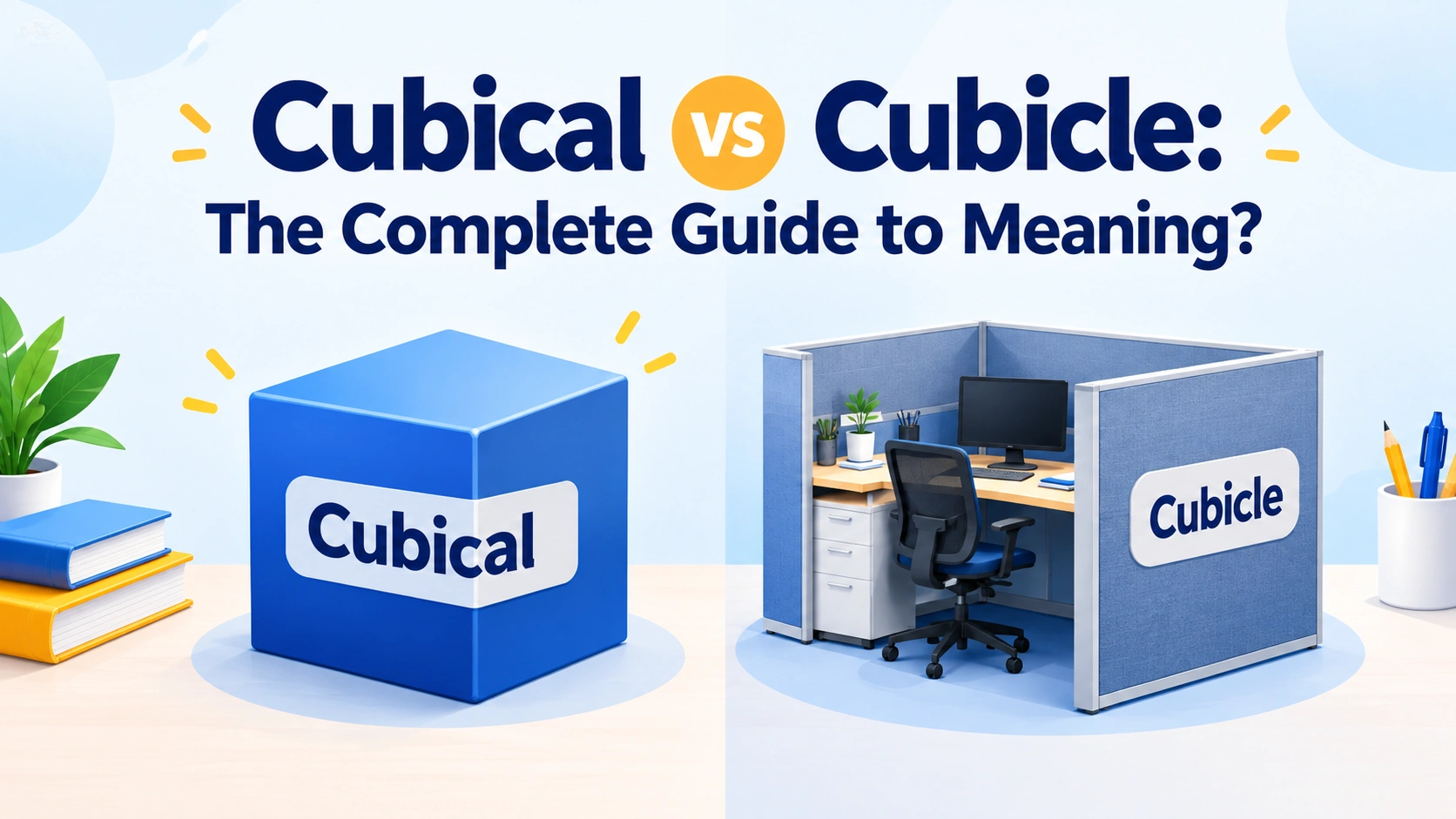
Cubical vs cubicle is an easy pair to mix up because both words begin with the same “cubic-” sound and are connected historically and semantically with the idea of a cube or small space. The problem is that they do very different jobs in a sentence. Cubical is normally an adjective used to describe something with a cube-like form, while cubicle is a noun for a small enclosed or partitioned space. That distinction matters in everyday writing, workplace communication, architecture, mathematics, and product descriptions. Once you connect each word to its function—shape versus space—the difference becomes much easier to remember and apply.
The confusion becomes especially noticeable in phrases such as office cubicle, shower cubicle, and cubical structure. A person may hear “cubicle” and assume that “cubical” is simply another spelling, or they may use “cubical” when they mean a small office compartment. Neither assumption is correct. The two words have different grammatical roles as well as different meanings. In this guide, you will see how cubical and cubicle differ, when each word is appropriate, how pronunciation contributes to the confusion, why a cubicle does not actually have to be cube-shaped, and how cubic fits into the same group of related words.
There is also a useful historical reason the words look related: they are connected to older vocabulary associated with cubes, chambers, and enclosed spaces. But modern English has given them distinct jobs. Understanding that development is more useful than memorizing an arbitrary spelling rule. You will learn the difference through definitions, comparison tables, real-world examples, common mistakes, pronunciation, word origins, British and American usage, and practical proofreading tests. By the end, choosing between “cubical” and “cubicle” should take only a few seconds.
Quick Answer: Cubical vs Cubicle
The simplest distinction is:
Cubical describes a shape; cubicle names a space.
Cubical is an adjective. It means cube-shaped, resembling a cube, or relating to a cube.
- “The sculpture has a cubical form.”
- “The building has a striking cubical design.”
- “The machine is housed inside a cubical enclosure.”
Cubicle is a noun. It means a small enclosed, separated, or partitioned space, often within a larger room.
- “She works in an office cubicle.”
- “The gym has several changing cubicles.”
- “The bathroom contains a separate shower cubicle.”
So, if you are describing what something looks like, choose cubical. If you are naming a small space or compartment, choose a cubicle.
Cubical vs Cubicle at a glance
| Word | Part of speech | Basic meaning | Typical contexts | Example |
| Cubical | Adjective | Cube-shaped or cube-like | Geometry, architecture, design, engineering | “a cubical structure” |
| Cubicle | Noun | Small enclosed or partitioned space | Offices, bathrooms, changing rooms, voting areas | “an office cubicle” |
What Does “Cubical” Mean?
Cubical is an adjective used to describe something that has the form or general shape of a cube.
Merriam-Webster defines cubical as meaning cubic, especially “shaped like a cube,” and records the word as dating back to the 15th century.
A cube has six equal square faces, so the most straightforward use of cubical refers to an object whose shape resembles that geometric form.
For example:
- “The storage box has a cubical shape.”
- “The architect designed a cubical pavilion.”
- “Several cubical blocks were arranged in a pattern.”
The word does not necessarily mean that an object is a mathematically perfect cube. In ordinary descriptive writing, cubical can simply indicate a strongly cube-like form.
Cubical in mathematics and geometry
In technical contexts, cubical can have a more specialized meaning.
You may encounter expressions such as:
- cubical structure
- cubical geometry
- cubical complex
- cubical cells
- cubical form
In these contexts, the word relates to structures built from or associated with cubes.
That is different from the everyday meaning of cubicle. A mathematician discussing a cubical complex is talking about a mathematical structure, not an office compartment.
Cubical in architecture and design
Architects and designers may use cubical when discussing the visual form of a building, room, object, or component.
For example:
“The new gallery has a simple cubical form.”
Here, cubical tells the reader something about shape.
It does not tell the reader that the gallery contains small rooms or workstations.
Cubical in product descriptions
The adjective is also useful when describing physical products.
Consider:
“The speaker has a compact cubical housing.”
The important feature is the shape of the housing.
Compare that with:
“The laboratory contains individual cubicles.”
Now the word refers to separate spaces.
That distinction is especially useful in technical writing because replacing one word with the other can change the meaning of an entire sentence.
What Does “Cubicle” Mean?
Cubicle is a noun referring to a small space that is separated from a larger room or area.
Cambridge defines it as a small space surrounded by walls or curtains and separated from the rest of a room. Its American English definition also includes a small room, often large enough for only one person, within a larger room or area. In workplace English, a cubicle commonly means a small office space formed by low partitions.
Common examples include:
- office cubicle
- shower cubicle
- changing cubicle
- voting cubicle
- medical cubicle
- study cubicle
The key point is that a cubicle refers to a space or compartment, not to a geometric shape.
Office cubicles
An office cubicle is a workstation separated from neighboring work areas by partitions, usually without being a completely enclosed room.
For example:
“I left the report on my desk in my office cubicle.”
The cubicle could be rectangular, irregularly shaped, or part of a larger modular office system. It does not have to resemble a cube.
Shower and bathroom cubicles
In many varieties of English, particularly British English, a cubicle is commonly used for a small enclosed bathroom or shower area.
Examples include:
- “The hotel has individual shower cubicles.”
- “Each changing room has several cubicles.”
- “The public restroom contains separate toilet cubicles.”
Again, the defining characteristic is separation and privacy, not a cube shape.
Changing cubicles
A changing cubicle provides a private area where someone can change clothes.
This is common in:
- clothing stores
- gyms
- swimming pools
- sports facilities
- department stores
You might hear a changing room in some contexts, but a changing cubicle specifically emphasizes the individual partitioned space.
Voting cubicles
A voting cubicle is a private area where a voter can complete a ballot without other people seeing the choices.
The word cubicle works because the area is a small separated space, not because it resembles a cube.
Study and library cubicles
Libraries may provide individual study spaces separated by partitions. These can be called study cubicles.
A related term is carrel, which Cambridge defines as a cubicle containing a desk for one person, often in a library.
Cubical vs Cubicle: The Main Difference
The most useful way to understand these words is to stop looking at their endings and ask what the word is doing.
Cubical describes. Cubicle names.
That is the grammatical distinction behind the meaning difference.
| Question | Cubical | Cubicle |
| What is it? | An adjective | A noun |
| What does it describe? | Shape or form | A physical space |
| Can it describe an object? | Yes | No, not in this sense |
| Can it be called a workstation? | No | Yes |
| Can it describe cube-like architecture? | Yes | No |
| Can it refer to a shower space? | No | Yes |
| Example | “a cubical box” | “a shower cubicle” |
A useful test is to replace the word mentally.
If cube-shaped works, cubical is probably what you need.
“The container is cube-shaped.”
“The container is cubical.”
If a small compartment works, the cubicle is probably correct.
“She works in a small compartment.”
“She works in a cubicle.”
This test is more reliable than simply asking which word “sounds right.”
Is It “Office Cubical” or “Office Cubicle”?
The standard phrase is office cubicle.
That is one of the most common situations in which people confuse the two words.
Correct: “I work in an office cubicle.”
Incorrect for this meaning: “I work in an office cubical.”
Why?
Because the writer is naming a workstation or compartment. That requires the noun cubicle.
However, cubical can still appear in an office-related sentence when you are actually describing shape:
“The office uses several cubical storage units.”
Here, cubical modifies storage units. It tells us that the units are cube-shaped.
The difference is subtle only if you focus on spelling. Once you focus on meaning, it is straightforward.
Cubical vs Cubicle in Grammar
Cubical is an adjective
An adjective modifies or describes a noun.
Examples:
- a cubical building
- a cubical container
- a cubical structure
- a cubical object
- a cubical design
Notice that cubical does not name the object. It gives the reader information about its form.
Cubicle is a noun
A noun can name a person, place, thing, or concept. Cubicle names a type of physical space.
Examples:
- an office cubicle
- a shower cubicle
- several cubicles
- a private cubicle
- the nearest cubicle
The plural is straightforward:
cubicle → cubicles
For example:
“The company replaced its old cubicles.”
Why the grammatical difference matters
Knowing the part of speech helps when you encounter an unfamiliar sentence.
Compare:
“The designer created a cubical workspace.”
Here, cubical describes the workspace.
Now:
“The designer created several cubicles.”
Here, cubicles name the spaces.
This is not merely a spelling distinction. The sentence structure itself changes.
Pronunciation: Cubical vs Cubicle
Pronunciation contributes to the confusion because both words begin with the same cue-bic- sound.
Cambridge gives both words closely related pronunciations, with the principal difference occurring in the ending.
A useful approximate breakdown is:
- cubical: CUBE-ih-kəl
- cubicle: CUBE-ih-kəl
In many varieties of English, the words can sound extremely similar in ordinary speech.
That is why pronunciation alone is not always enough to identify the intended word.
Why sound is a poor spelling test here
Imagine hearing:
“She works in a cubicle.”
If you have never seen the word written, it is easy to imagine a spelling such as cubical.
The solution is not to invent a complicated pronunciation rule. Instead, connect the meaning to the spelling:
cubical → cube-like adjective
cubicle → compartment noun
Once those associations are familiar, the spelling becomes much easier to retrieve.
Why Are Cubical and Cubicle Confused?
There are several reasons this pair causes trouble.
They share the same beginning
Both words contain cubic-, which immediately connects them with the word cube.
That visual similarity encourages people to treat them as spelling variants when they are actually separate words.
Their endings are similar
The difference between -ical and -icle is easy to overlook, especially when typing quickly.
Compare:
- cubical
- cubicle
Only a few letters separate them, but those letters matter.
They sound similar
In everyday speech, the distinction may not be obvious.
That creates a classic spelling problem: a writer knows the word from hearing it but has not developed a strong visual memory of its written form.
The workplace phrase causes repeated exposure
People regularly hear or read office cubicles. Someone who has not encountered the written form frequently may assume that cubical is the correct adjective-like spelling.
It is not.
Similar roots do not mean identical meanings
English contains many groups of words that share a root while developing different meanings and grammatical functions.
The fact that cubical and cubicle are related does not make them interchangeable.
Cubical vs Cubic: Are They the Same?
Cubical and cubic overlap in meaning, but they are not equally useful in every context.
Cambridge gives cubic a particularly important mathematical use: it describes units of volume based on length × width × height, such as cubic centimeters and cubic meters.
Cubical
Usually emphasizes shape or form.
“The sculpture has a cubical shape.”
Cubic
Can describe a cube or cube-related property, but is especially common in mathematics and measurement.
“The tank holds 50 cubic meters of water.”
So:
- cubical shape → shape
- cubic meter → volume
- cubicle → enclosed space
These three words belong to the same semantic family, but they should not be treated as interchangeable.
A useful comparison
| Word | Main function | Example | Main idea |
| Cubical | Describes form | “a cubical object” | Cube-like shape |
| Cubic | Describes cube-related dimensions or mathematical properties | “10 cubic meters” | Volume/geometry |
| Cubicle | Names a space | “an office cubicle” | Compartment |
Does a Cubicle Have to Be Cube-Shaped?
No.
This is one of the most useful misconceptions to correct.
The word cubicle refers to a small separated or partitioned space. Its practical design does not have to match the geometry of a mathematical cube.
An office cubicle might be:
- rectangular
- L-shaped
- irregularly arranged
- open on one side
- divided by low partitions
Likewise, a shower cubicle can have a rectangular footprint and still be correctly called a cubicle.
The word developed around the idea of a small private room or compartment, so its modern meaning is primarily functional.
Do not choose “cubicle” because something looks like a cube. Choose it because it is a small compartment or separated space.
That single distinction prevents many errors.
The History and Origins of Cubical and Cubicle
The similarity between these words is not accidental.
The English word cube comes through Latin cubus from Greek kybos. Merriam-Webster records cube as having entered English centuries before the modern workplace sense of cubicle.
Cubical developed as an adjective connected with the cube.
Cubicle, however, has a different historical path. It is connected with the Latin cubiculum, a chamber or room, itself associated with cubare, “to lie down.” The historical connection helps explain why cubicles developed toward the meaning of a small room or enclosed space rather than simply “something cube-shaped.”
That history explains an important point:
The two words are related, but their modern meanings diverged.
You therefore should not reason:
“Cubicles contain cubes, so it must mean a small cube.”
English vocabulary does not work that mechanically.
A word’s historical root can explain why it looks familiar without telling you exactly how modern speakers use it.
British English vs American English
Both cubical and cubicle occur in British and American English, but cubicle can have somewhat different everyday associations depending on the variety and context.
Cambridge lists cubicles in both UK and US English. Its UK definition emphasizes a small separated space, such as a shower cubicle, while its American entry includes a small room within a larger space and gives a work cubicle as an example. Its Business English entry specifically covers the office meaning.
The important point is that this is not a British-versus-American spelling difference.
You should not think:
- British = cubicle
- American = cubical
That is incorrect.
Instead:
- cubical = adjective relating to cube-like form
- cubicle = noun referring to a small compartment or separated space
Regional context may affect which kind of cubicle people mention most often, but it does not turn cubical into an alternative spelling of cubicle.
Common Mistakes With Cubical and Cubicle
Mistake 1: Writing “office cubical”
This is probably the most recognizable error.
❌ “She sits in an office cubical.”
✅ “She sits in an office cubicle.”
The sentence names a workstation, so a cubicle is required.
Mistake 2: Using “cubicle” to describe shape
❌ “The box is cubicle.”
✅ “The box is cubical.”
The first sentence treats cubicle as though it were an adjective meaning cube-shaped. It is not.
Mistake 3: Assuming a cubicle must be cube-shaped
❌ “It cannot be a cubicle because it is rectangular.”
✅ A rectangular partitioned space can still be a cubicle.
The meaning concerns the type of space, not mathematical geometry.
Mistake 4: Treating cubical and cubic as identical in every context
While dictionaries recognize overlap between cubical and cubic, technical writing often has established conventions. For example, cubic meter is the normal measurement expression, not cubic meter.
Mistake 5: Choosing by sound alone
Because the words are pronounced similarly, listening is not always enough.
When proofreading, look at the meaning and grammatical role instead.
Real-Life Examples: Which Word Fits?
| Situation | Correct word | Example |
| Describing a cube-shaped box | cubical | “The box has a cubical design.” |
| Referring to an office workstation | cubicle | “He works in a corner cubicle.” |
| Describing a building’s shape | cubical | “The building has a cubical form.” |
| Referring to a shower enclosure | cubicle | “The bathroom has a glass shower cubicle.” |
| Describing a geometric structure | cubical | “The model uses cubical elements.” |
| Referring to a changing space | cubicle | “The store has six changing cubicles.” |
| Measuring volume | cubic | “The tank holds 20 cubic meters.” |
| Referring to a partitioned study area | cubicle | “Students can reserve individual study cubicles.” |
The table reveals why a simple spelling rule is not enough. Meaning determines the word.
How to Choose Between Cubical and Cubicle in Five Seconds
When you are unsure, follow this sequence.
Step 1: Identify what you are talking about
Is it an object or structure’s shape?
If yes, consider cubical.
Is it a small space or compartment?
If yes, choose a cubicle.
Step 2: Try a replacement
Replace the word with cube-shaped.
If the sentence still makes sense:
“The building is cube-shaped.”
Then:
“The building is cubical.”
If the replacement sounds wrong, try a small compartment.
“She works in a small compartment.”
Then:
“She works in a cubicle.”
Step 3: Check the part of speech
If you need a word that describes a noun, cubical may fit.
If you need a noun that can be preceded by a, the, or an, cubicle may fit.
For example:
“a cubicle”
“the cubicle”
“three cubicles”
By contrast:
“a cubical box”
Here, cubical is describing a box.
Memory Tricks for Remembering the Difference
Cubical = cube-like
The ending -ical can remind you that cubical is functioning as a descriptive adjective.
Think:
cubical → cube-like
Cubicle = compartment
Think about the place where you work, change clothes, shower, or study.
cubicle → small space
The shape-versus-space trick
If you remember only one thing, make it this:
Shape → cubical
Space → cubicle
This is better than memorizing individual phrases because it works in unfamiliar sentences too.
Related Words: Cube, Cubic, Cubical, Cubicle, and Cuboid
These words are easy to mix up because they belong to the same family of ideas.
Cube
A cube is the geometric object itself.
“The child built a cube from six square faces.”
Cubic
Cubic is an adjective with important mathematical and measurement uses.
“The container has a volume of two cubic meters.”
Cubical
Cubical describes something as cube-shaped or cube-like.
“The sculpture has a cubical form.”
Cubicle
A cubicle is a small enclosed or partitioned space.
“She moved to a larger office cubicle.”
Cuboid
A cuboid is a three-dimensional shape resembling a rectangular box. Not every cuboid is a cube because its dimensions do not have to be equal.
This distinction matters when writing technical descriptions. If geometric precision is important, use the established mathematical term rather than relying on a vague visual description.
How to Proofread Your Own Writing
Before publishing an email, report, article, product description, or technical document, run this quick check.
| Question | If the answer is yes | Likely choice |
| Am I describing something as cube-shaped? | The word describes form | Cubical |
| Am I naming a small separated area? | The word names a space | Cubicle |
| Am I talking about volume or dimensions? | Mathematical measurement | Cubic |
| Can I replace the word with “cube-shaped”? | Meaning still works | Cubical |
| Can I replace it with “small compartment”? | Meaning still works | Cubicle |
| Am I writing “office ___”? | Referring to a workstation | Cubicle |
Watch for these high-risk phrases
Pay particular attention when writing:
- office cubicle
- work cubicle
- shower cubicle
- changing cubicle
- voting cubicle
- cubical structure
- cubical shape
- cubical design
- cubic meter
- cubic centimeter
These phrases make the intended meaning much easier to recognize.
Conclusion:
The difference between cubical and cubicle becomes straightforward once you stop treating them as competing spellings. Cubical is an adjective that describes something with a cube-like form, while cubicle is a noun for a small enclosed or partitioned space. That is why we write office cubicles, shower cubicles, and changing cubicles, but cubical structure, cubical object, and cubical design. Cubic belongs nearby but serves an important role of its own, especially in mathematics and measurements such as cubic meters. One final actionable tip: when proofreading, replace the word mentally with “cube-shaped” or “small compartment.” A common mistake to avoid is assuming that similar spelling means similar meaning. In this pair, meaning is the fastest route to the correct spelling.
FAQs
Q1. Is “cubical” a correct English word?
Yes. Cubical is a standard English adjective meaning cube-shaped, cubic, or relating to a cube. Merriam-Webster lists it as an adjective and gives “shaped like a cube” as a principal sense. It is therefore not a misspelling of cubicle.
Q2. Is “office cubical” ever correct?
For an ordinary workstation, office cubicle is the standard expression. Cubical could appear in an office context only when it actually describes shape, such as “cubical storage units.” The intended meaning—not the similarity between the words—determines the correct choice.
Q3. Does “cubicle” mean something that is cube-shaped?
No. A cubicle is a small enclosed or partitioned space. It may be rectangular, irregular, or only partially enclosed. The word describes its function as a separated space, not its geometric shape. A cubicle therefore does not need to resemble a mathematical cube.
Q4. What is the difference between “cubical” and “cubic”?
Both can relate to cubes, but their uses differ. Cubical commonly describes shape or form, while cubic has important mathematical and measurement uses, such as cubic meter or cubic centimeter. In technical writing, use the conventional term for the intended concept.
Q5. How can I remember cubical vs cubicle?
Use the simplest possible mnemonic: cubical = cube-shaped; cubicle = small space. If you can replace the word with “cube-shaped,” choose cubical. If “small compartment” fits better, choose a cubicle. This meaning-based test is more reliable than pronunciation alone.