

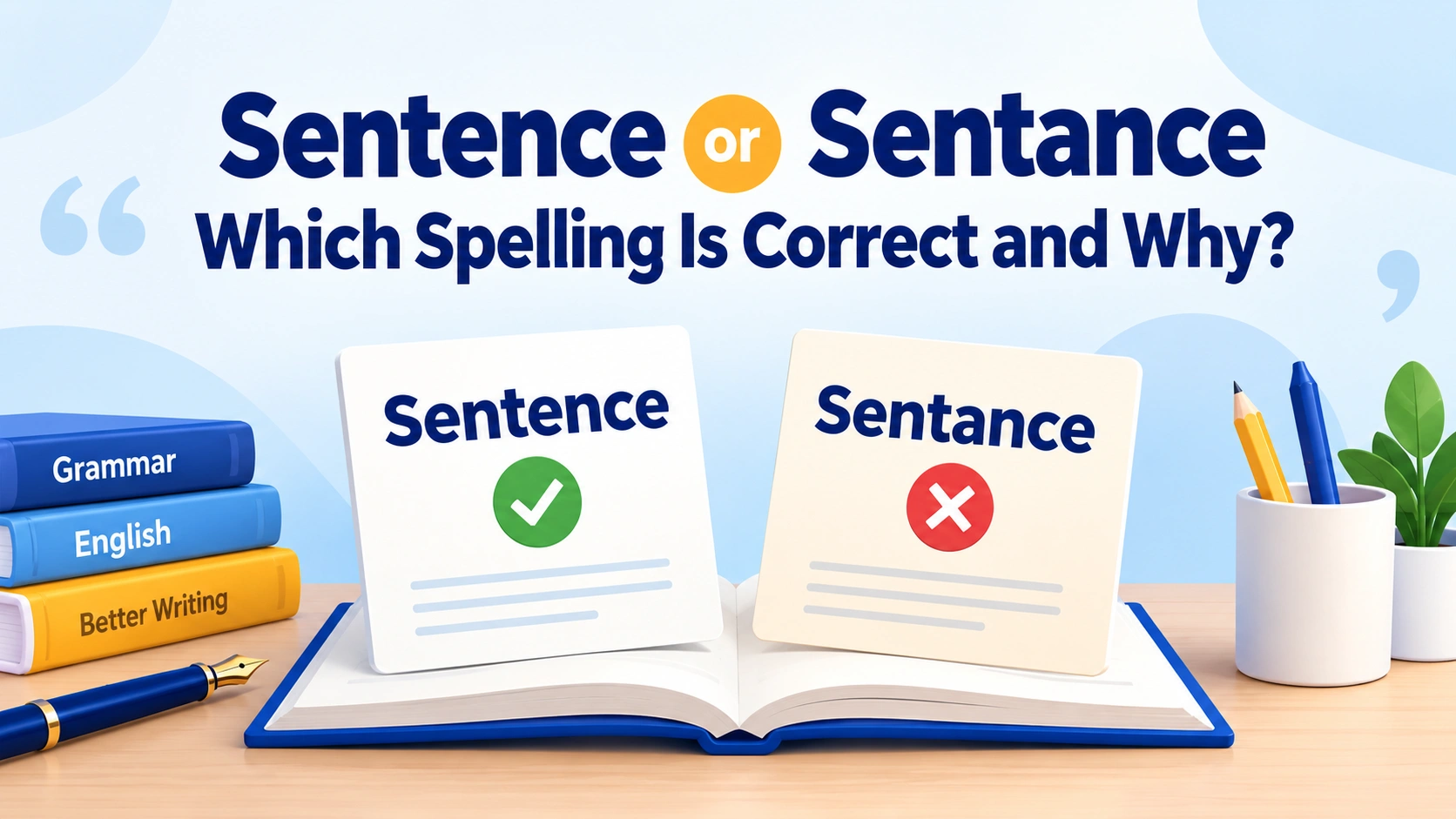
Sentence or sentance is a common spelling question, but the answer is straightforward: sentence is the correct spelling in standard English, while sentance is a misspelling. The confusion is understandable because both forms can sound similar when spoken, and English contains many words whose endings are written with either -ance or -ence. That makes the final few letters surprisingly easy to misremember. If you are writing an essay, email, report, application, or academic assignment, use sentences. In this guide, you’ll learn why the correct spelling uses -ence, how to remember it, and how the word works in different contexts.
The issue is not the difference between British English and American English. Unlike words such as colour/color or centre/center, sentences do not change spelling according to the variety of English. The same standard spelling is used in both. What makes this word particularly interesting is that the sentence has more than one meaning: it can describe a grammatical unit of words, or it can refer to a punishment imposed by a court. It can also function as a verb in legal contexts. Understanding these meanings makes the spelling easier to recognize in real writing.
There is also a useful lesson here for English learners: pronunciation is not always a reliable guide to spelling. The sentence is pronounced roughly like “SEN-tuhns,” so the unstressed middle vowel does not clearly tell you whether to write -ance or -ence. That is why simply sounding out the word may not prevent the mistake. Instead, you can rely on the spelling pattern, visual recognition, and a simple memory technique. By the end of this article, you’ll know not only which spelling is correct, but also how to use sentences accurately in grammar, everyday writing, and legal language.
Quick Answer: Is It Sentence or Sentance?
The correct spelling is sentence.
Sentance is not an alternative British or American spelling. It is a spelling error.
| Spelling | Correct? | Explanation |
| sentence | Yes | Standard English spelling |
| sentance | No | Common misspelling |
| sentences | Yes | Plural form of sentence |
| sentenced | Yes | Past tense/past participle of the legal verb sentence |
| sentencing | Yes | Present participle/gerund of sentence |
Correct examples
- Please write a complete sentence.
- The paragraph contains five sentences.
- That sentence is difficult to understand.
- The judge sentenced him to five years in prison.
Incorrect example
- Please write a complete sentance.
Quick rule: If you mean the grammatical unit or a court-imposed punishment, spell it sentence, with -ence at the end.
Why Do People Misspell “Sentence” as “Sentance”?
The mistake usually comes from a combination of pronunciation, spelling patterns, and memory rather than from any real disagreement about the word.
Pronunciation does not clearly reveal the spelling
In both British and American English, sentence is pronounced approximately /ˈsen.təns/. The middle vowel is weak, so when someone hears the word, they do not necessarily hear a clear “e” or “a” sound.
That creates a familiar spelling problem:
sentence → -ence
sentance → -ance
Because the two endings can sound very similar in ordinary speech, an inexperienced writer may choose the more familiar-looking pattern.
English has both “-ance” and “-ence” endings
English contains many words ending in -ance:
- appearance
- distance
- importance
- performance
- resistance
It also contains many words ending in -ence:
- difference
- existence
- independence
- reference
- presence
The problem is that pronunciation does not provide a universal rule for choosing between them. You cannot simply hear an unstressed vowel and know which letter belongs there.
Similar words can interfere with memory
Spelling is partly visual memory. Once you have seen a word many times, you tend to recognize its overall shape rather than consciously construct every letter.
That is why sentence becomes easier with repeated exposure. The more often you read the correct spelling, the less likely sentance is to look natural.
Typing can reinforce the mistake
Fast typing creates another opportunity for errors. If you type sentance automatically and do not reread the word, the incorrect form can survive into an email, assignment, or social-media post.
Spell-checkers are useful, but they should be a backup rather than your only proofreading method.
What Does “Sentence” Mean?
Sentences have two major meanings in everyday English: a grammatical meaning and a legal meaning.
Sentence as a grammatical term
In grammar, a sentence is a unit of language that expresses a complete thought and contains at least one main clause.
For example:
The children played outside.
This is a sentence because it contains a main clause.
A sentence can be short:
She laughed.
Or considerably longer:
Although the weather was cold, the children continued playing outside because they had been waiting all week.
Length is not what makes something a sentence. Structure matters more than word count.
Sentence as a legal term
In law, a sentence is a punishment imposed by a court following a criminal conviction.
For example:
The judge imposed a five-year prison sentence.
Here, sentences have nothing to do with grammar.
The word can also function as a verb:
The judge sentenced the defendant to five years in prison.
This gives us several related forms:
- sentence
- sentenced
- sentencing
The spelling remains based on sentence, not sentance.
Why the two meanings matter
Context usually makes the intended meaning obvious.
Compare:
This paragraph needs another sentence.
Here, the sentence is grammatically correct.
The court handed down a lengthy sentence.
Here, it is legal.
The spelling is identical in both cases.
Sentence vs. Sentance: What Is the Actual Difference?
There is no difference in meaning between sentence and sentance because sentance is not the standard spelling of the word.
| Feature | Sentence | Sentance |
| Standard English word | Yes | No |
| Correct spelling | Yes | No |
| Used in grammar | Yes | No |
| Used in legal English | Yes | No |
| British spelling | Yes | No |
| American spelling | Yes | No |
| Pronunciation | /ˈsen.təns/ | Not a standard separate pronunciation |
| Plural | sentences | — |
| Past-tense verb | sentenced | — |
Spelling difference
The key difference is the vowel in the ending:
sentence → -ence
sentance → -ance
Only the first is correct.
Meaning difference
There is no legitimate meaning distinction such as “sentence for grammar” versus “sentence for law.” Both grammatical and legal uses require a sentence.
Usage difference
Use sentences whenever the word is needed.
The first sentence introduces the topic.
The defendant received a prison sentence.
The editor shortened the final sentence.
The judge sentenced the offender after the conviction.
Why Is “Sentence” Spelled With “-ence”?
The spelling is connected to the word’s history rather than to a simple modern pronunciation rule.
Sentence ultimately traces back through French to Latin sententia, associated with a thought, opinion, judgment, or meaning. Over time, the word developed into the English form sentence.
This history helps explain why English spelling sometimes preserves letter patterns that are not obvious from modern pronunciation.
Why pronunciation is not enough
A common beginner strategy is:
“Say the word slowly and write what you hear.”
That can work for some simple words, but it is unreliable for words with unstressed vowels.
In sentences, the middle syllable is weak. The pronunciation therefore does not strongly distinguish the spelling -ence from the imagined -ance.
For words like this, visual memory and repeated exposure are more dependable than trying to reconstruct the spelling entirely from sound.
Is “Sentance” Ever Correct?
In standard English, no. Sentance is a misspelling of a sentence.
You may encounter the form online because people make spelling errors in:
- social-media posts
- comments
- informal messages
- student writing
- user-generated websites
- quickly typed emails
Its appearance online does not make it an accepted spelling.
What about names or usernames?
A person, organization, fictional character, username, or other proper name could theoretically contain Sentance as part of its name. That does not make the spelling correct when you are using the ordinary English word.
The important distinction is between a particular name and standard vocabulary.
What should you do if spell-check flags it?
If your spell-checker underlines sentance, change it to sentence unless you are deliberately reproducing a proper name or quoted material.
For ordinary writing, there is no need to choose between the two.
How to Remember the Correct Spelling of “Sentence”
A good memory trick should make the correct spelling easier without pretending that English has a universal rule where none exists.
Use the “-ENCE” memory trick
Remember:
SENT + ENCE = SENTENCE
The final part is -ence, not -ance.
You can mentally break the word into:
SENT | ENCE
rather than trying to spell it from pronunciation.
Connect it with “sense”
Another useful association is:
sentence → sense
The connection is not a formal spelling rule, but it can help reinforce the e in the middle.
Use visual pattern recognition
Write the correct word several times:
sentence
sentence
sentence
Then compare it visually with:
sentance
The second form should begin to look unfamiliar.
This is especially useful for people who repeatedly make the same spelling mistake. Recognition often becomes faster when the correct pattern has been deliberately reinforced.
Do not rely on an invented pronunciation rule
Avoid memorizing something like “all words pronounced this way use -ence.” English simply does not work that neatly.
The better approach is:
- Recognize sentences as the standard spelling.
- Notice the -ence ending.
- Associate the visual pattern with the word.
- Confirm it when proofreading.
Sentence in Grammar: What Makes a Complete Sentence?
Knowing how to spell sentences is only part of the story. The word itself describes one of the central units of written grammar.
A sentence normally contains at least one main clause. It may contain additional subordinate clauses.
Subject and predicate
A simple sentence often contains a subject and a predicate.
The dog barked.
- The dog = subject
- barked = predicate
However, English sentence structures can become much more complex.
The dog barked because someone was approaching the house.
This contains a main clause and a subordinate clause.
Sentence fragments
A fragment may look like a sentence but fail to express a complete grammatical structure.
Because the weather was terrible.
On its own, this leaves the reader expecting more information.
A complete version might be:
Because the weather was terrible, we stayed home.
Run-on sentences
A run-on sentence occurs when independent clauses are joined incorrectly.
For example:
I finished my homework and watched television.
Possible corrections include:
I finished my homework, and I watched television.
Or:
I finished my homework. Then I watched television.
Good writing is not simply about avoiding long sentences. It is about making the relationships between ideas clear.
Types of Sentences in English
English grammar commonly distinguishes four major sentence types according to their communicative function.
| Type | Purpose | Example |
| Declarative | Makes a statement | The train leaves at six. |
| Interrogative | Asks a question | Does the train leave at six? |
| Imperative | Gives an instruction or command | Check the timetable. |
| Exclamative | Expresses strong feeling or surprise | What a beautiful view! |
Sentence structure can also be classified differently, including simple, compound, and complex sentences.
These classifications describe different aspects of sentences. One system focuses on purpose, while another focuses on structure.
That distinction is useful when studying grammar because the categories are not interchangeable.
How to Use “Sentence” Correctly in Real Writing
The word appears in almost every area of written English, but the surrounding context changes what readers expect.
Academic writing
In essays and reports, sentences commonly refer to grammar and style.
The second sentence introduces the main argument.
A useful editing practice is to check sentence length and structure rather than assuming that shorter sentences are always better.
Business emails
Professional communication often benefits from clear, direct sentences.
Instead of packing several unrelated ideas into one long sentence, separating them when doing so improves readability.
Please review the attached document. Let me know if you have any questions.
Everyday communication
In casual messages, people often use fragments:
Sounds good.
See you tomorrow.
These can work perfectly well in conversation even though they may not meet the traditional definition of a complete formal sentence.
That is an important distinction: grammar depends partly on context and purpose.
Legal writing
In legal contexts, a sentence may refer to a court-imposed punishment.
The court imposed a suspended sentence.
Because legal terminology can be precise, context is especially important when interpreting the word.
Textbooks and educational materials
Teachers and textbooks often use sentences when discussing:
- grammar
- punctuation
- clauses
- sentence structure
- sentence types
- writing exercises
- proofreading
Students may encounter the word repeatedly, making correct spelling particularly important in academic work.
Common Mistakes Involving “Sentence”
Writing “sentance” instead of “sentence”
This is the primary spelling mistake.
Incorrect:
The final sentance needs editing.
Correct:
The final sentence needs editing.
Confusing sentence with sentience
This is a different problem because sentience is a real English word.
Sentience refers broadly to the capacity to experience sensations or feelings.
Compare:
Please read the final sentence.
The debate concerned artificial intelligence and sentience.
The words look somewhat alike, but their meanings are completely different.
Assuming British English uses “sentance”
It does not. Sentence is the standard spelling in British English as well as American English.
This is not one of those words where regional spelling explains the variation.
Trusting pronunciation too much
If you write sentance because that is what the word seems to sound like, you are letting pronunciation determine a spelling that must instead be learned as a fixed written form.
Ignoring the surrounding grammar
Sometimes the problem is not spelling at all.
Compare:
I wrote a sentence.
with:
I wrote a paragraph.
If you are editing a piece of writing, ask whether you mean a sentence, clause, phrase, or paragraph. Correct terminology makes feedback much more precise.
Sentence vs. Sentience: A Commonly Confused Pair
The similarity between these words deserves special attention.
| Word | Meaning | Example |
| sentence | A grammatical unit or legal punishment | Write one complete sentence. |
| sentience | Capacity to experience sensations or feelings | The question concerns machine sentience. |
The spelling difference is larger than it may initially appear:
sentence → s-e-n-t-e-n-c-e
sentience → s-e-n-t-i-e-n-c-e
If you see sentance, however, you are almost certainly looking at a misspelling of sentence, not a shortened form of sentience.
British English vs. American English: Is the spelling different?
No. Sentences are spelled the same in British and American English.
That makes this an important distinction from genuine British-American spelling differences.
For example:
- British colour / American color
- British centre / American center
- British organise / American organize
But:
- British sentence
- American sentence
The spelling stays the same.
Why this matters for writers
If you are writing for an international audience, you do not need to change sentences based on whether your readers use British or American English.
You should still follow the spelling conventions of your chosen variety consistently elsewhere in the document.
Expert tip: Do not invent a regional distinction simply because two spellings look plausible. Check whether dictionaries actually recognize both forms.
Sentence Examples: Correct Usage in Context
Here are examples covering the most common uses.
Everyday writing
That was the funniest sentence in the story.
Academic writing
The final sentence clearly states the author’s conclusion.
Grammar instruction
Identify the subject and verb in each sentence.
Professional communication
Please revise the second sentence for clarity.
Legal context
The judge imposed a ten-year sentence.
Legal verb
The defendant was sentenced after the trial.
Plural form
The paragraph contains four sentences.
These examples show why learning the word as a family of related forms is useful:
sentence → sentences → sentenced → sentencing
Words With Similar “-ence” and “-ance” Confusion
The sentence/sentance error belongs to a larger spelling challenge: deciding between -ence and -ance.
Some commonly misspelled examples include:
| Correct | Common misspelling |
| occurrence | occurence |
| maintenance | maintainance |
| existence | existance |
| difference | differance |
| reference | referance |
| appearance | appearence |
There is no single spelling rule that safely solves every one of these.
That is the key lesson.
A writer who memorizes a rigid rule such as “words with this sound always use -ence” will eventually encounter an exception and make another error. Word-specific recognition, reading, and dictionary checking are more reliable.
A Simple Proofreading Checklist for “Sentence”
Before submitting an essay, email, article, or report, run through this quick check:
1. Look at the ending
Does it say:
-ence
If so, you have the standard spelling.
2. Watch for “sentance”
If your eyes catch:
sentance
replace it with:
sentence
3. Check related forms
Make sure you also recognize:
- sentence
- sentences
- sentenced
- sentencing
4. Consider the meaning
Are you referring to:
- a grammatical unit?
- a legal punishment?
Either way, the spelling is a sentence.
5. Use a dictionary when uncertain
When a spelling question genuinely remains unclear, checking a reputable dictionary is faster and safer than guessing from pronunciation.
Conclusion:
The answer to sentence or sentance is clear: sentence is the correct standard spelling, and sentance is a misspelling. More importantly, there is no British-American spelling distinction hiding behind the two forms. The word keeps the same spelling whether you are discussing grammar, everyday writing, or a legal punishment.One final actionable tip: train yourself to recognize the ending -ence in a sentence rather than trying to spell the word entirely from its pronunciation. That small habit can prevent the error before spell-check ever has to catch it.A common mistake to avoid is treating plausible-looking spellings as regional variants. When two forms appear online, that does not automatically mean both are accepted. In this case, the reliable choice is simple: write a sentence, every time.
FAQs
Q1. Is “sentance” a correct English word?
No. Sentance is a misspelling of a sentence in standard English. It is not an alternative British spelling, American spelling, or special grammatical form. If you mean a grammatical unit or a court-imposed punishment, the correct spelling is sentence, with -ence.
Q2. Is “sentence” spelled differently in British and American English?
No. Sentences have the same spelling in British and American English. Unlike colour/color or centre/center, there is no standard regional spelling difference here. Writers should use sentences regardless of which major variety of English they follow.
Q3. Why do people write “sentance” instead of “sentence”?
The most likely reason is pronunciation. The unstressed vowel in sentence does not clearly signal whether the spelling should contain a or e. Familiar words ending in -ance can also influence memory, making sentance look plausible even though it is incorrect.
Q4. What is the difference between “sentence” and “sentience”?
Sentences can mean a grammatical unit or a legal punishment. Sentience means the capacity to experience sensations or feelings. Although the words look similar, they have different meanings and different spellings. Neither sentence nor sentience is an alternative spelling of sentence.
Q5. What is the easiest way to remember how to spell “sentence”?
Remember the ending as -ENCE: SENT + ENCE = SENTENCE. You can also reinforce the spelling by noticing it repeatedly in books, articles, and edited writing. If you are unsure, check the word visually rather than relying entirely on how its unstressed vowel sounds.