

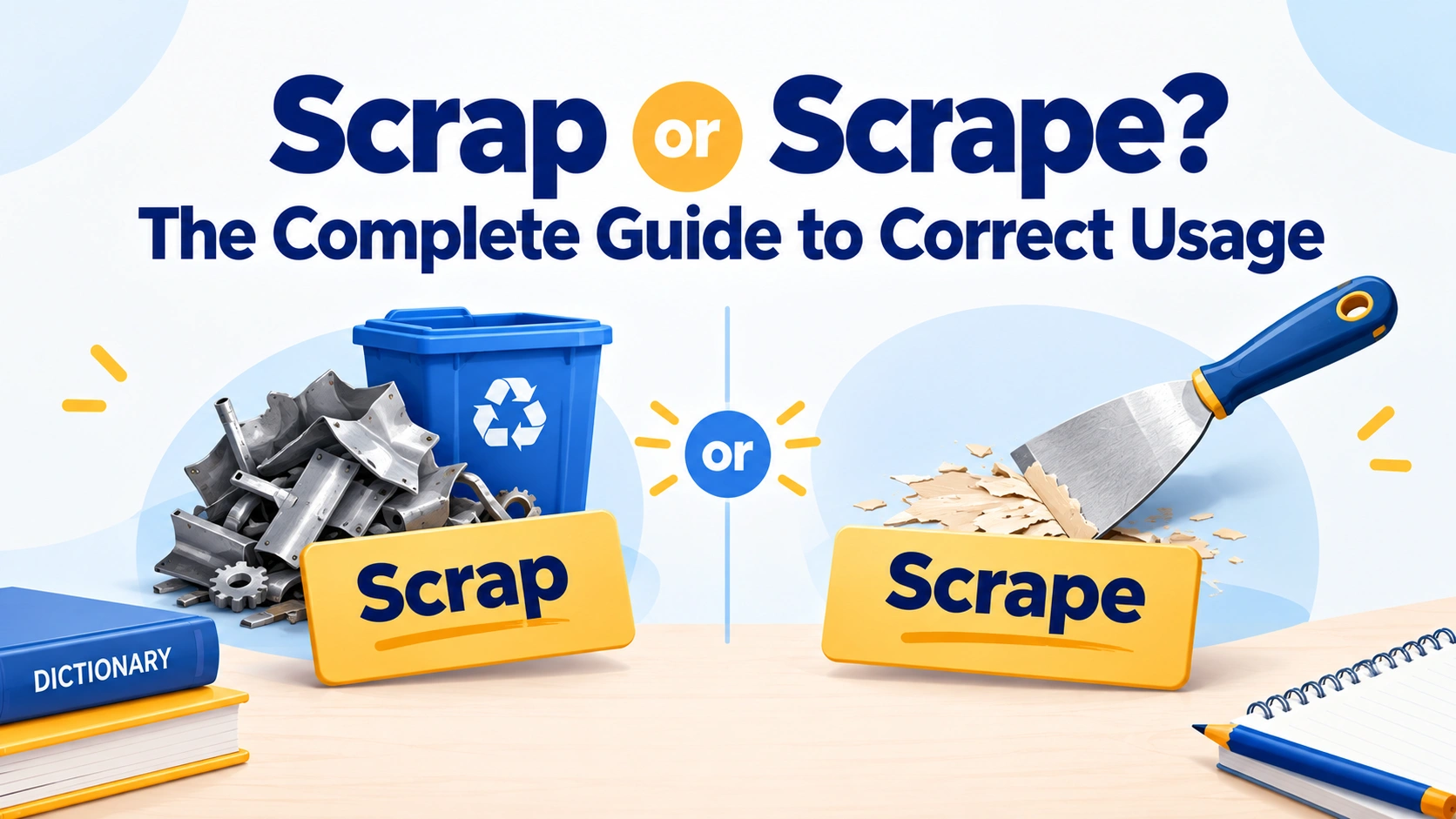
Scrap or scrape? The two words differ by only one letter, but they can describe completely different actions. You scrap a plan, but you scrape paint from a wall. You collect scrap metal, yet you use web scraping to collect information online. That small spelling difference carries a meaningful change in pronunciation, grammar, and meaning. Understanding the distinction is useful not only for avoiding spelling mistakes but also for choosing the precise word in business, everyday conversation, manufacturing, recycling, and technology. This guide explains scrap vs. scrape with clear rules, examples, common mistakes, and practical ways to remember the difference.
The confusion becomes easier to solve once you stop treating these words as simple spelling variants. Scrap is strongly associated with something discarded, abandoned, leftover, or broken up for reuse, although it has several other meanings. Scrape, by contrast, centers on rubbing, removing, or collecting something by dragging across a surface. It can also describe a minor injury, a difficult situation, or the act of barely managing something. Those meanings explain why phrases such as scrap metal, scrap a proposal, scrape paint, and scrape together enough money are all correct—but not interchangeable.
This article takes the distinction beyond a dictionary definition. You will see how scrap and scrape behave as nouns and verbs, why their past-tense forms are easy to mix up, how their meanings developed, and why scrape appears in modern expressions such as web scraping. You will also get side-by-side examples, collocations, proofreading tests, and practical decision rules. By the end, you should be able to choose the right word almost instantly—even when autocorrect, fast typing, or similar-sounding words make the choice less obvious.
Quick Answer: Scrap vs. Scrape
The easiest way to separate the two is to focus on the core action or idea:
- Scrap usually means discard, abandon, cancel, or treat something as unwanted material.
- Scrape usually means rub, remove something from a surface, or collect something by scraping.
- Scrap can be a noun, verb, or modifier in compounds such as scrap metal.
- Scrape is mainly a noun or verb.
- Scrap metal means unwanted or recyclable metal.
- Scrape the paint means remove paint from a surface.
- Scrap the proposal means abandon or cancel the proposal.
- Web scraping means collecting information from websites or other digital sources.
Quick memory rule:
Scrap = discard or leftover material.
Scrape = rub, remove, or collect from a surface.
The distinction is especially important when the words function as verbs. If a company scraps a project, the project is abandoned. If a worker scrapes a surface, something is physically removed or rubbed against it.
Why “Scrap” and “Scrape” Are So Easy to Confuse
The words look almost identical: scrap and scrape. Both begin with scr- and contain the same consonant sequence. When someone is typing quickly, that final e can easily disappear—or appear where it does not belong.
Pronunciation also contributes to the confusion. Scrap is pronounced /skræp/, while scrape is /skreɪp/. The vowel sounds are different, but in rapid speech the distinction may be less noticeable to a learner than it is on the page.
There is another reason the confusion persists: both words can involve the general idea of getting rid of something. You can scrap an unwanted object, while you can scrape an unwanted layer from an object. The physical result may overlap, but the action is different.
Consider:
- Scrap the old machine. → Get rid of it, possibly for parts or recycling.
- Scrape the rust off the machine. → Remove rust from its surface.
The best approach is therefore not to memorize spelling in isolation. Identify what the sentence is actually describing.
What Does “Scrap” Mean?
Scrap has several meanings, but its central modern uses fall into a few recognizable groups.
Scrap as a Noun
As a noun, scrap can mean a small piece or fragment of something:
- a scrap of paper
- a scrap of fabric
- a scrap of information
- food scraps
- scrap metal
It can also refer to material that is no longer wanted or useful, particularly material collected for reuse or recycling.
For example:
The mechanic sold the damaged parts for scrap.
Here, scrap refers to material that has been discarded or is being treated as material for recovery.
The word can also mean a fight or quarrel in informal English:
The two boys got into a scrap after school.
That meaning is unrelated to the common scrap = discarded material sense, so context matters.
Scrap as a Verb
As a verb, scrap commonly means to abandon, cancel, or get rid of something.
Examples:
- The company scrapped the proposal.
- The council decided to scrap the old system.
- They scrapped their plans for the event.
- The manufacturer scrapped the defective machine.
The important idea is discontinuation or disposal.
When you scrap an idea, you are not physically rubbing it against anything. You are deciding that it should no longer be used or pursued.
Scrap in Recycling and Manufacturing
In industrial contexts, scrap has a particularly practical meaning. Scrap material is material left over from production, rejected material, or old material that can potentially be recovered or recycled.
Common expressions include:
- scrap metal
- scrap steel
- scrap material
- scrap parts
- scrap value
- scrap dealer
- sell for scrap
This is why a damaged vehicle might be sold for scrap rather than repaired.
What Does “Scrape” Mean?
Scrape has a different central concept: contact with a surface involving rubbing, dragging, or removal.
Scrape as a Verb
You can scrape something when you remove material from a surface, usually with something rough or edged.
Examples include:
- scrape paint from a wall
- scrape ice from a windshield
- scrape mud off your shoes
- scrape food from a pan
- scrape dirt from a surface
The word can also describe rubbing against something:
The chair scraped across the floor.
Or an injury caused by rough contact:
She scraped her knee on the pavement.
The common thread is physical contact involving rubbing, abrasion, or removal.
Scrape as a Noun
A scrape can be a small injury or abrasion:
He had a scrape on his elbow.
It can also mean an unpleasant or difficult situation:
She got into a serious scrape while traveling.
And scrape can describe the sound produced by something rubbing against another surface:
We heard the scrape of metal against concrete.
These meanings may seem unrelated at first, but they all retain a connection to the underlying idea of rough contact or difficulty.
Scrape in Technology and Data
Modern technology adds another important meaning.
Web scraping or data scraping refers to collecting information from websites or digital sources, often through automated software.
For example:
The company uses software for web scraping to collect publicly available product information.
The spelling is scraping, not scrapping.
This technical sense is especially useful to remember because it provides a strong real-world distinction:
- scrapping → discarding or abandoning
- scraping → collecting or extracting information
The two forms may look nearly identical when typed quickly, but they describe opposite kinds of activity.
Scrap vs. Scrape: The Key Difference
| Feature | Scrap | Scrape |
| Main idea | Discard, abandon, leftover material | Rub, remove, or collect |
| Common grammatical roles | Noun, verb | Noun, verb |
| Physical example | Scrap metal | Scrape paint |
| Decision-making example | Scrap a proposal | Not normally used |
| Surface example | Not normally used | Scrape ice off a windshield |
| Technology | Scrapped software/project | Web scraping |
| Injury | A scrap can mean a fight | A scrape can mean an abrasion |
| Pronunciation | /skræp/ | /skreɪp/ |
A useful way to think about the difference is this:
Scrap changes the status of something. Scrape changes or removes something from a surface.
That is not a rule for every obscure dictionary sense, but it works remarkably well for ordinary writing.
Scrap vs. Scrape as Verbs
The verb distinction causes most practical errors.
When “Scrap” Means Cancel or Abandon
Use scrap when someone decides not to continue with something:
- scrap a plan
- scrap an idea
- scrap a project
- scrap a proposal
- scrap a policy
- scrap an outdated system
For example:
After reviewing the costs, the company scrapped the project.
The project was not physically scrapped. It was abandoned.
When “Scrape” Means Remove Something
Use scrape when something is removed by rubbing, dragging, or using a rough or sharp edge:
The painter scraped the old paint off the door.
Other natural examples:
- Scrape the snow off the windshield.
- Scrape the burned food from the pan.
- Scrape the sticker from the glass.
- Scrape the mud from your boots.
The object being removed may be tiny or substantial. What matters is how the removal happens.
Scrap vs. Scrape in Different Contexts
Business and Project Decisions
Business writing frequently uses scrap because organizations regularly abandon projects, plans, systems, or proposals.
The company scrapped its expansion plans after costs increased.
Using scrape here changes the meaning and sounds incorrect.
Recycling and Manufacturing
Industrial writing uses scrap for discarded or recoverable materials:
The factory separates aluminum scrap from reusable components.
But a worker can scrape material from a machine:
The technician scraped residue from the equipment.
The material can be scrap, while the action performed on it can be scraping.
Household Situations
Everyday activities provide some of the clearest contrasts:
| Situation | Correct Word | Example |
| Cancel an idea | scrap | We scrapped the idea. |
| Remove paint | scrape | We scraped the paint off. |
| Discard old metal | scrap | The metal was sold for scrap. |
| Remove food from a pan | scrape | Scrape the food from the pan. |
| Abandon a plan | scrap | They scrapped their travel plans. |
| Rub against a rough surface | scrape | The box scraped along the floor. |
Technology and the Internet
Technology has created an especially useful distinction:
The developer scrapped the old feature.
The feature was abandoned.
The developer scraped data from a website.
Information was collected.
This contrast is worth remembering because scrap and scrape are both common in technical writing, but they refer to very different operations.
Pronunciation and Spelling: Why the Final “E” Matters
The pronunciation difference is significant.
Scrap is pronounced approximately /skræp/.
Scrape is pronounced approximately /skreɪp/.
The final e in scrape is silent, but it helps produce the long a sound /eɪ/.
Compare:
- scrap → /skræp/
- scrape → /skreɪp/
This is a useful spelling pattern, but it should not be treated as the entire rule. English spelling contains many exceptions, so pronunciation alone is not always enough to select the correct word.
A better proofreading habit is to combine sound + meaning + collocation.
If you are writing about:
- canceling a plan → scrap
- discarded metal → scrap
- removing paint → scrape
- rubbing against a surface → scrape
- collecting website information → scrape
the context gives you the decisive answer.
Common Mistakes With Scrap and Scrape
Mistake 1: “Scrape the Project”
❌ The company decided to scrape the project.
✅ The company decided to scrap the project.
If the company has decided not to continue the project, scrap is correct.
Mistake 2: “Scrap the Paint”
❌ We need to scrap the paint from the wall.
✅ We need to scrape the paint from the wall.
The writer means remove the paint from the surface, so scrape is the appropriate verb.
Mistake 3: Confusing “Scrap Metal” and “Scraped Metal”
These expressions are not automatically equivalent.
Scrap metal is a standard noun phrase referring to unwanted or recoverable metal.
Scraped metal describes metal that has been scraped or subjected to a scraping action.
Compare:
The old pipes were sold as scrap metal.
with:
The worker scraped the metal to remove the residue.
The first describes the material’s status. The second describes an action.
Mistake 4: Writing “Scrapping” for Data Collection
❌ The program is scrapping data from several websites.
✅ The program is scraping data from several websites.
In this context, the intended meaning is collecting information, so scraping is correct.
Mistake 5: Assuming “Scrap” Always Means Trash
That is too narrow.
Scrap can mean:
- a small piece
- discarded material
- a plan that has been abandoned
- a fight or quarrel
So the sentence “They had a scrap” does not mean they had some waste material. It means they had a fight or argument.
Scrap vs. Scrape: Important Collocations
One of the fastest ways to develop accurate usage is to learn common word partnerships rather than isolated definitions.
Common Collocations With “Scrap”
- scrap metal
- scrap paper
- scrap material
- scrap parts
- scrap value
- scrap a plan
- scrap an idea
- scrap a project
- scrap a proposal
- scrap an old system
- sell something for scrap
Common Collocations With “Scrape”
- scrape the surface
- scrape off
- scrape away
- scrape clean
- scrape paint
- scrape ice
- scrape mud
- scrape food from a pan
- scrape a knee
- scrape together money
- scrape by
- web scraping
- data scraping
Expert proofreading tip: If a word appears in a familiar fixed expression, check the entire phrase rather than judging the spelling letter by letter.
For example, scrap metal is immediately recognizable, as is web scraping. Learning these combinations makes errors less likely than memorizing two dictionary definitions and hoping to recall them under pressure.
“Scrapped” vs. “Scraped”: The Past-Tense Trap
The confusion becomes even more noticeable in past-tense writing.
Scrapped
The past tense of scrap is scrapped.
Examples:
- The committee scrapped the proposal.
- They scrapped the old schedule.
- The manufacturer scrapped the damaged vehicle.
Notice the doubled p.
Scraped
The past tense of scrape is scraped.
Examples:
- She scraped the paint from the door.
- He scraped his knee.
- The software scraped information from the website.
Notice that the final e is retained in scraped.
The contrast is easy to visualize:
| Base Form | Past Tense | Meaning |
| scrap | scrapped | discarded, canceled, or dismantled |
| scrape | scraped | rubbed, removed, or collected |
This distinction becomes particularly valuable in professional editing because both forms can occur frequently in the same document.
Scrap vs. Scrape: Etymology and Word History
The similarity between the words is not completely accidental.
Where “Scrap” Comes From
Merriam-Webster traces the noun scrap to Middle English and Old Norse, with the word historically associated with scraps or small pieces. The verb later developed the meaning of converting something into scrap or getting rid of it.
This helps explain the modern relationship between:
- scrap metal
- scrap material
- scrap something
The idea moves from discarded pieces to the action of treating something as discarded material.
Where “Scrape” Comes From
Scrape has an older history connected with the physical action of rubbing, cutting, or removing material from a surface. Merriam-Webster traces the verb to Middle English and Old Norse sources.
That physical meaning remains remarkably visible in modern English:
scrape the paint
scrape the ice
scrape your knee
scrape the surface
The figurative meanings developed from this physical foundation.
Why the Histories Matter
Etymology does not give you a perfect modern usage rule, but it explains why the words developed into different semantic families.
Scrap became strongly associated with fragments, waste, disposal, and abandonment.
Scrape remained associated with rubbing, removal, abrasion, and difficult accumulation.
That distinction is much more useful than simply memorizing that “one has an e.”
Why “Scrape” Has So Many Figurative Meanings
Some of scrape’s less obvious meanings become easier to understand once the physical sense is clear.
Scrape Together
If you scrape together money, you gather it little by little, often with difficulty.
We managed to scrape together enough money for the repair.
The expression suggests effort and limited resources.
Scrape By
To scrape by means to manage with difficulty or barely succeed.
He managed to scrape by on a very limited budget.
Scrape Through
To scrape through means to succeed narrowly.
She scraped through the exam with the minimum required score.
These expressions are figurative, but they retain the broader idea of barely managing to achieve a result.
Does “Scrap” Also Mean “Fight”?
Yes. This is one of the meanings learners may overlook.
As an informal noun:
The two players got into a scrap.
As a verb:
The boys were scrapping in the playground.
Here, scrap means fight, quarrel, or engage in a physical confrontation. It is a separate sense from scrap meaning discarded material.
Context makes the meaning clear:
- a scrap of paper → a small piece
- scrap metal → discarded/recoverable metal
- scrap a plan → abandon it
- get into a scrap → get into a fight
This is a good reminder that a word can have several established meanings without becoming confusing once the surrounding sentence is considered.
Scrap vs. Scrape in Real-World Sentences
Business
The board scrapped the expansion plan after costs rose sharply.
The plan was canceled.
Construction
Workers scraped old adhesive from the concrete floor.
The adhesive was physically removed.
Manufacturing
The defective components were separated and sold as scrap.
The components were treated as unwanted material.
Household Cleaning
I had to scrape dried food from the baking tray.
The action involved removing material from a surface.
Technology
The company scrapped the outdated software feature.
The feature was abandoned.
The analyst used a script for web scraping.
The script collected information.
Everyday Conversation
“Let’s scrap that idea and try something simpler.”
“Can you scrape the mud off your shoes before coming inside?”
These examples show why the words cannot be selected merely because they sound similar.
Scrap vs. Scrape vs. Scarp
There is a third spelling that occasionally enters the picture: scarp.
A scarp is a steep slope or cliff-like face, especially in geographical or geological contexts.
For ordinary English learners, the important point is simple:
- scrap → discarded material, fragment, cancel, or fight
- scrape → rub, remove, collect, or barely manage
- scarp → a steep slope or escarpment
Do not treat scarp as another spelling of either word. Its meaning belongs to a different vocabulary area.
Synonyms: Choose According to Meaning
Neither word has one universal synonym. The correct alternative depends on the sense being used.
Synonyms for “Scrap”
✅When scrap means cancel:
- abandon
- cancel
- discontinue
- drop
- reject
- discard
When it means discarded material:
- waste
- remnants
- leftovers
- fragments
- refuse
When it means a small piece:
- fragment
- piece
- bit
- remnant
Synonyms for “Scrape”
When scrape means remove:
- rub off
- remove
- strip
- peel
- clean
- abrade
✅When it means collect with difficulty:
- gather
- accumulate
- assemble
When it means barely manage:
- struggle through
- barely manage
- get by
Be careful with substitution. Remove is broader than scrape, while scratch can describe damage without necessarily involving deliberate removal. A synonym may be grammatically possible while still changing the precise meaning.
How to Remember the Difference Between Scrap and Scrape
The Surface Test
Ask:
Is something being rubbed, dragged, or removed from a surface?
If yes, think scrape.
- scrape paint
- scrape ice
- scrape mud
- scrape food
- scrape a knee
The Discard Test
Ask:
Is something being canceled, abandoned, discarded, or treated as waste?
If yes, think scrap.
- scrap a plan
- scrap a project
- scrap an idea
- scrap a machine
- scrap metal
The “Keep or Cancel?” Test
For decisions, imagine a manager looking at a proposal.
If the decision is:
“We are not going ahead with this.”
→ scrap it
If the action is:
“We need to remove this layer from the surface.”
→ scrape it
This two-question method is more reliable than trying to remember which spelling “looks right.”
A 5-Second Proofreading Checklist
Before submitting an email, article, report, or assignment, run through these questions:
| Question | Choose |
| Am I canceling or abandoning something? | scrap |
| Am I describing unwanted/recyclable material? | scrap |
| Am I talking about a small fragment? | scrap |
| Am I rubbing against a surface? | scrape |
| Am I removing a layer from a surface? | scrape |
| Am I describing a minor abrasion? | scrape |
| Am I collecting website information? | scrape |
| Am I saying “barely manage”? | scrape |
If you still hesitate, replace the word temporarily with a clearer synonym.
For example:
“The company decided to ___ the proposal.”
Try to cancel. If that works, scrap is probably the intended word.
“The worker ___ the paint from the wall.”
Try removing. If the action involves rubbing or a tool, scrape is likely correct.
Conclusion
Choosing between scrap and scrape becomes much easier when you focus on meaning instead of spelling. Scrap is the word for discarded material, fragments, and the decision to abandon or cancel something. Scrape is the word for rubbing, removing material from a surface, collecting something by scraping, and several related figurative expressions. The distinction also appears in their past forms: scrapped and scraped. One final actionable tip: when proofreading, replace the uncertain word with cancel, discard, or remove and see which meaning fits. A common mistake to avoid is assuming that the words differ only by an extra letter. That letter signals a different word, pronunciation, and meaning. Once you learn the core concepts, accurate usage becomes almost automatic.
FAQs
Q1. Is it “scrap” or “scrape” a project?
Use scrap a project when you mean to cancel, abandon, or discontinue it. Scrape a project is not the normal expression for that meaning. You could, however, scrape data from a project-related website because scrape describes collecting information.
Q2. Is “scrap metal” or “scrape metal” correct?
Scrap metal is the standard expression when referring to discarded or recyclable metal. Scraped metal can occur grammatically when describing metal that has been scraped, but it has a different meaning. The two expressions should not be treated as interchangeable.
Q3. Is it “web scraping” or “web scrapping”?
The standard technical term is web scraping. It describes collecting information from websites or digital sources. Scrapping comes from scrap and relates to discarding, abandoning, or dismantling something. In technology writing, choosing the wrong form can change the intended meaning.
Q4. What is the difference between “scrapped” and “scraped”?
Scrapped is the past tense of scrap: “They scrapped the plan.” Scraped is the past tense of scrape: “They scraped the paint.” The first concerns abandonment or disposal; the second concerns rubbing, removing, collecting, or abrasion.
Q5. Can “scrap” and “scrape” mean the same thing?
They are not interchangeable in their ordinary meanings. Scrap generally concerns fragments, discarded material, cancellation, or fighting. Scrape concerns rubbing, surface removal, abrasion, collecting, or barely managing. Some situations involve both concepts, but the words still describe different actions.