

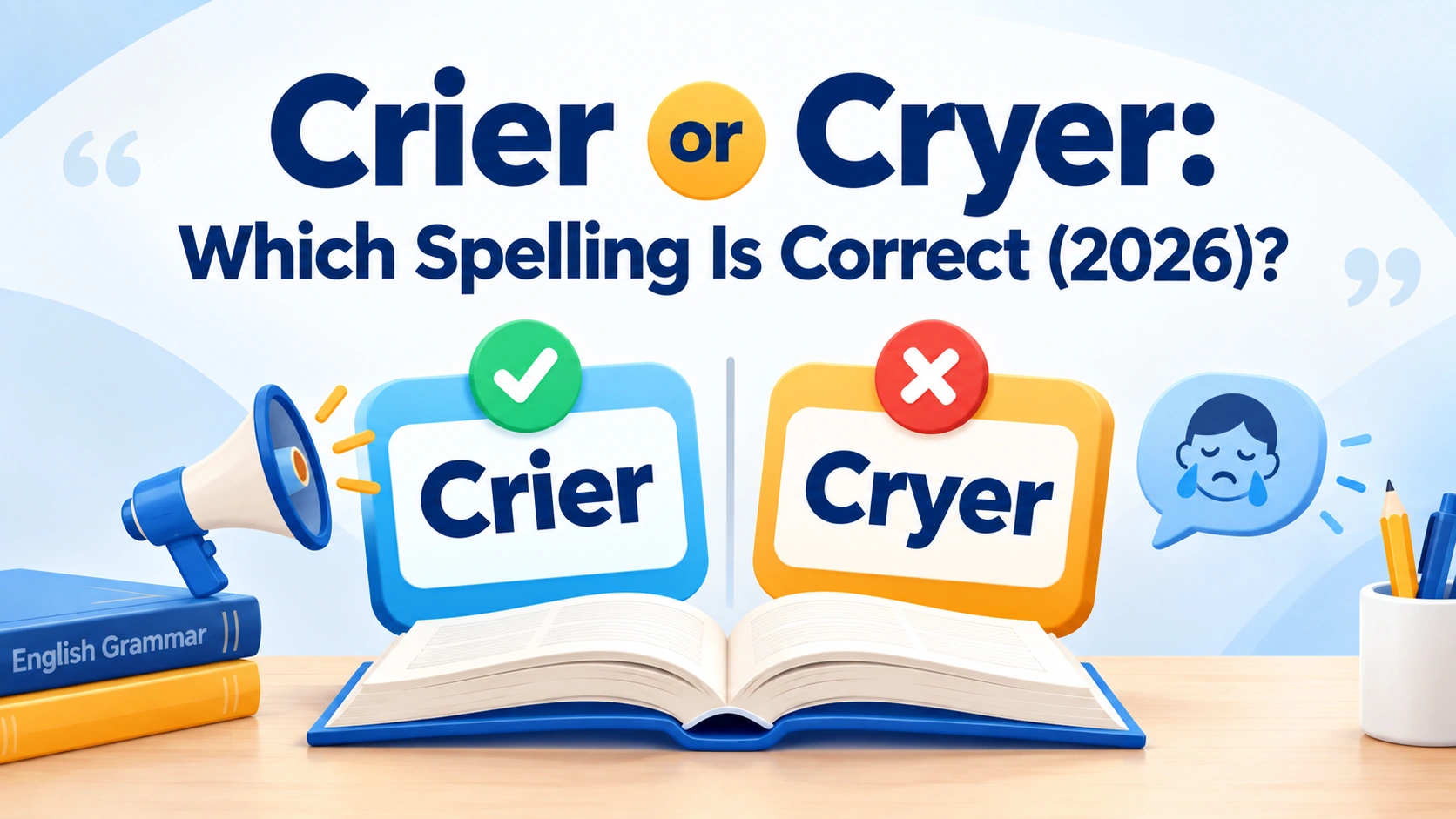
Crier or cryer is one of those spelling questions that looks easier than it really is. If you mean a person who cries, the standard modern spelling is crier. The same spelling appears in established expressions such as town crier, and major dictionaries recognize crier for someone who cries. But there is an important qualification: cryer is not simply a meaningless typo. Merriam-Webster lists cryer as a variant spelling of crier, while historical sources show it has been used for the same occupational sense.
That distinction matters because English spelling is not always governed by a single neat rule. Crier is the normal choice in contemporary edited English, but cryer survives in historical material, specialized usage, and especially as a surname. The family name Cryer has an established history connected with the occupational word for a public announcer. So if you are proofreading an article, writing an essay, or choosing a word yourself, the right question is not merely “Does cryer exist?” It does. The better question is which form fits the context?
This guide explains crier vs. cryer from the practical angle writers actually need. You will learn why crier is normally preferred, how the word developed, why cryer appears in older sources, when Cryer must be preserved as a proper name, how town crier is used, and why the spelling pattern can be confusing. You will also get sentence examples, comparison tables, proofreading strategies, common mistakes, and a quick decision test so you can choose the appropriate form without relying on guesswork.
Quick Answer: Crier or Cryer?
For ordinary modern English, crier is the preferred spelling when you mean someone who cries or a person who makes a public announcement, especially in the established expression town crier. Oxford and Cambridge both list crier as a noun, and Cambridge explicitly defines it both as someone who cries and in the expression town crier.
However, saying “cryer is always wrong” is too strong.
Merriam-Webster lists cryer as a variant spelling of crier. Historical sources also document cryer as a form used for a crier or public announcer.
The Practical Rule
| If you mean… | Best choice |
| Someone who cries | crier |
| Someone who makes public announcements | crier |
| A town crier | town crier |
| Standard modern edited English | crier |
| A historical source that uses “cryer” | Preserve cryer when quoting or accurately reproducing it |
| Someone whose surname is Cryer | Cryer |
| A recognized variant in a dictionary context | cryer may be valid |
Bottom line: Use crier as your default spelling. Do not automatically “correct” Cryer when it is someone’s established surname or when you are preserving a historical spelling.
Why Do People Confuse “Crier” and “Cryer”?
The confusion is understandable because both spellings appear to follow the same basic idea:
cry + -er
A reader may naturally reason:
cry + er = cryer
That looks perfectly logical at first glance.
But English spelling often changes the form of a word when a suffix is added. In the ordinary modern noun crier, the spelling reflects a longer historical development rather than a simple modern-day mechanical attachment of -er. The result is a form that looks less obvious than cryer but is firmly established.
There is another reason the confusion persists: both spellings have existed. Historical English did not always use the same spelling conventions that modern editors use, and cryer has survived in dictionaries as a variant.
Do Crier and Cryer Sound the Same?
In standard modern pronunciation, they are generally pronounced alike or extremely similarly.
Oxford gives crier as /ˈkraɪə(r)/ in British English and /ˈkraɪər/ in American English, while Cambridge gives corresponding British and American pronunciations.
That means hearing the word does not reliably tell you which spelling to write.
This is a classic spelling problem: pronunciation provides the sound, but context determines the written form.
What Does “Crier” Mean?
Crier is a noun with two particularly useful meanings.
First, it can mean someone who cries. Cambridge gives this modern meaning directly, including the example of someone describing themselves as a crier.
Second, it can refer to a person who makes public announcements by calling them out, especially in the established phrase town crier. Oxford and Cambridge both document this historical occupational meaning.
Crier as Someone Who Cries
When crier means a person who cries, it functions as a straightforward noun.
Examples:
- I’m not usually a crier, but that film made me emotional.
- The baby was a frequent crier during the first few months.
- She described herself as a crier at sentimental events.
- He is not much of a crier.
This use is perfectly natural in contemporary English.
However, crier does not necessarily mean someone who cries constantly. Context determines the degree. A person might call themselves a crier simply because they tend to cry easily or become emotional in certain situations.
Crier as a Public Announcer
Historically, a crier could be an official whose job was to make announcements publicly.
This sense appears in terms such as:
- town crier
- court crier
- public crier
The word is related to the older idea of crying out information so that people could hear it.
Oxford traces crier to Middle English forms derived from Old French crier, meaning “to shout.”
Dictionary Definition of Crier
Current learner dictionaries support both major senses.
Cambridge defines crier as someone who cries and also identifies the town-crier sense. Oxford similarly gives crier and notes town crier as a related expression.
That makes crier the safest choice when you are writing ordinary contemporary English.
What Does “Cryer” Mean?
This is where simplistic grammar advice often goes wrong.
Cryer is a real English form, but its status depends on context.
Merriam-Webster currently lists cryer as a variant spelling of crier. Historical dictionaries and language records also show cryer being used for a person who cries or makes proclamations.
So it would be inaccurate to say:
“Cryer is not a word.”
A more precise statement is:
Crier is the standard choice for most contemporary common-noun uses, while cryer survives as a variant and in proper names and historical contexts.
Cryer in Historical English
Older English spelling was considerably less standardized than modern English spelling. Forms such as crier, cryer, cryour, criour, and related spellings appear in historical records.
The Anglo-Norman Dictionary, for example, records historical forms connected with public announcers and includes Cryer among surname forms.
This matters when reading old texts or working with genealogy. A historical occurrence of cryer should not automatically be treated as a modern spelling mistake.
Cryer as a Surname
Cryer is also an established surname.
Family-name sources trace the surname to an occupational name associated with an official who made public announcements—a town crier or court official.
This creates an important modern exception:
If a person’s surname is Cryer, you should write Cryer, not “correct” it to Crier.
Proper names have their own established spellings.
For example:
- Dr. Cryer published the report.
- Ms. Cryer attended the meeting.
- The author is John Cryer.
Changing the surname because crier is the more familiar common noun would be an editorial error.
Crier vs. Cryer: Key Differences
| Feature | Crier | Cryer |
| Standard modern common noun | Yes | Variant |
| Means someone who cries | Yes | Historically/variantly |
| Town announcer | Yes | Historical/variant form |
| Common in modern edited writing | Yes | Less usual |
| Historical usage | Yes | Yes |
| Surname | Possible | Established surname |
| Best default for new writing | Yes | Usually no |
| Can it be legitimate? | Yes | Yes, depending on context |
The most important distinction is therefore not correct vs. incorrect. It is standard modern usage vs. variant, historical, or proper-name usage.
Why “Crier” Is the Preferred Spelling
There are two ways to understand the preference for crier: through modern usage and through the word’s historical development.
The Modern Usage Argument
Major contemporary dictionaries give crier as the established noun. Cambridge explicitly lists it for someone who cries and for a town crier, while Oxford lists the noun and its historical public-announcer sense.
That makes crier the natural choice when you are:
- writing an article,
- completing an English exercise,
- editing formal prose,
- writing a school assignment,
- preparing professional copy,
- or simply trying to use standard contemporary English.
Why “Cry + Er” Can Be Misleading
The spelling cryer looks as though it should follow directly from the verb cry plus the agent suffix -er.
But English word formation does not always preserve the visible spelling of the base word unchanged.
Compare:
- try → trier
- dry → drier
- cry → crier
These examples show the familiar pattern in which final y following a consonant changes to i before certain suffixes.
However, it is worth avoiding an overly broad rule such as “every word ending in y must change to i.” English contains exceptions and different suffix conventions. Good spelling advice should explain the pattern without pretending English is perfectly mechanical.
Crier as “Someone Who Cries”
The modern personal sense of crier deserves special attention because it is probably the meaning most relevant to someone searching this spelling question today.
Is “Crier” Natural in Conversation?
Yes, although the exact phrasing depends on the situation.
Natural examples include:
- I’m a bit of a crier.
- She’s not normally a crier.
- He became a crier after having children.
- The movie turned me into a crier.
In casual conversation, speakers may also simply say:
I cry easily.
That can sound more direct and natural than using the noun crier.
Crier vs. “Someone Who Cries”
These expressions are grammatically different but semantically similar.
Crier is concise:
I’m a crier.
Someone who cries easily is more descriptive:
I’m someone who cries easily.
The second version can be clearer when you need to explain the person’s behavior rather than label it.
Crier Does Not Mean “Weak”
It is also worth avoiding an unnecessary assumption about the word’s emotional meaning.
Calling someone a crier simply identifies them as someone who cries. The surrounding sentence determines whether the description is neutral, affectionate, humorous, critical, or self-deprecating.
Good writing should not automatically attach a negative judgment to the noun.
Crier as a Town Crier
The expression town crier is one of the strongest reasons to remember the spelling.
A town crier was historically a person who made official announcements publicly, often by calling them out so that residents could hear. Cambridge describes the term as referring to someone whose job was to make official announcements in a town or village by calling them out publicly.
Oxford similarly defines town crier as a person whose historical job involved walking through a town and shouting news or official announcements.
Why Is It “Town Crier”?
Because crier is the established form of the occupational noun.
Correct:
The town crier announced the proclamation.
Not the standard modern spelling:
The town cryer announced the proclamation.
Is the Town Crier Only Historical?
The role is strongly associated with earlier communities, but the term can still be used today for ceremonial or revived town-crier roles.
It can also be used figuratively.
For example:
The newspaper served as the town crier for the community.
Here, town crier functions as a familiar metaphor for something that announces information publicly.
“Crier” in Historical and Literary English
The historical sense of crier is broader than the modern image of a person walking through a village with a bell.
Historical criers could be connected with courts, official announcements, proclamations, and public communication.
The Anglo-Norman Dictionary records related occupational meanings involving public announcements and court functions.
This explains why the word developed into an occupational surname as well.
The broader historical pattern is:
public proclamation → occupational title → family name
That history helps explain why surnames such as Crier and Cryer can exist even though crier is the usual modern common noun.
“Cryer” as a Surname
The surname Cryer deserves separate treatment because it is not merely a spelling error.
FamilySearch describes Cryer as an English occupational surname associated with an officer of the court who made public announcements, while also noting other possible family-name origins.
The Oxford Dictionary of Family Names material likewise records Cryer as an English occupational surname and identifies historical forms and early bearers.
Why You Should Never “Correct” Someone’s Name
Suppose an author writes:
The study was conducted by Professor Cryer.
You should not silently change it to:
Professor Crier.
The second version may be the standard common noun, but names belong to the person who bears them.
The same principle applies to:
- company names,
- place names,
- historical names,
- archival records,
- quoted documents,
- and titles.
Cryer vs. cryer
Capitalization provides a useful clue.
Cryer with a capital C is often a surname:
Mr. Cryer spoke first.
Lowercase cryer may refer to the variant common noun:
The historical text uses the spelling cryer.
Context still matters, but capitalization can help you spot the difference.
Is “Cryer” Ever Grammatically Correct?
Yes—but “grammatically correct” is not quite the best way to frame the issue.
The more useful question is whether cryer is an accepted form in the particular context.
In Standard Contemporary Common-Noun Usage
Prefer:
crier
For example:
She is a frequent crier.
In Historical Material
If an original source uses cryer, preserving it may be necessary.
For example:
The manuscript repeatedly refers to the official as a “cryer.”
Changing the spelling could distort the historical source.
In a Proper Name
Use the established spelling:
John Cryer
As a Dictionary Variant
Merriam-Webster recognizes cryer as a variant of crier.
So cryer is not best described as “fake English.” It is better understood as a less common or context-dependent form.
Crier vs. Cryer: Pronunciation
The two spellings are not useful pronunciation guides because they are generally pronounced the same in contemporary English.
Oxford gives crier as:
- British: /ˈkraɪə(r)/
- American: /ˈkraɪər/
Cambridge gives corresponding UK and US forms.
Why Pronunciation Causes the Spelling Problem
When two spellings share the same pronunciation, listeners cannot rely on sound to distinguish them.
That is why you might hear:
“She’s a crier.”
and wonder whether the writer should use crier or cryer.
The answer comes from standard written usage and context, not from pronunciation.
Crier vs. Cryer: Examples in Sentences
Correct Modern Examples With “Crier”
- I’m not usually a crier, but that ending was moving.
- The baby was a frequent crier.
- She described herself as an emotional crier.
- The town crier announced the news.
- The historical officer served as a crier for the court.
Examples Where “Cryer” Is Appropriate
- Professor Cryer published a new study.
- The historical document uses the spelling “cryer.”
- Merriam-Webster lists cryer as a variant spelling of crier.
Correct vs. Incorrect-for-Standard-Modern-Usage
| Sentence | Assessment | Explanation |
| She is a frequent crier. | Standard | Modern common-noun use |
| She is a frequent cryer. | Variant / less usual | Crier is the safer modern choice |
| The town crier announced the news. | Standard | Established expression |
| The town cryer announced the news. | Not the usual modern form | Use town crier |
| Mr. Cryer gave the lecture. | Correct | Established surname |
| The old document calls him a cryer. | Potentially correct | Historical/source-specific spelling |
Common Mistakes With Crier and Cryer
Mistake 1: Assuming “Cry + Er” Must Produce “Cryer”
This is the most understandable error.
English spelling often changes when suffixes are added. Crier is the established modern form, even though cryer appears superficially logical.
Mistake 2: Saying “Cryer Is Never a Word”
That claim is too absolute.
Merriam-Webster recognizes cryer as a variant spelling, and historical records support its use.
A better correction is:
Use crier by default, but recognize cryer when context makes it legitimate.
Mistake 3: Writing “Town Cryer”
The established modern expression is:
town crier
This is one of the easiest phrases to memorize because the spelling is fixed by conventional usage.
Mistake 4: Changing a Person’s Surname
If someone’s name is Cryer, leave it alone.
A spelling checker or grammar guide should never turn an individual’s established surname into the common noun crier.
Mistake 5: Treating Historical Spelling as a Typographical Error
Older documents may contain spelling forms that differ from contemporary standards.
When transcribing historical material, the goal may be accuracy to the source, not modernization.
Why Spellcheck May Not Catch “Crier” vs. “Cryer”
Automated spellcheckers are useful, but this is exactly the kind of problem they may not solve perfectly.
If both forms are recognized in a dictionary or word list, software may not know what you intended.
Compare:
She is a crier.
with:
She is a cryer.
The second sentence may be less appropriate for ordinary contemporary writing, but it contains a sequence that can be recognized as a word or variant.
A Better Proofreading Method
Ask three questions:
- What does the word mean here?
- Is it a common noun, proper name, or historical form?
- What spelling would a modern edited publication normally use?
This method works better than blindly accepting a spellchecker’s green checkmark.
Crier, Cryer, and Related Word Forms
Understanding the family of forms can make the spelling easier to remember.
| Word | Function | Meaning |
| cry | Verb/noun | To produce tears or make a loud call |
| cried | Past tense | Past form of cry |
| crying | Present participle/gerund | The act or process of crying |
| crier | Noun | Someone who cries or publicly proclaims |
| cryer | Noun/variant | Variant or historical form of crier |
| crybaby | Noun | Informal term for someone who cries easily |
| weeper | Noun | Someone who weeps; often stylistically marked |
| whiner | Noun | Someone who complains persistently |
These words are not interchangeable.
For example, whiner implies complaining, while crier primarily concerns crying. Calling someone a whiner therefore adds a judgment that crier does not necessarily contain.
Crier or Cryer in British and American English?
This is not primarily a British-versus-American spelling difference.
Both varieties recognize crier, and dictionaries provide British and American pronunciation information for the word.
The more important distinction is:
- modern standard usage
- historical usage
- variant spelling
- proper-name usage
So you should not assume that cryer is simply an American spelling while crier is British.
It is more accurate to say that crier is the standard modern choice across mainstream English usage, while cryer has variant, historical, and surname uses.
A Context-Based Decision Guide
Use this table when proofreading.
| Context | Recommended form | Reason |
| Someone who cries | crier | Standard modern noun |
| “I’m a ___.” | crier | Contemporary usage |
| Town announcer | town crier | Established expression |
| Historical public announcer | crier or source-specific variant | Context determines whether original spelling is being preserved |
| A person’s family name | Cryer if that is their name | Proper names retain their spelling |
| Historical quotation | Preserve original | Accuracy to source matters |
| Modern article or essay | crier | Safest standard choice |
| Dictionary discussion of variants | crier / cryer | Both forms may be relevant |
How to Remember “Crier” Correctly
Remember “Cry → Crier”
The easiest memory trick is to connect crier with other forms in which a final y changes before a suffix:
- try → trier
- dry → drier
- cry → crier
So if you need the ordinary noun for someone who cries, crier is the spelling to reach for first.
Remember “Town Crier”
If you ever forget the spelling, think of the established expression:
town crier
That phrase appears frequently enough in dictionaries and historical writing to make it a useful mental anchor.
The Five-Second Test
Ask:
Am I writing a person’s name, a historical quotation, or ordinary modern English?
- Ordinary modern English → crier
- Established surname → preserve Cryer
- Historical quotation → preserve the source’s spelling
- Unsure and writing a new sentence → crier is the safest standard choice
When “Crier” Is Better Than “Someone Who Cries”
Correctness and style are not always the same thing.
Crier is concise:
I’m a crier.
But sometimes a longer phrase communicates the intended meaning more naturally:
I cry easily when I’m watching emotional films.
The second version may be preferable when the audience is unfamiliar with the noun or when you want to emphasize behavior rather than identity.
In professional writing, therefore, do not force crier merely because it is the dictionary form. Choose the wording that communicates the idea most naturally.
Editorial Advice: How Professionals Handle Crier vs. Cryer
A careful editor does not use a blanket rule such as “always change cryer to crier.”
Instead, the editor checks the context.
Step 1: Identify the Part of Speech
Is the word functioning as an ordinary noun?
If so, crier is usually the appropriate modern form.
Step 2: Check for a Proper Name
Is it Cryer because it is someone’s surname?
If yes, preserve it.
Step 3: Check the Source
Is the text historical, archival, or quoted?
If yes, determine whether the original spelling needs to be retained.
Step 4: Consider Modern Editorial Style
If you are writing a new article, essay, or webpage and simply mean “someone who cries,” choose crier.
Step 5: Don’t Overcorrect
The existence of a less common form does not mean every appearance of it is an error.
That is the larger lesson here: good editing is contextual, not mechanical.
Mini Practice Quiz: Crier or Cryer?
Choose the form that best fits each sentence.
- I’m not normally a ___, but that ending made me emotional.
- The ___ announced the official news.
- Professor ___ presented the paper.
- Which is the standard modern noun: ___ or cryer?
- The old manuscript uses the spelling “___.”
- The phrase is “town ___.”
- The historian preserved the original spelling “___” in the quotation.
Answers
- crier
- crier
- Cryer — assuming this is the person’s surname
- crier
- cryer — if that is the spelling used in the manuscript
- crier
- cryer — because the original spelling is being preserved
The point of the exercise is not simply to memorize crier. It is to recognize why the context changes the answer.
Conclusion:
The safest answer to crier or cryer is crier when you are writing ordinary modern English. It is the established form for someone who cries and for the familiar expression town crier. But accuracy requires one important qualification: cryer is not simply an invented misspelling. Dictionaries recognize it as a variant, historical records contain it, and Cryer is an established surname.One final actionable tip: before changing cryer, identify what kind of text you are editing. If it is a new sentence about someone who cries, use crier. If it is a person’s name or a historical quotation, preserve the established spelling. A common mistake to avoid is treating every spelling difference as a simple right-or-wrong question. In English, context often determines what “correct” really means—and careful writers know when to apply the rule and when to respect the exception.
FAQs
Q1. Is “crier” or “cryer” the correct spelling?
Crier is the standard modern spelling for someone who cries and for expressions such as town crier. However, cryer is a recognized variant spelling and appears in historical usage and surnames. For ordinary contemporary writing, choose crier unless the context specifically calls for cryer.
Q2. Is “cryer” a real word?
Yes. Cryer is a real English form, although it is much less usual as a modern common noun than crier. Merriam-Webster lists it as a variant spelling of crier, and historical sources document the form in occupational contexts.
Q3. Why is it “crier” instead of “cryer”?
Crier reflects the established spelling of the noun and the familiar English pattern in which a final y changes to i before certain suffixes. Compare try → trier and dry → drier. Historical spelling was less uniform, which helps explain why cryer also exists.
Q4. Is “Cryer” a correct surname?
Yes. Cryer is an established surname, with sources tracing it to an occupational name associated with public announcers or criers. If a person’s surname is Cryer, retain that spelling. A proper name should not be “corrected” to the common noun crier.
Q5. Is “town crier” or “town cryer” correct?
The established modern expression is town crier. Major dictionaries use that spelling for the historical role of someone who publicly announced official information in a town or village. Cryer may occur historically, but town crier is the standard choice in new writing.