

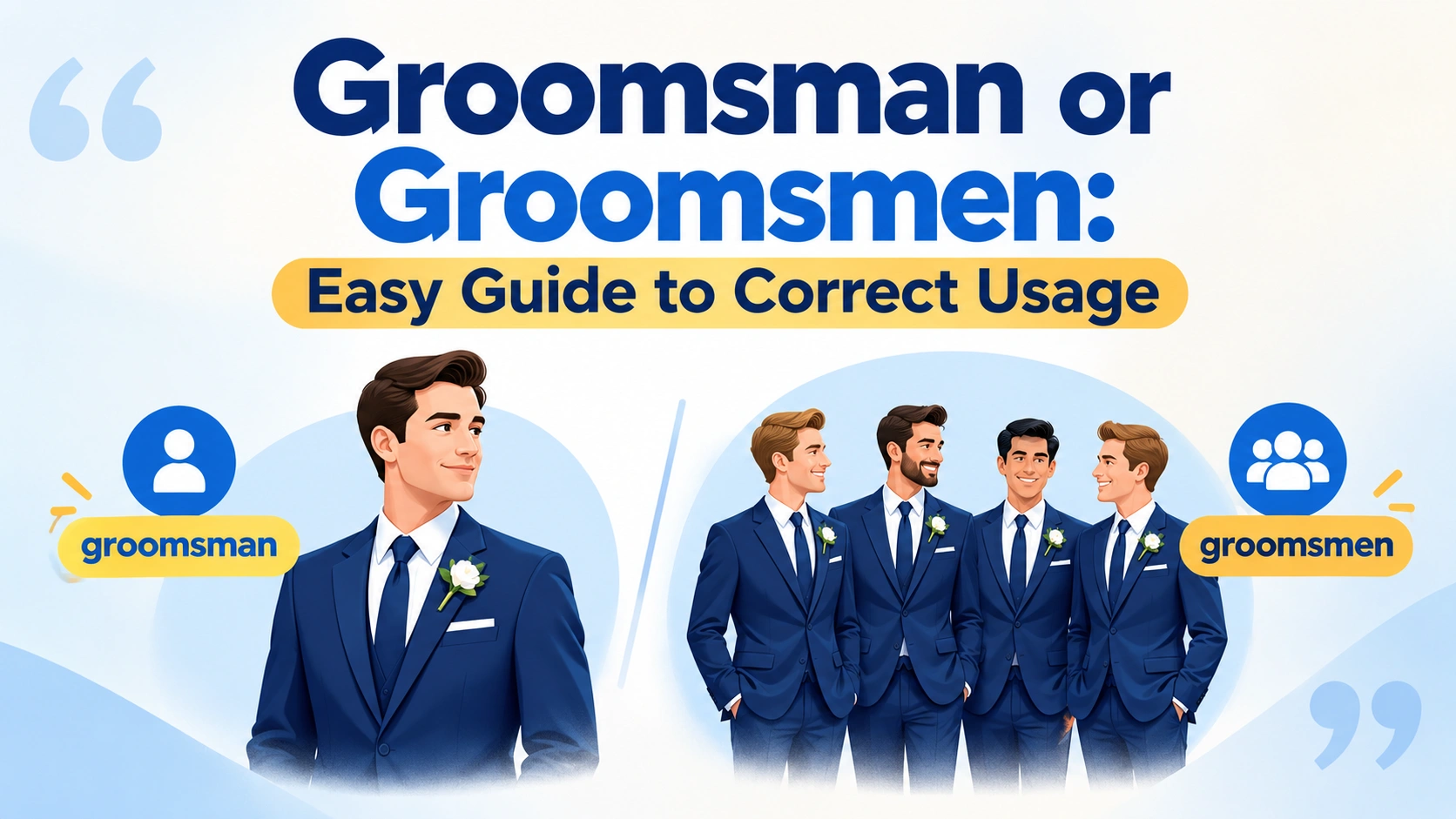
Groomsman or groomsmen—which one should you use? The answer is straightforward once you know whether you are talking about one person or more than one person. Groomsman is the singular noun for one member of the groom’s wedding party, while groomsmen is the plural form for two or more. The difference may seem minor, but it matters in wedding invitations, programs, websites, speeches, emails, and social media posts. A sentence such as “James is a groomsmen” contains a number error, while “The groomsman are ready” has both a noun and verb agreement problem.
The confusion often comes from the unusual plural pattern. English normally forms plurals with -s or -es, but groomsman follows the same pattern as other compounds ending in man: man becomes men. That gives us one groomsman, two groomsmen, not “groomsmans.” There are also a few related distinctions worth knowing. The best man is usually the groom’s principal attendant, whereas the groomsmen are the other members of the groom’s side of the wedding party. And if you are looking for more inclusive wording, a wedding attendant or member of the wedding party may be a better choice.
This guide explains exactly when to use groomsman and groomsmen, how their possessive forms work, why “groomsmans” is incorrect, and how these terms fit into modern wedding language. You will also see realistic examples from wedding programs, invitations, emails, websites, and everyday conversation. By the end, you should be able to choose the right form instinctively—and avoid the small grammatical mistakes that can look surprisingly conspicuous on a carefully prepared wedding document.
Groomsman or Groomsmen: Quick Answer
The easiest rule is:
One person = groomsman. Two or more people = groomsmen.
A groomsman is one male member of the groom’s wedding party.
Example:
“Michael is a groomsman at his brother’s wedding.”
Groomsmen is the plural form and refers to two or more male members of the groom’s wedding party.
Example:
“Michael and David are groomsmen.”
The plural is irregular because groomsman ends in -man. Just as man becomes men, groomsman becomes groomsmen.
| If you mean… | Use… | Example |
| One person | groomsman | “Alex is a groomsman.” |
| Two or more people | groomsmen | “Alex and Ben are groomsmen.” |
| Something belonging to one groomsman | groomsman’s | “The groomsman’s suit is ready.” |
| Something belonging to multiple groomsmen | groomsmen’s | “The groomsmen’s suits are ready.” |
| A broader or gender-neutral role | wedding attendant | “Each wedding attendant has a designated seat.” |
The most important point is that groomsmen is not a singular noun in standard English. If you are referring to one individual, use groomsman.
What Does “Groomsman” Mean?
A groomsman is traditionally a male attendant who is part of the groom’s wedding party. Depending on the couple, culture, ceremony, and personal preferences, groomsmen may help with wedding preparations, attend pre-wedding events, support the groom, participate in photographs, stand with the couple during the ceremony, or assist guests.
The exact responsibilities are not fixed. A wedding party is a social and ceremonial arrangement, so the role can vary considerably from one wedding to another.
For grammar purposes, however, the definition is simple: groomsman is a singular count noun.
You can therefore say:
- “My cousin is a groomsman.”
- “He was chosen as a groomsman.”
- “Each groomsman received a boutonniere.”
- “The groomsman helped the groom prepare.”
- “I asked one groomsman to give a speech.”
Notice that words such as a, each, and one naturally point toward the singular form.
Groomsman as a Singular Noun
Because groomsman refers to one person, it takes singular verbs.
Correct:
- “The groomsman is waiting outside.”
- “A groomsman was assigned to each table.”
- “The groomsman has his suit.”
- “Each groomsman receives a boutonniere.”
The singular possessive is groomsman’s.
Example:
“The groomsman’s speech was heartfelt.”
Here, the speech belongs to one groomsman.
Groomsmen as a Plural Noun
Groomsmen refers to two or more people.
Examples:
- “The groomsmen are arriving at noon.”
- “The groom thanked his groomsmen.”
- “Several groomsmen helped organize the photographs.”
- “All the groomsmen wore matching ties.”
Because groomsmen is plural, it normally takes plural verbs:
- The groomsmen are ready.
- The groomsmen were seated.
- The groomsmen have arrived.
A useful test is to replace the word with they. If “they” makes sense, groomsmen ” is probably the appropriate form.
Groomsman vs. Groomsmen: What’s the Difference?
The difference between groomsman and groomsmen is grammatical rather than conceptual. Both words identify members of the groom’s wedding party. The distinction is simply singular versus plural.
Think of the relationship this way:
groomsman → one
groomsmen → more than one
This is similar to:
- man → men
- policeman → policemen
- businessman → businessmen
- salesman → salesmen
The important point is that the entire compound changes its plural ending. You do not add an ordinary -s to the groomsman.
Why “Groomsmen” Is the Plural of “Groomsman”
The word groomsman is a compound noun made from groom + man. Its plural follows the irregular plural pattern of man.
So:
- one groomsman
- two groomsmen
- several groomsmen
- many groomsmen
Not:
- “groomsmans”
- “groomsman” when referring to multiple people
This is one of those English forms that is easier to remember as a complete pair rather than as a rule you have to reconstruct every time.
Quick memory trick: If there is more than one man, the ending changes to men: groomsman → groomsmen.
Is “Groomsmans” Correct?
No. Groomsmans is not the standard plural form.
The correct plural is groomsmen.
The mistake is understandable because many English nouns simply take -s in the plural. But groomsman belongs to a group of compounds whose plural changes man to men.
Incorrect:
“The groom introduced his groomsmans.”
Correct:
“The groom introduced his groomsmen.”
If you remember only one spelling rule from this article, make it this one: never add -s directly to groomsman to create its standard plural.
How to Choose the Right Word in a Sentence
When you are unsure, do not focus on the wedding context first. Focus on how many people the sentence describes.
If the answer is one, use a groomsman. If the answer is two or more, use groomsmen.
Use “Groomsman” for One Person
Use the singular when referring to an individual.
Examples:
- “Ryan is a groomsman.”
- “One groomsman will accompany the groom.”
- “Each groomsman received a schedule.”
- “Every groomsman should arrive by 3 p.m.”
- “The groomsman standing beside the groom is my brother.”
Words such as one, each, every, a, and another commonly signal that the singular noun is needed.
Use “Groomsmen” for Two or More People
Use the plural when discussing a group.
Examples:
- “The groomsmen arrived early.”
- “Three groomsmen helped decorate the reception area.”
- “Both groomsmen gave speeches.”
- “Several groomsmen traveled from out of town.”
- “All the groomsmen attended the rehearsal.”
Words such as two, three, several, both, many, and all naturally pair with the plural.
Watch the Verb, Too
Choosing the correct noun is only part of the sentence.
Compare:
Singular:
“The groomsman is ready.”
Plural:
“The groomsmen are ready.”
Another pair:
Singular:
“Each groomsman has a boutonniere.”
Plural:
“All the groomsmen have boutonnieres.”
This matters because writers sometimes recognize that groomsmen is plural but accidentally leave a singular verb behind.
Incorrect: “The groomsmen is waiting.”
Correct: “The groomsmen are waiting.”
Groomsman, Groomsmen, Best Man, and Wedding Party: Related Terms Explained
Wedding vocabulary can become confusing because several terms overlap without meaning exactly the same thing.
A groomsman is one member of the groom’s side of the wedding party. Groomsmen is the plural. The best man is traditionally the groom’s principal attendant and is generally understood as holding a distinct role from the other groomsmen.
The broader term wedding party can include the people supporting both the bride and groom, although modern weddings do not always follow traditional terminology.
| Term | Basic meaning | Number | Typical use |
| Groomsman | One male attendant on the groom’s side | Singular | “James is a groomsman.” |
| Groomsmen | Multiple male attendants on the groom’s side | Plural | “The groomsmen are ready.” |
| Best man | Groom’s principal male attendant in a traditional arrangement | Singular | “His brother is the best man.” |
| Wedding party | The larger group of wedding attendants | Collective | “The wedding party posed for photos.” |
| Wedding attendant | A broader term for someone serving in an attendant role | Singular | “Each attendant received a schedule.” |
Is the Best Man a Groomsman?
Traditionally, the best man has a distinct role, but he is also part of the groom’s group of attendants. In everyday descriptions, people may distinguish him from the groomsmen because his title is specifically best man.
For example:
- “The best man gave the toast.”
- “The groomsmen stood beside the groom.”
- “The best man and groomsmen arrived together.”
Whether a particular wedding treats the best man as one of the groomsmen is ultimately a matter of terminology and organization. There is no grammatical rule requiring a particular wedding party structure.
Can Someone Be in the Groom’s Wedding Party Without Being a Groomsman?
Yes. Modern couples often design wedding parties around their relationships rather than traditional labels.
A person may be described as:
- a wedding attendant
- a member of the wedding party
- an attendant of the groom
- a person of honor
- another title chosen by the couple
The important distinction is that grammar determines how a word works, while the couple determines which role names fit their wedding.
Gender-Neutral and Modern Alternatives
Traditional wedding vocabulary often divides attendants into terms associated with the bride or groom. Modern couples may prefer language that reflects the actual people involved rather than a traditional gender structure.
If you need a broader term, wedding attendant is a practical option.
You might write:
“The couple’s wedding attendants will enter before the ceremony.”
Or:
“Members of the wedding party should arrive by 2 p.m.”
These alternatives are particularly useful when a wedding party includes people who do not identify with traditional gendered labels or when the couple simply prefers neutral terminology.
When “Wedding Attendant” May Be Better
Choose a broader term when:
- the wedding party is mixed-gender;
- the couple wants inclusive wording;
- a formal document needs a neutral umbrella term;
- traditional titles do not accurately describe the roles;
- The couple has created customized wedding-party positions.
There is no need to replace groomsman when the traditional term accurately describes the role. Inclusive language is a contextual choice, not a reason to declare traditional terminology grammatically wrong.
Common Mistakes With Groomsman and Groomsmen
Mistake 1: Writing “Groomsmans”
This is the most obvious spelling error.
Incorrect:
“We have six groomsmans.”
Correct:
“We have six groomsmen.”
The plural ending comes from man → men, not man + s.
Mistake 2: Using “Groomsmen” for One Person
Incorrect:
“James is a groomsmen.”
Correct:
“James is a groomsman.”
A quick substitution test helps. You would say “James is a man,” not “James is a man.” The same singular structure applies to groomsmen.
Mistake 3: Using “Groomsman” for a Group
Incorrect:
“The groomsman are getting ready.”
Correct:
“The groomsmen are getting ready.”
If the subject represents several people, the noun must be plural.
Mistake 4: Using the Wrong Verb
A plural noun needs a plural verb in ordinary subject–verb constructions.
Incorrect:
“The groomsmen are waiting.”
Correct:
“The groomsmen are waiting.”
Likewise:
Incorrect: “The groomsmen are ready.”
Correct: “The groomsman is ready.”
Mistake 5: Confusing “Groomsmen” With “Best Man”
The terms are related, but they are not interchangeable.
The best man identifies a particular role.
Groomsmen identify multiple members of the groom’s attendants.
So a wedding program might list:
- Best Man — Daniel Smith
- Groomsmen — Michael Lee, James Carter, Ryan Patel
The exact organization can vary, but the terms themselves have different meanings.
Mistake 6: Misusing the Possessive Forms
This mistake is easy to overlook.
For one groomsman:
groomsman’s
“The groomsman’s jacket was hanging in the room.”
For multiple groomsmen:
groomsmen’s
“The groomsmen’s jackets were hanging in the room.”
The apostrophe comes after groomsmen because groomsmen is already the plural form.
Not: “groomsmens’”
Groomsman and Groomsmen in Real-World Writing
The correct form becomes especially important in wedding materials because these documents are often printed, shared publicly, or kept as keepsakes.
Wedding Invitations
Most invitations do not need to mention individual groomsmen unless the design specifically includes the wedding party.
If they are mentioned, use the number appropriate to the context:
“Our groomsmen will join us during the ceremony.”
If referring to one:
“Our brother Daniel will serve as a groomsman.”
Wedding Programs
Programs often use headings such as:
Wedding Party
Best Man: Daniel Smith
Groomsmen: Michael Lee, James Carter, Ryan Patel
If the program introduces one individual in a sentence, use the singular:
“Michael Lee, groomsman and longtime friend of the groom.”
A heading can be plural even when the names beneath it are listed individually because the heading describes the group category.
Wedding Websites
Wedding websites often use informal introductions:
“Meet the groomsmen.”
Individual profiles can then use:
“James has been friends with the groom since college and is honored to be a groomsman.”
This is a good example of how both forms can appear naturally on the same page.
Emails and Messages
Wedding planning creates plenty of practical communication.
Singular:
“Could you ask the groomsman assigned to the first-row seating to arrive early?”
Plural:
“I’ll send the schedule to all the groomsmen tonight.”
The distinction is the same even in casual writing.
Social Media Posts
Social posts do not require special grammar simply because they are informal.
Natural examples:
- “So grateful to have these groomsmen by my side.”
- “Honored to stand as a groomsman for my best friend.”
- “The groomsmen are ready for the big day.”
Informality can change punctuation, capitalization, or style, but it does not change the standard singular/plural forms.
Formal Documents
For contracts, schedules, programs, or venue documents, consistency is particularly useful.
If the document uses Groomsmen as a category heading, keep that label consistent throughout the document. If individual responsibilities are assigned, use groomsman for each person.
A polished document should distinguish clearly between:
- the role category;
- individual people;
- collective instructions;
- possessive references.
Groomsman and Groomsmen in Possessive Constructions
Possessives deserve their own attention because the irregular plural can make the punctuation less intuitive.
Singular Possessive: “Groomsman’s”
Use groomsman’s when something belongs to one groomsman.
Examples:
- “The groomsman’s suit was tailored yesterday.”
- “The groomsman’s speech was scheduled for 8 p.m.”
- “A groomsman’s responsibilities may vary.”
- “We found the groomsman’s missing tie.”
The formula is:
groomsman + ’s = groomsman’s
Plural Possessive: “Groomsmen’s”
Use groomsmen’s when something belongs to two or more groomsmen collectively.
Examples:
- “The groomsmen’s suits matched.”
- “The groomsmen’s photographs were displayed at the reception.”
- “The groom organized the groomsmen’s transportation.”
- “The groomsmen’s room is upstairs.”
The formula is:
groomsmen + ’s = groomsmen’s
This may look unusual because groomsmen already ends in n, but the possessive construction is straightforward: the irregular plural does not end in s, so the possessive uses ’s.
Plural vs. Plural Possessive
Compare these carefully:
Groomsmen = the people
“The groomsmen arrived.”
Groomsmen’s = something belonging to the people
“The groomsmen’s suits arrived.”
That distinction is useful far beyond wedding vocabulary. It is the same grammatical principle used with other irregular plurals such as children’s and men’s.
Groomsman or Groomsmen in Titles, Lists, and Headings
Headings can make writers second-guess the singular/plural distinction because headings are often shortened.
If you are introducing several people, Groomsmen is appropriate:
Meet the Groomsmen
If you are discussing the role generally, Groomsman Responsibilities can also be grammatical because the singular noun can function as a category label.
For example:
Groomsman Responsibilities
Each groomsman should arrive 30 minutes before the ceremony.
Here, the heading describes the role in general rather than one particular person.
Similarly:
Groomsmen Attire
works naturally when discussing clothing for the group.
The key is to ask what the heading actually represents. Headings can function as labels, so they do not always follow the same sentence structure as a complete statement.
A Simple Decision Rule You Can Use Every Time
If you encounter groomsman/groomsmen while writing, use this five-second check:
- Am I talking about one person?
→ Use a groomsman. - Am I talking about two or more people?
→ Use groomsmen. - Does something belong to one person?
→ Use groomsman’s. - Does something belong to multiple groomsmen?
→ Use groomsmen’s. - Do I need a broader or more inclusive term?
→ Consider a wedding attendant or member of the wedding party.
A Fast Decision Table
| What you mean | Correct form | Example |
| One male attendant | groomsman | “He is a groomsman.” |
| Several male attendants | groomsmen | “They are groomsmen.” |
| One person’s belongings | groomsman’s | “The groomsman’s tie.” |
| Several people’s belongings | groomsmen’s | “The groomsmen’s ties.” |
| One person has a role | groomsman is | “The groomsman is ready.” |
| Several people have a role | groomsmen are | “The groomsmen are ready.” |
| Neutral/broad role | wedding attendant | “The attendant will enter first.” |
Common Misconceptions About Groomsman and Groomsmen
“Groomsmen” Can Be Used for One Person Because It Sounds Like a Job Title
No. In standard English, groomsmen is plural. A job title or role label does not automatically become singular simply because it describes someone’s position.
Use a groomsman for one individual.
“Groomsmans” Is Acceptable in Informal Writing
It is not the standard plural form. Even in a casual text, groomsmen is the conventional English form.
Informal writing can relax punctuation and style, but it does not normally change an established irregular plural into a nonstandard one.
“Best Man” and “Groomsman” Mean Exactly the Same Thing
They are related but distinct terms. The best man traditionally has a particular position within the groom’s attendants. Groomsman is the general term for one of the male attendants.
Every Wedding Must Use the Traditional Terms
Not necessarily. Couples can choose terminology that reflects their relationships, ceremony, and preferences. Wedding attendants and members of the wedding party are useful broader alternatives.
Practical Editing Tips for Wedding Writers
If you are proofreading a wedding website, program, invitation, or announcement, search specifically for the following errors.
Check the Number
Look for:
- “a groomsmen”
- “one groomsmen”
- “the groomsman” when clearly referring to several people
Then check whether the surrounding verbs agree.
Check the Plural Spelling
Search for:
- “groomsmans”
- “groomsmens”
Both should raise a red flag.
Check Possessives
Distinguish:
- groomsman’s — one person
- groomsmen’s — several people
This is particularly important in phrases involving suits, speeches, rooms, schedules, photographs, and transportation.
Keep Wedding Terminology Consistent
If a couple chooses wedding attendants instead of traditional gendered titles, use the preferred terminology consistently throughout the website and printed materials.
The best editorial choice is not always the most traditional one. It is the one that is grammatically correct, contextually appropriate, and consistent with the couple’s own terminology.
Groomsman or Groomsmen: Quick Reference
| Word or phrase | Correct? | Why |
| groomsman | Yes | Singular |
| groomsmen | Yes | Plural |
| groomsmans | No | Incorrect plural formation |
| groomsmens | No | Incorrect plural spelling |
| a groomsman | Yes | One person |
| two groomsmen | Yes | Multiple people |
| the groomsman is | Yes | Singular agreement |
| the groomsmen are | Yes | Plural agreement |
| groomsman’s suit | Yes | One groomsman’s suit |
| groomsmen’s suits | Yes | Suits belonging to multiple groomsmen |
| best man | Yes | Distinct traditional role |
| wedding attendant | Yes | Broader, more neutral term |
Conclusion:
Choosing between groomsman and groomsmen becomes easy once you stop treating them as competing words and recognize that they are simply the singular and plural forms of the same role. One person is a groomsman; two or more are groomsmen. Their possessive forms follow the same logic: groomsman’s for one person and groomsmen’s for a group. The traditional best man is a related but distinct role, while wedding attendant offers a broader alternative when traditional terminology does not fit.One final actionable tip: before publishing a wedding program, invitation, or website, check every occurrence of the word against the number of people it describes. A common mistake to avoid is writing “groomsmans” or using “groomsmen” for a single person. Once that simple number check becomes automatic, you will rarely have to think twice about this distinction.
FAQs
Q1. Is “groomsman” singular or plural?
Groomsman is singular. It refers to one male member of the groom’s wedding party. For example, “David is a groomsman.” Its plural is groomsmen, following the irregular man → men pattern found in other compound nouns.
Q2. Is “groomsmen” singular or plural?
Groomsmen is plural and refers to two or more male wedding attendants. You would say “The groomsmen are ready,” not “The groomsmen is ready.” For one person, use a groomsman. The distinction is based entirely on grammatical numbers.
Q3. What is the plural of groomsman?
The plural of groomsman is groomsmen. The form does not take a regular -s. This follows the same basic pattern as man → men. Therefore, “groomsmans” is not the standard plural, even though adding -s may seem intuitive.
Q4. How do you make “groomsman” possessive?
For one person, use groomsman’s: “the groomsman’s suit.” For several people, use groomsmen’s: “the groomsmen’s suits.” Because groomsmen is an irregular plural that does not end in s, its possessive takes ’s.
Q5. What is a gender-neutral alternative to “groomsman”?
Useful alternatives include wedding attendant, attendant, and member of the wedding party. The best choice depends on the context and the couple’s preferences. These terms can be especially helpful when a wedding party does not follow traditional gender-based role names.