
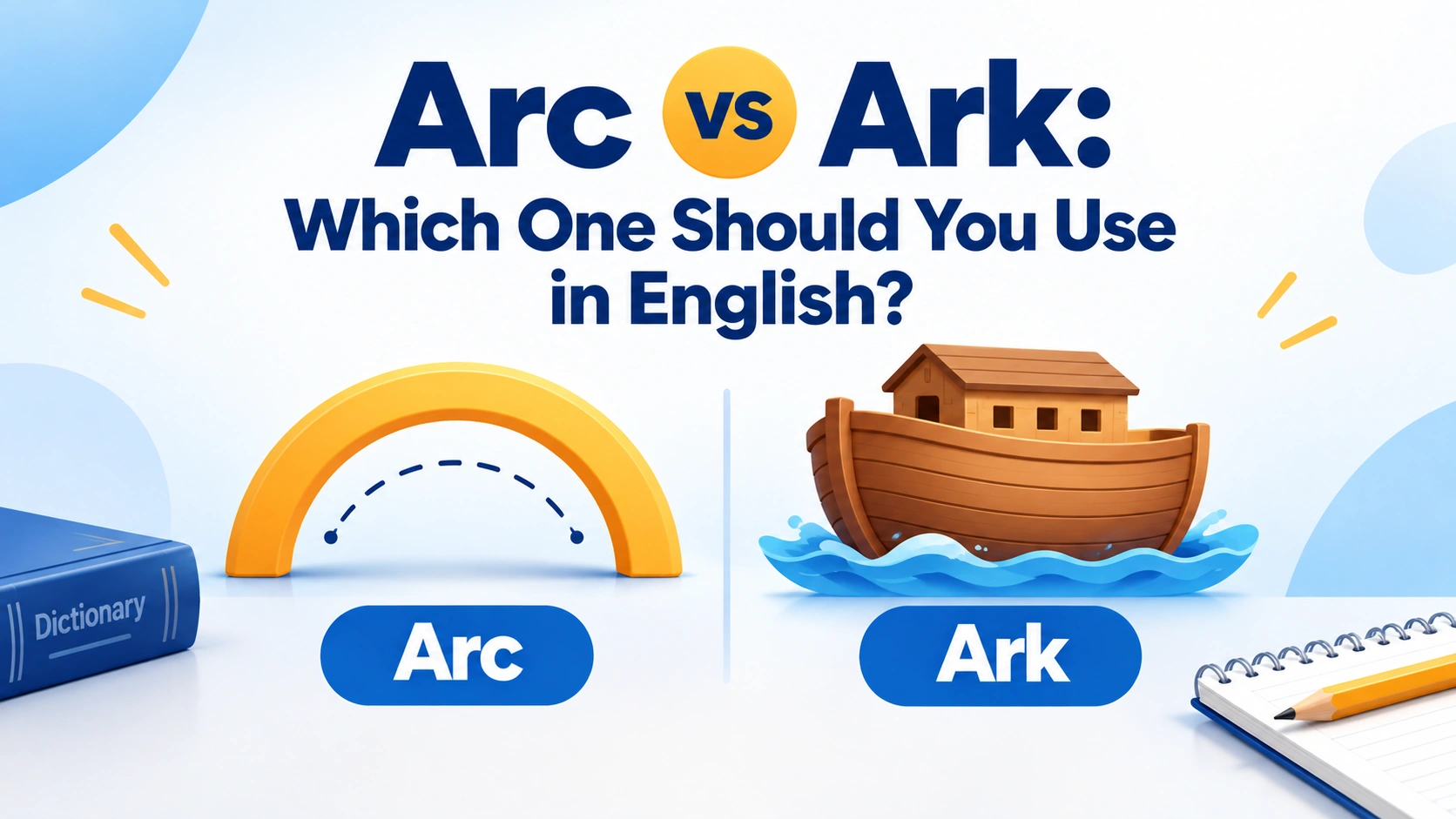
Arc vs Ark is a surprisingly common spelling question because the two words sound identical in many English accents but refer to completely different things. Arc usually describes a curve, a curved path, or a progression such as a character’s development in a story. Ark, by contrast, usually refers to a vessel, especially Noah’s Ark, or to a sacred chest in certain religious contexts. Since both spellings are legitimate English words, spellcheck alone may not catch the wrong choice. The reliable solution is to identify the meaning you intend before choosing the spelling.
The distinction becomes especially important because arc appears across several fields. In geometry, it can mean part of a circle; in sports, it describes a ball’s curved flight; in storytelling, it refers to character or plot development; and in electricity, an electrical arc is a type of discharge. Ark has a much narrower everyday range, but it has more than one historical meaning. Understanding these contexts makes the spelling difference much easier to remember—and helps you avoid errors such as “character ark” or “Noah’s Arc.”
This guide explains arc and ark from the ground up, including their definitions, origins, pronunciation, technical uses, biblical meanings, and relationship to the similarly confusing word arch. You’ll also find practical examples, comparison tables, a decision guide, common mistakes, and a short proofreading checklist. By the end, you should be able to choose the correct word instinctively: arc for a curve or progression, ark for a vessel or sacred chest.
Quick Answer: Arc vs Ark
The simplest distinction is:
Arc = a curve, curved path, or progression.
Ark = a vessel or sacred chest.
Consider these examples:
- The basketball traveled in a high arc.
- The character has a compelling emotional arc.
- The diagram shows an arc of a circle.
- Noah built an ark.
- The story describes the Ark of the Covenant.
The words are homophones in many varieties of English, meaning they are pronounced alike even though they have different spellings and meanings.
Arc vs Ark at a Glance
| Word | Main meaning | Typical contexts | Example |
| arc | A curve, curved path, or progression | Geometry, sports, storytelling, physics, electricity | The ball followed a wide arc. |
| ark | A vessel or sacred chest | Biblical, religious, historical contexts | The animals entered the ark. |
The Fastest Memory Rule
Think of arc as something that curves.
Think of ark as something that carries.
That single distinction will solve most arc/ark questions.
What Does “Arc” Mean?
The noun arc fundamentally refers to a curved line or portion of a curve. The word can describe something physically curved, something moving along a curved path, or something developing progressively over time.
Its meaning has expanded far beyond basic geometry. You can encounter arc in a mathematics textbook, a sports report, a novel review, an engineering document, or a physics discussion. The individual meanings differ, but they retain a useful underlying idea: a path or form that curves or progresses from one point toward another.
Arc as a Curved Shape
In everyday English, arc can describe a curved line or form.
For example:
- The rainbow formed a bright arc across the sky.
- A graceful arc appeared above the doorway.
- The wire bends into an arc.
- The bridge creates a broad arc over the river.
In these sentences, arc refers to the shape itself.
Arc as a Curved Path
An object does not have to be curved for arc to describe it. The word can refer to the path an object follows.
For example:
- The stone traveled through the air in a shallow arc.
- The ball rose in a high arc before dropping.
- The water followed an arc as it left the fountain.
This sense is particularly common when describing motion and trajectories.
Arc as a Development or Progression
English also uses arc figuratively for a sequence of development over time.
That is why we talk about:
- a character arc
- a story arc
- a plot arc
- an emotional arc
- a career arc
Here, the word does not describe a literal curved line. Instead, it describes how something moves from one state or stage to another.
For example:
The protagonist’s emotional arc is the most convincing part of the novel.
The character does not physically curve. The development of the character is what follows an arc.
Arc in Mathematics and Geometry
One of the most precise uses of arc occurs in geometry.
What Is an Arc in Geometry?
In geometry, an arc is a portion of the circumference of a circle. If two points are marked on a circle, the curved portion connecting them can be described as an arc.
This is different from a straight-line chord, which connects the same two points directly through the interior of the circle.
For example:
- A circle is the complete curved figure.
- Its circumference is the entire boundary.
- An arc is a selected portion of that boundary.
- A chord is a straight segment joining two points on the circle.
That distinction matters in geometry because these terms describe different objects.
Minor Arc, Major Arc, and Semicircle
Arcs can be classified according to how much of a circle they contain.
Minor Arc
A minor arc is the shorter arc between two points on a circle, normally measuring less than 180°.
Major Arc
A major arc is the longer route between the same two points, normally measuring more than 180°.
Semicircle
A semicircle corresponds to an arc measuring 180°. It represents half of a circle.
The terminology becomes especially useful when solving geometry problems involving central angles, arc measures, chords, and sectors.
What Is Arc Length?
Arc length is the distance measured along a curved portion of a circle.
For an angle measured in radians, the standard formula is:
Arc length = rθ
where:
- r = radius
- θ = central angle in radians
If the angle is given in degrees, it can first be converted to radians, or the equivalent degree-based formula can be used:
Arc length = (θ/360°) × 2πr
The important vocabulary point is that the word is always arc, not ark.
Real-World Uses of Geometric Arcs
Arcs are not limited to classroom diagrams. They appear in:
- Mechanical design
- Circular tracks
- Wheels and gears
- Engineering drawings
- Computer graphics
- Architecture
- Road and bridge design
When a professional describes part of a circular boundary or a curved geometric path, arc is the appropriate technical term.
Arc in Storytelling: Character Arc and Story Arc
One of the most important non-mathematical meanings of arc appears in literature, film, television, and other narrative forms.
What Is a Character Arc?
A character arc is the pattern of change, development, or realization a character experiences during a story.
A character might:
- overcome a weakness,
- develop a new understanding,
- become more confident,
- make increasingly harmful choices,
- lose an important belief,
- or deliberately remain unchanged while influencing others.
The key idea is development across time.
For example:
The protagonist’s character arc begins with fear and ends with greater confidence.
The word arc works because the character moves through a recognizable progression.
What Is a Story Arc?
A story arc or plot arc describes the development of a larger narrative.
It can cover:
- a short sequence of events,
- an entire novel,
- a television season,
- or a multi-part fictional storyline.
For example:
The first three chapters establish the central story arc.
Here, arc describes the narrative’s progression rather than a physical curve.
Positive, Negative, and Flat Character Arcs
Writers and critics often discuss several broad types of character development.
Positive Character Arc
The character changes in a constructive way, often through learning or overcoming a limitation.
Negative Character Arc
The character moves toward a damaging belief, decision, or outcome.
Flat Character Arc
The character remains relatively consistent but uses their established values to influence the surrounding world.
These categories are useful in literary analysis because arc captures the direction and shape of character development.
Common Storytelling Examples
- Her character arc feels gradual rather than forced.
- The novel’s emotional arc is particularly strong.
- The final chapter completes the protagonist’s story arc.
- The writer gives each major character a distinct arc.
If you’re writing about fiction, remember: character arc, never character ark.
Arc in Physics, Electricity, and Science
The word arc also has specialized scientific meanings.
What Is an Electrical Arc?
An electrical arc is an electrical discharge that travels across a gap, typically through ionized gas.
You may encounter the term in discussions of:
- electrical equipment,
- high-voltage systems,
- welding,
- circuit protection,
- industrial safety,
- and electrical engineering.
The important point for spelling is straightforward: the technical term is arc.
For example:
The equipment was designed to reduce the risk of electrical arcing.
Arc in Physics
Physics also uses arc when describing curved paths or geometric relationships.
For example:
- The projectile followed an arc.
- The particle’s path was approximated by an arc.
- The sensor measures movement along a circular arc.
Technical vocabulary does not change the spelling. Whether you’re discussing a novel or an electrical system, arc remains arc.
Arc in Sports and Movement
Sports writers frequently use arc to describe the trajectory of a ball or another moving object.
Arc as a Ball’s Flight Path
You might hear:
- The shot had a high arc.
- The quarterback threw the ball with a low arc.
- The ball traveled in a shallow arc.
- The kick sent the ball over the defenders in a high arc.
The word describes the shape of the flight path.
High Arc vs Low Arc
These descriptions can communicate different types of movement.
A high arc indicates that the object rises relatively high before descending.
A low arc indicates a flatter trajectory.
The exact physics varies according to speed, angle, gravity, air resistance, and the object involved, but the language remains consistent: the curved path is an arc.
Practical clue: If you can picture an object moving along a curve, arc is almost certainly the word you need.
What Does “Ark” Mean?
Unlike arc, ark has a much narrower range of modern meanings.
Its most familiar meaning is a large vessel, especially the vessel associated with Noah in the biblical account. It can also refer to a chest or sacred container, particularly in religious or historical contexts.
Ark as a Vessel
The best-known example is:
Noah’s Ark
In the biblical narrative, Noah’s Ark is the vessel associated with Noah, his family, and the animals during the Flood.
For modern English readers, this is by far the strongest association of the word ark.
For example:
- The children learned the story of Noah’s Ark.
- The museum displayed a model of the ark.
- The illustration showed animals entering the ark.
Ark as a Sacred Chest
There is another important sense that readers sometimes overlook.
Ark can refer to a sacred chest or container, particularly in biblical or religious contexts.
The most famous example is the:
Ark of the Covenant
This is not the same object as Noah’s vessel. The word ark is used for a sacred chest, illustrating that the English word has more than one historical religious application.
Ark Is Not a General Synonym for “Boat”
A useful distinction is that ark is not normally used as an everyday substitute for boat, ship, or vessel.
You would not normally write:
We took an ark across the lake.
That sounds unnatural unless the context deliberately uses ark in a special, historical, fictional, or metaphorical way.
In ordinary modern English, use boat, ship, or vessel according to the situation.
Arc vs Ark: The Exact Difference
The two words belong to different semantic categories despite their similar sound.
| Question | Arc | Ark |
| What does it describe? | A curve, path, or progression | A vessel or sacred chest |
| Is it common in technical writing? | Yes | Less commonly |
| Is it used in mathematics? | Yes | No |
| Is it used in storytelling? | Yes | No, except as a literal reference |
| Is it associated with Noah? | No | Yes |
| Is it used for electrical phenomena? | Yes | No |
| Typical phrase | character arc | Noah’s Ark |
| Basic memory idea | Curve/development | Vessel/container |
The Difference in One Sentence
Arc describes something that curves or develops; ark names a vessel or, in religious contexts, a sacred chest.
Arc or Ark? How to Choose the Correct Word
When you’re unsure, don’t rely on pronunciation. Instead, identify the concept behind the sentence.
Choose Arc for a Curve
Use arc when referring to:
- part of a circle,
- a curved line,
- a curved trajectory,
- a ball’s flight,
- or another curved path.
Example:
The arrow traveled in a smooth arc.
Choose Arc for Development
Use arc when referring to:
- character development,
- plot progression,
- emotional development,
- narrative structure,
- or another progression over time.
Example:
The protagonist’s arc becomes clearer in the final chapters.
Choose Ark for a Vessel
Use ark when referring to:
- Noah’s vessel,
- a historically or religiously named ark,
- or a deliberately metaphorical vessel based on that sense.
Example:
The story describes animals being taken aboard the ark.
Choose Ark for a Sacred Chest
Use ark in established religious or historical expressions such as Ark of the Covenant.
A Simple Decision Test
Ask yourself:
Does the word mean “curve” or “development”?
→ Arc
Does it mean “vessel” or “sacred chest”?
→ Ark
This test is more reliable than trying to remember how either word sounds.
Arc vs Ark vs Arch: Three Words Worth Keeping Separate
Arc, ark, and arch are easy to mix up because they look and sound similar. Their meanings, however, are distinct.
Arc
A curve, curved path, or progression.
The story has a satisfying character arc.
Ark
A vessel or sacred chest.
Noah’s Ark is described in the biblical account.
Arch
A curved structure or curved architectural form.
The entrance has a stone arch.
Comparison Table
| Word | Core meaning | Typical context | Example |
| arc | Curve, curved path, progression | Geometry, sports, stories | The ball followed an arc. |
| ark | Vessel or sacred chest | Religion, history | The animals entered the ark. |
| arch | Curved structure/form | Architecture, construction | The doorway has an arch. |
Why Arc and Arch Are Sometimes Confused
The meanings of arc and arch can overlap when describing curved forms, but they are not interchangeable.
An arc is commonly a geometric curve or part of a curve.
An arch is commonly a curved structure, especially one that spans an opening.
So:
- an arc of a circle → correct
- a stone arch over a doorway → correct
- a character arc → correct
- Noah’s Ark → correct
Common Arc vs Ark Mistakes
Mistake 1: Writing “Character Ark”
Incorrect:
The hero’s character ark is fascinating.
Correct:
The hero’s character arc is fascinating.
The sentence concerns development, so arc is required.
Mistake 2: Writing “Noah’s Arc”
Incorrect:
Noah’s Arc carried the animals.
Correct:
Noah’s Ark carried the animals.
The word refers to a vessel, so the spelling is ark.
Mistake 3: Using Ark for a Curved Trajectory
Incorrect:
The basketball traveled in a high ark.
Correct:
The basketball traveled in a high arc.
A ball’s flight path can curve, making arc the correct choice.
Mistake 4: Using Arc for a Biblical Vessel
Incorrect:
The animals entered the arc.
Correct:
The animals entered the ark.
The intended object is a vessel.
Mistake 5: Confusing Arc With Arch
Incorrect:
The architect designed a stone arc over the entrance.
If the writer means the structural feature spanning the entrance, arch is usually the better word.
Correct:
The architect designed a stone arch over the entrance.
The distinction depends on what exactly is being described.
Mistake 6: Assuming Spellcheck Will Catch the Error
This is one of the more important practical problems.
Both arc and ark are correctly spelled English words. A spellchecker can therefore see:
The character has an interesting ark.
and conclude that there is no spelling error.
The problem is meaning, not spelling validity.
Why Spellcheck May Not Save You
Homophones create a special proofreading challenge because automated spelling tools may not know which legitimate word you intended.
Consider:
The novel follows the hero’s character ark.
Every word is spelled correctly according to a dictionary. Yet the sentence contains a contextual error.
A Better Proofreading Strategy
When proofreading a sentence containing a potentially confusing homophone:
- Ignore the spelling temporarily.
- Ask what the word means.
- Replace it mentally with a simpler word.
- Check whether the sentence still makes sense.
- Restore the precise term.
For example:
The hero’s character ___ changes dramatically.
Replace the blank with development.
That meaning points clearly to arc.
For:
The animals entered the ___.
Replace it with a vessel.
That points to ark.
Expert proofreading tip: For homophones, proofread for semantic accuracy, not just dictionary spelling.
Where Arc and Ark Come From
The words have different histories despite their similar modern pronunciation.
Origin of Arc
Arc entered English through French and ultimately traces back to Latin arcus, associated with a bow or curved form.
That historical association helps explain the word’s connection with:
- curves,
- bows,
- circular portions,
- and curved trajectories.
Its modern technical and figurative senses developed from the underlying idea of curvature or a path.
Origin of Ark
Ark has a separate history. The English word is connected with older terms for a chest, box, or vessel and became especially prominent through biblical usage.
That history helps explain why ark can refer to both:
- a vessel, as in Noah’s Ark, and
- a sacred chest, as in the Ark of the Covenant.
The similarity between arc and ark in modern English is therefore not a reason to treat them as related meanings.
Does Similar Sound Mean Similar Origin?
No.
English contains many words that sound alike while having unrelated meanings and histories. Pronunciation alone cannot establish a word’s etymology.
That is precisely why arc and ark need to be learned as separate vocabulary items.
British English vs American English: Arc and Ark
There is no major British-versus-American spelling distinction here.
Both standard British English and American English use:
- arc
- ark
So this is not a case like colour/color or centre/center, where regional spelling conventions explain the difference.
What About Pronunciation?
Pronunciation can vary by accent, particularly in the vowel sound. In many varieties of English, however, arc and ark are pronounced the same.
The practical lesson is simple:
Do not try to determine the spelling from the accent. Determine it from the meaning.
Related Words and Useful Alternatives
Words Related to Arc
Depending on the context, related vocabulary includes:
- curve
- trajectory
- bend
- bow
- arc-shaped
- arc length
- arced
- arcing
- character arc
- story arc
- plot arc
Not all of these are exact synonyms. For example, trajectory describes a path of motion, while arc emphasizes its curved form.
Words Related to Ark
Related terms include:
- vessel
- boat
- ship
- chest
- container
- Noah’s Ark
- Ark of the Covenant
Again, context matters. Vessel is broader than ark, while boat is an everyday word that does not carry the same historical or biblical associations.
Are Arc and Ark Synonyms?
No.
They are not synonyms, even though they can sound alike.
- Arc belongs primarily to the semantic fields of curves, movement, development, mathematics, science, and storytelling.
- Ark belongs primarily to the semantic fields of vessels, biblical history, religion, and sacred containers.
Real-World Examples: Which Word Fits?
| Situation | Correct word | Example |
| Geometry problem | arc | Calculate the length of the arc. |
| Basketball trajectory | arc | The shot had a high arc. |
| Novel analysis | arc | Her character arc is subtle. |
| TV storyline | arc | The season’s main story arc is resolved. |
| Electrical engineering | arc | The system helps prevent electrical arcing. |
| Noah’s vessel | ark | The animals entered Noah’s Ark. |
| Biblical sacred chest | ark | The Ark of the Covenant has religious significance. |
| Curved doorway structure | arch | The building has a stone arch. |
This table reveals an important pattern: context determines the word far more reliably than pronunciation.
A Five-Second Proofreading Checklist
Before publishing or submitting your writing, use this quick check:
- Curve? → arc
- Part of a circle? → arc
- Curved flight path? → arc
- Character development? → arc
- Story progression? → arc
- Electrical discharge? → arc
- Noah’s vessel? → ark
- Sacred biblical chest? → ark
- Curved architectural structure? → arch
If none of those clues seems to fit, stop and examine the sentence rather than choosing based on sound.
Practice Quiz: Arc or Ark?
Fill in each blank with arc, ark, or, where appropriate, arch.
- The basketball followed a high ___ toward the basket.
- Noah’s ___ is central to the biblical story.
- The protagonist’s character ___ develops gradually.
- The diagram shows a quarter ___ of a circle.
- The electrical ___ damaged the equipment.
- The animals were taken aboard the ___.
- The novel has a compelling emotional ___.
- The old building has a stone ___ above the entrance.
- The story discusses the Ark of the ___.
- The projectile traveled in a curved ___.
Quiz Answers
- arc — a curved flight path
- ark — Noah’s vessel
- arc — character development
- arc — part of a circle
- arc — electrical discharge
- ark — vessel
- arc — emotional development
- arch — structural feature
- Covenant — the established expression is Ark of the Covenant
- arc — curved trajectory
The useful lesson is not simply memorizing the answers. Look at the semantic clue in each sentence. That is the same strategy you can use when proofreading your own writing.
Conclusion:
Choosing between arc and ark becomes straightforward once you stop listening for the spelling and start identifying the meaning. Use arc for a curve, curved path, character development, story progression, or electrical discharge. Use ark for a vessel such as Noah’s Ark, or for a sacred chest such as the Ark of the Covenant. And if you are describing a curved architectural structure, check whether arch is actually the word you need.One final actionable tip: whenever you encounter one of these homophones, replace it mentally with a plain-English clue such as curve, development, vessel, or chest. A common mistake to avoid is trusting spellcheck simply because the word is spelled correctly. The best proofreading checks whether the word is correct for the meaning, not merely whether it exists. When the meaning is clear, the spelling usually follows.
FAQs
Q1. What is the main difference between arc and ark?
Arc refers to a curve, curved path, or progression, while ark usually refers to a vessel or, in religious contexts, a sacred chest. For example, a character has a character arc, while Noah’s vessel is Noah’s Ark.
Q2. Is “Noah’s Arc” ever correct?
For the biblical vessel, the standard spelling is Noah’s Ark, with a K. Arc is a different word associated with curves and progressions. “Noah’s Arc” could only be intentional wordplay or a creative title, not the standard biblical name.
Q3. Why are arc and ark pronounced the same?
In many English accents, arc and ark have the same pronunciation. They are therefore homophones in those varieties. Their similar sound does not mean they have similar meanings. Writers must use context and meaning to select the correct spelling.
Q4. Can “ark” mean something other than Noah’s boat?
Yes. Ark also has a religious and historical sense referring to a sacred chest or container, most famously the Ark of the Covenant. Noah’s Ark and the Ark of the Covenant are therefore references to different objects.
Q5. Is “arc” the same as “arch”?
No. An arc is commonly a curve or part of a curve, while an arch generally refers to a curved structure spanning an opening. They can overlap when discussing shapes, but character arc, circular arc, and stone arch are distinct expressions.