

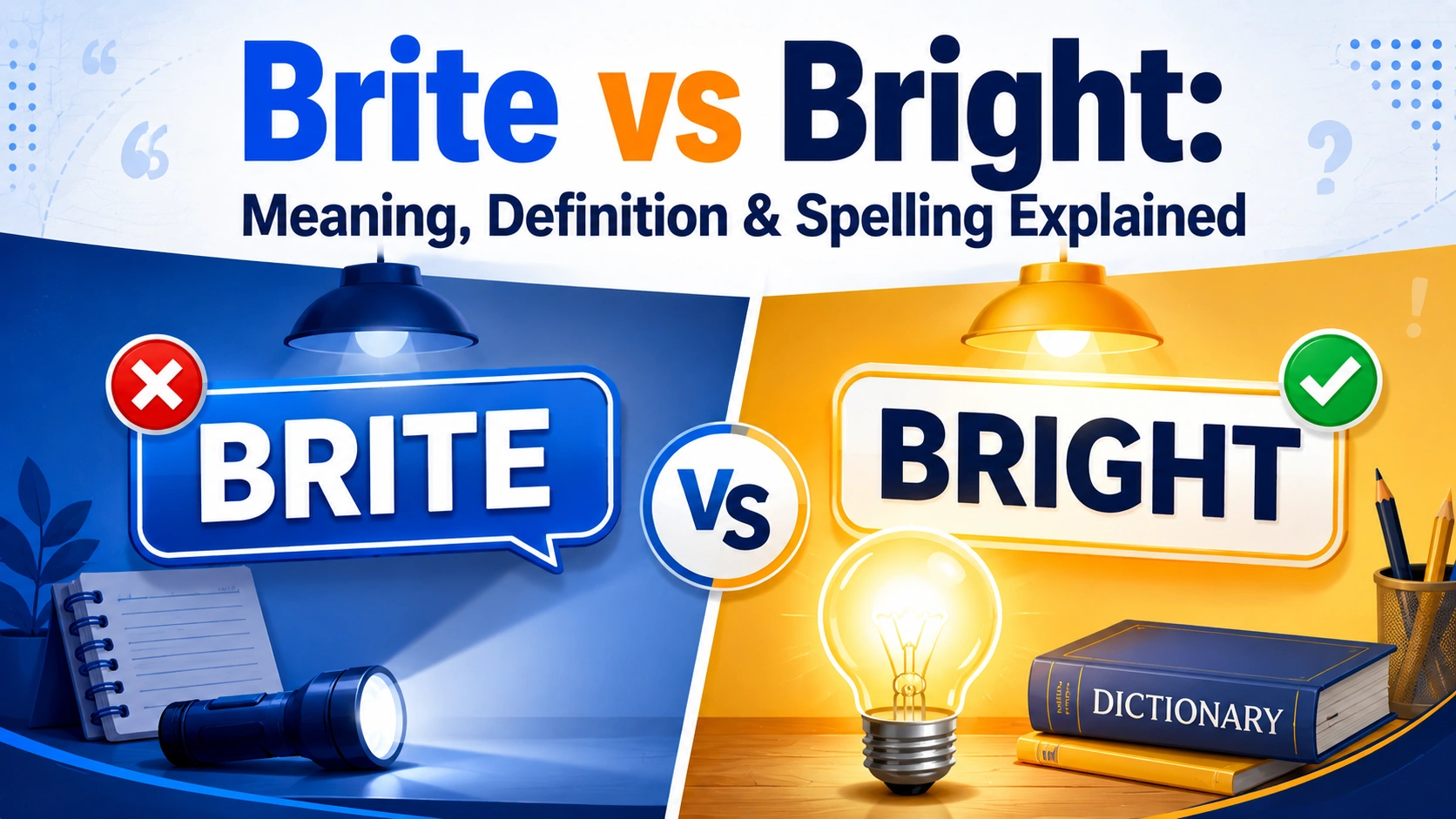
Brite vs Bright can be confusing because the two forms are pronounced alike in many English contexts, yet they do not have the same status in standard English writing. Bright is the established English adjective used for light, vivid colors, intelligence, cheerfulness, and promising prospects. Brite, meanwhile, is most often encountered as a stylized spelling in names, branding, advertising, and other specialized contexts.
That distinction matters because seeing Brite on packaging, in a company name, or online can make an unusual spelling look like a normal alternative. It is not safe to assume that every familiar-looking form belongs in ordinary prose. If you are writing an essay, email, report, article, or school assignment, bright is normally the form you want. If you are reproducing an official name, however, changing its spelling may be the actual mistake.
There is also more history behind this pair than a simple “right versus wrong” rule suggests. Bright is an old English word with roots reaching back to Old English and Proto-Germanic, while brite has a documented history as a spelling variant and has appeared in advertising since at least the early 20th century. This guide explains the difference, the meanings of bright, when Brite can legitimately appear, common mistakes, grammar patterns, and a simple rule you can use whenever you hesitate between the two.
Brite vs. Bright: What’s the Difference?
The simplest answer is straightforward:
Bright is the standard spelling of the ordinary English adjective. Brite is generally a stylized or specialized spelling and should not normally replace bright in standard prose.
The important word here is context. Calling Brite “always wrong” would be too broad because the spelling has real uses. Etymonline records brite as a spelling variant of bright and notes its use in phonetic spelling reforms as well as advertising.
Quick comparison
| Feature | Bright | Brite |
| Standard English adjective | Yes | Generally no |
| Ordinary meaning | Light, vivid, intelligent, cheerful, promising | Usually evokes bright when used as a stylized form |
| Pronunciation | /braɪt/ | Usually /braɪt/ when representing bright |
| Formal writing | Recommended | Usually avoid |
| Academic writing | Recommended | Usually avoid |
| Brand/product names | Possible | Common |
| Creative naming | Possible | Common |
| Proper-name spelling | Follow the official form | Follow the official form |
| Main rule | Use in normal English | Use only when context calls for it |
The simple rule
If you are using the ordinary English word, write bright.
If you are copying a brand, product, company, username, title, or other proper name that deliberately uses Brite, preserve the spelling exactly.
What Does “Bright” Mean?
Bright is a versatile English adjective. Its meanings are connected, but context determines which sense a reader understands.
Cambridge defines bright in its core sense as full of light or shining, while also recognizing meanings involving color, intelligence, and happiness or hope.
Bright as “full of light”
This is the most literal meaning.
You can describe something as bright when it gives off or reflects a strong amount of light.
Examples:
- The room was bright in the morning.
- The bright sunlight made the windows glow.
- That lamp is too bright for my eyes.
- We saw a bright star above the horizon.
Here, bright concerns illumination, not intelligence or mood.
Bright as “vivid in color”
A color can be bright when it is strong, vivid, and visually noticeable rather than dull.
Examples:
- She wore a bright yellow jacket.
- The artist used bright blue and orange.
- The flowers have bright red petals.
- The children painted the walls in bright colors.
This meaning is especially common in descriptions of clothing, artwork, interiors, nature, and design. Collins likewise lists intense or vivid color as a major sense of bright.
Bright as “intelligent”
Bright can also describe someone who is quick to learn, intelligent, or mentally capable.
Examples:
- Maya is a bright student.
- He is exceptionally bright for his age.
- The company hired several bright young engineers.
This figurative meaning is not a modern invention. Etymonline dates the “quick-witted” sense to the 18th century, showing how the word’s physical association with brightness developed into a metaphor for mental ability.
Bright as “cheerful or lively”
The word can describe someone’s expression, personality, or manner when they seem cheerful, lively, or animated.
Examples:
- She greeted everyone with a bright smile.
- His face looked bright and cheerful.
- The children were bright-eyed and energetic.
Bright as “hopeful or promising”
One of the most useful figurative meanings appears in expressions such as bright future.
Here, bright does not describe physical light. It suggests that something is promising, favorable, or full of potential.
Examples:
- She has a bright future ahead of her.
- The project has a bright outlook.
- The young athlete appears to have a bright career ahead.
Is “Brite” a Real Word?
This question needs a more careful answer than simply “yes” or “no.”
Brite exists as a documented spelling variant, but that does not make it interchangeable with bright in ordinary modern English prose. Etymonline specifically records brite as a spelling variant of bright and notes its use in advertising.
Why “Brite” looks familiar
Readers encounter Brite in places where unconventional spelling is intentional:
- Product names
- Brand names
- Advertising
- Company names
- Creative names
- Some informal writing
Because these examples are highly visible, people may reasonably wonder whether Brite is simply another accepted spelling of bright.
For normal English writing, however, bright remains the conventional choice.
When Brite is acceptable
The spelling can be appropriate when it is part of an official name.
For example, if a company officially calls a product Brite, an editor should not silently change the name to Bright. Proper names are reproduced according to their established spelling.
The same principle applies to:
- A company called Brite
- A product called Brite
- A fictional character called Brite
- A username intentionally spelled Brite
- A creative title using Brite
In these cases, the spelling is part of the identity.
When Brite is not appropriate
If you are simply trying to write the adjective meaning “full of light,” use bright.
For example:
❌ The room was brite.
✅ The room was bright.
❌ She is a brite student.
✅ She is a bright student.
We saw brite colors.
We saw bright colors.
The issue is not that readers cannot understand Brite. They probably can. The issue is standard written usage.
Why Do People Confuse Brite and Bright?
They sound the same
This is the biggest reason.
Both spellings can represent the pronunciation /braɪt/ when Brite is being used as a spelling variant of bright. The difference is therefore visible on the page rather than obvious in speech.
That creates a classic spelling problem:
You can know exactly which word someone said and still be uncertain how it should be written.
Branding makes unusual spellings familiar
Advertising has long used altered spellings to make names visually distinctive. Etymonline records brite in advertising from at least 1905, giving the spelling a considerably longer history than many people realize.
This is an important distinction:
A spelling can become commercially recognizable without becoming the standard spelling of the underlying English word.
Online exposure can reinforce the confusion
People encounter product names, usernames, advertisements, and creative spellings outside traditional edited prose. Repeated exposure can make Brite feel normal even when the writer actually needs the standard adjective bright.
Bright vs. Brite: Examples in Real Writing
The easiest way to understand the distinction is to see the forms in context.
Standard English examples
- The afternoon was bright and warm.
- She has a bright idea.
- He is a bright student.
- The walls were painted bright green.
- They are planning for a bright future.
- The stars looked unusually bright tonight.
Examples involving an official name
Suppose a fictional product is officially called BriteClean.
You could write:
I bought BriteClean yesterday.
Here, Brite is not functioning as an ordinary adjective. It is part of a product name.
But if you wrote:
The kitchen looks brite after cleaning.
the ordinary adjective should be:
The kitchen looks bright after cleaning.
The practical difference
| Sentence | Correct? | Reason |
| The room is bright. | ✅ | Standard adjective |
| She is a bright student. | ✅ | Standard adjective meaning intelligent |
| We chose bright colors. | ✅ | Standard adjective meaning vivid |
| They have a bright future. | ✅ | Figurative standard usage |
| The room is brite. | ❌ Usually | Nonstandard spelling in ordinary prose |
| I bought BriteClean. | ✅ If official | Brite is part of a proper name |
| The company is called Brite. | ✅ If official | Proper-name spelling |
Common Phrases That Use “Bright”
Learning common combinations is often more useful than memorizing an isolated definition.
“Bright future”
Means a future that appears promising or successful.
She has a bright future in science.
“Bright idea”
Usually it means a clever or useful idea.
That was a bright idea.
Depending on tone, it can also be sarcastic, so context matters.
“Bright side”
It usually appears in the expression look on the bright side, meaning to consider the positive aspect of a difficult situation.
“Bright colors”
Means colors that are vivid, strong, and visually noticeable.
“Bright light”
Usually refers to light that is strong or intense.
“Bright spark”
In informal English, a bright spark can describe an intelligent or energetic person. Collins lists this among expressions containing bright.
The Grammar of “Bright”
Understanding the grammar makes the spelling easier to use correctly.
Bright as an adjective
The most common grammatical role of bright is adjective.
It can appear before a noun:
a bright room
a bright student
a bright color
It can also follow a linking verb:
The room is bright.
Her future looks bright.
Comparative form: Brighter
When comparing two things, use brighter.
This room is brighter than the other one.
The blue screen looks brighter than the gray screen.
Superlative form: Brightest
When comparing three or more things, use the brightest.
That is the brightest star in the photograph.
Collins gives the standard forms as bright, brighter, brightest.
Bright vs. brightly
This is another useful distinction.
Bright is generally an adjective:
The room is bright.
Brightly is an adverb:
The stars were shining brightly.
So:
- bright light → adjective modifying light
- shining brightly → adverb modifying shining
This distinction matters because a spelling article can otherwise leave readers knowing which letters to use without knowing how the word behaves grammatically.
Bright vs. Brite in Different Types of Writing
Context should determine your choice.
| Writing situation | Preferred form | Explanation |
| School assignment | bright | Standard English |
| University essay | bright | Formal written usage |
| Business email | bright | Conventional spelling |
| Professional report | bright | Clear and standard |
| Blog article | bright | Unless reproducing a name |
| Text message | bright | Still the normal spelling |
| Product name | Official spelling | Preserve the actual name |
| Company name | Official spelling | Proper names are not “corrected” |
| Username | Creator’s chosen spelling | May be intentionally stylized |
| Advertisement | Context-dependent | Branding may use altered spelling |
For students
If you are writing:
The future looks brite.
change it to:
The future looks bright.
Unless your teacher has asked you to reproduce a particular name, bright is the safe and standard choice.
For editors
Editors need one additional skill: do not overcorrect proper names.
If a company deliberately spells its name Brite, changing it to Bright may make the copy inaccurate.
Why Do Brands Use Spellings Like “Brite”?
There is a practical reason unconventional spellings can work well for names.
A brand is not necessarily trying to write a dictionary entry. It is trying to create a distinctive identity.
A modified spelling can:
- Make a name visually distinctive
- Separate a brand from an ordinary vocabulary word
- Create a memorable appearance
- Support a particular marketing style
- Function as part of a larger trademark or product identity
Historical evidence supports the connection between brite and advertising: Etymonline records an advertising use dating to at least 1905.
Branding is not grammar
This is the principle worth remembering.
A business can choose:
Brite
without claiming that brite has replaced bright in standard English.
The name follows the brand’s naming convention. The surrounding prose follows ordinary English spelling.
For example:
Brite launched a new product.
The proper name remains Brite.
But:
The new product produces a bright light.
The ordinary adjective is still bright.
Bright: Origin and Etymology
The history of bright helps explain why the spelling is so firmly established.
Etymonline traces bright to Old English bryht, related to the earlier form beorht, with Germanic relatives including Old Norse, Old High German, and Gothic forms. The deeper Indo-European root is associated with ideas of shining, brightness, and whiteness.
The word therefore has a very long history in English.
How its meanings expanded
The earliest conceptual core involved light and radiance.
From there, English developed figurative associations:
physical brightness → clarity → mental brightness → promise and cheerfulness
That helps explain why the following meanings coexist naturally:
- A bright lamp
- A bright color
- A bright student
- A bright smile
- A bright future
They are not unrelated dictionary accidents. They represent different extensions of the same broad idea of something being noticeable, clear, lively, or favorable.
Is “Brite” Simply a Shorter Spelling of “Bright”?
In many modern uses, Brite is best understood as a stylized spelling associated with bright. But saying it is merely “the shorter spelling” misses an important point: spelling conventions depend on context.
Etymonline documents brite historically as a spelling variant, including phonetic-spelling reform contexts and advertising.
So the relationship is better expressed this way:
Bright is the established standard spelling; Brite is an alternative form that has acquired particular uses, especially in naming and advertising.
That explanation is more accurate than claiming that Brite was simply invented recently or that it can never occur legitimately.
Common Mistakes With Brite and Bright
Mistake 1: Writing “brite” whenever you hear /braɪt/
English spelling does not work purely from sound.
Many words can share a pronunciation while having different spellings and meanings. The written context determines which form is conventional.
Mistake 2: Assuming Brite is always wrong
That goes too far.
If Brite is an official company or product name, reproducing it accurately is correct.
Mistake 3: Assuming Brite and Bright are interchangeable
They are not interchangeable in ordinary prose.
The room is bright. ✅
The room is brite. ❌ Usually nonstandard.
Mistake 4: “Correcting” a brand name
If the official name is Brite, an editor should not automatically change it to Bright.
Proper names are a special category.
Mistake 5: Thinking frequent online use makes a spelling standard
Online frequency and standard written usage are not identical concepts.
A spelling can be widespread in branding or usernames without becoming the conventional spelling of an English adjective.
How to Remember the Correct Spelling of Bright
A useful memory strategy is to connect bright with its core meaning: light.
Think:
bright → light → standard spelling
You can also memorize a few familiar combinations:
- bright light
- bright color
- bright student
- bright idea
- bright future
Once these common phrases become familiar, brite tends to look unusual when it appears in an ordinary sentence.
The most reliable memory rule
Don’t memorize:
“Brite is always wrong.”
Instead memorize:
“Bright is the normal English word; Brite needs a special context.”
That rule handles more situations and avoids the problem of incorrectly changing official names.
Brite vs. Bright: A Practical Decision Guide
When you’re unsure, ask what role the spelling is playing.
| Question | If the answer is yes | Choice |
| Am I describing something full of light? | Ordinary adjective | bright |
| Am I describing a vivid color? | Ordinary adjective | bright |
| Am I describing intelligence? | Ordinary adjective | bright |
| Am I describing hope or promise? | Ordinary adjective | bright |
| Am I writing a school essay? | Formal/academic prose | bright |
| Am I writing a business email? | Professional prose | bright |
| Is “Brite” an official name? | Proper noun | Brite |
| Am I reproducing a product title? | Official title | Preserve its spelling |
| Am I creating a username? | Personal/creative choice | Either may be intentional |
Brite vs. Bright: What Should You Use?
Use bright when:
- You mean full of light.
- You mean vivid in color.
- You mean intelligent.
- You mean cheerful or lively.
- You mean promising or hopeful.
- You are writing an ordinary English sentence.
- You are writing for school or university.
- You are preparing professional or academic material.
Use Brite when:
- It is part of an official name.
- You are reproducing a product or company name.
- You are deliberately using a stylized spelling.
- The unusual spelling is part of a creative identity.
Editor’s tip: If you remove the logo, brand context, or proper-name context and the word is simply supposed to mean “bright,” choose bright.
A Final Checklist for Writers and Editors
Before publishing, run through these questions:
- Am I using bright as an ordinary English adjective?
- Does the sentence refer to light, color, intelligence, mood, or promise?
- Have I accidentally copied a stylized spelling into normal prose?
- Is Brite actually part of an official name?
- If it is a proper name, have I preserved the official capitalization and spelling?
- Is the surrounding sentence otherwise grammatically correct?
- Am I confusing pronunciation with spelling?
If the answer is clear, the choice is usually easy.
Conclusion:
The difference between Brite vs. Bright becomes simple once you separate standard vocabulary from intentional naming. Bright is the established English adjective, with meanings ranging from physical light and vivid color to intelligence, cheerfulness, and a promising future. Its history reaches back to Old English and Germanic forms, which helps explain why its conventional spelling is so firmly established.Brite, meanwhile, has a documented history as a spelling variant and has found particular use in advertising, branding, and other stylized contexts.One final actionable tip: when writing an ordinary sentence, choose bright without hesitation. A common mistake to avoid is assuming that every occurrence of Brite is an error—or, conversely, assuming that a familiar brand spelling belongs in standard prose. The right spelling depends on the job the word is doing. In everyday English, bright is the clear choice.
FAQs
Q1. Is “Brite” a misspelling of “bright”?
Usually, in ordinary English prose. Bright is the conventional spelling for the adjective meaning full of light, vivid, intelligent, cheerful, or promising. However, Brite can be legitimate as a proper name or stylized spelling, so it should not automatically be “corrected” when it appears in a brand or product name.
Q2. Are “Brite” and “bright” pronounced the same?
When Brite represents a stylized spelling of bright, the two are normally pronounced /braɪt/. That identical sound is the main reason they are confused. However, pronunciation does not determine standard spelling; English relies heavily on established written conventions.
Q3. Can I use “Brite” in a school essay?
Normally, no. If you mean the ordinary adjective, use bright: She is a bright student. The exception is when Brite is part of an official name, quotation, title, or other wording that must be reproduced exactly. In that situation, retaining the original spelling is appropriate.
Q4. Why do some companies spell “bright” as “Brite”?
Companies and advertisers may use altered spellings to create distinctive names. Historical evidence shows brite has been used in advertising for more than a century. A stylized commercial spelling can function as part of a brand identity without changing the standard spelling of the ordinary English adjective.
Q5. Which is correct: “bright” or “brite”?
For ordinary English writing, choose bright. It is the established spelling for meanings involving light, vivid color, intelligence, cheerfulness, and promise. Choose Brite only when the context specifically calls for that spelling, such as an official brand, product, company, username, or creative name.