

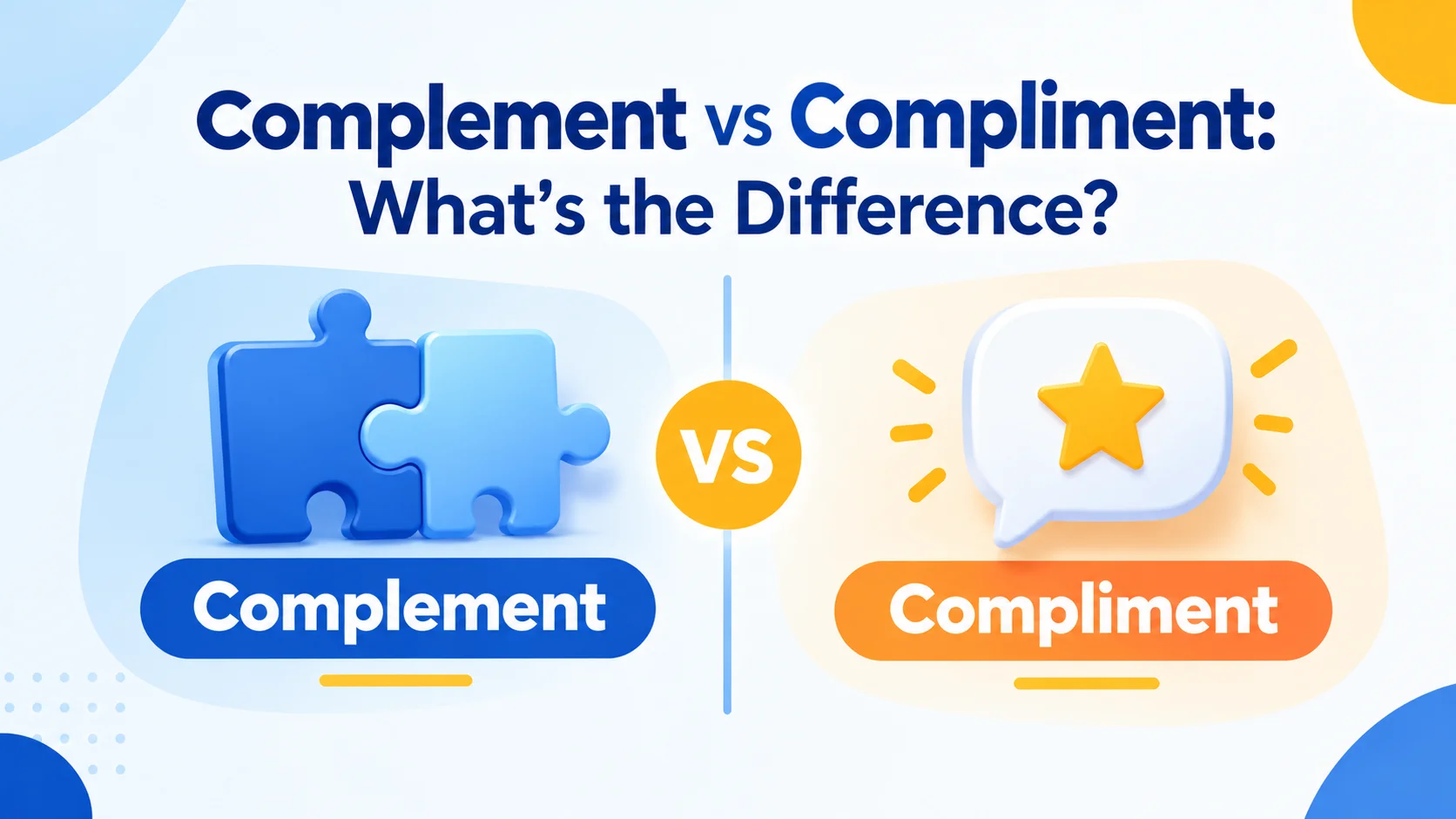
Complement vs. compliment is a common English spelling problem because the two words sound alike in many varieties of English but communicate different ideas. Complement means to complete, enhance, or work well with something; compliment means to express praise or admiration. Choosing the wrong word can change the meaning of a sentence, whether you are writing a business email, describing a meal, or giving someone feedback. Fortunately, you do not need to memorize complicated grammar rules to tell them apart. A simple connection between spelling and meaning makes the distinction much easier to remember.
The difference becomes especially useful when you encounter related words such as complementary and complimentary. One describes things that work well together, while the other can describe praise or something provided free of charge. Everyday expressions—including “a full complement,” “pay someone a compliment,” and “compliments of the house”—add another layer to the distinction. Understanding these phrases helps you choose the right spelling based on what a sentence actually means, rather than relying on how a word sounds or looks.
In this guide, you will learn how to use complement and compliment as nouns and verbs, recognize the adjectives derived from each, and avoid common mistakes in everyday and professional writing. You will also find paired examples, a practical comparison table, memory tricks, and a short quiz with explanations. Whether you are learning English, proofreading an assignment, or polishing workplace communication, the goal is straightforward: to help you make the correct choice confidently and understand why it is correct. By the end, you should be able to spot the difference even in less familiar expressions.
Complement vs. Compliment: The Difference at a Glance
The quickest way to choose between these words is to identify the intended meaning.
| Feature | Complement | Compliment |
| Main meaning | Something that completes, improves, or works well with another thing | Praise or an expression of admiration |
| As a noun | Something that completes or enhances something else | A statement or action expressing praise |
| As a verb | To enhance, complete, or suit something | To praise someone or something |
| Example | The lemon dressing complements the salad. | The chef complimented the salad. |
| Memory clue | Complete and complement both contain comple- | A compliment is a form of praise |
The essential rule: If something enhances or completes something else, use complement. If someone is praising a person, an achievement, or an object, use a compliment.
Compare these sentences:
- The blue tie complements his suit. The tie works well with the suit.
- She complimented him on his suit. She praised his clothing.
Both sentences concern the same suit, but the words describe different actions. In the first, two things go well together. In the second, someone expresses admiration.
What Does Complement Mean?
Complement refers to something that completes, enhances, balances, or works well with something else. It can be a noun or a verb, and it appears in contexts ranging from food and fashion to staffing, research, and grammar.
One important nuance: a complement does not always supply something missing. Sometimes it simply makes an existing thing more effective, attractive, or well balanced.
Complement as a Noun
As a noun, a complement is something that completes or enhances another thing.
Examples include:
- The fresh herbs were an excellent complement to the soup.
- Her practical experience is a valuable complement to her academic training.
- The illustrations provide a useful complement to the written instructions.
- The new team member is a welcome complement to the group.
In each sentence, the complement adds value or helps create a more effective whole.
What Does “A Full Complement” Mean?
The expression a full complement means the complete or required number of people or things for a particular purpose.
For example:
- The clinic now has a full complement of nurses.
- The vessel departed with its full complement of crew members.
- The project cannot begin until the team has its full complement of specialists.
This meaning is common in organizational, staffing, and technical contexts. It is unrelated to praise: a full complement is a complete set, not a collection of compliments.
Complement as a Verb
As a verb, complement means to enhance, complete, balance, or work well with something.
Examples:
- The warm lighting complements the room’s natural colors.
- Her research complements the findings of the earlier study.
- The side dish complements the main course without overpowering it.
- Their different skills complement each other.
Notice that the verb often describes a relationship between two things. One element contributes something that makes the other more effective or appealing.
Common sentence patterns include:
- A complements B: The photographs complement the article.
- A and B complement each other: Their approaches complement each other.
- A is complemented by B: The menu is complemented by a thoughtful wine selection.
In professional writing, complement can be especially useful when explaining how two methods, departments, resources, or pieces of evidence work together. It does not necessarily mean that one replaces the other.
Complement in Grammar
In grammar, a complement is a word or phrase that completes the meaning of another element in a sentence.
For example:
- In “Mina is a doctor,” doctor is a subject complement describing Mina.
- In “They elected Mina president,” president is an object complement identifying the role given to Mina.
This is a technical grammatical use of complement, not compliment. The word refers to a structural role in the sentence, not an expression of admiration.
Common Synonyms for Complement
The best substitute depends on the intended meaning.
| Meaning | Possible synonyms |
| Complete or supply what is needed | Complete, fulfill, round out |
| Improve or enrich | Enhance, enrich, improve |
| Go well with something | Suit, match, harmonize with |
| Provide a balancing element | Balance, offset |
These alternatives are not always interchangeable. Complete emphasizes making something whole; enhance focuses on improvement; and match often refers to compatibility. Choose the word that expresses the relationship you mean.
What Does Compliment Mean?
Compliment means an expression of praise, admiration, appreciation, or respect. It can be a noun—the praise itself—or a verb describing the act of praising someone or something.
Compliments may recognize appearance, but they can also acknowledge effort, skill, character, creativity, or a job well done.
Compliment as a Noun
As a noun, a compliment is something said or done to express admiration or approval.
Examples:
- She received a compliment on the clarity of her presentation.
- His teacher gave him a compliment for his thoughtful analysis.
- That is a generous compliment coming from an experienced editor.
- The designer appreciated the compliment about the website’s layout.
Several common expressions use the noun compliment:
- Give someone a compliment: He gave his colleague a compliment on her report.
- Receive a compliment: I received a compliment about my presentation.
- Pay someone a compliment: She paid the artist a compliment on the painting.
- Take something as a compliment: He took the remark as a compliment.
A compliment does not have to be elaborate. Specific praise—such as recognizing someone’s careful research or helpful explanation—can communicate exactly what the speaker appreciates.
Compliment as a Verb
As a verb, compliment means to praise or express admiration for someone or something.
Examples:
- The manager complimented the team on its careful work.
- I complimented her on the way she explained the difficult concept.
- The reviewer complimented the author on the book’s clear structure.
- They complimented the chef on the meal.
A particularly useful pattern is compliment someone on something:
- She complimented him on his presentation.
- The teacher complimented the student on her progress.
- We complimented the designer on the thoughtful details.
You may also see people compliment someone for doing something, as in “They complimented her for handling the situation calmly.”
Common mistake: If you mean that a person praised your work, write “She complimented me on my work,” not “She complemented me on my work.” The first sentence describes praise; the second would suggest that she enhanced or completed you or your work, depending on context.
Common Synonyms for Compliment
| Intended meaning | Possible synonyms |
| Express praise | Praise, commend |
| Show admiration | Admire, applaud |
| Recognize an achievement | Congratulate, acknowledge |
| Speak positively about someone | Speak highly of, appreciate |
The distinctions matter. Congratulations usually marks an achievement or milestone, while a compliment can recognize a quality, effort, appearance, or performance. Commend often sounds more formal and is common in professional or official contexts.
Complement vs. Compliment in Example Sentences
Paired examples make the difference clearer because they show how the words behave in similar situations.
Everyday Examples
- Complement: The green curtains complement the cream-colored walls.
The colors work well together. - Compliment: She complimented the curtains.
She praised them. - Complement: The spices complement the flavor of the vegetables.
They enhance the dish. - Compliment: The guests complimented the cook on the vegetables.
They expressed approval of the food.
Work and Professional Writing
- The consultant’s recommendations complement the company’s existing strategy.
- The director complimented the team on its thorough research.
- The new software complements the tools employees already use.
- The client complimented the designer on the finished presentation.
In a workplace setting, complement is useful for describing how resources or approaches fit together. Compliment is the right choice when describing praise given to a colleague, team, or service provider.
Academic and Technical Writing
- The second study complements the evidence presented in the first.
- The professor complimented the student on the clarity of the argument.
- The diagram complements the written explanation.
- The examiner complimented the candidate on the quality of the response.
A useful proofreading question is: Could I replace this word with “enhances” or “praises”? If “enhances” fits, complement is probably right. If “praises” fits, choose a compliment.
When Both Words Could Fit the Same Topic
The subject matter alone does not determine the spelling. The intended action does.
| Sentence | Correct word | Why |
| The scarf _____ her coat. | Complements | The scarf goes well with the coat. |
| She _____ him on his coat. | Complimented | She praised the coat. |
| The two report _____ each other. | Complement | Together, they provide a fuller picture. |
| The editor _____ the writer on the report. | Complimented | The editor expressed praise. |
| The music _____ the scene. | Complements | The music enhances the scene. |
| The audience _____ the musician. | Complimented | The audience praised the musician. |
Complementary vs. Complimentary: What Is the Difference?
The adjectives complementary and complimentary follow the meanings of their related nouns and verbs, but the difference is easy to miss.
- Complementary means completing, enhancing, balancing, or working well with something else.
- Complimentary means expressing praise or provided free of charge.
What Does Complementary Mean?
Complementary describes things that work well together or enhance each other.
Examples:
- The two colors are complementary.
- The researchers used complementary methods to investigate the question.
- Their complementary skills helped the group solve the problem.
- The course offers complementary material for students who want additional practice.
In color theory, complementary colors have a specific technical meaning: they occupy opposite positions on a traditional color wheel. In general writing, however, the word can simply describe things that work well together.
What Does Complimentary Mean?
Complimentary has two common meanings: expressing praise and provided free of charge.
Examples of praise:
- The reviewer made complimentary remarks about the novel.
- She was complimentary about the team’s work.
Examples of something free:
- The hotel offers complimentary breakfast.
- Guests received complimentary tickets to the exhibition.
- The airline provided complimentary refreshments.
Context usually makes the intended meaning clear. A complimentary review expresses praise; complimentary breakfast is provided without charge.
Comparison Table: Complementary vs. Complimentary
| Word | Meaning | Example |
| Complementary | Working well together or enhancing each other | The two approaches are complementary. |
| Complimentary | Expressing praise | The editor made complimentary comments. |
| Complimentary | Free of charge | The hotel provides complimentary Wi-Fi. |
Memory clue: Complementary connects to complete. Complimentary connects to compliment—either praise or a courtesy provided free.
Common Expressions With Complement and Compliment
Some expressions are worth learning as complete phrases because their meaning is more specific than the individual word.
“Complement Each Other”
This means that two people or things work well together, often because their strengths balance one another.
- The two musicians complement each other.
- Their skills complement each other on complex projects.
- The flavors complement each other without competing.
Use this phrase when describing compatibility or a productive combination—not when one person praises another.
“Pay Someone a Compliment”
To pay someone a compliment means to say something appreciative or admiring.
- He paid his colleague a compliment on her presentation.
- She paid the artist a compliment on the use of color.
Although the phrase contains pay, it does not ordinarily involve money. It is an established expression meaning to praise someone.
“Backhanded Compliment”
A backhanded compliment sounds positive but also carries an insult, criticism, or unflattering implication.
For example: “You explained that much better than I expected.”
The speaker appears to praise the explanation, but the wording suggests that the speaker had low expectations. Tone and context can affect interpretation, so not every awkward compliment is deliberately insulting.
“Fishing for Compliments”
Fishing for compliments means trying to encourage other people to offer praise.
For example: “When he repeatedly asked whether his presentation was impressive, his colleagues wondered if he was fishing for compliments.”
The phrase can imply that the person is seeking reassurance or praise indirectly, sometimes in a way others find uncomfortable.
“Compliments Of” and “Compliments of the House”
The expression compliments can introduce something given as a courtesy or gift. In hospitality, compliments of the house means that an establishment is providing something without charge.
For example: “The restaurant served a small dessert, compliments of the house.”
This use connects to the free-of-charge meaning of complimentary. It does not mean that the dessert is praising the restaurant.
How to Remember Complement vs. Compliment
You can usually make the right choice by linking each spelling to a familiar idea.
Use “Complete” to Remember Complement
Complement shares its opening letters with complete. When something completes, enhances, balances, or works well with another thing, choose a complement.
- The illustrations complement the article.
- The side dish is a complement to the main course.
- The team has a full complement of staff.
Use “Praise” to Remember Compliment
Think of compliment as an expression of praise or admiration. If someone is saying something appreciative about a person, action, or object, choose a compliment.
- The teacher complimented the student on her progress.
- He received a compliment about his writing.
- They paid the chef a compliment.
A Quick Decision Test
Before writing either word, ask yourself:
- Does the sentence mean “complete” or “enhance”? Choose a complement.
- Does it mean “praise”? Choose a compliment.
- Does the adjective mean “working well together”? Choose complementary.
- Does it mean “praising” or “free of charge”? Choose complimentary.
This test is more reliable than trying to remember which word “looks right,” particularly when proofreading quickly.
Common Mistakes With Complement and Compliment
Using Complement When You Mean Praise
Incorrect: She complimented me on my presentation.
Correct: She complimented me on my presentation.
The sentence describes praise, so the spelling with i is needed.
Using Compliment When You Mean Enhancement
Incorrect: The sauce compliments the pasta.
Correct: The sauce complements the pasta.
The sauce enhances the pasta dish; it is not praising it. The spelling with e expresses that relationship.
Confusing Complimentary and Complementary
Compare these sentences:
- The hotel offers complimentary breakfast. It is free.
- The two dishes have complementary flavors. They work well together.
The words differ by one letter, but the meanings are distinct. When proofreading, check whether the sentence describes a courtesy or a combination.
Assuming Complement Always Means Something Is Missing
A complement can fill a gap, but it can also improve something that is already complete. A scarf may complement an outfit even when the outfit needs nothing else; a photograph may complement a written article by making it more engaging.
Do not limit complement to the idea of repairing something incomplete. Enhancement and compatibility are also central meanings.
Complement vs. Compliment Practice Quiz
Choose the correct word or form for each blank.
- The new curtains _____ the color of the walls.
- My supervisor _____ me on the quality of my report.
- The hotel provides _____ toiletries to its guests.
- The two studies _____ each other by examining different aspects of the problem.
- He paid her a _____ on her presentation.
- The reviewer made _____ remarks about the book.
- The clinic now has a full _____ of trained staff.
- The chef received a _____ for the meal.
Answer Key and Explanations
- Complement — The curtains enhance the room’s color scheme.
- Complimented — The supervisor praised the report.
- Complimentary — The toiletries are provided free of charge.
- Complement — The studies add value to one another.
- Compliment — The phrase refers to an expression of praise.
- Complimentary — The remarks express admiration or approval.
- Complement — A full complement is the complete or required number of people or things.
- Compliment — The chef received praise for the meal.
If you missed any answers, return to the distinction between enhancement and praise. Most mistakes become easier to correct once you identify which meaning the sentence requires.
Conclusion:
The difference between complement vs. compliment becomes simple once you focus on what the sentence means. A complement completes, enhances, or works well with something else; a compliment expresses praise or admiration. The related adjectives follow the same distinction: complementary describes things that work well together, while complimentary can mean praising or free of charge.One final actionable tip: When proofreading, replace complement with “enhance” and compliment with “praise.” If the sentence still makes sense, you have a useful clue that you chose the right word. A common mistake to avoid is choosing a spelling because it looks familiar without checking the intended meaning. One letter can change the message, but a quick meaning check can prevent the error. Write for clarity, and let context guide your choice.
FAQs
Q1. Is it correct to say “complement each other” or “compliment each other”?
Use complement each other when two people, ideas, skills, or objects work well together or enhance one another. For example, “Their different strengths complement each other.” Use compliments when someone expresses praise, as in “They complimented each other on their presentations.”
Q2. Can a person be a complement to another person?
Yes. A person can be described as a complement to another when their abilities, qualities, or contributions work well together. The word describes how they fit together, not whether one person is better. In ordinary conversation, explain the specific qualities involved to avoid sounding overly formal.
Q3. Is “complimentary” always the same as “free”?
No. Complimentary can mean expressing praise, as in “She was complimentary about the proposal,” or provided without charge, as in “The hotel offers complimentary parking.” The surrounding words reveal which meaning applies. Complementary, by contrast, describes things that complete or enhance each other.
Q4. What does “my compliments to the chef” mean?
“My compliments to the chef” is a polite expression of praise for a meal. It communicates that the speaker enjoyed the food and wants the chef to know. Here, compliments is a plural noun meaning expressions of admiration, not complements that complete a dish.
Q5. Does complement have a special meaning in grammar?
Yes. In grammar, a complement is a word or phrase that completes the meaning of another sentence element. In “The sky became dark,” dark is a subject complement describing the sky. This technical use is distinct from compliment, which refers to praise or admiration.