

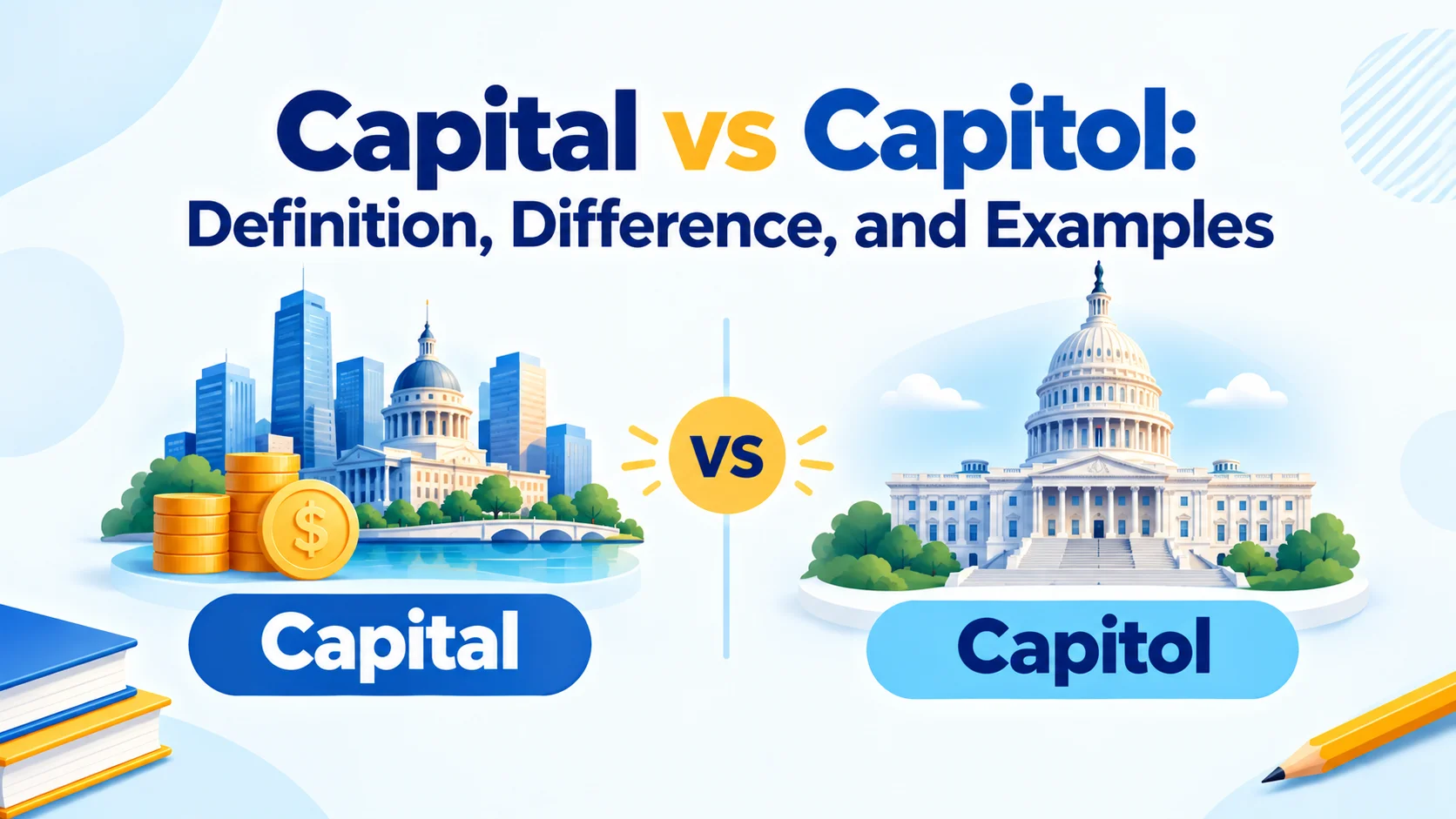
The difference between capital vs capitol comes down to what you mean: a city, money, or an uppercase letter calls for capital, while a building where legislators meet is a capitol. The words sound alike, so it is easy to confuse them when writing about government, geography, or public affairs. Yet choosing the correct spelling makes a sentence more precise. Once you recognize what each word refers to, the distinction becomes straightforward—and you can apply it confidently in school assignments, professional documents, news articles, and everyday communication.
The confusion often arises because both words appear in discussions about government. A country has a capital city, and that city may contain a capitol building. For example, Washington, D.C., is the capital of the United States, while the U.S. Capitol is the building where Congress meets. The two terms describe related but different things. Outside government, capital has several other meanings, including financial resources, uppercase letters, and something of major importance. Capitol, by contrast, has a much narrower meaning.
This guide explains the definitions, grammatical roles, and practical uses of both words, with examples that show how context determines the correct spelling. You will learn how to distinguish a state capital from a state capitol, recognize common expressions such as capital investment and capital letter, and understand when capitalization matters. You will also find a quick-reference table, a simple memory trick, common mistakes to avoid, and a short practice quiz. By the end, you should be able to choose the right word without stopping to second-guess yourself.
Capital vs Capitol: What Is the Difference?
Capital is a noun or adjective with several meanings. It can identify a city that serves as a seat of government, money or assets available for use or investment, an uppercase letter, or something important. Capitol is a noun that refers to a building where a legislature meets, especially the U.S. Capitol or a U.S. state capitol.
The words are homophones in many varieties of English: they are pronounced alike but have different spellings and meanings. Because both can appear in government-related writing, the surrounding context is the most reliable way to tell them apart.
| Feature | Capital | Capitol |
| Main meaning | A city, financial resources, an uppercase letter, or something important | A legislative building |
| Part of speech | Noun and adjective | Noun |
| Example | Ottawa is the capital of Canada. | The lawmakers met at the capitol. |
| Common contexts | Geography, business, grammar, and general writing | Government buildings and legislative institutions |
| Quick memory clue | Think of a capital city or capital letter | Think of a capitol building |
The simplest rule: If you mean a city, money, or an uppercase letter, use capital. If you mean the building where legislators meet, use capitol.
What Does Capital Mean?
Capital has a broad range of meanings, which is why it appears in many types of writing. Its precise definition depends on the subject being discussed. In geography, it identifies a city; in business, it often refers to money or assets; in writing, it can mean an uppercase letter. It can also function as an adjective.
Capital as a Noun
A noun names a person, place, thing, or idea. When capital functions as a noun, it commonly refers to a city, financial resources, or an uppercase letter.
Capital as a City or Seat of Government
A capital city is the city where a country’s or political region’s central government is based. Countries, states, provinces, and other administrative areas can have capitals.
Examples include:
- Islamabad is the capital of Pakistan.
- Tokyo is the capital of Japan.
- Canberra is the capital of Australia.
- Albany is the capital of New York State.
Notice that capital refers to the city as a whole, not necessarily to the building where government officials work. A capital may contain a parliament building, a presidential residence, courts, ministries, and other public institutions.
Another useful point: a capital city is not necessarily the largest city in its country or region. Canberra, for example, is Australia’s capital, while Sydney is its largest city by population. The terms capital and largest city describe different things.
Use capital when you are naming the place that serves as a seat of government:
- Correct: The delegation traveled to the country’s capital.
- Incorrect for this meaning: The delegation traveled to the country’s capitol.
The second sentence would suggest a particular legislative building rather than the city.
Capital in Business and Finance
In business and economics, capital refers to money, property, equipment, or other resources used to operate a business, produce goods, or generate income. The exact meaning can vary by financial context.
For example:
- The company raised capital to expand its operations.
- The restaurant needs more capital to renovate its kitchen.
- The firm invested additional capital in new equipment.
Several common expressions use capital:
- Working capital: Resources available for a business’s day-to-day operations, commonly understood in accounting as current assets minus current liabilities.
- Investment capital: Money or assets committed to an investment.
- Capital expenditure: Spending on assets intended to provide longer-term benefits, such as machinery or buildings.
- Capital gains: Profits realized when certain assets are sold for more than their relevant cost basis, subject to applicable tax rules.
Do not confuse capital with revenue or profit. Revenue is money earned through sales or other business activities before expenses are deducted. Profit is what remains after relevant expenses are accounted for. Capital, meanwhile, refers to resources available to fund activity or investment, although accounting definitions can be more specific.
For example, a company may earn substantial revenue but still need additional capital to purchase equipment or open a new location.
Capital as an Uppercase Letter
A capital letter is an uppercase letter, such as A, B, or C, rather than a lowercase letter such as a, b, or c. The word can refer to a single letter or to uppercase letters generally.
Examples:
- Begin each sentence with a capital letter.
- Write the name Maria with a capital M.
- The word Monday begins with a capital letter.
In everyday writing, capital letters and uppercase letters generally mean the same thing. Capital can also stand alone when the meaning is clear: “The word begins with a capital.”
Remember that capital is the correct spelling in this context. A capitol is a building, not a type of letter.
Capital Meaning Something Important or Excellent
Capital can also refer to something of primary importance. As an adjective, it appears in expressions such as capital concern, capital importance, and capital mistake.
Examples:
- Protecting customer information is of capital importance.
- The report identifies a capital error in the original calculation.
A less common, somewhat old-fashioned use of capital means excellent or first-rate:
- “That is a capital idea!”
Readers are more likely to encounter this last meaning in older writing or deliberately traditional dialogue than in ordinary contemporary business communication. In most modern contexts, words such as excellent, major, or essential may sound more natural.
Capital as an Adjective
An adjective describes or modifies a noun. Capital can describe something related to a capital city, financial resources, importance, or a serious offense.
Here are some common combinations:
| Expression | Meaning | Example |
| Capital city | A city serving as a seat of government | The capital city attracts visitors throughout the year. |
| Capital investment | Money or resources committed to an asset or project | The factory needs a major capital investment. |
| Capital expenditure | Spending on longer-term assets | The council approved capital expenditure for a new bridge. |
| Capital gains | Profits from selling certain assets | She reported capital gains from the sale. |
| Capital offense | A crime that may carry the death penalty under the applicable law | The legal article discusses the definition of a capital offense. |
| Capital importance | Great or primary importance | Accurate documentation is of capital importance. |
The context tells you which meaning applies. ✅In capital investment, the adjective relates to financial resources. In the capital city, it identifies a city’s governmental role. In capital offense, it refers to the legal classification of an offense.
A practical editing tip: when you encounter capital before another noun, do not automatically assume it means a city. Read the complete phrase.
What Does Capitol Mean?
Capitol is a noun referring to a building where a legislature meets. The word is especially associated with the United States, where it is used for the building housing Congress and for buildings used by state legislatures.
For example:
- The legislators gathered at the state capitol.
- Tourists visited the U.S. Capitol in Washington, D.C.
- The committee held a public meeting inside the capitol building.
Unlike capital, capitol does not ordinarily refer to a city’s status, a company’s financial resources, or an uppercase letter. Its meaning is much more specific.
Capitol as a Noun
The word often appears in American civic and political writing. A state capitol is the building where a state’s legislature meets. The U.S. Capitol is the building in Washington, D.C., where the United States Congress meets.
Consider these examples:
- The school group toured the U.S. Capitol.
- State lawmakers returned to the capitol after the recess.
- The historic capitol building underwent renovations.
- The visitors photographed the dome of the state capitol.
In each sentence, the word refers to a physical building. It does not identify the entire city or automatically refer to every government office in the area.
The word can sometimes be used more broadly for a group of buildings associated with legislative or state-government functions. However, the legislative-building meaning is the most useful distinction for everyday writing.
Capitol vs. Capitol Building: Is There a Difference?
In many contexts, capitol and capitol building refer to the same place. Adding building makes the physical meaning explicit, which can help readers who might otherwise confuse capitol with capital.
Compare these sentences:
- The visitors toured the capitol.
- The visitors toured the capitol building.
Both can refer to the same legislative structure. The second is more explicit, but it is not automatically more correct.
The important distinction is between the building and the city:
- The capital is where the government is based.
- The capitol is the legislative building.
A city may have many government buildings, but that does not make every one of them a capitol. A courthouse, city hall, ministry, or presidential residence is not automatically a capitol simply because it is involved in government.
Why Is “Capitol” Capitalized in Some Sentences?
The spelling and the capitalization of the first letter are two separate issues.
When referring to the specific building in Washington, D.C., writers commonly use the U.S. Capitol or the Capitol. Here, Capitol is capitalized because it refers to a particular, named building.
When referring to a legislative building generically, lowercase is usually appropriate:
- The state capitol is open for public tours.
- The delegation visited the capitol building.
Compare that with:
- The delegation visited the U.S. Capitol.
The general principle is to capitalize an official proper name and lowercase a generic use, while following the relevant publication’s style guide and official naming conventions.
Also, do not confuse the uppercase C in Capitol with the word capital meaning an uppercase letter. The words serve different purposes even when they appear in the same discussion.
Capital vs Capitol: Examples in Everyday Writing
Seeing the two words in realistic sentences is one of the easiest ways to learn the distinction. The examples below cover geography, government, finance, and grammar.
| Sentence | Correct word | Reason |
| Ottawa is the ___ of Canada. | Capital | Ottawa is a city serving as a seat of government. |
| The state legislature met at the ___. | Capitol | The sentence refers to a legislative building. |
| The startup raised additional ___ to hire staff. | Capital | The word means financial resources. |
| Use a ___ letter at the beginning of the sentence. | Capital | It means an uppercase letter. |
| The visitors toured the U.S. ___. | Capitol | This is the name of a specific government building. |
| The business approved a major ___ investment. | Capital | It describes investment in assets or projects. |
| The governor delivered a speech at the state ___. | Capitol | The speech took place at the legislative building. |
| The country’s ___ city has a large diplomatic community. | Capital | The word describes the city serving as the seat of government. |
| The company lacked enough ___ to open another branch. | Capital | The sentence refers to money or resources. |
| The museum is near the historic state ___. | Capitol | The reference is to the legislative building. |
Capital or Capitol in Common Phrases?
Some phrases are so established that recognizing them can help you select the correct spelling immediately.
| Phrase | Correct spelling | What it means |
| Capital city | Capital | A city serving as a seat of government |
| Capital letter | Capital | An uppercase letter |
| Capital investment | Capital | Resources invested in an asset or project |
| Working capital | Capital | Resources used for day-to-day business operations |
| Capital gains | Capital | Profits from selling certain assets |
| State capitol | Capitol | A building where a state legislature meets |
| U.S. Capitol | Capitol | The building where the U.S. Congress meets |
| Capitol building | Capitol | A legislative building |
One subtle point: capital can also describe the most important center for a particular activity, even when the place is not a national or state government seat. For example, someone might call a city a fashion capital or a financial capital. In those expressions, capital means a leading center of activity, not a capitol building.
Capital vs Capitol in American and British English
The distinction is not simply a matter of American versus British spelling. Capital is used in both varieties of English for a city, financial resources, and uppercase letters. Capitol is especially associated with American legislative buildings and U.S. government terminology.
In American writing, it is common to see phrases such as the U.S. Capitol, the state capitol, and Capitol Hill. The last expression can refer to the area around the U.S. Capitol and, by extension, to the U.S. Congress or the legislative side of the federal government.
British writing more commonly refers to the Houses of Parliament or the Palace of Westminster when discussing the UK’s national legislature and its building. The word capital still refers to the city—in this case, London. The appropriate term depends on the institution and location being discussed.
For example:
- American usage: The senator arrived at the Capitol.
- Geographical usage: Washington, D.C., is the capital of the United States.
- British usage: London is the capital of the United Kingdom.
- British parliamentary context: The debate took place in the Houses of Parliament.
These examples illustrate differences in institutional terminology, not a rule that British English never uses capitol. Official names, historical references, and specific organizations may use the word in other contexts.
How to Remember the Difference Between Capital and Capitol
A useful memory trick is to connect the capitol with a building. Both words contain the letter o, and you can associate that letter with the rounded dome found on many capitol buildings. It is only a memory aid—not a rule about the architecture of every legislative building—but it can help you recall the spelling.
For capital, think of its broader range of meanings: capital city, capital letter, and financial capital.
Use the Quick Substitution Test
If you are unsure which word belongs in a sentence, replace it temporarily with a more specific phrase.
- If you can replace the word with city, money, resources, or uppercase letter, choose capital.
- If you can replace it with a legislative building, choose the capital.
For example:
- “The capital of France” becomes “the city serving as France’s seat of government.” The correct word is capital.
- “The state capitol” becomes “the state legislative building.” The correct word is capitol.
This test works because it checks the intended meaning rather than relying on the sound of the word.
A Quick Decision Checklist
Before finalizing a sentence, ask:
- Am I referring to a city where a government is based? Use capital.
- Am I referring to money or business resources? Use capital.
- Am I referring to an uppercase letter? Use capital.
- Am I referring to a legislative building? Use capital.
- Am I naming the U.S. Congress’s building? Write the U.S. Capitol.
- Am I unsure whether the first letter should be uppercase? Check whether the word is part of an official name or is being used generically.
Common Mistakes When Using Capital and Capitol
Most errors happen when a writer knows the general topic but overlooks the exact thing being described. These corrections show how to avoid that problem.
Mistake 1: Calling a Capital City a Capitol
Incorrect: Islamabad is the capitol of Pakistan.
Correct: Islamabad is the capital of Pakistan.
Why? Islamabad is a city serving as Pakistan’s seat of government. The sentence is about a place, not a legislative building.
Mistake 2: Calling a Legislative Building a Capital
Incorrect: The representatives met inside the state capital.
Correct: The representatives met inside the state capitol.
Why? The sentence identifies the building where the representatives met. If the writer meant the city instead, a state capital would be appropriate.
Mistake 3: Assuming Capital Only Refers to Geography
Incorrect reasoning: “This sentence is about business, so neither word applies.”
Correct understanding: Capital is common in finance, including phrases such as working capital, capital investment, and capital expenditure.
Example: The company needs more capital to purchase equipment.
The word does not need to relate to a city or a government building to be correct.
Mistake 4: Capitalizing Every Use of Capitol
Incorrect in ordinary generic usage: The visitors toured the State Capitol Building—if those words are not part of an official name and the chosen style calls for lowercase.
Often appropriate: The visitors toured the state capitol building.
Appropriate for the specific U.S. building: The visitors toured the U.S. Capitol.
Capitalization conventions can vary with official names and editorial style, so check the exact name when writing formal copy.
Mistake 5: Treating “Capital” and “Capitol” as Interchangeable
The two words may sound alike, but they cannot be substituted freely. A sentence about financial resources will not work with capitol, and a sentence about a legislative building will generally not work with capital.
The best proofreading habit is to check meaning first and spelling second. Ask what the word refers to, then choose the spelling that matches.
Capital vs Capitol: Practice Quiz
Choose capital or capitol for each blank. Try answering before checking the key.
- Canberra is the ___ of Australia.
- The governor gave a speech at the state ___.
- The business secured additional ___ to expand.
- Write the first word of the sentence with a ___ letter.
- The school group toured the U.S. ___.
- The company planned a major ___ investment in new equipment.
- The legislature returned to the ___ after the break.
- The country’s ___ city hosts many foreign embassies.
Answer Key With Explanations
- Capital — Canberra is Australia’s seat of government.
- Capitol — The sentence refers to the legislative building.
- Capital — The business needs financial resources.
- Capital — A capital letter is an uppercase letter.
- Capitol — The U.S. Capitol is the building where Congress meets.
- Capital — The adjective describes an investment in assets or a project.
- Capitol — The legislature returns to the building where it meets.
- Capital — The phrase refers to the city, not a government building.
If you missed any answers, identify what the word describes before trying again. That approach is more reliable than memorizing isolated sentences.
Conclusion:
The distinction between capital vs capitol becomes easy once you focus on the thing being described. A capital can be a city, financial resources, an uppercase letter, or something of major importance. A capitol is a legislative building, such as the U.S. Capitol or a state capitol. One final actionable tip: before submitting an essay, report, or article, replace the word mentally with its intended meaning—city, money, uppercase letter, or legislative building. If the sentence still makes sense, you have probably chosen correctly. A common mistake to avoid is assuming that every government-related reference requires capitol. Government can refer to a city, an institution, or a building, and each calls for precise wording. Choose the spelling that matches your meaning, and your writing will be clearer.
FAQs
Q1. What is the main difference between capital and capitol?
Capital can refer to a city, financial resources, an uppercase letter, or something important. Capitol refers to a legislative building. Although the words sound alike, they are not interchangeable. The best way to choose is to identify whether the sentence describes a place, resources, a letter, or a building.
Q2. Is Washington, D.C., a capital or a capitol?
Washington, D.C., is the capital of the United States because it is the country’s federal seat of government. The U.S. Capitol is a particular building in that city where Congress meets. One name identifies the city; the other identifies the legislative building within it.
Q3. Should I write state capital or state capitol?
Both phrases are correct, but they refer to different things. A state capital is the city serving as the state’s seat of government. A state capitol is the building where the state legislature meets. For example, Albany is New York’s state capital, and its state capitol is a building there.
Q4. Is “capitol” always capitalized?
No. Use Capitol when it forms part of a proper name, such as the U.S. Capitol. Use lowercase capitol for a generic reference, such as the state capitol, unless an official name or applicable style guide specifies otherwise. Capitalization depends on how the word is being used.
Q5. Are capital and capitol homophones?
Yes, in many varieties of English, capital and capitol are homophones because they share the same pronunciation but have different spellings and meanings. They are easy to confuse when listening, so writers must rely on context. Remembering capital city and capitol building makes the distinction easier to apply.