

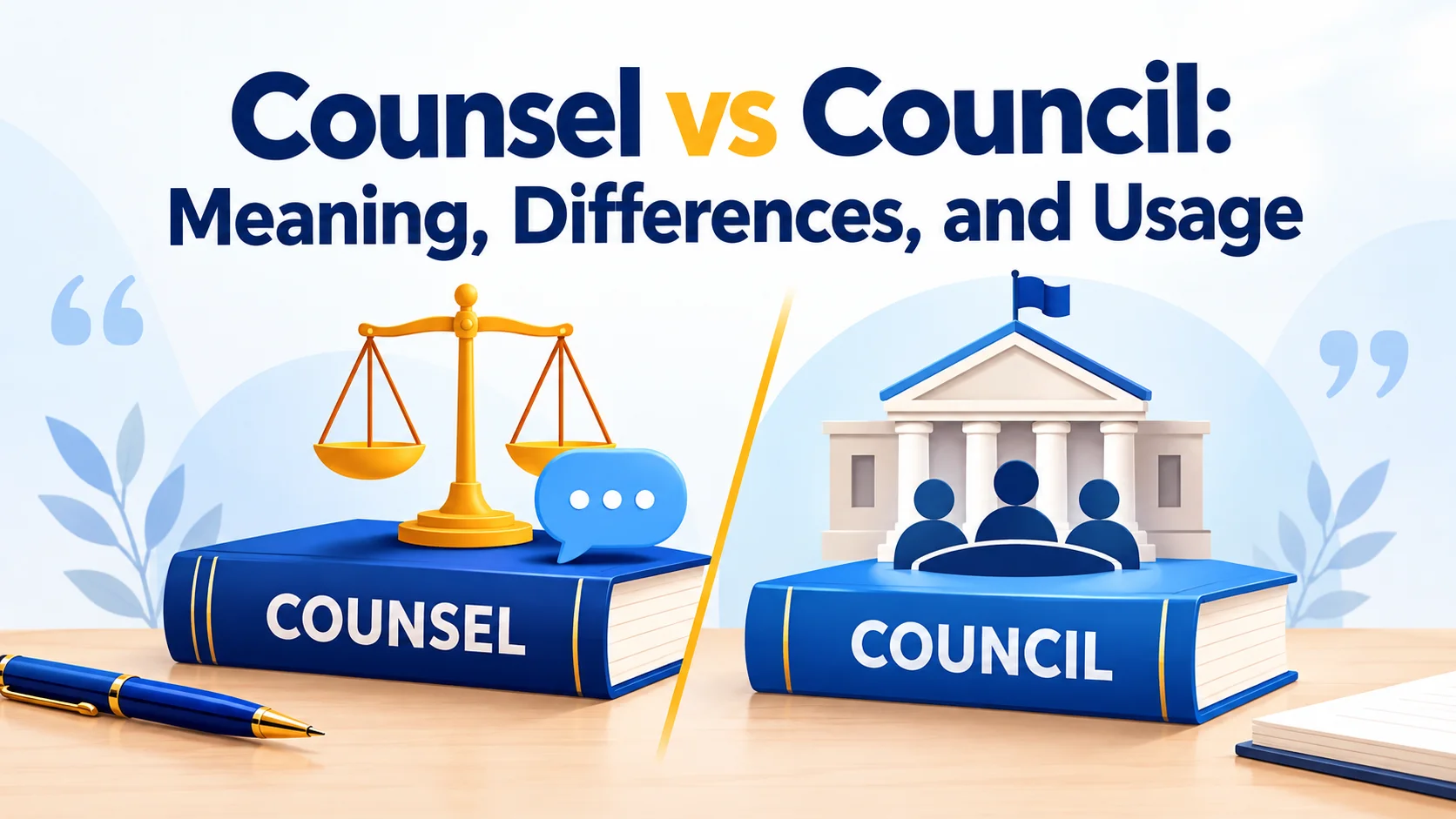
Counsel vs. council is a common source of confusion because the two words sound alike but refer to different things. Counsel means advice or guidance, and it can also refer to a lawyer or the act of advising someone. Council, by contrast, means a group of people who meet to discuss issues, offer recommendations, or make decisions. Choosing the wrong word can change the meaning of a sentence, especially in legal documents, workplace communication, and local government reporting. Understanding the distinction makes your writing more precise and helps you avoid mistakes that spellcheck may not catch.
The confusion becomes easier to understand when you look at how each word functions. You might seek counsel from a mentor, consult legal counsel before signing an agreement, or counsel a colleague about a difficult decision. A school, meanwhile, may elect a student council, while a city may rely on a city council to consider local policies. These examples illustrate a useful distinction: one word concerns advice or advising; the other identifies a collective body. Both are standard English words, but they are not interchangeable simply because their pronunciation is similar.
This guide explains the meaning of counsel and council, their grammatical roles, and the contexts in which each belongs. You will find side-by-side comparisons, practical examples, common expressions, and a short quiz to test your understanding. We will also examine related terms such as counselor, councilor, and counsel of record, which can create additional uncertainty. Whether you are writing an academic assignment, preparing a professional email, or discussing a public decision, the goal is to help you choose the right word by understanding what your sentence actually means—not by relying on guesswork.
Counsel vs. Council: The Difference at a Glance
The quickest way to distinguish the words is to ask whether the sentence refers to advice or a group of people.
| Feature | Counsel | Council |
| Main meaning | Advice, guidance, or a person providing legal advice | A group assembled to advise, govern, represent members, or make decisions |
| Part of speech | Noun and verb | Noun |
| Typical settings | Legal matters, professional advice, personal guidance | Government, schools, associations, organizations |
| Example | The company sought legal counsel. | The city council reviewed the proposal. |
| Verb use | Yes: to counsel someone | No, not in standard contemporary usage |
| Related word | Counselor or counsellor | Councilor or councillor |
The essential rule: Use counsel when you mean advice, a legal adviser, or the act of advising. Use council when you mean an organized group.
For example:
- Counsel: The adviser offered counsel before the interview.
- Council: The student council organized a career fair.
The first sentence refers to guidance. The second identifies a group of students.
What Does Counsel Mean?
Counsel is a noun and a verb. As a noun, it can mean advice or guidance, or it can refer to a lawyer or group of lawyers involved in a legal matter. As a verb, it means to advise, guide, or recommend a course of action.
The word often appears in formal, professional, and legal contexts, although it is not limited to them. Its precise meaning depends on the sentence.
Counsel as a Noun: Advice or Guidance
When counsel means advice, it usually refers to considered guidance intended to help someone understand a situation or decide what to do. It often sounds more formal than the everyday word advice, but the two overlap in meaning.
Examples:
- Her mentor offered valuable counsel before she accepted the position.
- I wish I had followed my father’s wise counsel about saving money.
- The principal provided counsel to students choosing their courses.
- The team sought outside counsel before changing its strategy.
In these sentences, counsel is the guidance itself, not necessarily the person giving it.
It commonly appears with verbs such as seek, offer, give, provide, and follow. These combinations are useful in formal writing:
- seek counsel
- offer counsel
- provide counsel
- follow someone’s counsel
- act on someone’s counsel
Practical tip: In an informal message, advice will often sound more natural. In a formal report or professional discussion, counsel may suit the tone better. Neither choice is automatically more correct; the context determines which sounds appropriate.
Counsel as a Noun: A Lawyer or Legal Adviser
In legal contexts, counsel can refer to a lawyer or lawyers representing or advising a person, business, or organization. The word can identify the professional, rather than the advice that professional gives.
Examples:
- The company consulted legal counsel before signing the agreement.
- Defense counsel questioned the witness.
- The client met with counsel to discuss the case.
- The organization hired outside counsel to review its contracts.
Common legal expressions include:
- Legal counsel: a lawyer or legal advice, depending on context.
- Defense counsel: a lawyer or legal team representing the defense.
- Counsel for the plaintiff: the lawyer representing the plaintiff in a case.
- In-house counsel: a lawyer working within an organization.
- Counsel of record: a lawyer formally recognized as representing a party in a proceeding, where that designation applies.
Notice that counsel does not always refer to one individual. In legal usage, it can refer to one or more lawyers. The surrounding sentence usually makes the intended meaning clear.
For instance, “The judge heard arguments from counsel” refers to the lawyers presenting arguments. “The client acted on the advice of counsel” refers to guidance received from a lawyer.
Legal terminology can vary by jurisdiction and type of proceeding, so formal legal documents should follow the relevant court’s or organization’s terminology.
Counsel as a Verb: To Advise or Guide
As a verb, counsel means to advise someone, guide them through a decision, or recommend a particular course of action. It is more formal than tell and often suggests that the advice concerns a meaningful decision or situation.
Examples:
- The teacher counseled the student to consider all available options.
- Her supervisor counseled her on managing a difficult conversation.
- The adviser counseled the team against rushing into a decision.
- The organization counsels families about available support services.
Two useful sentence patterns are:
- Counsel someone to do something: The adviser counseled him to review the contract.
- Counsel someone on/about something: She counseled the students on career planning.
The verb is usually transitive in everyday contemporary usage: someone counsels another person or advises them about a subject.
Counseled or Counselled?
Both spellings are correct, but the preferred form varies by English variety.
| American English | British English and many other varieties |
| counseled | counselled |
| counseling | counselling |
For example:
- US: The adviser counseled the student.
- UK: The adviser counselled the student.
Choose the spelling that matches your publication’s style guide and apply it consistently.
Synonyms for Counsel
The best synonym depends on whether counsel refers to advice, a professional, or an action.
| Intended meaning | Possible alternatives |
| Advice or guidance | Advice, guidance, recommendation |
| A legal professional | Lawyer, attorney, legal adviser |
| To give advice | Advise, guide, recommend |
| To support someone’s decision-making | Mentor, direct, assist |
These alternatives are not interchangeable in every sentence. Legal counsel can often be replaced by lawyer or attorney when referring to a person, but sound counsel means sensible advice—not a sensible lawyer.
What Does Council Mean?
A council is a group of people brought together to discuss, advise on, oversee, or make decisions about a particular subject or organization. Depending on its purpose, the group may be elected, appointed, or established under an organization’s rules.
Unlike counsel, council functions as a noun in standard contemporary English. It names a body of people rather than advice or the act of advising.
Council in Local Government
A city or municipal council is a group involved in local government. Depending on the jurisdiction, it may approve policies, oversee public services, consider budgets, or make decisions about community matters.
Examples:
- The city council approved funding for a new public park.
- Residents attended the council meeting to discuss traffic problems.
- The town council reviewed proposals for improving public transport.
- A council member asked for more information before the vote.
The exact powers of a council vary between countries and local authorities. Some councils have substantial decision-making responsibilities; others have more limited or advisory roles. When writing about a specific council, check its official description rather than assuming every council has the same authority.
Council in Schools and Other Organizations
The word is not limited to government. Many schools, professional bodies, associations, and institutions have councils that represent members, discuss issues, or help guide policy.
Examples include:
- Student council: a group that represents students or organizes student activities.
- School council: a body that discusses school-related issues, with its role depending on the school system.
- Advisory council: a group that provides recommendations to an organization.
- Research council: an organization or governing body associated with research priorities or funding.
- Professional council: a body that may represent a profession or oversee particular professional matters.
Example sentences:
- The student council arranged a welcome event for new pupils.
- An advisory council reviewed the organization’s proposed guidelines.
- The research council announced a new funding initiative.
In each example, the council names a group. It does not refer to the recommendations the group makes.
Is a Council the Same as a Committee or Board?
Not necessarily. All three terms can describe groups, but their roles often differ.
| Term | Typical function | Example |
| Council | May advise, represent members, govern, or make decisions | The council reviewed the community plan. |
| Committee | Often handles a particular task or subject | The committee examined the proposed changes. |
| Board | Often oversees an organization or has formal management responsibilities | The board approved the annual budget. |
| Panel | Usually a group assembled for discussion, evaluation, or judgment | The panel assessed the applications. |
These are general patterns, not universal legal definitions. An organization may use a particular title for historical or administrative reasons. If the body has an official name, use that name rather than substituting another term just to avoid repetition.
Synonyms and Related Terms for Council
Depending on the context, related terms include board, committee, assembly, panel, and governing body. Each emphasizes a different type of group.
For example, a committee may investigate one issue, while a council may have a broader representative or governing role. A board may supervise an organization, whereas an advisory council may provide recommendations without making the final decision.
These words can overlap, so they should not be treated as exact synonyms. In formal writing, the organization’s official terminology is usually the safest choice.
Counsel vs. Council in Real-World Contexts
The difference becomes particularly clear when the words appear in situations where advice and authority intersect.
✅Legal Writing: Legal Counsel vs. Legal Council
Legal counsel is the established expression for a lawyer or legal advice. Legal counsel would only be appropriate if you were referring to a particular council whose role was legal or related to legal matters.
Compare these examples:
- Correct: The company consulted legal counsel before signing the contract.
- Correct: The council approved a revised policy for handling legal complaints.
- Incorrect for the intended meaning: The company consulted its legal council to review the contract.
The distinction matters because the two words identify different things. A council might employ legal counsel, for example, but the council itself is not automatically a lawyer or a source of legal advice.
Workplace Writing: Advice vs. Decision-Making Authority
Imagine that a company is considering a major change to its working arrangements. An employee may seek counsel from a manager, mentor, or legal adviser. Separately, an executive council may discuss or approve the change if that responsibility belongs to the group.
- The manager offered counsel about communicating the change.
- The executive council reviewed the proposal.
- The company sought legal counsel before updating its contracts.
These sentences describe three different roles: giving advice, reviewing a proposal as a group, and obtaining legal guidance. Using the right word helps readers understand who is advising whom and who has authority to act.
Education and Community Examples
School-related writing provides another straightforward comparison.
- The teacher offered counsel to a student choosing subjects.
- The student council organized a school fundraiser.
- The principal sought counsel from an experienced colleague.
- The school council discussed a proposed timetable change.
A useful proofreading question is: Could this word be replaced by “advice” or “group” without changing the intended meaning? If advice fits, counsel may be correct. If the group fits, council is likely the right choice.
Common Expressions With Counsel and Council
Learning familiar phrases helps you recognize the correct spelling without stopping to reconsider every sentence.
Common Expressions With Counsel
| Expression | Meaning | Example |
| Legal counsel | A lawyer or legal advice | The business consulted legal counsel. |
| Wise counsel | Sensible advice | She followed her mentor’s wise counsel. |
| Seek counsel | Ask for advice or guidance | He sought counsel before making a decision. |
| Counsel of record | A lawyer formally recognized as representing a party in a proceeding, where applicable | The filing identified counsel of record. |
| Counsel someone against something | Advise someone not to do something | The adviser counseled them against acting hastily. |
The expression seek counsel is broader than legal usage. Someone can seek counsel from a trusted mentor or experienced colleague without consulting a lawyer.
Common Expressions With Council
| Expression | Meaning | Example |
| City council | A local government body | The city council discussed road repairs. |
| Student council | A group representing students or organizing activities | The student council planned a school event. |
| Council meeting | A meeting of a council | The council meeting begins at noon. |
| Council member | Someone who serves on a council | Each council member received the report. |
| Council resolution | A formal decision or statement adopted by a council | The council passed a resolution on the issue. |
Capitalization depends on whether you are using a generic description or the official name of a particular body. For instance, the city council is normally lowercase as a general reference, while the official name of an organization may require capitals under its established styling.
Can Counsel and Council Appear in the Same Sentence?
Yes. The words have different meanings, so using both in one sentence is perfectly natural.
Examples:
- The council sought legal counsel before approving the agreement.
- The council received counsel from an independent adviser.
- Legal counsel explained the options available to the council.
- The council asked its counsel to clarify the proposal.
In the first example, council is the group and counsel is the legal adviser or advice. In the last, the exact meaning of counsel depends on the organization’s context, but the distinction remains the same.
How to Remember Counsel vs. Council
A memory trick works best when it connects a word to a meaning you already understand.
Remember Counsel Through Advice and Counseling
Connect counsel with counseling, guidance, and legal advice. If someone gives you counsel, they are advising or guiding you.
Example: The mentor offered counsel before the interview.
Remember Council as a Group That Convenes
Connect the council with a group of people who come together to discuss a matter or make decisions.
Example: The city council convened to review the budget.
These are practical memory aids rather than strict explanations of the words’ historical origins.
Use This Quick Decision Test
When you are unsure, ask yourself what the sentence is talking about.
| If you mean… | Choose… |
| Advice or guidance | Counsel |
| A lawyer or legal adviser | Counsel |
| The act of advising someone | Counsel |
| An elected or appointed group | Council |
| A school or student representative body | Council |
| A governing or advisory group | Council |
If neither option seems obvious, read the entire sentence and identify the role the word plays. Context is more reliable than pronunciation because the words are homophones in many varieties of English.
Common Mistakes With Counsel and Council
Writing “City Counsel” Instead of “City Council”
Incorrect: The city counsel voted to approve the proposal.
Correct: The city council voted to approve the proposal.
The sentence refers to a local governing body. It does not describe advice or a legal adviser.
Writing “Legal Council” When You Mean a Lawyer
Incorrect for the intended meaning: The company consulted its legal council.
Correct: The company consulted its legal counsel.
Use legal counsel when you mean a lawyer or legal advice. Use council only when the sentence genuinely refers to a group.
Assuming Counsel Is Only a Noun
Counsel can function as a verb as well as a noun.
- Noun: The student valued her mentor’s counsel.
- Verb: The mentor counseled the student to compare the options.
Remember that the verb changes form: counsels, counseled or counselled, and counseling or counselling.
Confusing Counselor With Councilor
These related-looking words refer to different roles.
- Counselor (also counsellor): a person who gives guidance or advice; in some contexts, a professional providing counseling.
- Councilor (also councillor): a member of a council.
For example, a school counselor may help a student consider academic options, while a school councilor—if the school uses that term for a council member—would belong to a governing or representative group. In most contexts, the distinction is between a counselor who advises and a councilor who serves on a council.
Assuming Every Council Has the Same Authority
A council may advise, represent members, oversee activities, or exercise formal decision-making powers. Its actual role depends on the institution and its governing rules.
When writing about a real council, verify its responsibilities rather than describing it as a governing body if it only provides advice. This is especially important in news reporting, academic writing, and formal organizational documents.
Counsel vs. Council: Practice Quiz
Choose the word or form that best completes each sentence.
- The city _____ voted to fund improvements to the public library.
- The lawyer offered valuable _____ before the hearing.
- The adviser _____ the student to explore other options.
- The student _____ organized a fundraising event.
- The company consulted legal _____ before signing the agreement.
- The advisory _____ published its recommendations.
- She sought _____ from an experienced mentor.
- The filing identified the lawyer serving as _____ of record.
Answer Key With Explanations
- Council — The sentence refers to a group involved in local government.
- Counsel — Here, the word means advice or guidance.
- Counseled — Counsel is used as a verb meaning advised. Counseling is also correct in British English and many other varieties.
- Council — A student council is a group of students.
- Counsel — Legal counsel refers to a lawyer or legal advice.
- Council — An advisory council is a group that provides recommendations.
- Counsel — The person sought advice or guidance.
- Counsel — Counsel of record refers to a lawyer formally recognized as representing a party in a proceeding, where the term applies.
Conclusion:
The difference between counsel vs. council becomes straightforward when you focus on what the sentence describes. Counsel refers to advice, a legal adviser, or the act of advising someone. Council names a group assembled to discuss, represent, oversee, or make decisions. This distinction matters in everyday communication, but it becomes especially important in legal documents, workplace reports, and descriptions of public institutions, where one misplaced word can change the meaning. One final actionable tip: when proofreading, replace the word mentally with advice, lawyer, or group and see which meaning fits. A common mistake to avoid is choosing a spelling based on sound alone; both words are pronounced alike in many accents. Precise writing starts with precise meaning, and that small check can prevent a confusing sentence before it reaches your reader.
FAQs
Q1. What is the main difference between counsel and council?
Counsel means advice, guidance, or a person who provides legal advice; it can also be a verb meaning to advise. Council means a group of people assembled to discuss, advise, govern, or make decisions. For example, you seek counsel but attend a council meeting.
Q2. Is it legal counsel or legal council?
The standard expression is legal counsel when referring to a lawyer or legal advice. Legal council would be appropriate only if you specifically meant a council or group concerned with legal matters. In contracts and formal business writing, choose the expression that accurately identifies the person or body involved.
Q3. Can counsel be used as a verb?
Yes. Counsel means to advise, guide, or recommend a course of action. For example, “The adviser counseled the student to review the choices carefully.” American English usually spells the past tense counseled, while British English commonly uses counselled.
Q4. Is a council the same as a committee?
Not necessarily. A council may represent members, advise leaders, or exercise governing responsibilities, while a committee often focuses on a particular task or issue. However, organizational terminology varies, so consult the group’s official description before assuming one term accurately replaces the other.
Q5. What is the difference between a counselor and a councilor?
A counselor (or counsellor) provides guidance or advice, sometimes as a professional. A councilor (or councillor) is a member of a council. The first word connects to counseling; the second connects to membership in a group. Their spelling signals different roles.