

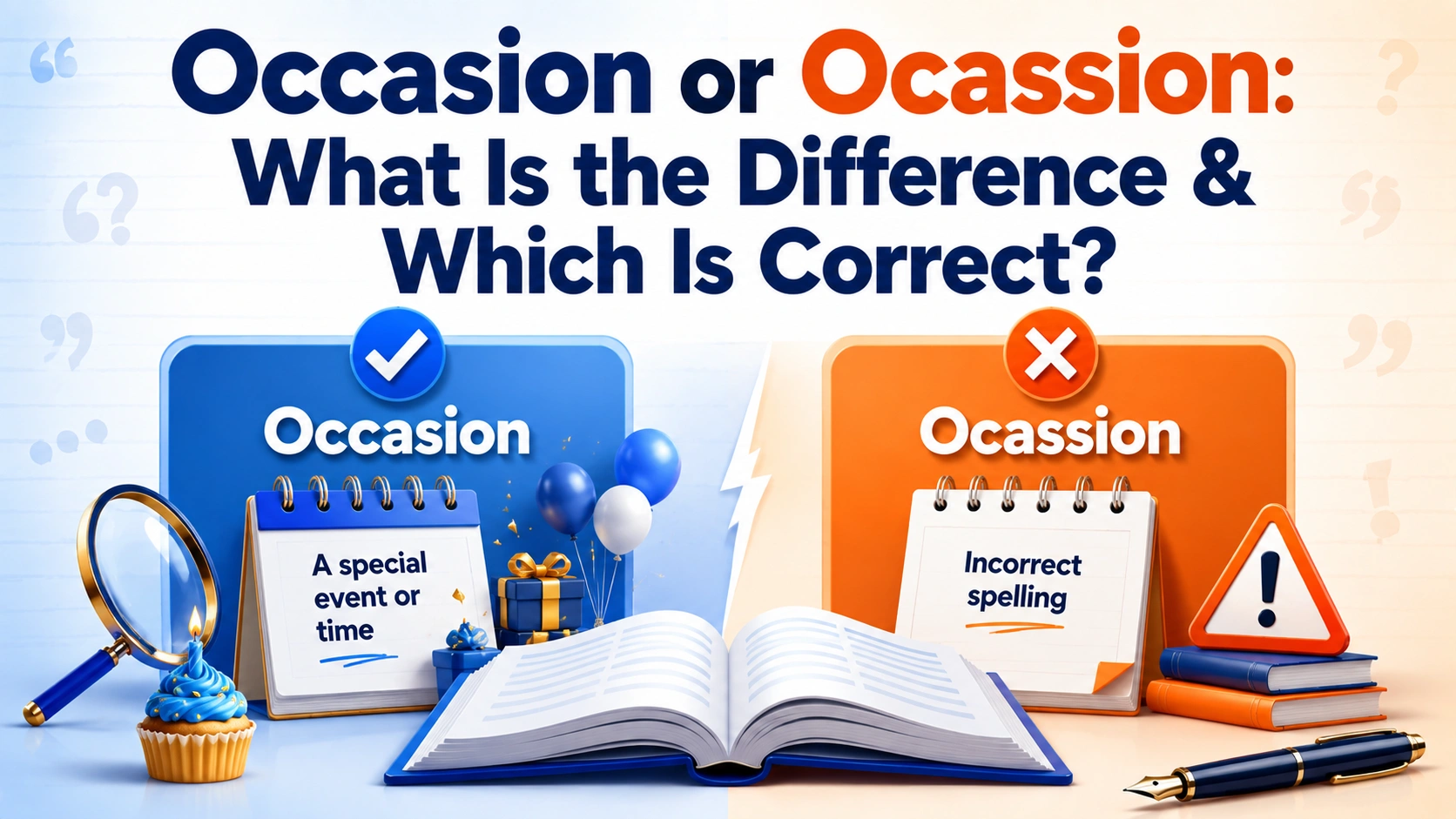
Occasion or ocassion is a spelling question that regularly confuses students, English learners, professionals, and even native speakers. Because the two versions differ by just one letter, it’s easy to assume they’re both acceptable. In reality, only occasion is recognized as the correct spelling in standard English. The incorrect form, ocassion, appears frequently in emails, essays, online searches, and social media posts, but no major dictionary accepts it as a valid English word. Using the right spelling is important because it improves clarity, strengthens your credibility, and helps your writing appear polished in both formal and informal settings.
The confusion usually arises because English spelling isn’t always phonetic. When people hear the word spoken aloud, the double c and single s aren’t obvious, leading many writers to reverse the letters by mistake. Fast typing, limited exposure to professionally edited English, and relying on pronunciation instead of spelling patterns all contribute to this common error. Since occasion is widely used in education, business, journalism, literature, invitations, and everyday conversation, learning its correct spelling is a small improvement that has a lasting impact on your writing.
In this guide, you’ll discover the difference between occasion and ocassion, learn why only one spelling is correct, and understand how occasion functions in different contexts. You’ll also find practical examples, comparison tables, grammar explanations, common collocations, real-world usage, memory tricks, and expert proofreading tips that make the correct spelling easy to remember. By the end, you’ll know exactly when to use occasion, why ocassion should always be avoided, and how to write the word confidently in every situation.
Quick Answer: Is It “Occasion” or “Ocassion”?
The answer is simple:
- ✅ Occasion is the correct spelling.
- ❌ Ocassion is a spelling mistake and is not recognized in standard English.
- ✅ Occasion is a noun that can refer to a special event, a particular time, or a reason or cause.
Whenever you’re writing about a celebration, a specific instance, or a reason for something happening, the correct word is always occasion.
Key Takeaway: If you’re writing in English, always use the occasion. The spelling ocassion should never appear in academic papers, business emails, blog posts, résumés, reports, or everyday writing.
Occasion vs. Ocassion: Side-by-Side Comparison
| Feature | Occasion | Ocassion |
| Correct English spelling | ✅ Yes | ❌ No |
| Found in major dictionaries | ✅ Yes | ❌ No |
| Accepted in formal writing | ✅ Yes | ❌ Never |
| Accepted in academic writing | ✅ Yes | ❌ Never |
| Used in professional communication | ✅ Yes | ❌ No |
| Functions as a noun | ✅ Yes | ❌ No |
| Suitable for exams and official documents | ✅ Yes | ❌ No |
Correct Usage Examples
✅ Occasion
- Her graduation was a memorable occasion.
- We only meet on special occasions.
- This seems like the perfect occasion to celebrate.
- His comments gave us occasion for concern.
❌ Ocassion
- Her graduation was a memorable ocassion.
- We only meet on special ocassions.
- This is an important ocassion.
- The announcement created an ocassion for discussion.
What Does “Occasion” Mean?
Occasion is a versatile English noun with several related meanings. Depending on the context, it can describe a special event, a particular time, or a reason that causes something to happen. Although the meaning changes slightly from one situation to another, the central idea always involves something noteworthy, specific, or significant.
Because of its flexibility, occasion appears in virtually every type of writing—from casual conversations and invitations to legal documents, academic papers, business reports, newspapers, and literature.
Occasion as a Special Event
The most familiar meaning refers to an important event, celebration, or ceremony.
Examples:
- Her wedding was a wonderful occasion.
- Everyone dressed formally for the special occasion.
- Birthdays are occasions worth celebrating.
- The company organized a dinner for the occasion.
In these examples, occasion refers to an event that people consider meaningful or memorable.
Occasion as a Particular Time or Instance
Sometimes occasion simply means a specific time when something happens.
Examples:
- On one occasion, I forgot my passport.
- We’ve spoken on several occasions.
- There was only one occasion when the system failed.
- The museum offers free admission on certain occasions.
Here, occasion refers to a particular occurrence rather than a celebration.
Occasion as a Reason or Cause
In formal English, occasion can also mean a reason or cause for an action or feeling.
Examples:
- His behavior gave us occasion for concern.
- The discovery provided occasion for further research.
- There was no occasion to worry.
- Her success became an occasion for celebration.
This meaning is especially common in journalism, legal writing, academic English, and formal speeches.
Is “Ocassion” Ever a Correct Word?
The answer is no.
Many English learners wonder whether ocassion might be an accepted alternative spelling or a regional variation. It isn’t. Unlike pairs such as color/colour or organize/organise, there is no recognized English variety in which ocassion is considered correct.
Why “Ocassion” Is Considered a Misspelling
Ocassion does not appear as a standard entry in major dictionaries because it doesn’t follow the accepted spelling of the word.
The error usually happens because writers accidentally reverse the order of the double c and single s, producing:
- ❌ ocassion
- ✅ occasion
Whether you’re writing:
- essays
- business emails
- reports
- invitations
- blog posts
- résumés
- professional documents
…the correct spelling is always an occasion.
Why Spell Check Doesn’t Always Catch It
Although most writing tools flag ocassion as incorrect, mistakes can still slip through because:
- autocorrect may be disabled
- browsers don’t always check every text field
- writers type quickly without proofreading
- some editing tools have limited dictionaries
A careful proofreading review remains the best defense against spelling mistakes.
Can “Ocassion” Ever Be Correct in Any English Variety?
No.
Neither American English, British English, Canadian English, Australian English, nor any other standard variety of English accepts ocassion as a correct spelling.
Unlike genuine regional spelling differences, occasion has only one standard spelling worldwide.
Expert Tip: If you’re ever uncertain, remember that every major English dictionary, educational institution, and style guide recognizes only occasion. The spelling ocassion is always an error.
Definition of Occasion
Unlike ocassion, which is simply a spelling mistake, occasion is a legitimate English noun recognized by every major dictionary and style guide. It is used in formal writing, everyday conversation, journalism, literature, legal documents, business communication, and academic English.
At its core, occasion refers to an event, a specific point in time, or a reason that causes something to happen. The exact meaning depends on context, but the underlying idea always involves something significant, noteworthy, or connected to a particular circumstance.
Key Point: Whenever you need to refer to a special event, a particular instance, or a reason for an action, occasion is always the correct spelling.
Common Meanings of “Occasion”
Although the word has several meanings, they are closely related. Understanding these meanings helps you use occasion naturally in different situations.
A Special Event or Celebration
The most common meaning of occasion refers to an important event that people recognize or celebrate.
Examples:
- Their anniversary was a joyful occasion.
- Graduation is a memorable occasion for every student.
- The family gathered for the special occasion.
- Weddings are occasions that bring people together.
This meaning often appears alongside words like celebration, ceremony, anniversary, festival, gathering, and milestone.
A Particular Time or Instance
Sometimes occasion simply means a specific occurrence or one particular time.
Examples:
- On one occasion, we stayed at the office until midnight.
- I’ve visited Paris on several occasions.
- There was only one occasion when the machine stopped working.
- The museum opens free of charge on certain occasions.
In this sense, occasion doesn’t describe a celebration—it simply identifies a specific moment.
A Reason or Cause
In formal English, occasion can also mean a reason that gives rise to something.
Examples:
- His comments gave us occasion for concern.
- The results provided occasion for optimism.
- There was no occasion to become angry.
- The discovery gave scientists occasion to conduct further research.
This usage is especially common in:
- academic writing
- legal documents
- journalism
- formal speeches
- historical writing
How “Occasion” Functions in English Grammar
One reason the occasion appears so frequently is that it fits naturally into many sentence structures. Although it is almost always used as a noun, it can express different ideas depending on how it’s combined with surrounding words.
Occasion as a Noun
Occasion is primarily a countable noun.
Examples:
- Every birthday is an occasion worth celebrating.
- We attended several formal occasions this year.
- The conference was an important occasion.
- Special occasions often bring families together.
Because it’s countable, it changes normally:
- occasion
- occasions
Common Sentence Patterns
Native speakers frequently use occasion in these patterns:
- on one occasion
- on several occasions
- on this occasion
- for the occasion
- on the occasion of
- rise to the occasion
- give occasion for
- have occasion to
Examples:
- We met on several occasions.
- She bought a new dress for the occasion.
- They gathered on the occasion of their parents’ anniversary.
- The emergency required everyone to rise to the occasion.
Learning these natural patterns makes your English sound much more fluent.
Common Contexts Where “Occasion” Is Used
Because occasion has several meanings, it appears across many different fields of communication.
Everyday Conversation
People often use occasion when discussing memorable events or particular moments.
Examples:
- We only visit them on special occasions.
- It was a happy occasion.
- That was the first occasion we’d met in years.
- We celebrated the occasion with dinner.
Education
Teachers and students frequently use occasion in assignments, presentations, and academic discussions.
Examples:
- The ceremony marked an important occasion in the school’s history.
- Students were asked to describe an occasion they overcame a challenge.
- The speech was delivered on the occasion of graduation.
- Historical occasions often shape national identity.
Business and Professional Communication
Professionals use occasion in speeches, announcements, and workplace correspondence.
Examples:
- The award ceremony was an important company occasion.
- We’d like to thank everyone for attending this special occasion.
- The launch provided an occasion to recognize the team’s efforts.
- It was an excellent occasion for networking.
Journalism and Media
News organizations often use occasion when reporting significant events.
Examples:
- World leaders met on the occasion of the international summit.
- The visit marked a historic occasion.
- The ceremony became a national occasion.
- The anniversary was remembered as a solemn occasion.
Legal and Official Writing
Formal documents sometimes use occasion to mean reason or cause.
Examples:
- The evidence gave no occasion for further investigation.
- There was sufficient occasion to reopen the case.
- The report provided occasion for regulatory review.
- The complaint gave occasion for disciplinary action.
This meaning emphasizes the reason something happens, rather than the event itself.
Popular Expressions and Collocations with “Occasion”
One of the best ways to sound like a native speaker is to learn common word combinations rather than individual vocabulary items.
Some of the most natural collocations include:
- special occasion
- memorable occasion
- happy occasion
- formal occasion
- historic occasion
- social occasion
- family occasion
- public occasion
- festive occasion
- rare occasion
- on one occasion
- on several occasions
- for the occasion
- mark the occasion
- celebrate the occasion
- rise to the occasion
- equal to the occasion
- give occasion for
- have occasion to
- suitable for the occasion
Using these combinations naturally improves both spoken and written English.
Occasion vs. Event vs. Opportunity vs. Ceremony
Although these words are related, they are not interchangeable in every situation.
| Word | Primary Meaning | Best Used When |
| Occasion | A special event, specific time, or reason | General situations with significance or purpose |
| Event | Something that happens | Conferences, sports, concerts, public gatherings |
| Opportunity | A favorable chance | Personal growth, careers, education, business |
| Ceremony | A formal ritual or official event | Weddings, graduations, awards, religious services |
Quick Examples
- Graduation is a special occasion. ✅
- Graduation is an important event. ✅
- Graduation is an excellent opportunity to celebrate achievements. ✅
- Graduation includes a formal ceremony. ✅
Each word highlights a different aspect of the same situation, so choosing the right one makes your writing more precise.
When to Use Occasion
Understanding the correct spelling is only part of using occasion effectively. You also need to know when the word fits naturally in different situations. Because occasion has several related meanings, it appears in everyday conversations, formal writing, business communication, education, and literature. The key is recognizing the context in which it is being used.
Use Occasion for Special Events
The most common use of occasion is to describe an important event, celebration, or ceremony.
Examples include birthdays, weddings, anniversaries, graduations, festivals, and award ceremonies.
Examples:
- Their wedding was a joyful occasion.
- We bought new clothes for the special occasion.
- Graduation is an unforgettable occasion for many students.
- The family gathered to celebrate the happy occasion.
In these examples, occasion refers to an event that has particular importance or significance.
Use Occasion for a Particular Time or Instance
Occasion can also mean a specific time when something happens.
Examples:
- On one occasion, we missed our train.
- I’ve visited Paris on several occasions.
- There was an occasion when everyone agreed.
- On this occasion, the committee approved the proposal immediately.
Here, the word means an individual occurrence or instance, not necessarily a celebration.
Use Occasion for a Reason or Opportunity
In more formal English, occasion can refer to a reason, cause, or opportunity for doing something.
Examples:
- There was no occasion for concern.
- The announcement gave everyone occasion to celebrate.
- His success provided an occasion for national pride.
- The incident became an occasion for discussing workplace safety.
This meaning is especially common in professional, academic, and literary writing.
Use Occasion as a Verb in Formal Writing
Although less common, occasion can also function as a verb meaning to cause or bring about.
Examples:
- The severe weather occasioned widespread delays.
- The decision occasioned considerable debate.
- The new policy occasioned unexpected changes.
- The discovery occasioned renewed scientific interest.
This usage is primarily found in formal reports, legal writing, journalism, and academic publications.
When NOT to Use Each One
Many spelling comparisons involve two correct words with different meanings. That is not the case here. Only occasion is correct in standard English, while ocassion should never be used.
Do Not Use Occasion Incorrectly
Although occasion is correctly spelled, it should only be used when it genuinely refers to an event, a particular time, a reason, or something that causes another event.
Incorrect examples include using it where another word would fit better.
❌ The meeting was an occasionly event.
✅ The meeting was an occasional event.
❌ He has many occasions skills.
✅ He has many skills.
Also avoid forcing occasion into sentences where words such as event, opportunity, ceremony, instance, or celebration would be clearer.
Do Not Use Ocassion
There is no context in modern English where ocassion is considered correct.
Whether you’re writing:
- School assignments
- Business reports
- Emails
- Research papers
- Blog posts
- Social media updates
- Marketing copy
- Professional documents
…the correct spelling is always an occasion.
Incorrect examples:
- It was a memorable ocassion.
- Thank you for the wonderful ocassion.
- We met on several ocassions.
Correct versions:
- It was a memorable occasion.
- Thank you for the wonderful occasion.
- We met on several occasions.
Which One to Use (Decision Guide)
If you’re uncertain while writing, this quick guide will help you choose instantly.
| If you mean… | Correct Choice |
| A special event or celebration | Occasion ✅ |
| A particular time or instance | Occasion ✅ |
| A reason or opportunity | Occasion ✅ |
| To cause something (formal verb) | Occasion ✅ |
| The spelling “Ocassion” | Never use it ❌ |
Quick Rule to Remember
- Occasion is the only correct spelling.
- Ocassion is always a spelling mistake.
- If you’re writing for any audience, always choose an occasion.
Expert Tip: When proofreading, pay special attention to the middle of the word. The correct pattern is Occa + sion (double c, then double s).
Real-World Practical Examples
Seeing an occasion used naturally in different situations makes it much easier to remember both its spelling and meaning.
Occasion Examples
Education
- Graduation was a proud occasion for every student.
- The teacher planned a special activity for the occasion.
- On one occasion, the principal addressed the entire school.
Daily Life
- We only use fine china for special occasions.
- It was the perfect occasion to reunite with old friends.
- They dressed formally for the family occasion.
Business
- The company’s anniversary was an important occasion.
- The award ceremony provided an occasion to recognize outstanding employees.
- There was no occasion to postpone the meeting.
Technology
- The product launch was a major occasion for the company.
- The software update occasioned several improvements in performance.
- Engineers marked the occasion by releasing a public demonstration.
News and Media
- The president delivered a speech on the occasion of Independence Day.
- The historic occasion attracted international media coverage.
- The anniversary became an occasion for national reflection.
Everyday Conversation
- Thanks for making the occasion so memorable.
- We don’t get many occasions like this.
- On one occasion, I forgot my passport while traveling.
- Every special occasion deserves to be celebrated.
Ocassion Examples
There are no correct examples of ocassion because it is not a valid English spelling.
Common mistakes include:
- Happy ocassion
- Special ocassion
- On several ocassions
Correct forms are:
- Happy occasion
- Special occasion
- On several occasions
Conclusion
Although occasion and ocassion differ by only one letter, only occasion is recognized as the correct spelling in modern English. Whether you’re referring to a special event, a particular time, a reason or opportunity, or using the word as a formal verb meaning “to cause,” the correct spelling is always occasion. Ocassion is simply a common spelling mistake and is not accepted in dictionaries, academic writing, professional communication, or everyday English. Learning the correct spelling not only improves your grammar but also makes your writing appear more polished and credible. One final actionable tip: remember that an occasion contains double “c” followed by double “s”—thinking of the pattern “CC comes before SS” can help you recall it instantly. A common mistake to avoid is relying solely on pronunciation when spelling the word, as English spelling often follows historical patterns rather than sound alone.
FAQs
Q1. Which spelling is correct: occasion or ocassion?
Occasion is the only correct spelling in standard English. It is recognized by all major dictionaries and is used in academic, professional, and everyday writing. Ocassion is a misspelling and should never be used in formal or informal communication.
Q2. Why do people commonly misspell occasion as ocassion?
The mistake usually happens because occasion contains both double “c” and double “s,” making the letter order easy to confuse. Many writers also rely on pronunciation rather than the actual spelling, which leads to this common error.
Q3. Can occasion be used as both a noun and a verb?
Yes. Occasion is primarily used as a noun to describe an event, a particular time, or a reason. In more formal English, it can also function as a verb, meaning to cause or bring about something, especially in academic, legal, or journalistic writing.
Q4. Is ocassion ever correct in any variety of English?
No. Ocassion is not an accepted spelling in American English, British English, Canadian English, Australian English, or any other standard variety of English. Regardless of where you’re writing, occasion is always the correct form.
Q5. What’s the easiest way to remember the correct spelling of an occasion?
A simple memory trick is to remember that occasion follows the pattern “CC before SS.” You can also think of related words such as occasional and occasionally, which all begin with the same correctly spelled root. Once you remember the base word, the related forms become much easier to spell consistently.