

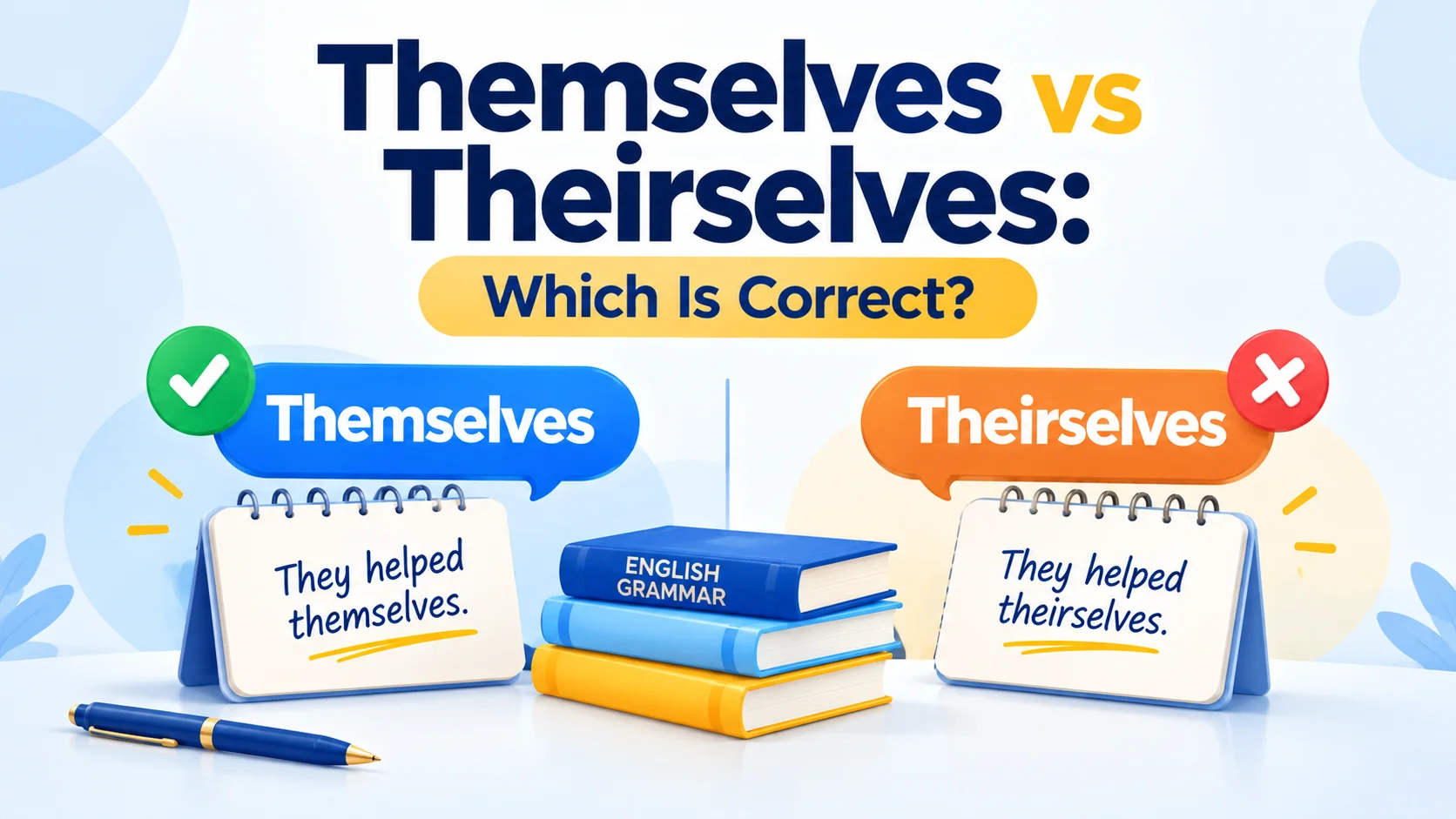
The difference between themselves vs. theirselves can be confusing because both forms may sound natural to people who hear them in everyday conversation. However, if you are writing an essay, preparing a professional email, or publishing an article, the distinction matters: themselves is the standard reflexive pronoun in modern English, while theirselves is a nonstandard form found in some regional varieties of English. Knowing this rule helps you choose the right word without assuming that every expression heard in conversation belongs in formal writing.
The confusion is understandable. English uses them to show possession, as in “their books,” so theirselves may seem like a logical way to form a reflexive pronoun. Yet standard English does not follow that pattern here. Instead, it uses themselves when referring back to them or to a person described with singular they. The distinction is not simply about spelling; it involves grammar, established usage, regional speech, and writing context. Understanding these differences makes it easier to recognize both forms and use the standard one confidently.
In this guide, you will learn what each form means, why theirselves appears in speech, and how American and British English treat the distinction. You will also find practical examples, corrections of common mistakes, a simple memory trick, and a short quiz to test your understanding. Whether you are an English learner, a student checking an assignment, or a writer editing published content, the goal is straightforward: learn when to use themselves, understand where theirselves fits, and make an informed choice without confusing standard written English with the natural variation found in spoken language.
Themselves vs. Theirselves: The Quick Answer
Use themselves in standard English. It is the accepted reflexive and emphatic pronoun associated with them. Theirselves occurs in some regional and nonstandard varieties of English, but it is generally not recommended in formal or edited writing.
Compare these sentences:
- Standard: The students prepared themselves for the examination.
- Nonstandard or dialectal: The students prepared theirselves for the examination.
Both sentences are likely to communicate the same intended meaning. The difference is that they follow the standard written convention.
| Question | Answer |
| Which form is standard? | Themselves |
| Is theirselves used in English? | Yes, in some dialects and informal speech |
| Should I write theirselves in an essay? | Generally, no |
| Is the rule different in British and American English? | No; themselves is standard in both |
| Can they refer to one person? | Yes, when used with singular they |
| Can theirselves appear in fiction? | Yes, when a writer intentionally represents a speaker’s dialect |
The simplest rule: If you are writing standard English and need a reflexive pronoun associated with them, choose yourself.
What Does “Themselves” Mean?
Themselves is a reflexive pronoun that usually refers back to the people or person represented by the subject. It can also emphasize who performs an action. Its meaning depends on how it functions in a sentence.
For example:
- The children dressed themselves.
- The employees introduced themselves to the new manager.
- The authors themselves reviewed the final draft.
In the first two sentences, they refer back to the subject. In the third, it emphasizes that the authors personally reviewed the draft.
Themselves as a Reflexive Pronoun
A reflexive pronoun is used when the subject and the person or people affected by the action refer to the same individual or group.
Consider this example:
The volunteers organized themselves into smaller teams.
The volunteers performed the action, and the resulting groups consisted of those same volunteers. The pronoun itself connects the action to its subject.
More examples include:
- The children taught themselves to play chess.
- The employees reminded themselves of the deadline.
- The participants introduced themselves before the meeting.
- The neighbors helped themselves to refreshments.
In each case, they refer back to the people already identified in the sentence.
One useful distinction: a reflexive pronoun is not automatically required whenever someone acts independently. Whether it belongs in a sentence depends on the verb and intended meaning.
Themselves for Emphasis
They can also emphasize that particular people, rather than someone else, performed an action.
For example:
- The students themselves suggested the new schedule.
- The managers themselves attended the meeting.
- The authors themselves checked every reference.
These sentences would still be grammatically possible without the pronoun, but the emphasis would be weaker.
Compare:
- The managers approved the plan.
- The managers themselves approved the plan.
The second sentence highlights the managers’ personal involvement. Depending on context, it may imply that the decision was important enough for them to handle directly rather than delegate.
Common Expressions With Themselves
Some English expressions use themselves in ways that are not always obvious to learners.
| Expression | Meaning | Example |
| Enjoy themselves | Have a good time | The children enjoyed themselves at the fair. |
| Find themselves | Discover that they are in a situation | They found themselves without enough time to finish. |
| Keep to themselves | Avoid socializing much with others | The new neighbors tend to keep to themselves. |
| Be themselves | Behave naturally or authentically | The performers felt free to be themselves. |
| Help themselves to | Take something, usually with permission | Please help yourself to some fruit. |
These expressions show why it is useful to learn themselves in context rather than treating it as a form used only when an action is physically directed back at the subject.
Can They Refer to One Person?
Yes. Themselves can refer to a single person when that person is described using singular they.
For example:
- Each applicant should introduce themselves.
- Someone has left their umbrella; they may come back for it themselves.
- Every student should ask themselves whether the answer makes sense.
In the first and third examples, each applicant and every student refer grammatically to individuals, but they are used as a singular pronoun. The reflexive form themselves is widely used in this construction.
The important point is that the choice of reflexive pronoun follows the pronoun being used, not simply the number of people involved.
What Does “Theirselves” Mean?
Theirselves is a nonstandard reflexive form used by some speakers in regional varieties of English and informal conversation. It generally expresses the meaning conveyed by the standards themselves.
For example:
- “They made theirselves comfortable.”
- “The children looked after theirselves.”
- “They introduced theirselves to the neighbors.”
In standard written English, these would normally be written as:
- They made themselves comfortable.
- The children looked after themselves.
- They introduced themselves to the neighbors.
The key distinction is not that readers can never understand theirselves. Rather, it is that the form does not follow the standard convention expected in most edited English.
Why Theirselves May Sound Logical
The form can seem reasonable because English has a possessive determiner, their, associated with the pronoun they. Someone may therefore expect theirselves to be the reflexive equivalent.
However, standard English does not build this pronoun by simply adding -selves to the possessive form. It uses them as the base of themselves.
This becomes clearer when you compare the forms:
- They → them → themselves
- We → us → ourselves
- I → me → myself
The pattern is not based exclusively on possessive forms. For that reason, themselves is the form to learn and use in standard English, even if theirselves seems more predictable at first.
Is Theirselves a Real Word?
The answer depends on what you mean by a real word.
Theirselves is a form that people use, and it can be discussed in descriptions of regional or nonstandard English. Its existence in speech does not make it the standard form for formal writing.
It is helpful to separate two questions:
- Does the form occur in actual English? Yes.
- Is it the standard choice in edited English? No; themselves is preferred.
This distinction applies to many language questions. A word or construction can be recognizable, meaningful, and established in a particular speech community without being appropriate in every writing context.
The Key Differences Between Themselves and Theirselves
The two forms usually communicate a similar idea, but they differ in standardness and suitability for particular contexts.
| Feature | Themselves | Theirselves |
| Grammatical role | Reflexive or emphatic pronoun | Used as a reflexive form in some dialects |
| Standard written English | Accepted | Nonstandard |
| Academic writing | Recommended | Generally avoid |
| Professional communication | Recommended | Generally avoid |
| Everyday conversation | Common | Occurs in some speech communities |
| Fictional dialogue | Suitable | May be suitable for deliberate dialect representation |
| Singular they | Standard choice | Not the standard choice |
| Best choice when uncertain | Yes | No |
Are Themselves and Theirselves Interchangeable?
They may be understood as conveying the same intended meaning, but they are not interchangeable in standard written English.
For example:
- Standard: The players congratulated themselves after the match.
- Nonstandard or dialectal: The players congratulated theirselves after the match.
If you are writing a report about the match, the first sentence is the appropriate choice. If you are recording someone’s exact words or writing dialogue that intentionally reflects a particular dialect, the second form may be retained for a specific reason.
The important lesson is that understandable meaning and standard usage are related but separate issues.
Is Theirselves Grammatically Correct?
In general-purpose writing, theirselves is classified as nonstandard, and writers should use themselves instead.
When discussing dialects, however, it is more precise to describe theirselves as a dialectal or nonstandard form rather than claiming that nobody uses it correctly in any linguistic context. A linguist documenting a community’s speech, for instance, may need to record the form exactly as speakers use it.
For most readers, the practical rule remains uncomplicated: use themselves in standard prose.
Why Do People Confuse Themselves and Theirselves?
The confusion is not difficult to explain. English pronouns have different forms for different grammatical functions, and those forms do not always follow an obvious pattern.
“Their” Makes Theirselves Seem Logical
The words they and their are closely associated:
- They arrived early.
- Their bags were already in the room.
- They carried their bags inside.
Because this indicates possession, some speakers may naturally extend it to form theirselves. That is an understandable analogy, but it does not reflect the standard reflexive form.
When checking a sentence, focus on the grammatical function of the word. If you need a reflexive pronoun associated with them, use themselves.
English Reflexive Pronouns Follow Different Patterns
English reflexive pronouns have to be learned as a set because they do not all derive from the corresponding possessive forms.
| Subject pronoun | Standard reflexive pronoun |
| I | Myself |
| You, singular | Yourself |
| He | Himself |
| She | Herself |
| It | Itself |
| We | Ourselves |
| You, plural | Yourselves |
| They | Themselves |
The list also explains why theirselves can appear plausible without being standard. The reflexive form associated with they is themselves, not a form created from their.
Regional Speech and Family Language Habits
People acquire much of their language through conversation with family, friends, and their wider community. As a result, a form may feel completely natural to one speaker while sounding unusual to another.
This variation does not automatically mean that a speaker is careless. Different varieties of English can have distinct patterns of pronunciation, vocabulary, and grammar. Formal writing, meanwhile, usually follows a more standardized set of conventions.
If you encounter theirselves in conversation, you can recognize what the speaker means while still choosing themselves in your own standard writing.
Spoken English and Written English Have Different Expectations
A phrase can be common in informal speech yet unsuitable for an academic essay or a business report. The audience and purpose of a piece of writing help determine which conventions apply.
For example, a novelist may preserve a character’s established dialect in dialogue. An editor preparing a university textbook would normally use themselves in explanatory prose.
Practical advice: Learn to recognize the nonstandard form, but use the standard form when accuracy in formal writing matters.
Is Theirselves Used in American English or British English?
The standard rule is the same in both major varieties: American English and British English use themselves. The distinction between themselves and theirselves is not like the spelling difference between color and colour.
Themselves in American English
In standard American English, themselves is the expected form in academic writing, workplace communication, journalism, and edited publications.
Examples:
- The committee members introduced themselves.
- The students prepared themselves for the presentation.
- The applicants should familiarize themselves with the requirements.
Some American speakers may use theirselves in informal or regional speech. That does not make it a standard American spelling variant.
Themselves in British English
British English follows the same standard rule.
Examples:
- The pupils organized themselves into groups.
- The volunteers made themselves available for the event.
- The team members reminded themselves of the deadline.
Although regional speech varies across the United Kingdom, writers should not treat theirselves as the British equivalent of standard themselves.
Does Theirselves Belong to a Particular Region?
The form has been associated with regional and nonstandard varieties of English, but it would be misleading to claim that it belongs exclusively to one country or that every speaker in a particular region uses it.
If you are writing about the distribution or history of the word, consult a reputable dialect dictionary or linguistic reference. For everyday writing decisions, you do not need to establish a speaker’s region: use themselves in standard English.
When Should You Use Themselves?
The best form depends partly on what you are writing. In most ordinary situations, themselves is the clear choice.
In School Assignments and Academic Writing
Use themselves in essays, examinations, research papers, reports, and other assessed work.
Avoid standard academic writing: The participants evaluated theirselves after the experiment.
Preferred: The participants evaluated themselves after the experiment.
Academic writing generally follows standard written conventions so readers can focus on the argument rather than be distracted by nonstandard forms. Unless the assignment specifically involves documenting dialect speech, themselves is the appropriate choice.
In Professional Emails and Business Documents
Professional communication benefits from familiar, standard grammar. Use themselves in emails, proposals, reports, policies, and workplace instructions.
Examples:
- Team members should familiarize themselves with the updated procedure.
- Applicants may introduce themselves at the beginning of the interview.
- Employees should ask themselves whether the information is accurate.
These sentences are clear and natural. There is no practical advantage to using theirselves in this context.
In Website Articles and Published Content
For blog posts, educational resources, news articles, and other general-audience content, use themselves.
Editors and content writers should also distinguish between the author’s own wording and a quotation. If a source says theirselves, an exact quotation may preserve the original wording when it is important to the reader. If the wording is not being quoted directly, use the standard form in the article’s own prose.
This distinction is useful for maintaining both grammatical consistency and quotation accuracy.
In Everyday Conversation
Themselves is perfectly natural in ordinary conversation, so it is a reliable choice even when you are speaking casually.
For example:
- They can look after themselves.
- They should introduce themselves first.
- They bought the tickets themselves.
If someone else says theirselves, you can understand the intended meaning without adopting the form yourself. Recognizing a variation and choosing your own preferred usage are separate skills.
In Fiction and Dialogue
Creative writing allows more flexibility because dialogue sometimes needs to reflect the way a character speaks.
A writer may retain theirselves if it is a deliberate and well-supported feature of a character’s dialect. However, it should not be inserted randomly or used as a shortcut for portraying a character as less intelligent.
Consider three editorial situations:
- Narration: Use themselves in standard narrative prose.
- Dialogue: Consider retaining theirselves when it accurately reflects the character’s established speech.
- Direct quotation: Preserve the original wording when an exact quotation is necessary, following the publication’s editorial conventions.
The aim is not to erase linguistic variation. It is to make deliberate choices that suit the writing’s purpose.
Common Mistakes to Avoid
Knowing which form is standard is only part of using reflexive pronouns well. The following mistakes show how the issue can overlap with other grammar problems.
Mistake 1: Using Theirselves in Formal Writing
Nonstandard: The students prepared theirselves for the examination.
Standard: The students prepared themselves for the examination.
The correction is straightforward: replace theirselves with themselves. You do not need to restructure the sentence because the intended meaning remains the same.
Mistake 2: Confusing Their With Themselves
They and themselves are not alternative spellings of the same word.
Compare:
- Their: The students collected their books.
- Themselves: The students collected the books themselves.
In the first sentence, they identify who owns the books. In the second, they emphasise who collected them.
A useful editing question is: Does this word show possession, or does it refer back to the subject? The answer will usually make the choice clear.
Mistake 3: Using a Reflexive Pronoun When It Is Unnecessary
Not every sentence about an action performed by a person needs a reflexive pronoun.
Compare:
- The children washed before dinner.
- The children washed themselves before dinner.
Both sentences can be grammatical. The second explicitly identifies the children as the people being washed; the first leaves that detail unstated.
However, some verbs and expressions conventionally use reflexive pronouns in particular meanings. For example, enjoy oneself is a standard expression:
- Natural: The children enjoyed themselves.
- Not standard for the intended meaning: The children enjoyed it.
The best approach is to consider the verb and the meaning you want to convey, rather than adding themselves mechanically.
Mistake 4: Assuming Familiar Speech Is Always Standard Writing
A word may feel natural because you have heard it frequently. Familiarity alone, however, does not determine whether a form belongs in formal written English.
If you are preparing a report or essay and notice theirselves, replace it with themselves unless you have a specific reason to preserve the original wording.
Mistake 5: Treating Theirselves as a British or American Spelling Variant
Unlike center and centre, theirselves is not a standard national spelling alternative to themselves.
Both American and British standard English use themselves. Do not apply spelling-variant rules to a difference involving a nonstandard reflexive form.
Mistake 6: Correcting Every Dialect Form Without Considering Context
An editor should not automatically change every occurrence of theirselves without first checking what the text is doing.
In a formal essay, correction is usually appropriate. In a linguistic study, a direct quotation, or carefully written dialogue, changing the form may distort the original speech.
Editorial checklist:
- Is the sentence standard narration or formal prose?
- Is the form part of a direct quotation?
- Is a speaker’s dialect being represented intentionally?
- Would changing the form alter the meaning or authenticity of the passage?
These questions help distinguish an ordinary editing correction from an intentional linguistic choice.
Themselves vs. Theirselves: Examples in Real Sentences
The following examples show how the standard form works in different sentence types.
| Context | Standard example | Why it works |
| Preparation | The students prepared themselves for the test. | Refers back to the students |
| Introductions | They introduced themselves to the guests. | The subject and object refer to the same people |
| Organization | The workers organized themselves into teams. | The workers formed the teams |
| Enjoyment | The children enjoyed themselves at the party. | Uses a common reflexive expression |
| Independence | They completed the project themselves. | Emphasizes who completed it |
| Responsibility | They blamed themselves for the mistake. | Refers back to the people accepting blame |
| Singular they | Each applicant should introduce themselves. | Uses a standard singular-they construction |
Examples in Questions
The same standard form applies when a sentence asks a question.
- Did the students introduce themselves?
- Can the children look after themselves?
- Have the participants familiarized themselves with the instructions?
The question structure does not change the reflexive pronoun.
Examples in Negative Sentences
Negation also has no effect on the choice between the two forms.
- They did not blame themselves for the delay.
- The participants should not compare themselves unfairly with others.
- The employees could not make themselves heard above the noise.
In each case, they refer back to the subject.
Examples With Singular They
Use themselves when a singular person is referred to with them.
- Each guest can serve themselves.
- The applicant should ask themselves whether the role is suitable.
- Anyone who finds a lost phone should identify themselves to the staff.
These examples demonstrate why themselves should not be treated as a form reserved exclusively for groups.
How to Remember Themselves vs. Theirselves
The easiest way to remember the distinction is to learn the standard pronoun pairing instead of trying to build the word from there.
Remember: They → Themselves
Practice the form in short sentences:
- They helped themselves.
- They introduced themselves.
- They completed the work themselves.
Reading the sentences aloud can help reinforce the standard form, especially if you have regularly heard theirselves in conversation.
Use the Their-versus-Themselves Test
When you are unsure which word belongs in a sentence, check its grammatical role.
- They indicate possession: Their coats are in the hallway.
- Themselves refer back to the subject or add emphasis: They collected their coats themselves.
This test will not explain every use of reflexive pronouns, but it resolves many common mistakes.
A Simple Editing Routine
Before submitting an essay or publishing an article:
- Search for theirselves.
- Check whether the sentence is standard prose, dialogue, or a quotation.
- In ordinary standard writing, replace it with themselves.
- Read the full sentence to make sure the pronoun is necessary and has a clear referent.
This quick check is particularly useful for writers and editors who work with long documents.
Practice Quiz: Themselves or Theirselves?
Test your understanding by choosing the form appropriate for standard English in each sentence.
Choose the Correct Form
- The students introduced ______ to their new teacher.
- The workers organized ______ into smaller groups.
- The children enjoyed ______ during the school trip.
- Each applicant should prepare ______ for the interview.
- The team members ______ reviewed the final report.
Answers and Explanations
- Themselves — the students are introducing themselves.
- Themselves — the workers are organizing the same people represented by the subject.
- Themselves — enjoyed themselves is the standard expression.
- Themselves — singular they can refer to an individual applicant.
- Themselves — the pronoun adds emphasis, highlighting the team members’ personal involvement.
Editing Challenge
Correct the following paragraph for standard written English:
The volunteers introduced theirselves before the event. They reminded theirselves of the schedule and prepared theirselves for the day’s activities. Each volunteer also checked that they had everything they needed.
Corrected version:
The volunteers introduced themselves before the event. They reminded themselves of the schedule and prepared themselves for the day’s activities. Each volunteer also checked that they had everything they needed.
The main corrections replace theirselves with themselves. The final sentence already uses a natural singular-they construction and does not need changing.
Conclusion:
The distinction between themselves vs. theirselves becomes straightforward once you separate standard written English from regional speech. Themselves is the accepted reflexive and emphatic pronoun associated with they, including when they refers to one person. Theirselves occurs in some varieties of spoken English, but it is not the standard substitute for formal writing.One final actionable tip: When editing an essay, email, or article, search for theirselves and replace it with themselves wherever standard English is intended. A common mistake to avoid is assuming that a form must be standard simply because it sounds familiar or follows a seemingly logical pattern. Recognize language variation without confusing it with formal conventions. The best word choice is the one that fits both the intended meaning and the context.
FAQs
Q1. Is “Theirselves” a Real Word?
Theirselves is a form used in some regional and nonstandard varieties of English. It is understandable in context, but themselves is the standard form expected in general written English. Its occurrence in speech does not make it the preferred choice for formal writing.
Q2. Which Is Correct: Themselves or Theirselves?
Themselves is correct in standard English. Use it in school assignments, professional emails, reports, and published articles. Theirselves may occur in regional speech or informal conversation, but it is generally considered nonstandard and should not replace themselves in formal prose.
Q3. Is Theirselves Ever Acceptable in Writing?
Yes, in specific contexts. A writer may preserve theirselves in an accurate direct quotation, a linguistic study, or fictional dialogue that deliberately represents a speaker’s dialect. In ordinary narration, academic work, and professional writing, use themselves unless there is a clear reason not to.
Q4. Do Americans Say Theirselves Instead of Themselves?
Some American speakers use theirselves in informal or regional speech, but themselves remain standard in American English. The same standard applies in British English. It is therefore misleading to describe theirselves as an accepted American spelling or as a standard regional alternative.
Q5. Can Themselves Refer to One Person?
Yes. Themselves can refer to one person when that person is described using singular they. For example, “Each applicant should introduce themselves.” This construction is widely used in contemporary English, particularly when a person’s gender is unknown, irrelevant, or expressed using they/them pronouns.