

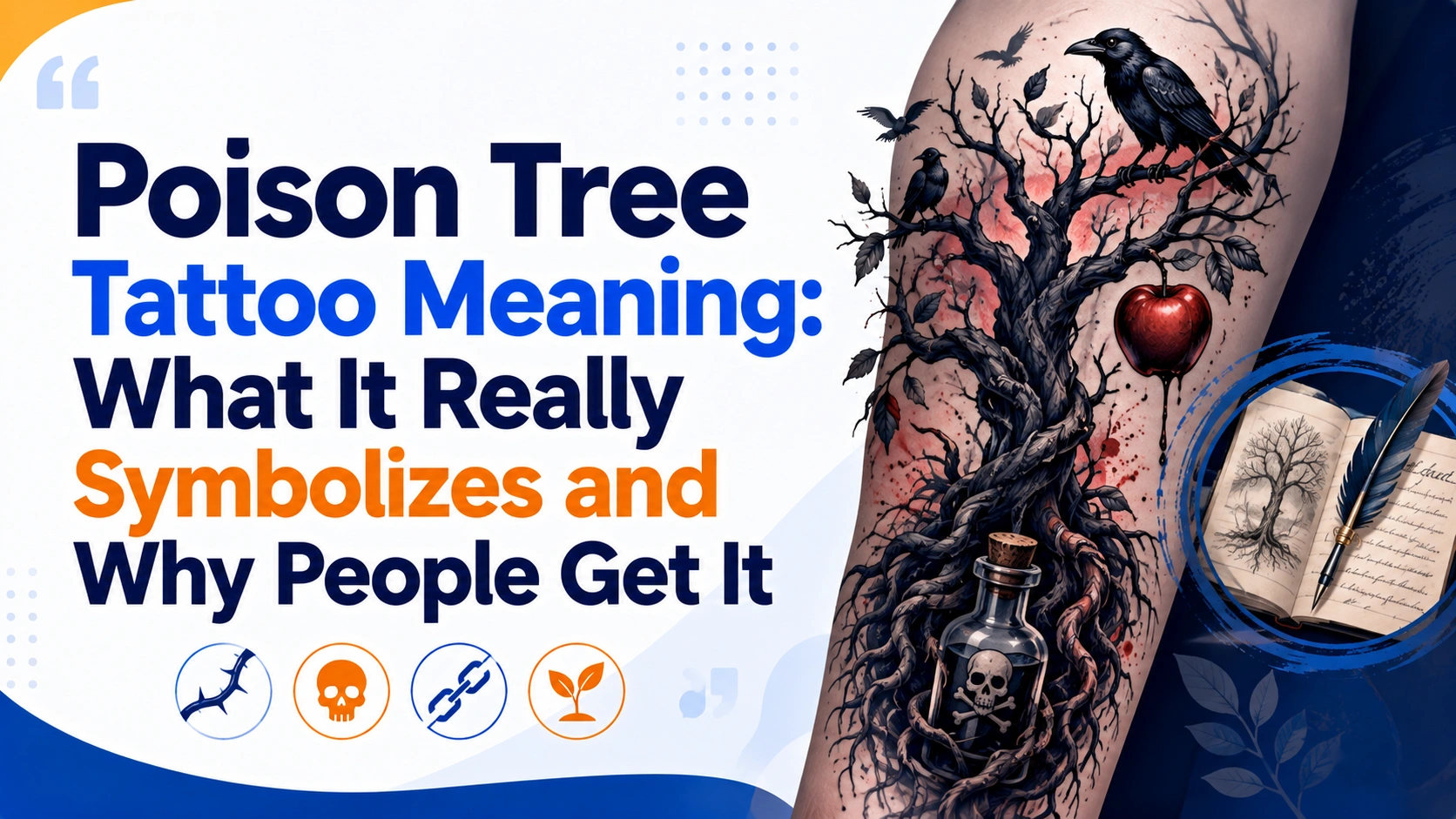
Poison tree tattoo meaning is rarely as simple as “dark” or “evil.” The symbol is most strongly associated with William Blake’s poem “A Poison Tree,” where hidden anger grows into a poisonous tree and produces destructive consequences. The image can therefore represent suppressed resentment, betrayal, emotional conflict, revenge, consequences, or the transformation of pain into self-awareness. However, a tattoo does not have one universal definition. Its meaning depends heavily on the wearer’s design choices, personal story, and relationship to the literary or biblical imagery behind it.
That flexibility is part of what makes the poison tree tattoo so visually powerful. A tree can look peaceful while its roots, branches, fruit, or thorns suggest something much darker underneath. Someone may use the design to represent anger that was never expressed, while another person may see it as a reminder not to let bitterness control their life. Others are drawn primarily to William Blake, Gothic art, dark botanical imagery, or the symbolism of poisonous fruit rather than to one specific emotional experience.
Before interpreting the design, it helps to separate documented symbolism from personal interpretation. Blake’s poem provides the strongest literary foundation, while the Garden of Eden provides an important biblical association with forbidden fruit, temptation, knowledge, and consequences. Modern tattoo culture then adds new possibilities. This guide explains those layers, shows what common design elements can communicate, compares the poison tree with related symbols, and explains why the same tattoo can mean something very different from one person to another.
Quick Answer: What Does a Poison Tree Tattoo Mean?
A poison tree tattoo commonly symbolizes suppressed anger, resentment, betrayal, emotional pain, revenge, temptation, or the consequences of allowing negative emotions to grow.
Its most recognizable literary connection is William Blake’s “A Poison Tree,” published in Songs of Experience in 1794. The poem contrasts anger that is openly expressed with anger that is concealed and allowed to grow. The hidden anger becomes a metaphorical tree bearing a bright but poisonous apple.
A modern tattoo can therefore communicate several ideas:
- “What I keep inside can grow.”
- The consequences of unresolved resentment
- Betrayal or broken trust
- A difficult emotional chapter
- The temptation to seek revenge
- Awareness of one’s darker emotions
- Moving beyond bitterness
- Beauty that hides something dangerous
- Personal transformation after hardship
Important: There is no official dictionary definition for a “poison tree tattoo.” Tattoo symbolism is interpretive, so the wearer ultimately determines the personal meaning.
Where Does the Poison Tree Symbol Come From?
The phrase “poison tree” has more than one possible association, but William Blake’s poem is the most important literary source for the tattoo interpretation commonly discussed today.
William Blake’s “A Poison Tree”
William Blake published “A Poison Tree” as part of Songs of Experience. The collection dates to the late eighteenth century, with the work printed and hand-colored in different copies over the years. The Metropolitan Museum of Art identifies Songs of Experience: A Poison Tree as a Blake work from 1794.
The poem presents two situations.
In the first, the speaker is angry with a friend and communicates that anger. The conflict ends.
In the second, the speaker is angry with a foe but does not express the feeling. Instead, the anger grows. Blake turns that emotional growth into an extended metaphor: the resentment becomes a tree that eventually produces a bright apple. The poem ends with the foe beneath the tree.
That transformation is central to the tattoo symbolism:
anger → concealment → cultivation → growth → poisonous fruit → consequences
The tree is therefore more than an image of death. It represents an emotion becoming something larger than the person who originally experienced it.
Why the tree is such an effective metaphor
Trees naturally suggest growth, roots, time, cycles, and consequences.
That makes the metaphor especially effective. A temporary feeling becomes something with roots. A passing argument becomes a lasting grievance. A private thought becomes a visible structure.
A poison tree tattoo can capture precisely that tension: something beautiful on the surface but destructive underneath.
What Does “A Poison Tree” Actually Mean?
The poem is often reduced to a simple message such as “anger is bad.” Its symbolism is more complicated.
Blake contrasts communication and concealment. The speaker’s relationship with a friend allows anger to be expressed and therefore brought to an end. The relationship with the foe is different: anger is hidden and deliberately nurtured. Educational analysis of the poem similarly identifies the growing tree as an extended metaphor for negative emotions and resentment.
Anger that is expressed
The first emotional pattern suggests that acknowledging anger can prevent it from becoming something larger.
For tattoo symbolism, this can represent:
- emotional honesty
- communication
- confronting conflict
- refusing to hide resentment
- learning from past arguments
Anger that is hidden
The second pattern is darker. The speaker doesn’t simply experience anger; the poem describes the emotion being metaphorically fed and cultivated.
This gives the tattoo a deeper meaning than ordinary anger.
It can symbolize:
- unresolved resentment
- suppressed emotions
- grudges
- emotional isolation
- bitterness
- the danger of pretending everything is fine
The poisonous fruit
The apple is the result of the tree’s growth. Symbolically, it can represent the visible consequence of an invisible emotional process.
This is one reason a poisoned apple can make the tattoo’s message much clearer than a tree alone.
The Biblical Connection: Is a Poison Tree the Same as the Tree of Knowledge?
Not exactly.
The Garden of Eden is an important association because Genesis describes the tree of the knowledge of good and evil and the forbidden fruit. Genesis 2:9 places the tree of life and the tree of the knowledge of good and evil in the garden, while Genesis 2:17 establishes the prohibition against eating from the latter.
Genesis 3 then introduces the serpent, the temptation, the eating of the fruit, and the consequences that follow.
However, the Bible does not call that tree a “poison tree.”
That distinction matters.
| Symbol | Primary association | Typical tattoo interpretation |
| Poison tree | Blake’s poem and dark botanical symbolism | Resentment, suppressed anger, consequences |
| Tree of Knowledge | Genesis | Knowledge, temptation, moral awareness |
| Tree of Life | Biblical and broader cultural symbolism | Life, renewal, immortality |
| Dead tree | General visual symbolism | Loss, endings, mortality |
| Poisoned apple | Blake + broader forbidden-fruit imagery | Temptation, danger, hidden consequences |
Blake’s poem itself has been interpreted as having a biblical or Edenic resonance, particularly because of its garden, fruit, temptation-like imagery, and consequences.
So a tattoo combining a poison tree with a serpent or apple may intentionally blend Blakean literary symbolism with Eden imagery.
The Core Poison Tree Tattoo Meanings
A single design can carry several meanings simultaneously. The most common interpretations fall into a few broad categories.
1. Suppressed anger and resentment
This is probably the strongest interpretation when the tattoo is specifically inspired by Blake.
The tree represents an emotion that wasn’t dealt with when it first appeared. Instead, it developed roots and continued growing.
The message may be:
Unresolved emotions do not necessarily disappear just because they remain unspoken.
2. Betrayal and broken trust
A poison tree can symbolize what happens after someone has been betrayed.
The tree becomes a metaphor for the emotional aftermath:
trust → betrayal → resentment → emotional growth → lasting consequences
This interpretation is especially plausible when the tattoo includes broken branches, thorns, or a damaged fruit.
3. Revenge and its consequences
Blake’s poem has an unmistakably destructive ending, which makes revenge another common interpretation.
However, it is important not to treat the tattoo as automatically celebrating revenge.
It may instead communicate:
- “Revenge changed me.”
- “I understand the consequences of resentment.”
- “I survived a destructive relationship.”
- “I refuse to become consumed by anger.”
The same visual symbol can represent a warning against revenge rather than an endorsement of it.
4. Emotional pain
A poison tree can also function as a broader metaphor for pain that develops over time.
The roots may represent the origin of the experience. The trunk can represent its lasting effect. The branches show how the experience spreads into other parts of life.
5. Self-awareness and personal growth
This is where the symbol becomes less negative.
Someone may use a dark tree to acknowledge an unpleasant part of their past without allowing it to define their future.
In that interpretation, the tree says:
“Something painful grew here, but I understand it now.”
That is quite different from simply celebrating darkness.
What the Tree’s Design Elements Can Symbolize
The most interesting poison tree tattoos often use several visual elements, each contributing a different layer.
| Design element | Possible symbolism | What it changes about the overall message |
| Deep roots | Past experiences, hidden emotions | Makes the design feel psychological and deeply rooted |
| Twisted branches | Complicated emotions or relationships | Creates a sense of conflict |
| Poison apple | Temptation and consequences | Strengthens Blake/Eden associations |
| Thorns | Pain, defensiveness, emotional protection | Makes the design more guarded |
| Dead branches | Loss, endings, emotional exhaustion | Creates a more mournful interpretation |
| New leaves | Recovery and renewal | Adds hope to a dark design |
| Flowers | Transformation or beauty after hardship | Softens the symbolism |
| Snake | Temptation, deception, Eden | Strengthens biblical imagery |
| Raven or crow | Mortality, mystery, darkness | Makes the design more Gothic |
| Broken branch | Loss or damaged relationships | Adds a specific sense of rupture |
| Falling leaves | Change and impermanence | Suggests an ending or transition |
These meanings are interpretations, not universal tattoo rules. A wearer may assign an entirely different meaning to the same element.
Poison Tree Tattoo Designs and What They Communicate
Minimalist poison tree
A simple silhouette with a few branches can communicate the concept without making the imagery overwhelmingly dark.
This approach works particularly well when the idea matters more than realism.
Gothic poison tree
A twisted tree, dramatic branches, dark shading, and a bleak atmosphere emphasize:
- mortality
- darkness
- mystery
- emotional conflict
- Gothic aesthetics
Poison tree with an apple
This is one of the clearest versions of the concept.
The apple immediately connects the tree to Blake’s poem and forbidden-fruit imagery, although viewers unfamiliar with the literary source may simply read it as a dangerous or tempting fruit.
Tree with thorns
Thorns make the symbolism more defensive.
They can suggest:
- emotional protection
- painful memories
- mistrust
- danger
- boundaries
Poison tree with new growth
Adding flowers or fresh leaves changes the emotional direction.
Instead of saying “I am consumed by darkness,” the design can suggest:
“Something painful happened, but growth came afterward.”
That distinction can make the tattoo feel more reflective than purely bleak.
Color Choices Can Change the Meaning
Color isn’t a fixed symbolic language, but it strongly influences how viewers interpret a tattoo.
| Color approach | Likely visual effect | Possible interpretation |
| Black and gray | Somber, literary, Gothic | Resentment, memory, mortality |
| Deep red | Dramatic focal point | Anger, danger, passion, blood-red fruit imagery |
| Dark green | Botanical and organic | Poison, nature, hidden growth |
| Purple | Mysterious and surreal | Transformation, fantasy, symbolism |
| Red + black | High contrast | Conflict, temptation, danger |
| Green + red | Strong fruit symbolism | Poisoned apple / temptation |
| Black with small bright accents | Emphasizes selected elements | Hidden danger or a single defining memory |
There is no universal rule that says, for example, that green must mean poison. The artist’s composition matters more than a rigid color dictionary.
Poison Tree Tattoo vs. Other Dark Tree Tattoos
Not every dark tree tattoo represents the same idea.
| Tattoo type | Main visual message | Common interpretation |
| Poison tree | Tree + toxic fruit or Blake-inspired imagery | Resentment, hidden anger, consequences |
| Dead tree | Lifeless structure | Loss, mortality, endings |
| Tree of Life | Flourishing tree | Life, family, continuity, renewal |
| Weeping willow | Drooping branches | Grief, reflection, melancholy |
| Dark forest | Dense or threatening landscape | Mystery, uncertainty, exploration |
| Burning tree | Fire and destruction | Transformation, destruction, rebirth |
| Poison tree + apple | Tree and dangerous fruit | Temptation, resentment, consequence |
The fruit is often the fastest visual clue that a design is intended to be a poison-tree concept rather than simply a dead or Gothic tree.
Why Do People Choose a Poison Tree Tattoo?
People can be drawn to the image for very different reasons.
Literary connection
Someone familiar with William Blake may choose it as a visual reference to “A Poison Tree” and its themes of anger, concealment, and consequence.
Personal symbolism
The tree can represent a difficult chapter without requiring the wearer to explain the entire story publicly.
Dark botanical aesthetics
Some people simply appreciate the contrast between natural beauty and threatening imagery.
Transformation
A tree naturally represents growth, so combining growth with poison creates an interesting contradiction:
What grows is not always healthy.
That can be a powerful metaphor for experiences, habits, relationships, or emotions.
Philosophical symbolism
The design can raise questions about good and evil, temptation, responsibility, emotional control, and the consequences of choices.
Does a Poison Tree Tattoo Always Mean Revenge?
No.
Revenge is one possible interpretation, particularly because Blake’s poem ends with the foe dead beneath the tree. But reducing every poison tree tattoo to revenge misses much of the symbol’s complexity.
A person might use the design to represent:
- anger they have overcome
- a warning against holding grudges
- betrayal
- emotional maturity
- consequences
- temptation
- a literary interest
- personal transformation
The surrounding artwork is crucial.
A poison apple + snake + dark tree may lean toward temptation and danger.
A tree with new leaves and flowers may suggest recovery.
A bare tree with deep roots may emphasize loss or unresolved history.
Common Misconceptions About Poison Tree Tattoos
“It always means hatred.”
Not necessarily. Hatred and resentment are strongly compatible with Blake’s poem, but the tattoo may represent awareness of those emotions rather than identification with them.
“The poison tree is a biblical symbol.”
Not exactly. The Bible contains the tree of the knowledge of good and evil, but it does not name it a poison tree. The poison-tree concept is more directly associated with Blake’s poem and later artistic interpretation.
“The apple always means evil.”
An apple can suggest temptation, danger, knowledge, desire, or consequences. Its interpretation depends on the rest of the design.
“A dark tree tattoo must represent something traumatic.”
No. Some people choose dark imagery for literary, artistic, philosophical, or aesthetic reasons.
“There is one official poison tree tattoo meaning.”
There isn’t. Tattoo symbolism is personal and culturally variable.
What Makes a Poison Tree Tattoo Positive Rather Than Negative?
The symbolism can become surprisingly hopeful when the design shows growth after damage.
Consider a tree with:
- fresh leaves emerging from dead branches
- flowers growing around damaged roots
- a broken branch beginning to regenerate
- a single healthy fruit among darker elements
- light surrounding an otherwise dark tree
These details can shift the interpretation from “I am poisoned by the past” toward “I recognize what poisoned me, and I am growing beyond it.”
This is one of the most useful ways to understand the symbol: dark imagery does not automatically equal a negative message.
How Placement Can Affect the Symbolism
Placement does not have a universal dictionary meaning either, but it can influence how private or visible the symbolism feels.
For example, a highly visible placement can make the design function more like a public artistic statement, while a less visible placement may make it feel more personal.
Rather than assuming that a specific body location always means something specific, consider three questions:
- How visible should the artwork be?
- Does the shape of the body area suit a branching design?
- Will the composition still look balanced as the artwork ages?
The artist’s technical judgment matters because tree designs contain fine branches, roots, and negative spaces that can become visually crowded if poorly composed.
If you’re under the legal age for tattooing where you live, the relevant age restrictions and consent requirements should be followed rather than treating online tattoo advice as permission.
Poison Tree Tattoo Meaning in Different Contexts
The same artwork can be interpreted differently depending on the story behind it.
| Context | Likely meaning |
| Blake-inspired design | Suppressed anger and consequences |
| Breakup-related design | Betrayal, resentment, emotional aftermath |
| Gothic artwork | Darkness, mortality, mystery |
| Eden-inspired design | Temptation, knowledge, disobedience |
| Recovery-focused design | Growth after painful experiences |
| Philosophical design | Human nature and moral conflict |
| Purely artistic design | Beauty contrasted with danger |
This is why asking “What does a poison tree tattoo mean?” has no single answer.
The better question is:
“Which interpretation does this particular design communicate?”
A Simple Way to Interpret Any Poison Tree Tattoo
If you encounter one online or in artwork and want to understand its intended meaning, look at these elements in order:
1. Look at the fruit
Is there an apple?
If yes, Blake, Eden, temptation, or consequence becomes more likely.
2. Look at the tree’s condition
Is it flourishing, dead, twisted, burning, or partially recovering?
That often tells you whether the emphasis is on growth, loss, destruction, or transformation.
3. Look at surrounding symbols
Snakes, thorns, ravens, flowers, skulls, or religious imagery can change the interpretation substantially.
4. Look for text
A literary quotation, date, initials, or other personal element may reveal whether the tattoo is literary, commemorative, or autobiographical.
5. Don’t assume the story
Even when the symbolism seems obvious, the wearer may have chosen it for an entirely different reason.
Best interpretation rule: Read the design as a combination of symbols rather than assigning one fixed meaning to the tree itself.
Things to Consider Before Interpreting the Symbol
A thoughtful interpretation should distinguish between historical meaning, common symbolism, and personal meaning.
Historical meaning
Blake’s poem provides a documented literary foundation involving concealed anger, its cultivation, and destructive consequences.
Cultural meaning
Biblical imagery, particularly Eden and the forbidden fruit, can add ideas of temptation, knowledge, choice, and consequence.
Personal meaning
The wearer may attach a completely different story to the image.
Artistic meaning
A tattoo artist may use the poison tree primarily as a visual metaphor, emphasizing contrast between beauty and danger.
Keeping these levels separate prevents overconfident interpretations.
Poison Tree Tattoo Symbolism: A Practical Cheat Sheet
| If the design includes… | The symbolism may lean toward… |
| Poison apple | Temptation, danger, consequence |
| Deep roots | Past experiences, hidden emotions |
| Twisted trunk | Conflict or emotional complexity |
| Bare branches | Loss, isolation, mortality |
| New leaves | Renewal and personal growth |
| Thorns | Pain, protection, boundaries |
| Snake | Temptation or Eden imagery |
| Raven/crow | Mystery, mortality, darkness |
| Flowers | Beauty, recovery, transformation |
| Storm clouds | Emotional turmoil |
| Broken branches | Loss or damaged relationships |
| Bright fruit on a dark tree | Beauty hiding danger |
Again, these are interpretive associations rather than universal rules.
Conclusion:
The poison tree tattoo meaning is best understood as a layered symbol rather than a fixed definition. Its strongest literary foundation comes from William Blake’s “A Poison Tree,” where hidden anger grows into a tree and ultimately produces destructive consequences. From there, the imagery can connect with betrayal, resentment, temptation, emotional pain, revenge, mortality, self-awareness, and renewal.The biblical Garden of Eden adds another interpretive layer, particularly when a design includes an apple or serpent, although the biblical Tree of Knowledge should not simply be labeled a “poison tree.”One final actionable tip: when interpreting a poison tree design, examine the fruit, roots, branches, surrounding symbols, and overall mood together. A common mistake to avoid is assuming every dark tree represents hatred or revenge. Sometimes the darkest-looking image carries the most reflective message: recognizing what has grown inside you can be the first step toward deciding what deserves to grow next.
FAQs
Q1. What is the main poison tree tattoo meaning?
The strongest literary interpretation is suppressed anger and resentment that grow into destructive consequences, based on William Blake’s A Poison Tree. Modern tattoos can broaden that meaning to include betrayal, emotional pain, temptation, self-awareness, or personal transformation.
Q2. Is a poison tree tattoo connected to William Blake?
Often, yes. William Blake’s “A Poison Tree,” published in 1794, is the most important literary reference for this symbolism. The poem uses a growing tree and poisonous fruit as an extended metaphor for anger that is hidden and cultivated rather than resolved.
Q3. Does a poison tree tattoo symbolize revenge?
It can, but revenge is not its only meaning. Blake’s poem has a destructive ending, so revenge and retaliation are natural associations. However, the same tattoo can represent a warning about revenge, unresolved resentment, emotional consequences, or learning to let destructive feelings go.
Q4. Is the poison tree the Tree of Knowledge from the Bible?
They are not literally the same tree. Genesis describes the Tree of the Knowledge of Good and Evil in Eden, while “poison tree” is strongly associated with Blake’s poem. Artists sometimes combine the two traditions through apples, snakes, gardens, and other Eden imagery.
Q5. Can a poison tree tattoo have a positive meaning?
Absolutely. A design featuring new leaves, flowers, regeneration, or light can symbolize recovery and growth after difficult experiences. In that interpretation, the poison represents something that once caused harm, while the growing tree represents understanding, resilience, or transformation.