

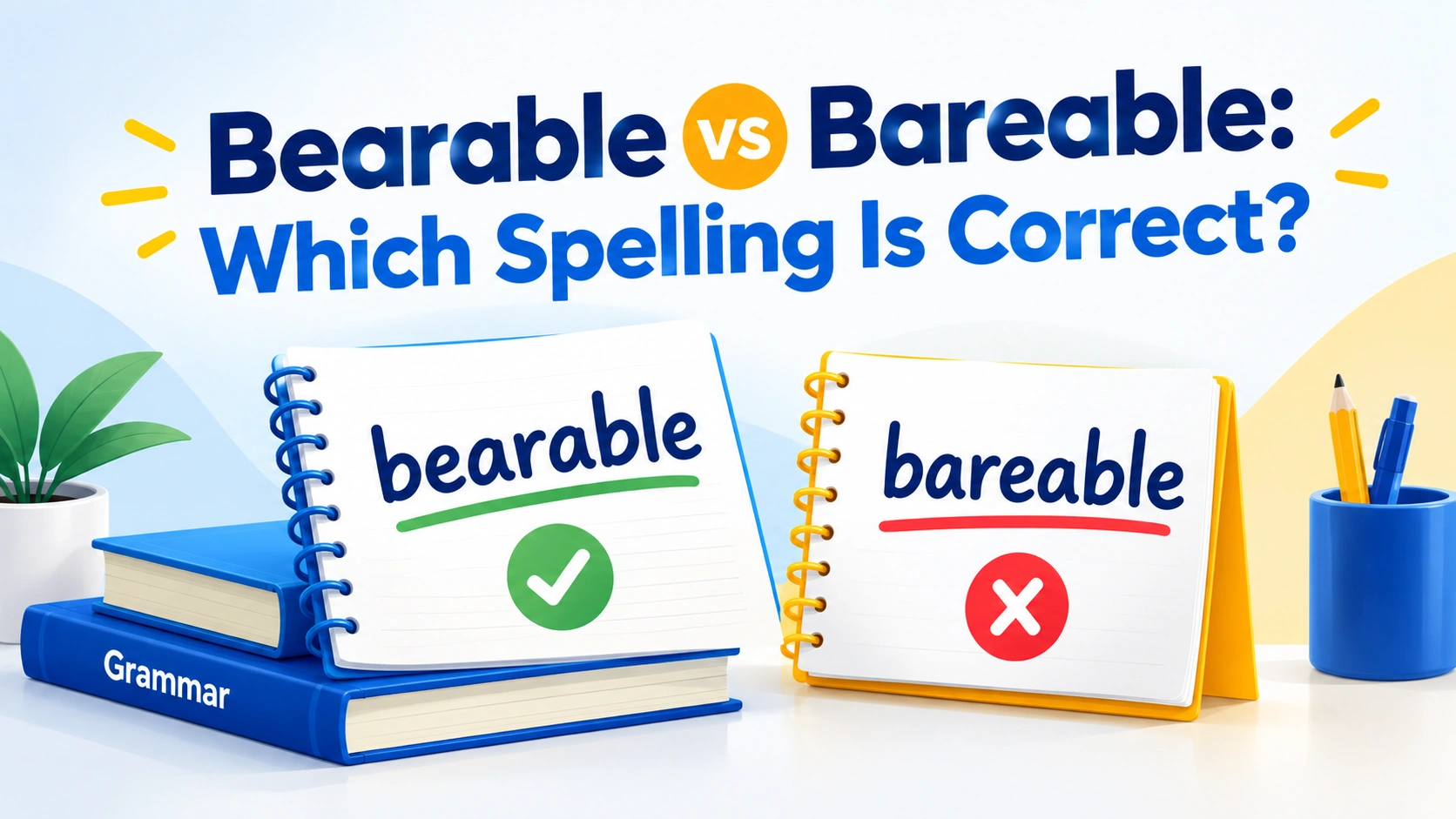
Bearable vs bareable is a common spelling question because the two forms sound the same in standard English pronunciation, yet only one is the normal spelling when you mean “able to be endured.” The correct word is bearable. It comes from the verb bear, meaning to endure, tolerate, or put up with something. For example, “The noise was bearable” means the noise could be tolerated. Bareable, by contrast, is not the standard spelling for this meaning. The confusion becomes easier to avoid once you connect bearable with its word family: bear → bearable → unbearable.
The mistake is understandable because bear and bare are homophones: they are pronounced alike in many varieties of English but have different meanings and spellings. Bear can mean to endure, while bare describes something uncovered or exposed. That difference matters when forming related words. If you can bear an uncomfortable situation, that situation is bearable. If something is bare, it may have no covering or decoration, as in bare walls or bare feet. Sound alone cannot tell you which spelling belongs in a sentence.
There is also a useful nuance that many short explanations overlook. Bearable does not mean pleasant, comfortable, or desirable; it simply means something can be endured. You can describe heat, pain, noise, delays, workloads, disappointment, or difficult circumstances as bearable without suggesting that they are enjoyable. This guide explains the meaning, word formation, pronunciation, common mistakes, related words, natural usage, and the especially confusing phrase barely bearable. By the end, you should be able to choose the spelling from meaning rather than guesswork.
The Quick Answer: Bearable or Bareable?
If you mean “able to be endured, tolerated, or dealt with,” the correct spelling is:
bearable ✅
Not:
bareable ❌
Examples:
- The heat was bearable in the evening.
- The waiting time was bearable because we had somewhere comfortable to sit.
- With the windows closed, the noise became bearable.
- The workload is difficult but still bearable.
The key connection is:
bear = endure → bearable = able to be endured
The word bare has a completely different meaning, so it does not provide the base for this adjective.
Bearable vs Bareable at a Glance
| Word | Standard use? | Meaning | Example |
| bearable | Yes | Able to be endured or tolerated | The pain was bearable. |
| bareable | No, for this intended meaning | Usually a misspelling of bearable | The pain was bareable. ❌ |
| bear | Yes | Endure, tolerate, carry, or support, depending on context | I can’t bear the noise. |
| bare | Yes | Uncovered, exposed, or without decoration | The room had bare walls. |
What Does “Bearable” Mean?
Bearable Definition in Plain English
Bearable is an adjective meaning possible to endure or tolerate.
It is related to the verb bear in one of its most important senses: to endure something difficult, unpleasant, painful, or demanding.
For example:
- The cold was bearable.
- The delay was bearable.
- The workload remained bearable.
- The noise was barely bearable.
In each case, the subject is not necessarily pleasant. It is simply within the limits of what someone can tolerate.
Bearable Is an Adjective
Because bearable is an adjective, it commonly describes a noun through a linking verb.
Common structures include:
Subject + be + bearable
- The temperature is bearable.
- The situation was bearable.
Subject + become/seem/remain + bearable
- The weather became bearable.
- The workload seems bearable.
- The conditions remained bearable.
You can also place bearable after adverbs:
- The pain was quite bearable.
- The journey was surprisingly bearable.
- The heat was barely bearable.
What Bearable Does Not Mean
One subtle but important point is that bearable is not synonymous with good or comfortable.
Consider:
The room was unbearably hot.
versus:
The room was hot but bearable.
The second sentence still describes an uncomfortable room. It simply says the discomfort can be endured.
This distinction makes bearable useful when describing experiences that are difficult but manageable enough to tolerate.
Why Is “Bearable” Spelled With “Bear”?
The answer lies in the word’s base verb.
Bear Means “Endure” Here
The verb bear has several meanings. It can refer to carrying, producing, giving birth, supporting, or enduring, depending on context.
In bearable, the relevant meaning is to endure or tolerate.
Compare:
- I cannot bear the noise.
- The noise is bearable.
The adjective is built from the same underlying idea.
The Word Formation: Bear + -able
The structure can be understood as:
bear + -able → bearable
The suffix -able often forms adjectives expressing the idea that something can be done, experienced, or endured.
Compare:
- read → readable
- wash → washable
- manage → manageable
- avoid → avoidable
- bear → bearable
So the spelling makes much more sense when you recognize the word family instead of trying to reconstruct the word from its sound.
Remember: If you can bear something, it is bearable.
That is more reliable than trying to remember whether the middle vowel “sounds” like bear or bare.
Is “Bareable” a Correct Word?
“Bareable” Is Not the Standard Spelling for This Meaning
When someone writes bareable intending to mean “able to be endured,” the standard correction is bearable.
For example:
The noise was bareable.
should be:
The noise was bearable.
Likewise:
The heat became bareable.
should be:
The heat became bearable.
Why Does “Bareable” Look Plausible?
There is a logical-looking pattern behind the mistake.
A writer knows:
bare + -able
and may instinctively create:
bareable
The problem is that the intended adjective does not come from bare. It comes from bear, in the sense of enduring something.
This is a classic example of why English spelling cannot always be solved by simply attaching a familiar suffix to whichever word seems visually related.
What Does “Bare” Actually Mean?
Bare generally describes something that is uncovered, exposed, empty, plain, or without an expected covering.
Examples include:
- bare feet
- bare hands
- bare walls
- bare floor
- bare branches
- bare essentials
- bare minimum
None of these meanings involve enduring something.
So:
bare → uncovered/exposed
while:
bear → endure
Those are different word families.
Bear vs Bare: The Root of the Confusion
The difficulty is largely caused by pronunciation.
Bear and Bare Are Homophones
In many standard varieties of English, bear and bare have the same pronunciation.
That makes this a spelling problem rather than a pronunciation problem.
You can hear:
“The conditions are bearable.”
but the sound itself does not tell you whether the spelling begins with bear- or bare-.
This is why learners need to connect the spelling to meaning and word family.
Compare the Two Word Families
| Bear family | Bare family |
| bear | bare |
| bears | bares |
| bearing | barely |
| bearable | bareness |
| unbearable | bare |
The families are not interchangeable.
For bearable, remember the meaning:
bear = endure
For bare, remember ideas such as:
bare = uncovered / exposed / lacking
Bearable vs Bareable: Pronunciation
How “Bearable” Is Pronounced
Bearable begins with the same sound as bear in varieties of English where bear and bare are homophones.
The pronunciation therefore does not provide a dependable way to distinguish the standard spelling from the common misspelling bareable.
Why Sound-Based Spelling Causes Errors
English has many spelling pairs that cannot be resolved from pronunciation alone.
Examples include:
- right / write
- there / their
- peace / piece
- bare / bear
The practical lesson is simple:
When two spellings sound alike, use meaning and word history—not sound alone—to choose the spelling.
For bearable, ask what the sentence means. If it describes something that can be endured, connect it to bear.
Bearable vs Similar Words
Choosing the correct synonym can also make your writing more precise.
Bearable vs Tolerable
These words are close in meaning.
- bearable emphasizes the ability to endure something.
- tolerable emphasizes the ability to put up with something.
Compare:
The heat was bearable.
The heat was tolerable.
Both can work, but bearable often sounds more natural in everyday descriptions of discomfort.
Bearable vs Manageable
Manageable means something can be handled, controlled, or dealt with successfully.
The workload is manageable.
This does not necessarily mean the workload is pleasant or easy.
Bearable, however, focuses more specifically on whether an experience can be endured.
The workload is bearable.
The two can overlap, but they answer slightly different questions.
Bearable vs Acceptable
Acceptable usually means meeting an expected standard or being considered satisfactory or permissible.
The delay was acceptable.
means the delay was considered okay.
The delay was bearable.
means the delay could be endured.
That distinction becomes important in professional or academic writing where precision matters.
Bearable vs Endurable
Endurable is also related to the idea of enduring something, but it is less common in ordinary conversation.
For everyday English, bearable is often the more natural choice when describing an unpleasant experience that can still be tolerated.
The Especially Confusing Phrase “Barely Bearable”
One expression deserves special attention because it combines two words that look remarkably similar.
What Does “Barely Bearable” Mean?
Barely bearable means only just tolerable.
It suggests that something is close to becoming unbearable.
Examples:
- The heat was barely bearable.
- The noise was barely bearable after several hours.
- The long wait became barely bearable.
The phrase creates a useful scale:
comfortable → unpleasant but bearable → barely bearable → unbearable
Why Is It “Barely Bearable”?
The two words have different jobs.
Barely means only just; by a very small margin.
Bearable means able to be endured.
Therefore:
barely bearable = only just able to be endured
Do not write barely bareable when you mean this expression.
Correct: The conditions were barely bearable.
Incorrect: The conditions were barely bareable.
This is one of the most useful phrases to memorize because it reinforces the correct spelling of bearable in context.
Where You Might Use “Bearable”
Weather and Temperature
Weather is a natural context for bearable.
- The heat became bearable after sunset.
- The cold was bearable with a warm jacket.
- The humidity made the afternoon barely bearable.
Noise
- The traffic noise was bearable with the windows closed.
- The construction became unbearable after several hours.
Workload and Stress
- The workload is heavy but bearable.
- The schedule became more bearable after the deadline was extended.
Here, bearable does not mean the workload is reasonable. It only describes whether someone can tolerate it.
Waiting and Delays
- The two-hour wait was bearable because there were plenty of seats.
- The delay was annoying but still bearable.
Physical Discomfort
- The discomfort was bearable.
- The pain was difficult but bearable.
In contexts involving health or injury, bearable describes subjective tolerance; it should not be interpreted as a medical judgment about whether a condition is safe or minor.
Emotional Difficulties
The word can also describe emotionally difficult experiences.
- The disappointment was bearable because she had support.
- The uncertainty became harder to bear over time.
This usage connects naturally to the underlying verb bear.
Bearable in Different Types of Writing
Everyday Writing
In casual conversation and everyday writing, bearable is natural when you want to say that something is unpleasant but tolerable.
The weather isn’t great, but it’s bearable.
Professional Writing
In professional communication, bearable is grammatically correct, but sometimes another adjective communicates the intended idea more precisely.
For example:
- The workload is manageable.
- The cost is affordable.
- The delay is acceptable.
- The conditions are tolerable.
A professional writer should choose the word that describes the actual judgment being made rather than automatically using bearable.
Academic Writing
In academic prose, bearable may be appropriate when discussing human tolerance or experience, but more specialized vocabulary may be preferable when precision matters.
For example:
- The temperature remained bearable for participants.
- The experimental conditions remained within an acceptable range.
The second sentence makes a different, more objective claim. Context should determine the vocabulary.
Common Mistakes With Bearable and Bareable
Mistake 1: Writing “Bareable” Because It Sounds Correct
Because bear and bare sound alike, bareable can seem perfectly reasonable.
The solution is to connect bearable with:
I can bear it.
If you can bear something, it is bearable.
Mistake 2: Confusing “Bearable” With “Barely”
The phrase barely bearable can create a visual trap.
Remember:
- barely = only just
- bearable = able to be endured
Example:
The noise was barely bearable.
Mistake 3: Thinking “Bareable” Means “Able to Be Bare”
This interpretation may seem logical because bare means uncovered. However, bareable is not the standard everyday adjective for that concept.
If you need to describe something that can be left uncovered, choose a more precise phrase based on the intended meaning rather than assuming bareable is the standard form.
Mistake 4: Trusting Pronunciation to Reveal Spelling
Homophones are specifically difficult because pronunciation does not distinguish them.
Instead of asking:
“Which one sounds right?”
ask:
“Which base word gives me the meaning I need?”
For bearable, the answer is bear.
Mistake 5: Treating Spellcheck as a Substitute for Meaning
Modern writing tools can identify many typographical errors, but a spelling checker is not a replacement for understanding a word’s meaning and usage.
The strongest check is:
Meaning → base word → spelling → sentence
A Reliable Memory Trick for “Bearable”
The simplest memory trick is to turn the adjective back into a sentence.
Use the “I Can Bear It” Test
If you can say:
I can bear it.
then write:
It is bearable.
Examples:
The noise is bearable.
→ I can bear the noise.
The wait was bearable.
→ I could bear the wait.
The heat became bearable.
→ We could bear the heat.
This works because it ties the spelling directly to the meaning.
Keep “Bare” Connected to Physical Absence
Associate bare with things that are exposed or uncovered:
- bare feet
- bare walls
- bare branches
- bare floor
- bare essentials
Then keep bearable with experiences you can endure.
That creates two separate mental categories:
| Think of… | Word |
| Enduring something difficult | bear → bearable |
| Something uncovered or exposed | bare |
A Practical Decision Checklist
Before submitting an essay, email, article, or other formal writing, run through this quick check:
- Does the word mean “able to be endured”? → Use bearable.
- Can you replace it with “able to bear”? → Use bearable.
- Does the sentence describe something uncovered or exposed? → You probably need to be bare, not bearable.
- Are you writing “barely bearable”? → Check that the second word is bearable.
- Are you relying only on pronunciation? → Stop and identify the base word.
- Are you comparing bearable with a synonym? → Decide whether you actually mean tolerable, manageable, or acceptable.
Quick Reference: Bearable vs Bareable
| Question | Answer |
| Correct spelling for “able to be endured”? | Bearable |
| Is bareable the standard spelling for that meaning? | No |
| What verb bearable come from? | Bear, meaning endure/tolerate |
| What does bare mean? | Uncovered, exposed, or lacking |
| Are bear and bear pronounced alike? | Often yes, depending on accent |
| What does barely bearable mean? | Only just tolerable |
| Opposite of bearable? | Unbearable |
| Useful memory trick? | If you can bear it, it is bearable. |
Conclusion
When choosing between bearable vs bareable, the standard spelling for “able to be endured” is bearable. The reason is straightforward once you trace the word back to its base: bear can mean “endure,” so bearable means “able to be endured.” The spelling bareable is tempting because bear and bare are homophones, but bare belongs to a completely different word family associated with being uncovered or exposed. One final actionable tip: use the “I can bear it” test whenever you hesitate. A common mistake to avoid is relying on pronunciation when two words sound alike. Meaning first, base word second, spelling third—that sequence will keep this particular homophone confusion out of your writing.
FAQs
Q1. Is “bareable” ever correct in English?
For the ordinary meaning “able to be endured,” bareable is not the standard spelling; use bearable. If you encounter bareable elsewhere, consider whether the writer is using an unusual coined formation or simply making a spelling error. Standard edited English favors bearable for the intended meaning.
Q2. Is “bearable” related to the animal called a bear?
The adjective bearable is related to the verb bear meaning “endure,” not to the animal. English happens to use the same spelling for both meanings of bear. In bearable, the relevant word family is bear → bearable → unbearable.
Q3. Can I use “bearable” to describe something positive?
Yes, although it normally emphasizes tolerability rather than enjoyment. Saying “The weather was bearable” suggests it was acceptable to endure, not necessarily pleasant. If something is genuinely pleasant, words such as comfortable, enjoyable, or pleasant may communicate the idea better.
Q4. What is the difference between “bearable” and “barely bearable”?
Bearable means something can be endured. Barely bearable means it can be endured only just. The second phrase therefore communicates a much narrower margin of tolerance and often suggests that the experience is approaching the point of being unbearable.
Q5. What is the opposite of “bearable”?
The direct opposite is unbearable. It describes something that is extremely difficult or impossible to endure. For example, “The noise was bearable at first but became unbearable later.” The prefix un- reverses the adjective’s basic meaning.