
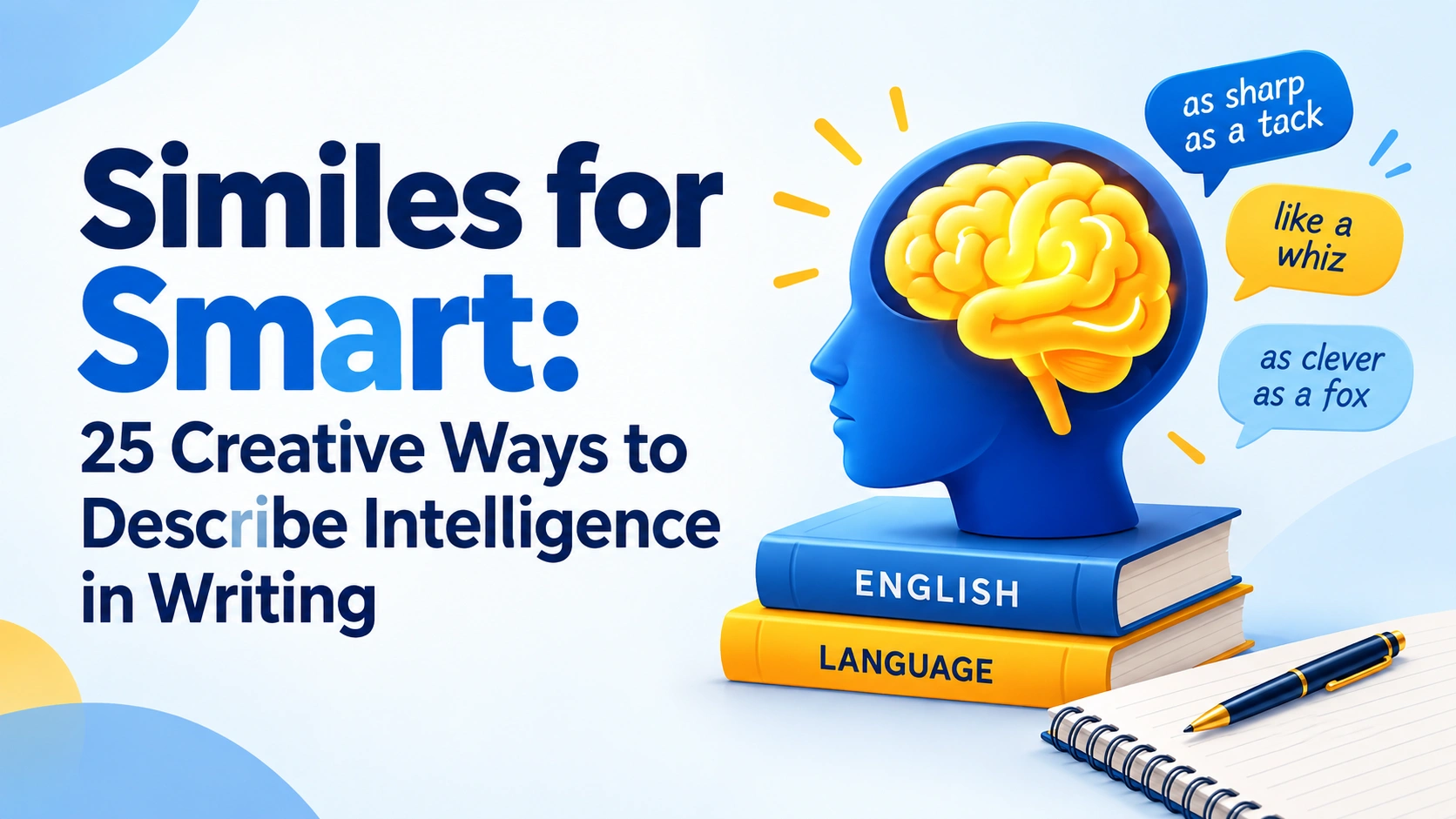
Similes for smart can turn a flat description of intelligence into something readers can actually picture. Instead of writing that someone is simply very intelligent, you can compare their mind to a compass, a detective following clues, a key fitting a lock, or a chess player thinking several moves ahead. The right comparison does more than decorate a sentence: it reveals how someone thinks. That distinction matters because intelligence can mean quick thinking, wisdom, creativity, observation, logic, or strategic judgment.
A good simile also depends on context. A fox may suggest cleverness and adaptability, while a lighthouse suggests clarity and guidance. A chess player evokes strategy; a spark suggests sudden insight. This guide brings together 25 creative similes for describing intelligence, then shows you how to choose one based on tone, character, purpose, and type of intelligence. You will also find examples for stories, essays, conversation, and other forms of writing.
The strongest figurative language is specific rather than merely impressive. Saying someone is “as smart as a computer” tells readers very little unless the context calls for analytical or information-processing ability. A more carefully chosen comparison can make the description memorable while remaining natural. By the end, you will know which simile fits which situation, how to avoid clichés, how similes differ from metaphors, and how to create original comparisons that sound intentional rather than forced.
25 Creative Similes for Smart and Intelligent
There is no single kind of intelligence, so these comparisons are deliberately varied. Some emphasize logic, others wisdom, creativity, observation, adaptability, or strategic thinking.
1. As Smart as a Fox
“As smart as a fox” is one of the most familiar ways to describe someone who is clever, resourceful, and capable of finding a way around obstacles.
It works particularly well when intelligence involves practical cunning rather than academic knowledge.
Example:
Maya was as smart as a fox, always finding a solution when everyone else had given up.
Best for: clever characters, informal writing, stories, and playful descriptions.
Watch out: because the comparison is familiar, it may feel predictable if originality is your goal.
2. As Sharp as a Tack
When someone is as sharp as a tack, the emphasis is on mental alertness and quick understanding.
This expression is especially natural in everyday English:
Even at nine years old, Sam was as sharp as a tack and rarely missed an important detail.
The word sharp is doing useful work here. It suggests a mind that reacts quickly and notices things readily.
Best for: conversational descriptions and informal character writing.
3. As Wise as an Owl
“As wise as an owl” emphasizes wisdom rather than raw intellectual ability.
That distinction is important. A person can be highly intelligent without necessarily having good judgment, while someone described as wise is usually associated with experience, perspective, and thoughtful decisions.
Her grandmother was as wise as an owl, giving advice that seemed simple until you realized how much experience it contained.
Best for: mature characters, mentors, elders, and reflective writing.
4. Like a Compass That Never Loses North
This original comparison presents intelligence as reliable judgment and direction.
When the team faced a difficult decision, Daniel’s mind was like a compass that never lost north.
The comparison does not merely say that Daniel knows a lot. It suggests that he can remain oriented when circumstances become confusing.
Best for: leadership, decision-making, strategy, and serious creative writing.
5. Like a Locksmith Opening an Impossible Door
A locksmith knows how to study a difficult mechanism and discover how it works. That makes this a useful image for problem-solving intelligence.
Her mind worked like a locksmith opening an impossible door; she kept examining the problem until she found the hidden solution.
This is stronger than simply calling someone “a good problem solver” because the image gives the reader something concrete to visualize.
Best for: mysteries, puzzles, technical problems, and character descriptions.
6. As Quick as Lightning in Thought
This comparison focuses specifically on speed of thinking.
He was as quick as lightning in thought, answering the unexpected question before anyone else had finished considering it.
It is useful when the defining quality is rapid mental processing rather than wisdom or deep knowledge.
Best for: dialogue, debates, competitions, and fast-moving scenes.
Tip: Don’t use a speed-based simile when you actually mean that someone is thoughtful or wise. Those are different qualities.
7. Like a Detective Following a Trail of Clues
A detective’s intelligence comes from observation, evidence, inference, and connecting details.
Priya’s mind was like a detective following a trail of clues; every small detail seemed to lead her closer to the answer.
This is particularly effective when describing someone who notices relationships other people overlook.
Best for: analytical characters, investigations, research, and problem-solving.
8. As Bright as a Spark
A spark is small but immediately noticeable, making it an effective image for sudden insight or intellectual brilliance.
An idea as bright as a spark crossed his mind just as the discussion seemed to have reached a dead end.
This works especially well when intelligence appears as a flash of inspiration rather than sustained analysis.
Best for: creative writing, brainstorming, invention, and moments of discovery.
9. Like a Chess Player Seeing Three Moves Ahead
Chess naturally represents planning, anticipation, and strategic reasoning.
She approached negotiations like a chess player seeing three moves ahead.
Notice that this comparison tells readers something specific: she does not merely react to events; she anticipates consequences.
Best for: strategy, leadership, negotiations, competition, and plotting.
10. Like a Lighthouse Guiding Ships Through Fog
Here intelligence becomes a source of clarity during uncertainty.
When everyone else was confused, his reasoning was like a lighthouse guiding ships through fog.
This is especially effective when describing someone who helps others understand a complicated situation.
Best for: leadership, teaching, explanations, and reflective prose.
11. As Sharp as a Razor
“As sharp as a razor” gives intelligence a more intense quality than “as sharp as a tack.”
Her questions were as sharp as a razor, cutting straight through the weakest part of the argument.
The comparison can suggest precision, incisiveness, and intellectual force.
Best for: debate, criticism, journalism, analytical writing, and powerful character descriptions.
Limitation: the image can sound aggressive if the surrounding context is confrontational.
12. Like a Telescope Finding Distant Stars
A telescope allows us to see things that would otherwise remain beyond ordinary perception. As a simile, it can represent vision, curiosity, and the ability to perceive possibilities others cannot yet see.
His imagination was like a telescope finding distant stars, always reaching beyond what was immediately visible.
Best for: inventors, researchers, visionaries, artists, and imaginative characters.
13. As Clever as a Magician Solving a Trick
This comparison emphasizes ingenuity and clever problem-solving.
She was as clever as a magician solving a trick, making the complicated solution look effortless.
It creates a lighter, more playful impression than comparisons involving scientists or computers.
Best for: humorous writing, children’s stories, playful descriptions, and inventive characters.
14. Like a Puzzle Solver Finding the Missing Piece
This is a straightforward image of logical reasoning and pattern recognition.
His mind worked like a puzzle solver finding the missing piece.
The comparison is particularly useful when a character receives incomplete information and must reconstruct the answer.
Best for: mysteries, mathematics, research, logic problems, and educational writing.
15. As Clear as Glass in Morning Light
Not all intelligence is about knowing more. Sometimes the valuable quality is the ability to make complicated ideas clear.
Her explanation was as clear as glass in morning light.
This simile works better for describing someone’s reasoning or explanation than their intelligence as a whole.
Best for: teachers, writers, speakers, explanations, and essays.
16. Like a Key Fitting the Perfect Lock
A key and lock form a natural image for precision and finding exactly the right solution.
His answer fit the problem like a key fitting the perfect lock.
This is especially effective when someone discovers a solution that seems precisely suited to a difficult situation.
Best for: problem-solving, engineering, puzzles, and analytical writing.
17. As Focused as a Falcon Watching Its Prey
This comparison highlights concentration and observation rather than intelligence alone.
She was as focused as a falcon watching its prey, noticing every movement across the room.
That distinction makes the simile more precise. Focus can support intelligence, but it is not synonymous with intelligence.
Best for: investigators, students, athletes, analysts, and tense fictional scenes.
18. Like a Map Drawn Before the Journey
A map represents preparation, orientation, and anticipation.
His strategy was like a map drawn before the journey; he had already considered where each decision might lead.
This gives intelligence a planned and deliberate quality.
Best for: strategic thinkers, project planning, leadership, and professional writing.
19. As Resourceful as Roots Finding Water
Roots do not follow a single obvious path. They adapt to their environment in search of what they need.
She was as resourceful as roots finding water, discovering opportunities where nobody else thought to look.
This is an excellent choice when intelligence is demonstrated through adaptability and persistence.
Best for: survival stories, entrepreneurship, difficult circumstances, and creative problem-solving.
20. Like a Lantern Lighting a Dark Library
A library represents information; a lantern represents illumination. Together they create an image of intelligence that makes knowledge understandable.
His explanation was like a lantern lighting a dark library, revealing connections that had been invisible before.
This is more literary than “as smart as a computer” and can give prose a thoughtful tone.
Best for: teachers, researchers, mentors, writers, and reflective passages.
21. As Inventive as a River Carving Its Own Path
A river does not always travel along a predetermined route. It finds a way around obstacles.
Her thinking was as inventive as a river carving its own path through stone.
The comparison suggests creativity, flexibility, and persistence simultaneously.
Best for: inventors, artists, entrepreneurs, engineers, and creative characters.
22. Like a Hawk Spotting What Others Miss
This simile centers on keen observation.
Omar was like a hawk spotting what others missed, catching the tiny inconsistency in the report immediately.
It is particularly useful when intelligence is revealed through noticing something subtle.
Best for: detectives, editors, researchers, analysts, and observant characters.
23. As Balanced as Perfect Scales
Intelligence sometimes means knowing how to weigh competing considerations.
Her judgment was as balanced as perfect scales, carefully considering every side before reaching a conclusion.
This describes discernment and judgment, not simply a high level of knowledge.
Best for: judges, advisers, leaders, mediators, and mature characters.
24. Like a Computer Connecting Thousands of Pieces at Once
This modern comparison presents intelligence as processing information and recognizing relationships.
His mind was like a computer connecting thousands of pieces at once, turning scattered facts into a coherent answer.
It can be useful when the subject quickly handles large amounts of information.
Best for: technology-related writing, analytical characters, science fiction, and contemporary descriptions.
Limitation: computers can process information, but this comparison does not naturally communicate wisdom, empathy, creativity, or judgment.
25. Like a Question That Leads Straight to the Truth
Sometimes intelligence appears not in the answer but in asking the right question.
Her curiosity was like a question that led straight to the truth.
This is a useful reminder that intellectual ability can involve inquiry, skepticism, and knowing what information matters.
Best for: researchers, journalists, investigators, students, and philosophical writing.
Different Ways to Describe Intelligence With Similes
The best simile depends on what kind of intelligence you want the reader to notice. Treating every intelligent person as simply “smart” throws away an opportunity for characterization.
| Type of intelligence | Useful imagery | What it communicates |
| Quick thinking | Lightning, sparks, racing signals | Speed and responsiveness |
| Wisdom | Owl, compass, balanced scales | Judgment and perspective |
| Cleverness | Fox, magician, locksmith | Ingenuity and resourcefulness |
| Strategy | Chess player, map, compass | Planning and foresight |
| Observation | Hawk, detective, telescope | Noticing hidden details |
| Creativity | River, spark, stars | Original ideas and invention |
| Logic | Puzzle, key and lock, computer | Analysis and connections |
| Clarity | Lighthouse, lantern, glass | Making complexity understandable |
Similes for Someone Who Is Very Intelligent
For exceptional intelligence, avoid automatically reaching for famous geniuses or exaggerated comparisons. A more specific image often sounds more sophisticated.
Instead of:
She was as smart as Einstein.
you might write:
Her mind was like a locksmith opening doors everyone else had assumed were sealed.
The second version gives the reader a reason to perceive the character as intelligent.
Similes for Quick Thinking
Choose imagery involving speed when the person must react immediately:
- As quick as lightning in thought.
- Like a spark jumping across a wire.
- Like a chess player already anticipating the next move.
These are particularly effective in dialogue-heavy scenes.
Similes for Wisdom and Good Judgment
Use images of direction, balance, age, or perspective:
- Like a compass that never loses north.
- As balanced as perfect scales.
- As wise as an owl.
These work when experience and judgment matter more than raw mental speed.
Similes for Cleverness and Cunning
Cleverness often involves finding an unexpected route to a goal.
Good imagery includes:
- A fox navigating a forest.
- A locksmith solving a difficult lock.
- A magician working out a trick.
The tone can range from admirable to mischievous, so context matters.
Similes for Creativity and Imagination
For creative intelligence, use imagery that suggests growth, movement, discovery, or transformation:
- Like a river carving its own path.
- Like a telescope finding distant stars.
- As bright as a spark.
These are more expressive than comparisons centered on computers or textbooks.
Similes for Academic Intelligence
Academic writing requires more restraint. A playful comparison can be memorable in an essay, but it can also sound informal if the assignment expects a formal register.
For creative or reflective academic prose, comparisons involving maps, libraries, telescopes, or puzzles can work naturally.
Similes for Problem-Solving Ability
If the defining trait is finding solutions, use imagery involving mechanisms, puzzles, navigation, or investigation.
Her mind was like a locksmith’s toolkit: whenever one method failed, she reached for another.
That tells readers more than the generic adjective smart.
How to Choose the Right Simile for “Smart”
Match the Simile to the Type of Intelligence
Start with the question: What exactly makes this person intelligent?
Is it their:
- Speed?
- Knowledge?
- Curiosity?
- Creativity?
- Memory?
- Logic?
- Observation?
- Strategic thinking?
- Judgment?
- Ability to explain difficult ideas?
Once you answer that, the comparison becomes much easier to choose.
Match the Comparison to Your Writing Tone
The same person can require completely different wording depending on the situation.
| Writing context | Better approach | Example style |
| Casual conversation | Familiar and conversational | “As sharp as a tack” |
| Children’s fiction | Clear and visual | “As clever as a fox” |
| Literary fiction | Fresh, evocative imagery | “Like a lantern lighting a dark library” |
| Professional writing | Controlled and precise | “Like a compass that never loses north” |
| Humor | Playful exaggeration | “Like a calculator with a caffeine habit” |
| Academic prose | Restrained, purposeful imagery | “Like a map drawn before the journey” |
The goal isn’t to make every sentence poetic. Good writing uses figurative language selectively.
Consider Whether the Simile Sounds Natural
A technically grammatical comparison can still be a poor choice.
Before keeping a simile, ask:
- Can the reader understand the connection immediately?
- Does the image actually represent the intended trait?
- Does it fit the tone?
- Does it sound like something the narrator or speaker would naturally say?
- Does it add meaning rather than simply add decoration?
If the answer to several of these is no, simplify it.
Use Originality Without Making the Meaning Unclear
Originality is useful only when readers can still follow the comparison.
Compare:
His mind was like a machine built from moonlight and forgotten equations.
with:
His mind was like a locksmith opening an impossible door.
The first may sound imaginative, but the relationship between the image and intelligence is unclear. The second has a recognizable logic: difficult problem → careful analysis → solution.
Expert tip: A creative simile should make the reader think, “Yes, that’s exactly the quality you mean,” not “What is that supposed to mean?”
Similes for Smart in Different Writing Situations
Character Descriptions
Don’t use a simile as a substitute for characterization. Pair it with behavior.
Weak:
Liam was as smart as a chess player.
Stronger:
Liam was like a chess player seeing three moves ahead; while everyone else argued about the first decision, he was already considering its consequences.
The action makes the comparison believable.
School and Academic Writing
In academic writing, figurative language should serve a clear purpose. It can make an introduction, reflection, speech, or creative assignment more engaging, but excessive imagery can undermine precision.
For formal work, prefer one well-chosen comparison over several decorative ones.
Stories and Creative Writing
Fiction gives you more freedom. A simile can reveal not only intelligence but also the character’s personality.
For example, comparing a character to a computer makes them seem analytical, while comparing them to a fox may make them seem clever and adaptable.
Essays, Speeches, and Presentations
A memorable comparison can help an audience understand an abstract idea.
“A good teacher’s explanation can be like a lighthouse in fog: it doesn’t remove every difficulty, but it gives you enough clarity to find your way.”
Here, the simile explains an idea rather than merely praising someone.
Text Messages and Social Media
Shorter comparisons usually sound more natural:
- “She’s sharp as a tack.”
- “Bro thinks three moves ahead 😂”
- “His brain is like a puzzle-solving machine.”
The more casual the platform, the less formal the imagery can be.
“Smart” vs. “Clever,” “Intelligent,” “Wise,” and “Brilliant”
These words overlap, but they do not create identical impressions.
| Word | Typical emphasis | Possible implication |
| Smart | General ability | Broad, everyday intelligence |
| Clever | Ingenuity | Finding effective or unexpected solutions |
| Intelligent | Mental ability | More formal and neutral |
| Wise | Judgment | Experience, perspective, sound decisions |
| Brilliant | Exceptional ability | Very high or impressive intellectual ability |
Smart vs. Clever
Someone can be clever without being broadly knowledgeable. Cleverness often involves ingenuity, especially when solving a particular problem.
A fox comparison therefore fits clever particularly well.
Smart vs. Intelligent
Smart is common in everyday conversation, whereas intelligent often sounds more formal or neutral.
“She’s smart.”
is perfectly natural in conversation.
“The study examines how intelligent decision-making affects…”
is more suitable for formal prose.
Smart vs. Wise
Wisdom involves judgment. A wise person may know when not to act, when to listen, or which consequence matters most.
That is why owl, compass, and balanced-scale imagery can work better than computer imagery for wisdom.
Smart vs. Brilliant
Brilliant generally carries a stronger sense of exceptional ability. It should not be used merely because a person knows one fact or performs one task well.
Why the Difference Matters When Choosing a Simile
The noun or adjective you choose establishes the trait your comparison needs to reinforce.
- If you mean strategic, use chess or maps.
- If you mean observant, use a hawk or detective.
- If you mean wise, use a compass or balanced scales.
- If you mean creative, use sparks, rivers, or stars.
Precision makes figurative language stronger.
Examples of Smart Similes in Complete Sentences
Positive and Complimentary Examples
- “Her mind was like a compass that never lost north.”
- “He was as sharp as a tack, catching the mistake immediately.”
- “She was like a puzzle solver who could see the missing piece before anyone else.”
- “His reasoning was as clear as glass in morning light.”
Creative-Writing Examples
“He sat quietly while the others argued, his mind moving like a chess player seeing three moves ahead.”
“Her ideas were as bright as sparks, appearing suddenly and changing the direction of the conversation.”
“The old professor’s advice was like a lighthouse in fog, giving everyone a sense of direction.”
Casual and Conversational Examples
“She’s sharp as a tack.”
“He’s clever as a fox when there’s a problem to solve.”
“You have to admit, she thinks like a chess player.”
Examples Showing Different Kinds of Intelligence
Logic:
“His mind worked like a puzzle solver finding the missing piece.”
Creativity:
“Her imagination was like a river carving a new path.”
Observation:
“He was like a hawk spotting what everyone else missed.”
Wisdom:
“Her judgment was as balanced as perfect scales.”
Strategy:
“He planned like a chess player already thinking several moves ahead.”
How to Create Your Own Similes for Intelligence
Step 1: Decide What Kind of Intelligence You Mean
Don’t begin with “What rhymes with smart?” Begin with:
What does this person do that demonstrates intelligence?
Maybe they:
- solve problems quickly,
- notice hidden details,
- invent unusual solutions,
- understand complex subjects,
- predict consequences,
- ask excellent questions,
- remain calm under pressure.
That behavior gives you the foundation for the comparison.
Step 2: Find a Concrete Image That Represents That Trait
Turn the abstract quality into something visible.
For example:
Observation → hawk, telescope, magnifying glass
Strategy → chessboard, map, compass
Problem-solving → key, lock, puzzle
Creativity → spark, river, stars
Clarity → lighthouse, lantern, clear glass
Concrete objects generally produce stronger imagery than vague abstractions.
Step 3: Connect the Image With “Like” or “As”
A simile normally makes the comparison explicit:
Her mind was like a compass.
or:
She was as sharp as a tack.
Make sure the comparison is grammatically clear and that the two things share an understandable quality.
Step 4: Test Whether the Simile Adds Meaning
Remove the simile and read the sentence again.
If the sentence loses an important layer of meaning, the comparison is doing useful work.
If nothing changes except that the sentence becomes more decorative, you may not need it.
Example: Turning “She Is Very Smart” Into a More Specific Simile
Generic:
She is very smart.
More specific:
Her mind is like a locksmith opening an impossible door; she keeps testing possibilities until she finds the mechanism that works.
The second version identifies persistence, analysis, and problem-solving, giving the reader evidence of the intelligence being described.
Common Mistakes When Using Similes for Smart
Using the Same Overused Comparisons Repeatedly
“Smart as a fox” and “wise as an owl” are recognizable, but familiarity can make them predictable.
There’s nothing inherently wrong with traditional similes. The problem comes when every description relies on the same handful of comparisons.
Choosing a Comparison That Describes the Wrong Trait
Calling someone “as fast as lightning” communicates speed. It doesn’t automatically communicate intelligence.
Likewise, a computer may suggest information processing but not wisdom or emotional judgment.
Choose the image according to the trait, not merely according to how impressive it sounds.
Making the Simile Too Complicated
A comparison that requires a paragraph of explanation has probably lost its advantage.
Readers should be able to grasp the central connection quickly.
Mixing Metaphors and Similes Unintentionally
Compare:
“Her mind was like a lighthouse.”
That’s a simile.
“Her mind was a lighthouse.”
That’s a metaphor.
Both are legitimate. Problems arise when writers accidentally combine incompatible images in the same sentence.
Using a Simile That Does Not Fit the Tone
A humorous comparison can be excellent in dialogue but distracting in a serious report.
Always consider who is speaking, who is reading, and what the writing is trying to accomplish.
Telling Instead of Showing
A simile should support characterization, not replace evidence.
Instead of:
“He was as smart as a chess player.”
show the behavior:
“He was like a chess player seeing three moves ahead, quietly predicting how each decision would affect the next.”
The reader can now see the intelligence rather than merely being told about it.
Simile vs. Metaphor When Describing Intelligence
What Makes a Simile Different?
A simile explicitly compares two things, usually with like or as.
“Her mind was like a telescope.”
The reader is told that the two things are being compared.
What Does a Metaphor Do Instead?
A metaphor makes the comparison directly:
“Her mind was a telescope.”
This is more immediate and sometimes more forceful.
Examples of Both for “Smart”
| Device | Example | Effect |
| Simile | “His mind was like a compass.” | Explicit, accessible comparison |
| Metaphor | “His mind was a compass.” | More direct and forceful |
| Simile | “She was as sharp as a tack.” | Familiar and conversational |
| Metaphor | “She was a razor in every debate.” | Stronger, more figurative |
If the purpose is simply to explain a comparison clearly, a simile is often easier for readers to process. A metaphor can create a bolder literary effect.
Conclusion:
The most effective similes for smart don’t simply make a person sound intelligent; they show what kind of intelligence the writer wants the reader to notice. A fox suggests cleverness, a chess player suggests strategy, a hawk suggests observation, and a lighthouse suggests clarity. That extra layer is what turns figurative language into useful characterization rather than decoration.When choosing a comparison, think about trait, context, tone, and originality before reaching for the first familiar phrase. A conventional simile can be perfectly appropriate when the situation is casual, while a fresh comparison may be better for fiction or polished prose.One final actionable tip: identify the exact behavior that demonstrates intelligence, then build your image around that behavior.A common mistake to avoid: don’t confuse being quick, knowledgeable, creative, wise, or observant with being identical forms of “smart.” The most memorable simile is the one that makes the reader see the difference.
FAQs
Q1. What is a good smile for smart?
A strong general choice is “as sharp as a tack,” especially in everyday English. For more original writing, choose imagery based on the type of intelligence: a compass for judgment, a detective for deduction, or a locksmith for problem-solving. The best simile communicates a specific quality rather than intelligence in the abstract.
Q2. What is a creative way to say someone is very smart?
Try describing what the person’s intelligence actually does. For example, “Her mind was like a locksmith opening an impossible door” suggests persistence and problem-solving. This is often more vivid than simply saying someone is brilliant because it gives readers an image of intelligence in action.
Q3. What is a simile for someone who is intelligent?
“His mind was like a compass that never lost north” works well for someone with reliable judgment. Other options depend on the trait: a puzzle solver suggests logic, a hawk suggests observation, and a chess player suggests strategic thinking. Context should determine the comparison.
Q4. What is the difference between a smart simile and a metaphor?
A simile explicitly compares two things, usually with like or as: “Her mind was like a telescope.” A metaphor makes the comparison directly: “Her mind was a telescope.” Both can describe intelligence, but metaphors generally make the figurative identification more direct.
Q5. How can I make a simile for intelligence sound original?
Start with the specific behavior you want to describe instead of searching for a synonym for smart. Then find a concrete object or process that behaves similarly. A person who finds unconventional solutions might be compared to roots finding water. Specificity is usually more effective than elaborate wording.