

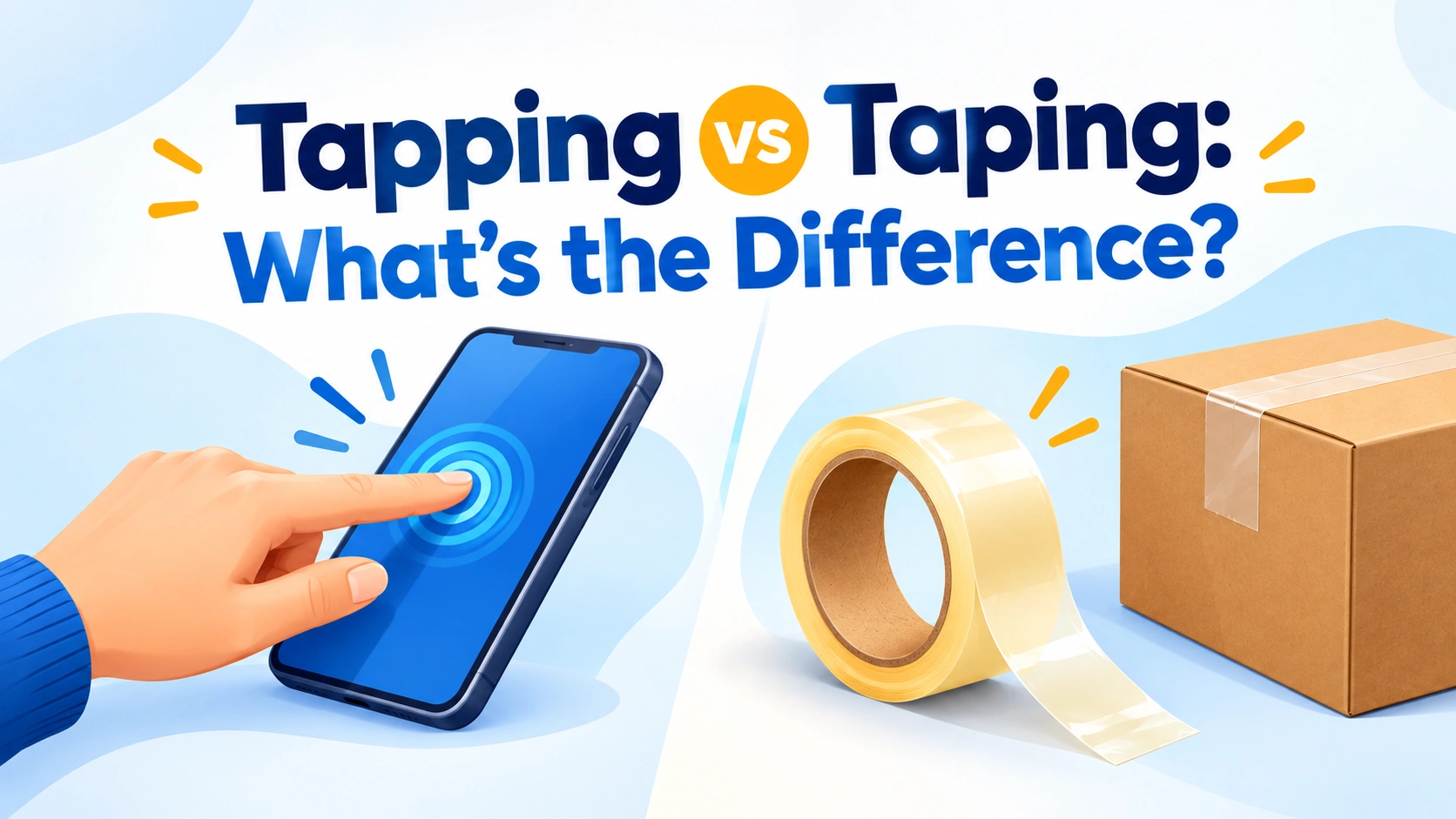
Tapping vs taping can look like a tiny spelling distinction, but the two words come from different verbs and describe different actions. Tapping comes from tap, meaning to touch, strike, or press something lightly, often repeatedly. Taping comes from tape, meaning to attach, cover, secure, or record something using tape or recording equipment. Compare “She is tapping the screen” with “She is taping the package.” Once you identify the base verb, the difference becomes much easier to understand. This guide explains the meanings, spelling rules, pronunciation, common expressions, confusing cases, and practical examples so you can choose the right form confidently.
The spelling difference follows a useful English pattern. Tap becomes tapping because the final consonant is doubled before -ing, while tape becomes taping because the silent final e is dropped. That gives us two distinct forms: tap → tapping and tape → taping. The difference is not simply a matter of adding -ing; the base verb determines both the spelling and the meaning. This matters in everyday writing, from describing a person touching a phone screen to explaining how someone secured a parcel. Knowing the rule helps you avoid errors such as “taping the screen” when you mean “tapping the screen.”
There is another useful distinction that learners sometimes miss: tapping and taping can occur in completely different contexts, even though they differ by only one letter. Tapping appears in technology, music, conversation, physical movement, and figurative expressions such as tapping into a resource. Taping appears in packaging, crafts, sports, medical support, painting, and recording. You will also learn how tapped and taped differ, why pronunciation can help you check your choice, and how to recognize the correct word without memorizing dozens of examples. By the end, the spelling should feel logical rather than arbitrary.
Tapping vs Taping at a Glance
The quickest way to separate the words is to start with their base verbs.
| Word | Base verb | Core meaning | Example |
| Tapping | tap | Touching, striking, or pressing lightly | She is tapping the screen. |
| Taping | tape | Attaching, covering, securing, or recording | He is taping the box shut. |
There is an important practical lesson here: do not decide between the words by looking only at their spelling. Ask what action the sentence describes.
If someone is touching a button on a phone, they are tapping it. If someone is attaching a label to a box with adhesive tape, they are taping it.
Memory formula:
TAP + ING = TAPPING
TAPE − E + ING = TAPING
That simple distinction solves most everyday cases.
What Does “Tapping” Mean?
Tapping as the Present Participle of “Tap”
Tapping is the present participle and gerund form of tap.
The verb tap commonly means to touch or strike something lightly, often with a finger, hand, foot, or another object. It can describe one action or a repeated series of light contacts.
Examples:
- She is tapping the table with her fingers.
- Someone was tapping on the window.
- He kept tapping his foot to the music.
- Tap the button to continue.
The word can also have broader figurative or specialized meanings, so physical contact is only the starting point.
Common Everyday Uses of Tapping
Tapping a Surface
When someone makes repeated light contacts with a surface, tapping is the natural choice.
- The student was tapping his pencil on the desk.
- I heard someone tapping on the door.
- She was tapping the glass gently.
The action is usually lighter than hitting or striking. That difference in force is part of the meaning of tap.
Tapping a Person
English commonly uses tap for a light touch directed at another person.
- She tapped him on the shoulder.
- The teacher tapped the student gently on the arm.
The common expression to tap someone on the shoulder does not mean hitting them. It generally describes a brief, light touch used to get someone’s attention.
Tapping Your Foot or Fingers
Tapping can describe repeated movement that creates a rhythm or reflects a person’s state of mind.
- He was tapping his foot to the beat.
- She nervously tapped her fingers on the desk.
In these sentences, the action may be intentional or habitual. The important point is that the underlying verb is still tap.
Tapping a Phone or Touchscreen
Modern technology has made tap especially common.
- Tap the icon to open the app.
- She tapped the screen twice.
- Tap here to see more information.
A touchscreen action is tapping, not taping, when you mean touching the screen to activate something.
Tapping Into a Resource or Opportunity
The expression tap into has a figurative meaning: to gain access to or make use of something available.
- The company is tapping into a growing market.
- The program helps students tap into their creative potential.
- Researchers are tapping into new sources of data.
Here, nobody is physically touching anything. The phrase is figurative, but the spelling remains tapping because its base verb is tap.
Other Uses of “Tapping”
Depending on the context, tap can also refer to:
- Tapping a tree to obtain sap.
- Tapping a keg to draw a beverage.
- Tapping a source of information for useful material.
- Tapping expertise within an organization.
- Tapping into technology or funding to accomplish a goal.
The meanings are different, but the spelling follows the same base verb: tap → tapping.
What Does “Taping” Mean?
Taping as the Present Participle of “Tape”
Taping is the present participle and gerund form of tape.
The verb tape generally means to attach, cover, secure, or hold something using tape. It can also mean to record audio, video, or an event, reflecting the older use of magnetic tape in recording.
Examples:
- He is taping the package shut.
- She is taping a photograph to the wall.
- The trainer is taping his ankle.
- The station is taping the interview.
The meaning changes with the context, but the base verb remains tape.
Taping Something Together or Securing It
This is one of the most common uses.
- She is taping the torn paper together.
- We taped the broken box closed.
- He is taping the cables together.
The object is being attached or held with tape, so taping is appropriate.
Taping an Area Before Painting
Painters often use tape to protect edges or create clean boundaries.
- They are taping the window frames before painting.
- We spent an hour taping the edges of the wall.
- She taped around the trim before applying the paint.
This is still the verb tape, so the present participle is taping.
Taping a Wound, Joint, or Body Part
In sports and healthcare-related contexts, taping can describe applying adhesive or athletic tape to provide support or secure a dressing.
- The trainer is taping the athlete’s ankle.
- The therapist demonstrated how to tape the area.
The word describes using tape, not touching the area lightly.
Taping an Interview, Performance, or Event
Taping can also mean recording something.
- The network is taping the interview this afternoon.
- They are taping a live performance.
- The show was taped earlier in the week.
This usage remains common even though many modern recordings are digital rather than stored on physical tape.
Taping Paper, Labels, and Other Materials
Everyday situations provide plenty of examples:
- She is taping the notice to the door.
- He is taping the label onto the package.
- The children are taping their drawings to the wall.
Whenever tape is being used as a material or recording medium, taping is the natural form.
The Spelling Rule: Why Is It “Tapping” but “Taping”?
The spelling difference becomes much easier once you stop treating the words as unrelated exceptions.
Why “Tap” Becomes “Tapping”
The word tap is a one-syllable verb ending in a consonant after a short vowel sound. In the standard spelling pattern used for forms such as this, the final consonant is doubled before -ing.
So:
tap + ing → tapping
The same general pattern appears in:
- run → running
- sit → sitting
- stop → stopping
The doubled p does not mean that English speakers pronounce two separate /p/ sounds. It is primarily a spelling signal showing how the short vowel in the base word is preserved.
Why “Tape” Becomes “Taping”
The base word tape ends with a silent e. When -ing is added, that final e is normally removed.
So:
tape + ing → taping
Compare:
- make → making
- write → writing
- use → using
The important difference is that tape does not become tapping. It remains connected to the long vowel sound represented by the spelling in tape.
A Useful Contrast: Tap + -ing vs. Tape + -ing
| Base verb | Spelling change | Correct form | Meaning |
| tap | Double final consonant | tapping | Touching or striking lightly |
| tape | Drop final silent e | taping | Attaching, covering, securing, or recording |
This is why the question “Which word is the base verb?” is more useful than simply asking which spelling looks right.
Related Forms: Tapped vs. Taped
The same distinction appears in the simple past and past participle forms.
Tap:
- tap
- taps
- tapped
- tapping
Tape:
- tape
- tapes
- taped
- taping
Compare:
- She tapped the screen.
- She taped the note to the screen.
Those two past-tense forms are especially easy to confuse when typing quickly.
Tapping vs Taping Pronunciation
Pronunciation provides another useful clue.
Tapping keeps the short vowel sound of tap. The doubled p is not pronounced as two separate consonants.
Taping keeps the long vowel sound associated with tape. The final e is silent, but it affects the vowel sound.
In simplified terms:
- tapping → short a sound
- taping → long a sound
For learners, pronunciation can be a helpful second check, but it should not be the first step. Meaning and the base verb are more reliable.
If you are unsure, mentally expand the word:
Is this tap + ing or tape + ing?
That question usually resolves the spelling immediately.
Tapping vs Taping: Meaning in Real Sentences
Seeing the words in parallel makes the semantic difference clearer.
Examples Where “Tapping” Is Correct
- The child is tapping the glass.
- She was tapping her fingers on the desk.
- He is tapping the screen to select an option.
- The musician kept tapping his foot to the rhythm.
- The company is tapping into new markets.
Examples Where “Taping” Is Correct
- He is taping the box shut.
- She is taping a picture to the wall.
- They are taping the edges before painting.
- The trainer is taping the player’s ankle.
- The production team is taping the interview.
Side-by-Side Examples
| If you mean… | Use… | Example |
| Lightly touching a screen | tapping | Tap the screen to continue. |
| Attaching something with adhesive tape | taping | She is taping the label to the box. |
| Making repeated light sounds | tapping | He was tapping on the window. |
| Securing a package | taping | They are taping the package shut. |
| Moving a foot rhythmically | tapping | She was tapping her foot to the music. |
| Supporting an ankle with athletic tape | taping | The trainer is taping his ankle. |
| Accessing a resource figuratively | tapping | The business is tapping into new talent. |
| Recording an interview | taping | The station is taping the interview. |
Tapping vs Taping in Technology
Technology creates one of the most common opportunities for confusion.
“Tapping” on a Phone or Tablet
When you touch a touchscreen to select or activate something, the verb is tap.
- Tap the menu.
- Tap the notification.
- Tap the icon.
- She is tapping the screen.
- Double-tap the image.
The action is a touch or press, so tapping is correct.
Why “Taping” Is Wrong for Touchscreen Interaction
Consider this sentence:
Tap the button to continue.
Changing tapping to taping changes the meaning entirely. Taping suggests using tape or, in another context, recording something.
That is why a sentence such as “I am taping the screen to open the app” would communicate the wrong action if the writer meant touching the screen.
There is one contextual exception worth remembering: taping the screen could be grammatically meaningful if someone literally attaches tape to a screen. The word is not “wrong” in every possible context; its meaning simply changes.
That illustrates a broader lesson in English: context determines whether a word is appropriate.
Tapping vs Taping in Sports and Medical Contexts
Sports terminology makes the distinction particularly clear.
Tapping in Sports
A player might tap a foot, ball, surface, or piece of equipment.
- The player was tapping his foot impatiently.
- She kept tapping the ball with her stick.
- He was tapping his fingers against the bench.
These actions come from tap.
Taping in Sports
A trainer may apply athletic tape to support or secure part of an athlete’s body.
- The trainer is taping the player’s ankle.
- She learned how to tape her wrist before practice.
This comes from tape.
A Common Sports-Related Confusion
Compare these two sentences:
- The player was tapping his foot while waiting.
- The trainer was taping his ankle before the game.
Both are grammatically correct. The difference is not the tense or sentence structure. It is the action being described.
Common Confusions and Mistakes
Writing “Taping” When You Mean Touching or Striking
Incorrect:
She was taping her fingers on the desk.
If the intended meaning is repeated light contact, use:
She was tapping her fingers on the desk.
Writing “Tapping” When You Mean Using Tape
Incorrect:
He is tapping the box shut.
If he is using adhesive tape, write:
He is taping the box shut.
Confusing “Tapped” and “Taped”
These past forms can cause the same problem:
- He tapped the microphone.
- He taped the microphone to the stand.
In the first sentence, he lightly touched or struck the microphone. In the second, he attached it with tape.
Applying the -ing Rule Without Finding the Base Verb
A common beginner mistake is to see tap and tape as almost identical words and assume their -ing forms should behave similarly.
They do not.
The better approach is:
- Identify the base verb.
- Determine its meaning.
- Apply the spelling rule.
Choosing a Word Without Considering Context
Context can completely change what is possible.
For example:
- They are taping the screen.
This could mean attaching tape to the screen. - They are tapping the screen.
This means touching the screen.
Neither form can be judged correctly without knowing the intended action.
A Simple Method for Choosing Between Tapping and Taping
Use this four-step check whenever you hesitate.
Step 1: Find the Base Verb
Ask:
Is the verb tap or tape?
If it is tap, the -ing form is tapping.
If it is tape, the -ing form is taping.
Step 2: Identify the Action
Use tapping when the sentence involves:
- light touching
- light striking
- pressing a touchscreen
- rhythmic contact
- accessing something figuratively through tap into
Use taping when it involves:
- adhesive tape
- securing or attaching
- covering an area with tape
- athletic or medical tape
- recording
Step 3: Apply the Spelling Rule
- tap → tapping
- tape → taping
Step 4: Check the Complete Sentence
Read the sentence again.
If tapping describes an action involving light contact, it probably fits.
If taping describes using tape or recording, it probably fits.
Expert tip: When spelling feels uncertain, go backward to the base verb instead of forward from the confusing word. English spelling becomes much more predictable when you start with meaning.
Tapping vs Taping: Natural English Usage
Learning isolated definitions is useful, but natural collocations make these words much easier to use correctly.
Common Collocations With “Tapping”
- tapping the screen
- tapping the table
- tapping on the window
- tapping someone on the shoulder
- tapping your foot
- tapping a button
- tapping into resources
- tapping into a market
- tapping into expertise
Common Collocations With “Taping”
- taping a box
- taping something together
- taping something to a wall
- taping a package
- taping the edges
- taping an ankle
- taping a joint
- taping an interview
- taping a performance
Learning these combinations is often more effective than memorizing the definitions alone because they show how native speakers actually build sentences around the verbs.
Tapping vs Taping: Related Words You Should Know
| Verb family | Present form | Past form | Core idea |
| tap | tapping | tapped | Light touch, strike, or press |
| tape | taping | taped | Attach with tape or record |
Tap, Tapped, Tapping
Examples:
- I tap the screen.
- I tapped the screen.
- I am tapping the screen.
All three forms belong to tap.
Tape, Taped, Taping
Examples:
- I tape the box.
- I taped the box.
- I am taping the box.
All three belong to tape.
The easiest way to avoid confusion is to learn each family as a unit rather than memorizing tapping and taping separately.
Tapping vs Taping: Practice Questions
Test yourself before looking at the explanations.
Fill in the Blank
Choose tapping or taping.
- She was ______ her fingers on the desk.
- He is ______ the package shut.
- Please keep ______ the screen until the menu appears.
- The trainer is ______ the athlete’s ankle.
- We could hear someone ______ on the window.
- They are ______ the edges before painting.
- The company is ______ into a new source of talent.
- The television crew is ______ the interview today.
Answers
- tapping — light repeated contact with the desk.
- taping — using tape to secure the package.
- tapping — interacting with a touchscreen.
- taping — applying athletic tape.
- tapping — making light contact with the window.
- taping — applying tape to protect the edges.
- tapping — figuratively accessing or making use of a resource.
- taping — recording the interview.
Choose the Correct Sentence
A. She is taping the phone to open the application.
B. She is tapping the phone to open the application.
Correct answer: B.
Here, tapping describes touchscreen interaction.
Now consider:
A. He is tapping the label to the box.
B. He is taping the label to the box.
Correct answer: B.
Here, taping means attaching the label with tape.
Conclusion
The difference between tapping vs taping becomes straightforward once you identify the base verb. Tapping comes from tap and describes light touching, striking, pressing, rhythmic contact, or figurative access through expressions such as tap into. Taping comes from tape and describes attaching, securing, covering, or recording. The spelling follows the meaning: tap → tapping, while tape → taping.One final actionable tip: whenever you hesitate, stop looking at the confusing -ing form and ask, “What is the base verb?” That single question usually reveals the answer. A common mistake to avoid is choosing a word solely because it looks or sounds similar to the other one. In English, meaning comes first; spelling follows the verb. Once that connection becomes automatic, tapping and taping are easy to keep apart.
FAQs
Q1. Is “tapping” or “taping” correct?
Both are correct words, but they come from different verbs. Tapping comes from tap and usually means touching, striking, or pressing lightly. Taping comes from tape and usually means attaching something with tape or recording something.
Q2. Why is “tapping” spelled with two p’s?
Tapping comes from the one-syllable verb tap. When -ing is added, the final consonant is doubled in this spelling pattern: tap + ing = tapping. The doubled p is a spelling convention; it does not mean that two separate /p/ sounds are pronounced.
Q3. Why is “taping” spelled with one p?
Taping comes from tape. The final silent e is dropped before -ing: tape → taping. The p is not doubled because the spelling pattern is different. Compare make → making and write → writing.
Q4. Is “taping” still used for recording?
Yes. Taping can still mean recording an interview, program, performance, or event, even though modern recording is usually digital. English retains many expressions from older technologies, so tape shows remain understandable and widely used.
Q5. What is the difference between “tapped” and “taped”?
Tapped is the past form of tap, while taped is the past form of tape. She tapped the screen and touched it lightly. She taped the note to the wall meaning she attached it using tape. The same meaning distinction applies to the present forms.