

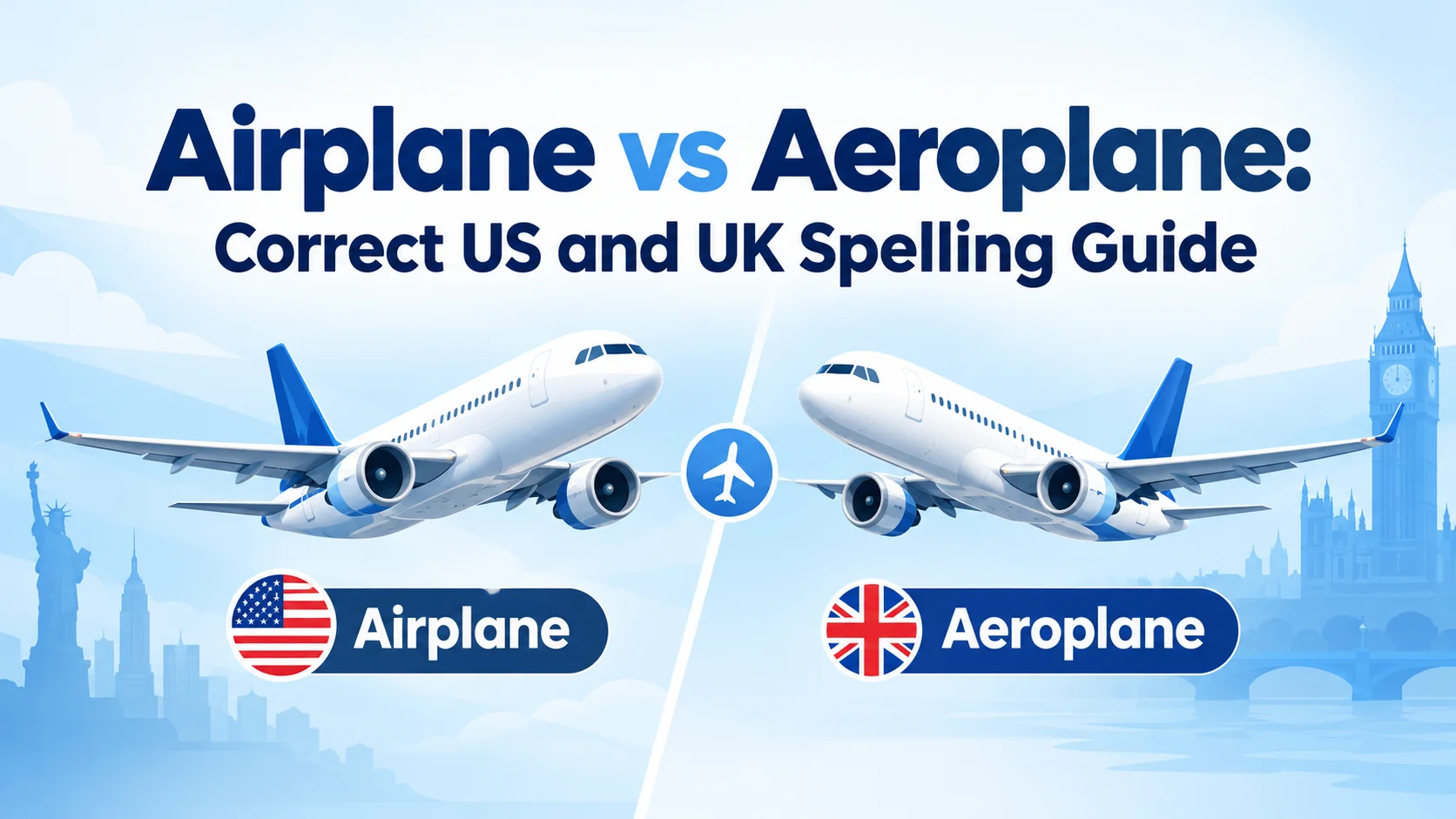
The difference between airplane vs aeroplane comes down to regional spelling, not meaning. Both words describe the same type of powered, fixed-wing aircraft, but American and British English traditionally favor different forms. If you are writing a school assignment, publishing a travel article, editing a business document, or creating website content, choosing the right spelling helps your writing feel natural to its intended audience. Neither word is universally wrong, and the longer spelling is not a different kind of aircraft. The key is understanding which spelling fits your readers and why.
At first glance, the difference looks minor: one word contains an extra e. Yet spelling choices can signal which variety of English a writer follows. Airplane is the standard form in American English, while aeroplane is traditionally associated with British English. Modern British writers also use planes frequently, particularly in everyday conversation. These patterns are useful guidelines rather than rigid rules for every speaker or publication. Understanding the distinction helps you avoid unnecessary corrections, maintain consistency, and recognize why a dictionary or editor might prefer one spelling over the other.
This guide explains the meaning, spelling, pronunciation, and history of both words, with practical examples for American and British readers. You will also learn when plane is the more natural choice, how aircraft differ from airplane, and what to consider in academic, technical, and online writing. Rather than memorizing a rule without context, you will be able to make a clear decision based on your audience, the document’s purpose, and any relevant style guide. By the end, choosing between airplane and aeroplane should be straightforward.
Airplane vs Aeroplane: The Quick Answer
Airplane is the standard spelling in American English. Aeroplane is the traditional British English spelling and remains a valid form, although plane is also common in modern British usage.
Both words refer to the same general type of aircraft. The spelling does not change the vehicle’s meaning, size, or purpose.
| Word | Typical regional association | Meaning |
| Airplane | American English | A powered, fixed-wing aircraft |
| Aeroplane | Traditional British English | A powered, fixed-wing aircraft |
| Plane | Common in both varieties | A shorter, everyday term for an airplane |
Quick rule: Use airplane for a US audience. For a UK audience, follow the publication’s preferred style; aeroplane is traditional, while plane is often the most natural everyday choice.
What Is the Difference Between Airplane and Aeroplane?
The essential difference is spelling convention. Both forms describe a powered, fixed-wing flying vehicle that uses wings to generate lift and is propelled through the air.
What Does Airplane Mean?
Airplane is the standard American English spelling. It is widely used in US newspapers, educational materials, travel websites, technical discussions, and everyday writing.
Examples:
- “Our airplane landed twenty minutes ahead of schedule.”
- “She built a model airplane for her science project.”
- “The pilot inspected the airplane before departure.”
- “I prefer a window seat when I travel by airplane.”
In American English, airplane is the safest choice when you want to follow conventional spelling. The shorter word plane is equally natural in many contexts, especially when the type of aircraft is already clear.
What Does an Aeroplane Mean?
Aeroplane is an established spelling traditionally associated with British English. It is not a typo or an incorrect version of airplane. It appears in British dictionaries, historical writing, and contexts that retain the traditional form.
Examples:
- “The aeroplane disappeared behind the clouds.”
- “The museum displays an early aeroplane from the history of flight.”
- “The children watched an aeroplane cross the sky.”
- “The pilot guided the aeroplane toward the runway.”
The spelling is recognizable beyond Britain, too. However, readers should not assume that every British writer uses aeroplanes in every situation. Many simply say plane, particularly in informal speech and contemporary writing.
Do the Two Words Have Different Meanings?
No. In ordinary usage, airplane and aeroplane mean the same thing. Neither spelling indicates a particular passenger capacity, engine type, flight range, or aircraft design.
Compare these sentences:
- American English: “The airplane carried passengers across the Atlantic.”
- Traditional British English: “The aeroplane carried passengers across the Atlantic.”
The regional spelling changes, but the information remains the same. If a technical document needs to distinguish a jet from a glider, or a fixed-wing aircraft from a helicopter, those distinctions require more specific terminology—not a change from airplane to aeroplane.
Is Airplane American or British English?
The distinction is best understood as a difference in standard regional preference, rather than a strict division in which one country understands only one spelling.
American English: Airplane
In US English, airplane is the conventional spelling. It is appropriate for:
- American school assignments and essays
- US-focused news and travel articles
- Business documents written in American English
- Educational material for American readers
- General website content following US spelling conventions
For example:
The airplane was delayed because of heavy rain at the departure airport.
A US editor would normally retain an airplane rather than change it to aeroplane. This is a matter of following the expected spelling standard, not correcting a difference in meaning.
British English: Aeroplane and Plane
In British English, aeroplane is the traditional form. Nevertheless, plain is common in modern everyday usage and often sounds less formal or more conversational.
For example:
We caught the plane to Edinburgh early on Friday.
That sentence sounds entirely natural in British English. A writer might choose aeroplanes when discussing aviation history, following a publication’s style, or deliberately using the traditional form.
The practical lesson is simple: do not replace every occurrence of plane with aeroplane just because your readers are British. Choose the word that suits the context and keep the overall spelling style consistent.
What About Australian and Canadian English?
Other English varieties do not always fit neatly into a US-versus-UK comparison. Australian and Canadian writers may follow regional conventions, organizational style guides, or established expressions that do not match every traditional British or American preference.
If you are writing for a specific country, check a reputable local dictionary or the publication’s editorial guidance. For an international audience, airplane is widely recognizable, but plane may be a more concise choice when the meaning is clear.
Avoid assuming that every country has one mandatory form. Regional English is shaped by usage, context, and editorial practice.
Why Are There Two Spellings?
The two spellings developed through the history of aviation vocabulary and the different conventions that emerged in English-speaking regions. The distinction is older than modern commercial air travel, and it reflects how English words can evolve along more than one path.
How the Word Airplane Developed
The word airplane combines air with plane, a word historically connected with a flat surface. In aviation, the term came to describe a flying machine whose fixed wings generate lift as it moves through the air.
As powered flight developed in the early twentieth century, English speakers needed familiar terms for the new machines. Airplane became the established American form and remains the standard spelling in the United States.
Where Did Aeroplane Come From?
Aeroplane uses the element aero-, which relates to air or flight and appears in words such as aerodynamics and aeronautics. The form became established in British English and was widely used in early aviation writing.
The two forms reflect different word-building and spelling conventions that became familiar in different communities. Neither needs to be treated as a mistake simply because the other is more common in a particular region.
Is the Difference Like Other US and UK Spellings?
Yes, in the broad sense that both are examples of regional variation. However, not all spelling differences follow exactly the same historical pattern.
| American English | British English | Example |
| Color | Colour | “The airplane has a blue color scheme.” |
| Center | Centre | “The airport is near the city centre.” |
| Traveling | Travelling | “We are travelling tomorrow.” |
| Airplane | Aeroplane | “The airplane landed safely.” |
These examples illustrate why writers should identify their intended English variety before editing a document. The goal is not to declare one side correct and the other incorrect; it is to follow the convention that best serves the reader.
Airplane or Aeroplane: Which Spelling Should You Use?
The best choice depends on your audience, the kind of document you are producing, and any style rules you must follow.
For American English and US Audiences
Choose aeroplanes for standard American English. It is the expected form in most general writing for US readers.
For example:
- “The airplane will arrive at Gate 12.”
- “The museum has a collection of historic airplanes.”
- “Airplane travel can be tiring on long journeys.”
If your article uses other American spellings, such as color, center, and traveling, airplane will fit that style.
For British English and UK Audiences
For British readers, you have two practical options:
- Use aeroplane if you want the traditional British form or your publication specifically prefers it.
- Use plane when a short, natural expression suits the context.
For example:
- “The aeroplane was part of the museum’s historic collection.”
- “We took the plane to Manchester.”
Both sentences can work in British English. You do not need to insert aeroplane into every sentence simply to make the text sound British.
For Academic and Professional Writing
Formal writing benefits from consistency and adherence to an established standard. If your university, employer, client, journal, or publisher specifies a style guide, follow it.
Use this approach:
- Identify the required English variety.
- Check the organization’s style guide or dictionary.
- Use the preferred form consistently.
- Preserve spellings in direct quotations and official names unless there is a clear editorial reason to alter them.
- Avoid changing regional spelling within a document without purpose.
In technical aviation writing, also make sure that the term itself is precise. Airplane and aeroplane refer to a particular broad category of aircraft; they are not interchangeable with every technical term for a flying vehicle.
For Websites, Blogs, and International Audiences
Writers who publish online should make the decision at the site or publication level, not one page at a time. Consistent spelling creates a more polished reading experience and reduces unnecessary editing.
For a US-focused website, use airplane in headings, body text, and metadata when appropriate. For a UK-focused publication, decide whether its style uses aeroplane or commonly uses plane. For a global audience, choose wording that reads naturally while making the meaning clear.
Do not insert both spellings repeatedly just to target search variations. A single, useful explanation of the difference is usually enough.
Airplane vs Aeroplane in Example Sentences
Side-by-side examples make it easy to see that the spelling changes while the meaning stays the same.
Example Sentences Using Airplane
- Travel: “Our airplane departed at seven in the morning.”
- Family conversation: “My nephew has never flown in an airplane.”
- Education: “The students built a model airplane for their science project.”
- News: “The airplane landed safely after a short delay.”
- Description: “A small airplane flew above the coastline.”
- History: “The exhibit explains how early airplane designs changed over time.”
- Work: “The engineer inspected the airplane’s wing before the test flight.”
These examples are suitable for American English. In a US-focused article, airplanes are the natural choice even when the subject is historical or technical.
Example Sentences Using Aeroplane
- Travel: “The aeroplane departed at seven in the morning.”
- Family conversation: “My nephew has never flown in an aeroplane.”
- Education: “The students built a model aeroplane for their science project.”
- News: “The aeroplane landed safely after a short delay.”
- Description: “A small aeroplane flew above the coastline.”
- History: “The exhibit explains how early aeroplane designs changed over time.”
- Work: “The engineer inspected the aeroplane’s wing before the test flight.”
These examples demonstrate how the traditional British spelling can be used in the same grammatical contexts as the American form.
How the Spelling Works in Common Phrases
Both words can appear in similar prepositional phrases, but the shorter plane often sounds more natural in everyday English.
| Expression | Example | Practical note |
| On an airplane | “I left my book on the airplane.” | Common in American English |
| On an aeroplane | “I left my book on the aeroplane.” | Possible in British English |
| On a plane | “I left my book on the plane.” | Natural and concise in both varieties |
| By airplane | “The goods were transported by airplane.” | Grammatically possible; may sound formal |
| By plane | “We travelled by plane.” | Often the more concise choice |
| In an airplane | “She fell asleep in the airplane.” | Correct when referring to being inside it |
| In an aeroplane | “She fell asleep in the aeroplane.” | Correct with the traditional British form |
The choice of preposition depends on the intended meaning, not on whether the noun contains an extra e. In many travel contexts, on a plane is a familiar expression for being aboard an aircraft, while by plane describes the mode of transport.
Airplane, Aeroplane, and Fixed Expressions
Some expressions have an established form that should not be changed mechanically to match a regional preference.
For example, airplane mode is the familiar name for a mobile-device setting that disables or limits wireless transmissions. A phone or operating system may use a different label depending on the manufacturer and region. If you are explaining a specific device feature, use the wording shown in that product’s interface.
Similarly, official names, book titles, museum labels, and quotations may retain the spelling used by their source. Regional consistency matters, but it does not justify altering an exact name or quotation.
Airplane vs Plane vs Aircraft: What Is the Difference?
Although these words are related, they are not identical in every context. Understanding their scope helps you choose more precise vocabulary.
Is a Plane the Same as an airplane?
In everyday conversation, plane is commonly used as a shorter form of airplane or aeroplane. For example, “Our plane leaves at noon” usually means the same thing as “Our airplane leaves at noon.”
However, plane has other meanings in English. It can refer to a flat surface in geometry, a level or dimension, or a woodworking tool used to smooth a surface. Context tells the reader which meaning is intended.
Is an Aircraft the Same as an Airplane?
Aircraft is the broader term. An airplane is a type of aircraft, but not every aircraft is an airplane.
The word aircraft can include airplanes, helicopters, gliders, and other machines designed to fly. In technical, regulatory, or safety-related writing, the broader term may be necessary when the information applies to more than one kind of flying vehicle.
For example:
- “The airplane taxied toward the runway.” — Refers to a particular kind of aircraft.
- “The aircraft must undergo inspection.” — Could refer to an airplane or another type of flying vehicle.
This distinction is useful when writing about aviation regulations, maintenance, or different aircraft designs. Do not use aeroplanes when you need a term broad enough to include helicopters or other non-airplane vehicles.
Airplane, Plane, and Aircraft Compared
| Term | Scope | Best use |
| Airplane | A powered, fixed-wing flying vehicle | General American English and contexts requiring the full term |
| Aeroplane | The same type of vehicle, using the traditional British spelling | British English styles that prefer this spelling |
| Plane | Often a short form of airplane or aeroplane; also has unrelated meanings | Everyday conversation and concise writing |
| Aircraft | A broader category of flying vehicles | Technical, regulatory, and general aviation contexts |
Practical tip: Use plane when the meaning is obvious and the tone is conversational. Use airplane or aeroplane when regional spelling matters, and use aircraft when you need the broader technical category.
How Are Airplane and Aeroplane Pronounced?
The two spellings are generally pronounced alike or very similarly within the same variety of English. The extra letters in aeroplane do not automatically create an extra spoken syllable.
Does the Pronunciation Change Between American and British English?
Regional accents can affect vowel sounds and the rhythm of speech, as they do with many English words. However, the spelling distinction itself does not establish a different meaning or require a different pronunciation.
If you are learning English, listen to dictionary recordings from the variety you are studying. A reputable dictionary with both US and UK audio can help you hear regional accent differences without confusing them with spelling rules.
Is One Pronunciation More Correct?
Neither spelling is inherently more correct, and there is no need to adopt an unfamiliar accent to use either word properly. Focus on clear pronunciation and use the regional spelling appropriate to your writing.
Remember that spelling and pronunciation are related but separate questions. A word can have regional spelling variants without a major difference in how speakers say it.
Common Mistakes When Choosing Airplane or Aeroplane
Most errors occur when writers mistake a regional preference for a universal rule or apply a spelling convention without considering the sentence.
Mistake 1: Treating Aeroplane as Incorrect
Aeroplane is an established English spelling, not a misspelling that must always be corrected. It is traditionally associated with British English and appears in legitimate publications and historical sources.
Better approach: Check the document’s intended English variety before marking the word as an error.
Mistake 2: Assuming Airplane Is Wrong in British English
British readers generally understand airplane, even though aeroplane is the traditional British form. Understanding a word and preferring it as a regional spelling are different things.
Better approach: Follow the chosen style guide instead of treating every American spelling in British writing as a communication failure.
Mistake 3: Mixing Regional Spellings Without a Reason
A document that switches between American and British spelling can look poorly edited, particularly when the same word appears several times.
For instance, a US-focused article might use airplane in one paragraph and aeroplane in the next without explanation. Neither word is inherently wrong, but the inconsistency may distract readers.
Better approach: Choose a regional style at the beginning of the editing process and check the whole document for consistency.
Mistake 4: Confusing Airplane With Aircraft
An airplane is a specific kind of aircraft, while aircraft covers a wider category. Using the terms as if they always mean precisely the same thing can make technical writing inaccurate.
Better approach: Ask whether the sentence refers specifically to an airplane or to flying vehicles more generally.
Mistake 5: Changing Official Names or Quotations
An organization may use a particular spelling in a title, quotation, exhibit label, or product name. Changing it just to match the rest of your article can misrepresent the source.
Better approach: Preserve official wording when accuracy requires it. If you need to explain a regional spelling difference, do so outside the quotation or name.
A Practical Editing Checklist for US and UK Spelling
Before publishing an article, essay, report, or website page, use this checklist:
- Identify the intended audience and English variety.
- Check whether a publisher, client, school, or employer requires a particular style guide.
- Use aeroplanes for standard American English writing.
- Use aeroplane when the chosen British English style prefers the traditional spelling.
- Consider a plane when a concise, natural expression suits the context.
- Use aircraft when the sentence needs a broader technical term.
- Preserve exact spellings in proper names and direct quotations where appropriate.
- Review the complete document for consistency rather than checking one word in isolation.
- Check any fixed expressions or product labels individually instead of changing them automatically.
A reliable editing process is not about forcing every reader to use the same spelling. It is about making a deliberate choice, understanding the exceptions, and applying the choice consistently.
Conclusion:
The difference between airplane vs aeroplane is straightforward once you understand regional English conventions. Both words refer to the same kind of flying vehicle, but airplane is standard in American English, while aeroplane is the traditional British form. The shorter word plane is common in everyday conversation on both sides of the Atlantic, and aircraft serves a broader purpose in technical contexts.One final actionable tip: Before writing, identify your audience and check any applicable style guide. Then apply your chosen spelling consistently across headings, body text, and supporting content.A common mistake to avoid is labeling one form incorrect simply because it is less familiar in your region. Good writing is not about enforcing one country’s conventions everywhere; it is about choosing accurate language that feels natural to the people reading it.
FAQs
Q1. Which spelling is correct: airplane or aeroplane?
Both airplane and aeroplane are correct English spellings. Airplane is the standard American English form, while aeroplane is traditionally associated with British English. Choose according to your audience, publication style, or regional spelling convention rather than treating either word as universally incorrect.
Q2. Do Canadians use airplane or aeroplane?
Canadian English can reflect both British and American influences, so usage may vary by context and publication. Airplanes are widely understood and commonly used. If you are writing for a Canadian institution, newspaper, or website, check its preferred terminology instead of assuming that every British-associated spelling is standard.
Q3. Is aeroplane an outdated word?
Aeroplane is an established word, not simply an obsolete spelling. However, its traditional British association can make it sound more formal or old-fashioned in some modern contexts, where plane is common. The impression depends on the sentence, audience, and publication rather than the spelling alone.
Q4. Should I use airplane or aeroplane in an SEO article?
Choose the form that matches your target audience and use it consistently. A US-focused article will generally use airplane, while a UK-focused article may use aeroplane or plane. Explain the alternative naturally when relevant, but avoid repeating both forms merely to target search keywords.
Q5. Can I use both airplane and aeroplane in the same document?
Yes, when there is a clear reason, such as discussing regional spelling differences or preserving an official title. Otherwise, switching between the two can make your writing look inconsistent. Choose a primary spelling convention and follow it throughout the document unless context requires otherwise.