

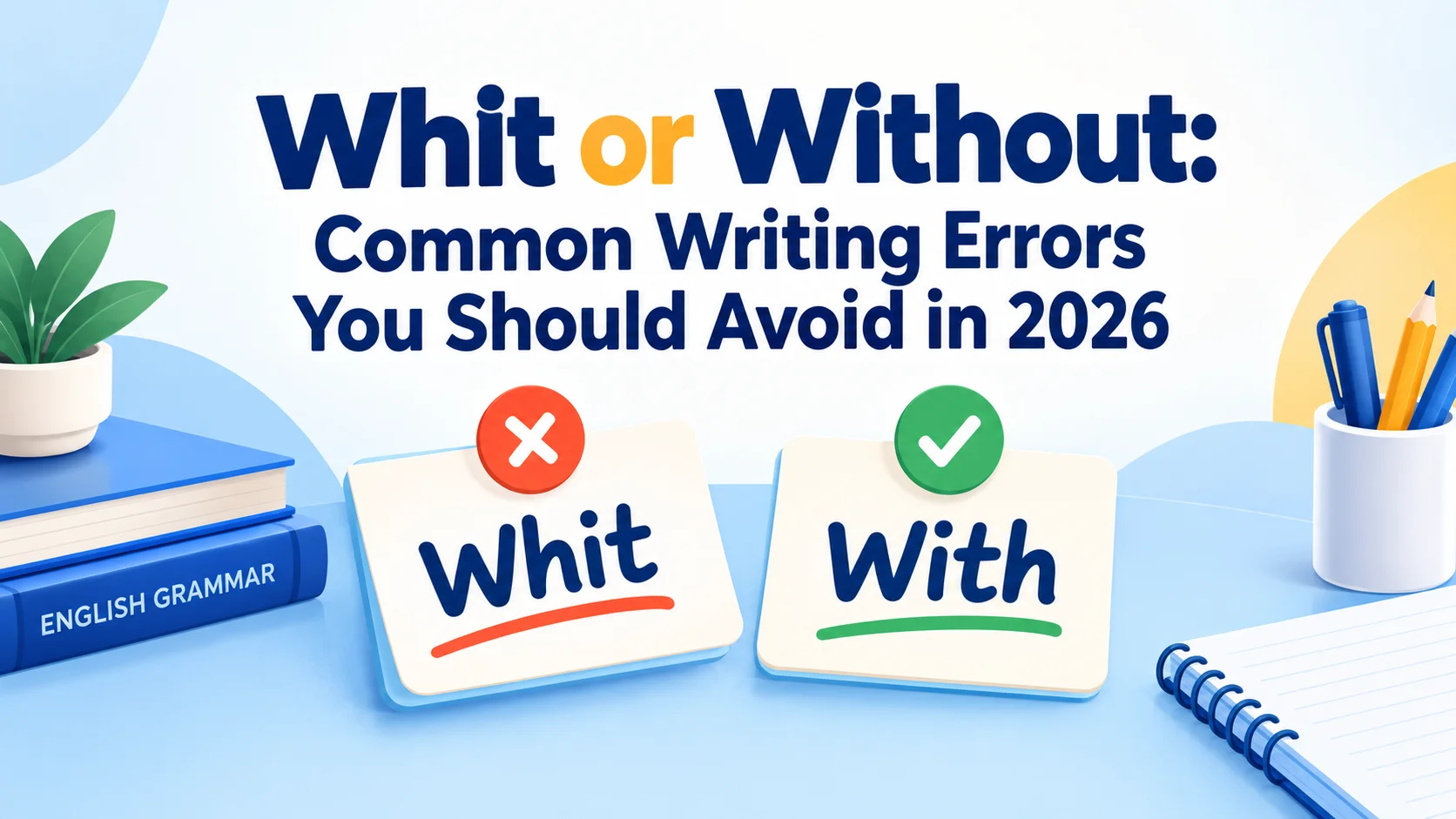
The confusion surrounding whether with or without usually begins with a simple typing mistake, but it raises an important question about English spelling: how can a tiny difference in letters change the accuracy of a sentence? The correct word depends on what you mean. With expresses accompaniment, association, or the use of something, while without indicates absence or lack. Although whit is a legitimate English word, it is uncommon and does not replace with in ordinary writing. Meanwhile, whitout is a misspelling of without.
These errors often appear in text messages, school assignments, business emails, blog posts, and online forms. Because with and without are familiar words, writers may type them automatically without checking every letter. Spell-checking software can help, but it does not always identify words used incorrectly in context. Understanding the difference between a genuine word, a spelling mistake, and a grammatical error makes proofreading more effective. It also helps writers catch mistakes that might otherwise distract readers or change the intended meaning of a sentence.
This guide explains whit vs. with and whitout vs. without, including their meanings, correct grammatical patterns, and examples from everyday and professional communication. You will also learn why these mistakes happen, how to correct them efficiently, and which proofreading habits are worth developing. Short practice exercises will help you apply the rules rather than simply memorize them. Whether you are learning English, preparing an academic assignment, or publishing website content, the goal is straightforward: choose the right word, communicate your meaning clearly, and avoid preventable spelling errors.
Quick Answer: Is It Whit, With, Whitout, or Without?
The correct spelling for the familiar preposition is with, and the correct spelling for its opposite in many contexts is without. The other two forms require a distinction: whit is a real but uncommon English word, whereas whitout is not a standard spelling of without.
| Word | Status | Meaning | Example |
| With | Correct | Accompanied by, using, or having something | She arrived with her classmates. |
| Without | Correct | In the absence of something | He left without his phone. |
| Whit | Valid but uncommon | A tiny amount or the slightest degree | There was not a whit of doubt. |
| Whitout | Incorrect for the intended meaning | Misspelling of without | Correct: “They worked without assistance.” |
The easiest way to remember the difference: without contains the complete word with, followed by out. If you are describing something missing or absent, check that you have written all seven letters: w-i-t-h-o-u-t.
What Is the Difference Between With and Without?
Although these words share several letters, they generally communicate contrasting ideas. Choosing between them depends on the relationship you want to describe.
What Does With Mean?
With is a preposition used to express accompaniment, association, possession or features, means, and manner. Its precise meaning depends on the words around it.
Consider these common uses:
- Accompaniment: “I went to the library with my brother.”
- Features: “She bought a notebook with a blue cover.”
- Means or instrument: “He cut the paper with scissors.”
- Manner: “The manager answered with patience.”
- Association: “The teacher spoke with the principal.”
In each example, with connects one person, object, action, or quality to another.
It can also appear in sentences such as “With more time, we could finish the project.” Here, the introductory phrase establishes a condition rather than simply describing accompaniment.
Practical tip: When you mean together with, using, or having, check whether with expresses the intended relationship.
What Does Without Mean?
Without expresses absence, lack, exclusion, or an action performed in the absence of something. It often introduces a condition that differs from what might normally be expected.
Examples include:
- Absence: “I left home without my umbrella.”
- Lack: “The room was without electricity.”
- An action not performed: “She submitted the form without checking it.”
- A condition: “You can browse the website without creating an account.”
- Exclusion: “The package arrived without the instruction booklet.”
Notice that without can precede a noun, pronoun, or an -ing verb form.
For example, “He walked away without answering” is natural English. In this construction, answering is a gerund—the -ing form functioning as part of a phrase after the preposition.
How With and Without Change a Sentence’s Meaning
Replacing one word with the other can reverse a sentence’s meaning. That makes the distinction important even when both spellings are correct.
| Sentence with with | Sentence with without | Meaning change |
| The child entered with permission. | The child entered without permission. | Permission was present versus absent. |
| She completed the task with help. | She completed the task without help. | Assistance was provided versus not provided. |
| The meal comes with dessert. | The meal comes without dessert. | Dessert is included versus excluded. |
| He answered with confidence. | He answered without confidence. | Confidence is present versus lacking. |
This is more than a spelling issue. A writer who chooses the wrong word may communicate the opposite of what they intended.
For that reason, proofreading should involve two checks: Is the word spelled correctly? and Does the word express the intended meaning?
Why Do People Write Whit Instead of With?
The substitution of whit for with is usually a typo rather than a deliberate vocabulary choice. However, because whit exists as a word, some automated spelling tools may accept it even when the sentence is incorrect.
Is Whit Ever a Correct English Word?
Yes. Whit is a legitimate but uncommon noun meaning a very small amount or the slightest degree. It frequently appears in the expression not a whit, which means not at all or not even slightly.
For example:
- “His explanation did not convince me one whit.”
- “There wasn’t a whit of evidence to support the claim.”
These are valid uses, although the word may sound formal, literary, or old-fashioned in everyday conversation.
Compare that meaning with the following sentence:
- Incorrect for the intended meaning: “I went whit my friend.”
- Correct: “I went with my friend.”
In the second example, the sentence describes accompaniment, so with is the appropriate word.
The important distinction is that a word can be spelled correctly and still be wrong for its context. A spell-checker may recognize whit without recognizing that the sentence requires with.
Common Reasons Writers Mistype With as Whit
Several everyday habits can produce this error.
1. Typing too quickly
When people write quickly, their fingers may strike an unintended key or omit a letter. Short, familiar words are particularly easy to type automatically without paying attention to each character.
2. Using a phone keyboard
Small touch targets, predictive text, and accidental taps can introduce mistakes. A quick message may be sent before the writer notices the error.
3. Relying entirely on spell-check
A basic spelling checker may accept whit because it is a valid English word. The problem is not necessarily the spelling of the individual word; it is whether the word fits the sentence.
4. Skipping proofreading
Writers often reread what they intended to write rather than what is actually on the screen. This can make missing or substituted letters difficult to notice.
How to Correct Whit in a Sentence
Start by identifying the intended meaning.
- If the sentence means accompanied by, use with.
- If it means using something, use with.
- If it means a tiny amount, whit may be appropriate.
For example:
| Incorrect or intended meaning unclear | Correct version |
| She came whit her cousin. | She came with her cousin. |
| He repaired it whit a screwdriver. | He repaired it with a screwdriver. |
| I don’t agree whit that statement. | I don’t agree with that statement. |
| There wasn’t a whit of concern. | There wasn’t a whit of concern. |
The final example is already correct because whit has its uncommon noun meaning. The goal is not to replace every occurrence of whit automatically; it is to use the word that accurately expresses the intended idea.
Why Do People Write Whitout Instead of Without?
Unlike whit, whitout is not a standard English spelling for the meaning of absence or lack. It is generally a typing or spelling error involving the word without.
The Missing Letter That Changes the Word
The correct spelling is:
W-I-T-H-O-U-T
The incorrect form whitout omits the h that follows the t in the first part of without.
A useful way to remember the spelling is to break the word into two familiar parts:
with + out = without
This is a practical memory aid, not a claim that every use of the word must be interpreted as the literal combination of two independent words. It simply helps you retain the correct sequence of letters.
Common Causes of the Whitout Typo
The error often occurs because the writer recognizes the word visually but does not check its individual letters.
Common causes include:
- Letter omission: The writer skips the h while typing.
- Fast messaging: The sentence is sent without a final review.
- Repeated copying: An existing typo is pasted into another document.
- Overconfidence: Familiar words receive less attention than unfamiliar vocabulary.
- Weak proofreading habits: The writer checks the general message but not the spelling of individual words.
These causes do not mean someone has poor English. Even experienced writers make typing mistakes. The useful response is to establish a reliable way to catch them.
Incorrect vs. Correct Examples
| Incorrect sentence | Correct sentence |
| You cannot enter whitout a ticket. | You cannot enter without a ticket. |
| She finished the assignment whitout help. | She finished the assignment without help. |
| I left whitout telling anyone. | I left without telling anyone. |
| The device works whitout an internet connection. | The device works without an internet connection. |
| He signed the document whitout reading it. | He signed the document without reading it. |
The corrected versions all use without to indicate absence or an action that did not take place.
When proofreading, do not search only for the exact typo whitout. Look for other errors in the same sentence as well. A sentence can contain the correct spelling but still communicate an unintended idea.
Grammar Rules for Using With and Without Correctly
Knowing the spelling is only the first step. The word must also fit the grammatical structure of the sentence.
Use With Before a Noun or Pronoun
A common pattern is with + noun phrase or with + pronoun.
Examples:
- “She arrived with her parents.”
- “He completed the task with a calculator.”
- “I discussed the proposal with them.”
- “The student with the highest score received a certificate.”
The phrase introduced by may identify a companion, a tool, a feature, or a relationship.
Another useful pattern is with + noun + adjective or other description, as in “She stood with her arms crossed.” Such constructions can describe a person’s posture or the circumstances of an action.
Use Without Before a Noun, Pronoun, or Gerund
Without also commonly takes a noun phrase or pronoun:
- “We cannot proceed without approval.”
- “She left without him.”
- “The team completed the project without outside funding.”
When without introduces an action, the usual structure is without + verb ending in -ing:
- Correct: “He left without locking the door.”
- Incorrect in standard usage: “He left without locking the door.”
Other examples include:
- “She answered without thinking.”
- “They started without waiting for the manager.”
- “I submitted the application without reading the instructions.”
The -ing form is used because the verb appears in a phrase following the preposition without.
Can With Be Followed by a Verb?
Yes, but the construction matters. When it introduces an action in a phrase such as “With the sun shining, we decided to walk,” the structure includes a noun and a participle. This differs from the simple pattern used in “with a friend.”
Do not assume that with and without always take exactly the same structures. Their shared role as prepositions explains some similarities, but specific constructions depend on the sentence.
For most everyday writing, focus on these reliable patterns:
| Structure | Example | Why it works |
| With + noun | with a plan | The noun identifies what accompanies the action. |
| With + pronoun | with her | The pronoun identifies a person or thing. |
| Without + noun | without permission | The noun identifies what is absent. |
| Without + pronoun | without them | The pronoun identifies who or what is absent. |
| Without + gerund | without asking | The -ing form describes an action not performed. |
How Punctuation and Sentence Structure Affect Usage
A phrase beginning with without can appear at the beginning of a sentence. When it functions as an introductory phrase, a comma often separates it from the main clause.
- “Without further discussion, the committee approved the proposal.”
- “Without a reliable internet connection, the upload may fail.”
The comma helps readers recognize where the introductory phrase ends and the main clause begins.
However, punctuation is not the main issue in whitout errors. Correct spelling and suitable grammar should come first; punctuation is a separate part of the final review.
Common Writing Errors Involving With and Without
Some mistakes involve spelling, while others involve meaning or sentence structure. Identifying the type of error helps you correct it rather than merely changing letters.
Using Whit in Place of With
Incorrect: “Please send the report whit your comments.”
Correct: “Please send the report with your comments.”
The intended meaning is accompaniment or inclusion. Because whit has a different meaning, it cannot replace with here.
Using Whitout Instead of Without
Incorrect: “The office cannot operate whitout electricity.”
Correct: “The office cannot operate without electricity.”
This is a straightforward spelling error. The sentence structure is otherwise natural, so correcting the missing letter solves the problem.
Choosing With When Without Is Intended
Incorrect for the intended meaning: “She submitted the form with attaching the required file.”
A clearer version would be: “She submitted the form without attaching the required file,” if the file was not attached.
Another possibility is “She submitted the form with the required file attached,” if the file was included.
The right correction depends on the facts. Do not change with to without automatically; first establish whether the item or action was present.
Using the Wrong Verb Form After Without
Incorrect: “He left without tell anyone.”
Correct: “He left without telling anyone.”
Here, without is spelled correctly, but the verb form is wrong for the intended construction. The gerund telling is appropriate after the preposition.
Trusting Spell-Check to Catch Every Error
A spell-checker may flag whitout as an unknown word, but it might not flag whit because that word exists in English. Similarly, a sentence can contain only correctly spelled words and still have the wrong meaning.
Use automated tools to support proofreading, not replace it. A reliable review considers spelling, grammar, context, and intended meaning.
Real-World Examples: With and Without in Different Writing Contexts
The right word matters in almost every kind of writing, but the consequences of an error vary by context.
Everyday Conversations and Text Messages
Informal messages are often written quickly, so typos can slip through.
Incorrect: “I’m coming whit my brother.”
Correct: “I’m coming with my brother.”
Incorrect: “I left whitout my wallet.”
Correct: “I left without my wallet.”
In a casual chat, readers may understand the intended meaning immediately. Nevertheless, correct spelling helps prevent confusion, especially when a message contains important details about plans, belongings, or instructions.
Useful habit: Before sending a message, reread short words in sentences where a single change could affect the meaning.
School Assignments and Academic Writing
Academic writing benefits from careful spelling because errors can distract readers from the argument.
Incorrect: “The experiment was conducted whitout changing the temperature.”
Correct: “The experiment was conducted without changing the temperature.”
Incorrect: “The researcher worked whit a small sample.”
Correct: “The researcher worked with a small sample.”
The second correction expresses association between the researcher and the sample, while the first describes an experimental condition. The difference is grammatical and semantic, not merely visual.
Students should proofread technical terms, measurements, and short connecting words. Reviewing only the difficult vocabulary can leave simple mistakes unnoticed.
Professional Emails and Business Communication
Professional messages often communicate deadlines, requirements, and decisions. A typo can make a message look less polished, and choosing the wrong word can create ambiguity.
Incorrect:
“Please submit the form whitout the signed approval page.”
Correct, if the page should be omitted:
“Please submit the form without the signed approval page.”
Correct, if the page must be included:
“Please submit the form with the signed approval page.”
These sentences give different instructions. When the message concerns a requirement, the writer must verify both spelling and meaning before sending it.
Websites, Blog Posts, and SEO Content
Published content represents the care taken in preparing a website. Errors in headings, product descriptions, instructions, and article text can interrupt reading and weaken readers’ confidence in the material.
For example:
- Incorrect heading: “How to Work Whitout an Internet Connection”
- Correct heading: “How to Work Without an Internet Connection”
When editing online content, check headings, metadata, image descriptions, captions, and text inside graphics—not only the main article.
Correct spelling supports a professional reading experience, but it is best not to overstate the SEO impact of one typo. Search visibility depends on many factors, and an isolated spelling mistake does not automatically determine a page’s ranking.
Forms, Instructions, and Safety Notices
In forms and instructions, the distinction between with and without can change what a reader is expected to do.
- “Enter with a valid pass” means entry requires or involves having a valid pass.
- “Entry without a valid pass is prohibited” means entry is not permitted in the absence of one.
Similarly, “Use the device with protective equipment” and “Use the device without protective equipment” communicate opposite conditions.
For important instructions, do not rely on a quick spelling check alone. Confirm that the sentence says exactly what the procedure requires.
How to Avoid Whit and Whitout Errors in 2026
The most useful approach combines word recognition, context checking, and a consistent proofreading routine. No single tool or technique catches every error.
Memorize the Correct Spellings
Use a simple reminder:
- With: the standard spelling for accompaniment, association, or means.
- Without: remember the full word followed by out.
- Whit: a real but uncommon word meaning a tiny amount.
- Whitout: not the standard spelling of without.
The goal is not to memorize a long list of isolated facts. It is to recognize the words and their functions quickly enough to spot an error when you see one.
Proofread Short Words Separately
When reviewing a document, give extra attention to familiar short words. Writers often notice unusual vocabulary more easily than tiny errors in everyday words.
Try this method:
- Review the document once for meaning and organization.
- Review it again for spelling and missing letters.
- Check any sentence containing with or without to confirm the intended meaning.
- Read the final version at a natural pace before submitting or publishing it.
A separate review for small words is especially useful in long articles, reports, and documents edited under time pressure.
Use Spell-Check and Grammar Tools Wisely
Spell-checking tools can identify many misspellings, and grammar tools may flag certain awkward constructions. However, their performance depends on the software, settings, and surrounding context.
For example, a tool might recognize whit as a valid word without knowing that you intended to write with. A basic spell-check may also overlook a correctly spelled word that has been used in the wrong sentence.
Use these tools to locate possible problems, then evaluate the suggestions yourself. Avoid accepting automatic corrections without checking whether they preserve your intended meaning.
Read the Sentence for Meaning
Context provides a useful second layer of protection.
Ask yourself:
- Does the sentence describe something accompanying another thing?
- Does it describe the absence of something?
- Does the word fit naturally into the sentence?
- Would replacing without reverse the intended meaning?
For example, “The application works without an internet connection” makes a specific claim about offline functionality. Changing without to would produce a different claim. A final meaning check can catch that kind of error even when the spelling is flawless.
Build a Personal Proofreading Checklist
Use the following checklist before sending, submitting, or publishing important writing.
Proofreading checklist
0 of 6
Check that with is used for the intended relationship or accompaniment.
Confirm that without includes the complete spelling: w-i-t-h-o-u-t.
Replace whit only when the intended meaning calls for with; retain whit when it is genuinely correct.
Check whether without is followed by a suitable noun phrase, pronoun, or gerund.
Review the full sentence to ensure it communicates the intended meaning.
Run a final spelling check and review any suggested corrections.
Reset checklist
This process is useful because it separates different editing tasks. Rather than expecting yourself to catch every problem in one read, you review spelling, grammar, and meaning deliberately.
With vs. Without: Practice Exercises With Answers
Try the exercises before looking at the explanations. They cover spelling, meaning, and the common grammatical pattern after without.
Exercise 1: Choose With or Without
Fill in each blank with with or without.
- She arrived ___ her project partner.
- The computer cannot connect ___ a network.
- He opened the package ___ a pair of scissors.
- They completed the assignment ___ outside help.
- Please send the application ___ the required documents.
Exercise 2: Correct the Spelling
Rewrite each sentence using the appropriate spelling.
- I went whit my cousin.
- The printer works whitout an internet connection.
- She finished the task whitout asking for help.
- He disagreed whit the final decision.
- They left whitout saying goodbye.
Exercise 3: Identify the Meaning Change
Explain how the meaning changes in each pair.
- “The student entered with permission.” / “The student entered without permission.”
- “The meal comes with a drink.” / “The meal comes without a drink.”
- “She worked with a partner.” / “She worked without a partner.”
Exercise 4: Fix the Grammar
Correct the following sentences where necessary.
- He left without telling his manager.
- She completed the form without assistance.
- They walked without stopping.
- I discussed the problem with them.
- We started the meeting without waiting for everyone.
Exercise 5: Proofread a Short Paragraph
Find and correct the spelling or grammar errors:
“Lena went to the library whit her classmate. She brought a notebook but left whitout her pencil case. She decided to complete the assignment without asking for help. Later, she discussed her answers whit the librarian.”
Answer Key and Explanations
Exercise 1
- with
- without
- with
- without
- with
The answers depend on the intended relationship. A partner or tool accompanies an action, while the absence of a network or outside help calls for without.
Exercise 2
- I went with my cousin.
- The printer works without an internet connection.
- She finished the task without asking for help.
- He disagreed with the final decision.
- They left without saying goodbye.
The first, second, fourth, and fifth corrections address spelling. The third sentence already uses the correct spelling, but it is included to reinforce the standard without + gerund construction.
Exercise 3
- The first sentence indicates permission was granted; the second indicates it was absent.
- The first includes a drink; the second excludes it.
- The first describes working alongside a partner; the second describes working alone.
Exercise 4
- He left without telling his manager.
- Correct as written.
- Correct as written.
- I discussed the problem with them.
- Correct as written.
The first correction uses a gerund after without. In the fourth sentence, them is the object pronoun needed after the preposition with.
Exercise 5
Corrected paragraph:
“Lena went to the library with her classmate. She brought a notebook but left without her pencil case. She decided to complete the assignment without asking for help. Later, she discussed her answers with the librarian.”
This paragraph illustrates three kinds of checks: correct spelling, the choice between presence and absence, and the appropriate verb form after without.
Related English Spelling and Usage Mistakes
The same proofreading habits can help with other common English errors. These words are not interchangeable, but they share one challenge: a small change in spelling can alter the meaning of a sentence.
Typing Errors vs. Grammar Errors
A typing error occurs when a writer accidentally presses the wrong key or omits a character. A spelling error involves an incorrect written form, while a grammar error concerns how words are structured or used.
For instance:
- Whitout assistance contains a spelling error.
- Without telling anyone, there is a problem with the grammatical construction.
- I discussed it with them using an incorrect pronoun form.
These categories can overlap, but distinguishing them helps you choose the right correction. Repeatedly checking spelling will not fix every grammar problem, and a grammar review may not catch a valid word used in the wrong context.
Conclusion:
The distinction between with and without is easy to remember once you connect each word to its meaning: accompaniment or association versus absence or lack. The spelling errors whit and whitout are different cases. Whit is a legitimate but uncommon word, while whitout is a misspelling when you mean without. One final actionable tip: before sending an important message or publishing an article, search your draft for these words and check each sentence in context. A common mistake to avoid is trusting spell-check simply because it accepts a word; a valid word can still be the wrong choice. Good proofreading combines correct spelling, suitable grammar, and clear meaning. Small checks like these make everyday writing more accurate and professional.
FAQs
Q1. Is Whit a Correct English Word?
Yes. Whit is a real but uncommon noun meaning a tiny amount or the slightest degree. It appears in expressions such as not a whit, meaning not at all or not even slightly. In ordinary sentences about accompaniment, however, with is the correct word.
Q2. Is Whitout Ever Correct?
In standard English, whitout is not an accepted spelling of without. Use without when describing absence, lack, or an action not performed. If a document contains whitout, correct it unless there is a specific reason the sequence is being reproduced as text.
Q3. What Is the Easiest Way to Remember Without?
Remember that without contains the complete word with, followed by out. Before submitting important writing, check that the spelling includes the letter h after t. Reading the whole sentence afterward helps confirm that without expressing the intended meaning.
Q4. Is It Grammatically Correct to Say Without Doing Something?
Yes. Without + gerund is a standard construction, as in “She left without saying goodbye.” The gerund describes the action that did not occur. In ordinary usage, write “without checking,” not “without check,” when the intended meaning is an action left undone.
Q5. Can Spell-Check Detect Whit and Whitout Errors?
It depends on the software and context. A tool may flag whitout as an unrecognized spelling but accept whit because it is a real word. Automated checking is useful, yet proofreading remains necessary to verify whether a word fits the sentence’s intended meaning.