

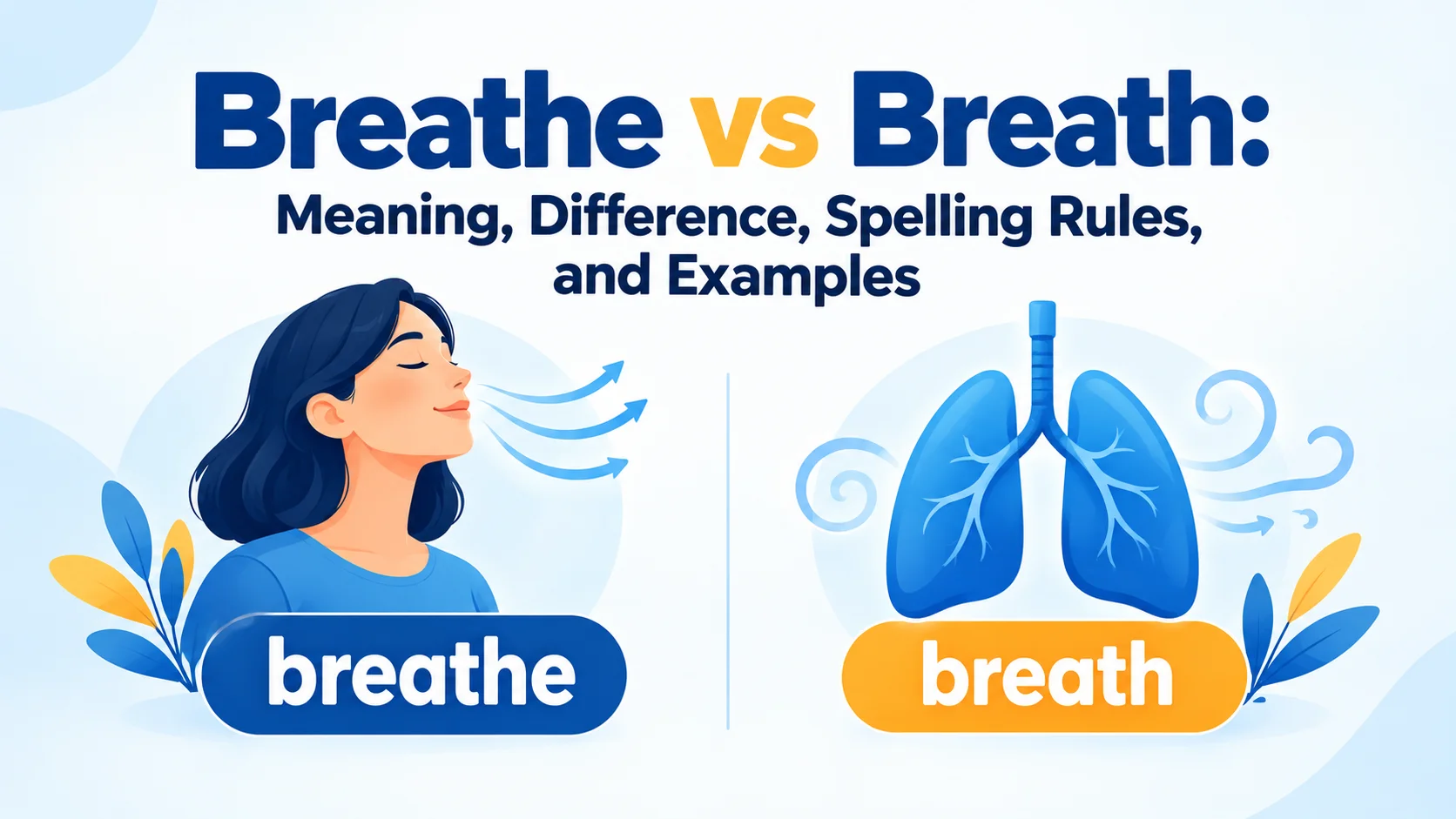
Breathe vs breath is a common English spelling confusion because the two words look almost identical and share a related meaning. However, they perform different grammatical jobs: breathe is a verb describing the action of taking air into and out of your lungs, while breath is a noun referring to the air you inhale or exhale. Choosing the correct word matters in school assignments, professional emails, creative writing, and everyday conversation. A single final letter can change how a sentence works, so understanding the distinction is more useful than simply memorizing two spellings.
The easiest way to recognize the difference is to ask yourself what your sentence needs. Are you describing an action, such as breathing slowly after exercise, or naming a thing, such as taking a deep breath before a presentation? The action requires breathe; the noun requires breath. Their pronunciations differ, too: breathe ends with a voiced “th” sound, while breath ends with an unvoiced “th” sound. Learning these grammatical and pronunciation clues together makes it easier to distinguish the words, even when you are writing quickly or proofreading a longer passage.
In this guide, you will learn the definitions, pronunciation differences, spelling patterns, verb forms, and practical uses of breathe and breath. You will also discover how the words appear in familiar expressions such as “take a deep breath,” “breathe a sigh of relief,” and “with bated breath.” Realistic example sentences, comparison tables, common-error corrections, and a short practice quiz will help you apply the rules confidently. By the end, you should be able to choose the right word based on its role in a sentence rather than relying on guesswork or autocorrect.
Breathe vs Breath: What Is the Difference?
The main difference is part of speech:
- Breathe is a verb. It means to take air into and release it from the lungs.
- Breath is a noun. It refers to the air taken in or released during breathing.
Compare these sentences:
- Please breathe slowly and relax.
- Take a deep breath before you begin.
In the first sentence, breathe describes an action. In the second, breath names something a person takes.
A useful memory trick is to notice the final e in breathe. The word with the extra letter is the verb, while the shorter spelling, breath, is the noun.
| Feature | Breathe | Breath |
| Part of speech | Verb | Noun |
| Basic meaning | To inhale and exhale | Air inhaled or exhaled |
| Typical question | What action is happening? | What thing is being referred to? |
| Pronunciation | /briːð/ — “breathe” | /brɛθ/ — “breath” |
| Final sound | Voiced “th” | Unvoiced “th” |
| Example | Try to breathe slowly. | Take a slow breath. |
| Related forms | Breathes, breathed, breathing | Breaths |
Quick rule: If the word describes what someone does, use breathe. If it names a single inhalation or exhalation, use breath.
What Does Breathe Mean?
Breathe is a verb meaning to draw air into the lungs and release it. It can describe ordinary respiration, deliberate breathing techniques, or the way someone responds to a physical or emotional situation.
The word also appears figuratively when writers describe relief, freedom, or the introduction of energy into something.
Examples of Breathe in Sentences
- Remember to breathe steadily while exercising.
- She stepped outside to breathe some fresh air.
- He could barely breathe after running up the stairs.
- The instructor told everyone to breathe slowly and relax.
- I can finally breathe more easily now that the deadline has passed.
- The new design helps the room breathe by allowing more natural light inside.
- Give the team some time to breathe between demanding projects.
These examples show that breathe does not always refer to a deliberate breathing exercise. It can describe a natural bodily function or express the idea of having space, relief, or room to develop.
Common Forms of Breathe
Like other regular English verbs, breathe changes form depending on tense and grammatical context.
| Verb form | When to use it | Example |
| Breathe | Base form or present tense with I, you, we, and they | I breathe deeply before a speech. |
| Breathes | Present tense with he, she, or it | She breathes slowly during meditation. |
| Breathed | Simple past and past participle | He breathed a sigh of relief. |
| Breathing | Present participle or gerund | Breathing calmly can help you focus. |
Breathe vs Breathes
Breathe is the base form, while breathes is the third-person singular form used with he, she, or it in the simple present tense.
- Correct: The baby breathes quietly.
- Correct: Babies breathe differently as they grow.
- Incorrect: The baby breathe quietly.
A quick way to check is to identify the subject. If it is a singular third-person subject in the simple present, the verb generally takes the -s ending.
Breathe vs Breathed
Breathed is the past tense and past participle of breathe. It is used when describing an action that happened earlier or when forming a perfect tense.
- She breathed deeply before answering.
- They have breathed cleaner air since the ventilation system was repaired.
- He had breathed a sigh of relief by the time the results arrived.
Notice that the spelling changes from breathe to breathed, not breath or breathed.
Breathe vs Breathing
Breathing is the -ing form of the verb. It can follow a helping verb or function as a noun-like gerund.
- She is breathing more comfortably now.
- Breathing through the nose may feel more comfortable for some people.
- Keep breathing normally while you complete the exercise.
The correct form depends on the sentence structure, not merely on whether the action is happening now.
What Does Breath Mean?
Breath is a noun referring to the air a person or animal inhales or exhales. It can describe one cycle or instance of breathing, the air leaving someone’s mouth, or a sensation associated with respiration.
It also appears in expressions involving anticipation, relief, and the temporary interruption of normal activity.
Examples of Breath in Sentences
- Take a deep breath before speaking.
- His breath was visible in the cold morning air.
- She held her breath while waiting for the announcement.
- The runner was out of breath after the race.
- I could feel a cool breath of wind from the open window.
- The audience listened with bated breath.
- He paused to catch his breath before continuing the climb.
In each sentence, breath names something rather than describing the action of breathing.
Singular and Plural Forms of Breath
The noun breath has a regular plural form: breaths.
Use breath when referring to one breath or when using it in an expression that takes the singular form. Use breaths when referring to multiple breaths.
| Form | Meaning | Example |
| Breath | One instance of breathing or the air exhaled | She took a deep breath. |
| Breaths | More than one instance | He took three slow breaths. |
| A breath of fresh air | A refreshing change or experience | Her new approach was a breath of fresh air. |
| Out of breath | Breathing hard after exertion | We were out of breath after the hike. |
| Under one’s breath | Quietly or almost inaudibly | He muttered the answer under his breath. |
Important: Breaths is a plural noun, not a verb. If you want to describe an action, choose the appropriate form of breathe.
Compare:
- The child takes several deep breaths.
- The child breathes deeply.
Both sentences are correct, but the grammatical roles differ. In the first, breaths names the things the child takes. In the second, breath describes what the child does.
Breathe vs Breath: Pronunciation Differences
The two words differ in both their vowel sounds and their final consonant sounds.
- Breathe: /briːð/ — rhymes with seethe.
- Breath: /brɛθ/ — rhymes with death.
The verb breathe has a long “ee” vowel sound, similar to the sound in green. The noun breath has a short “e” sound, as in bed.
Their final “th” sounds differ as well:
- In breathe, the final sound is voiced. Your vocal cords vibrate as you say it.
- In breath, the final sound is unvoiced. Your vocal cords do not vibrate in the same way.
A Simple Pronunciation Practice
Say these pairs aloud slowly:
- Breathe — breath
- Seethe — death
- Breathe deeply — take a deep breath
- She breathes slowly — she takes slow breaths
Pay attention to the vowel sound first, then the final consonant. Reading the words in complete phrases helps you connect pronunciation with grammar.
Pronunciation tip: Do not rely on the final “th” sound alone. The vowel difference is often the easier clue to hear, especially when comparing the words in isolation.
How to Remember Breathe vs Breath
If you regularly confuse the two spellings, use a short memory trick:
Take a breath, then breathe.
The shorter word, breath, names what you take. The longer word, breathe, describes the action you perform.
Another useful approach is to associate the final e in breathe with a verb. This is a memory aid rather than a universal spelling rule, so use it specifically for this word pair.
Use the Grammar Test
When you are unsure, examine how the word functions in your sentence.
Step 1: Identify the action.
Ask whether the sentence describes someone inhaling or exhaling.
- You should breathe slowly.
- The athlete breathes heavily.
Step 2: Identify the noun.
Ask whether the sentence refers to the air itself or a single instance of breathing.
- Take a breath.
- Her breath smelled of peppermint.
Step 3: Check the surrounding words.
Certain expressions commonly take the noun breath, including take a breath, hold your breath, and catch your breath. Sentences describing an action usually need a form of the verb breathe.
This method is more reliable than choosing a spelling based on which one looks familiar.
Common Expressions With Breathe and Breath
Both words appear in everyday English, idioms, and figurative writing. Learning these expressions helps you recognize the correct spelling in context.
Expressions With Breathe
Breathe a sigh of relief
This expression means to feel relieved after uncertainty or worry.
- We all breathed a sigh of relief when the missing documents were found.
Breathe life into something
This means to make something more lively, interesting, or successful.
- The redesign helped breathe life into the outdated website.
Breathe easy
This means to feel relieved or no longer worry about a particular problem.
- Once the repairs were complete, the homeowners could breathe easy.
Breathe down someone’s neck
This means to watch someone too closely or put pressure on them.
- The manager’s constant reminders made the employee feel as though someone were breathing down her neck.
Expressions With Breath
Take a deep breath
This means to inhale deeply, often to prepare for something or calm yourself.
- Take a deep breath before you start your presentation.
Hold your breath
This can mean to stop breathing briefly or to wait anxiously for an outcome.
- The students held their breath as the teacher announced the results.
Out of breath
This describes someone who is breathing hard, often after physical activity.
- I was out of breath after climbing the stairs.
Under your breath
This means speaking quietly enough that others may struggle to hear.
- She whispered the answer under her breath.
With bated breath
This means waiting with intense anticipation. The word is bated, meaning restrained or reduced—not baited.
- Fans waited with bated breath for the final score.
These expressions are worth learning as complete phrases. Memorizing their standard forms makes it easier to avoid spelling mistakes when writing quickly.
Breathe vs Breath: Common Mistakes to Avoid
Because the words look and sound similar, errors often occur when writers focus on pronunciation without checking grammar.
| Incorrect sentence | Correct sentence | Why? |
| Take a deep breathe. | Take a deep breath. | The sentence needs a noun after a deep. |
| I need to breath. | I need to breathe. | The infinitive to is followed by the base form of a verb. |
| She breath slowly. | She breathes slowly. | A third-person singular subject breathes in the simple present. |
| He was out of breathe. | He was out of breath. | Out of breath is the standard expression. |
| Try to breath calmly. | Try to breathe calmly. | Try to is followed by the base-form verb. |
| She took three breathes. | She took three breaths. | The plural noun is breaths, without the extra e. |
| He breath a sigh of relief. | He breathed a sigh of relief. | The sentence describes a completed action in the past. |
Mistake 1: Adding an Extra E to the Noun
A frequent error is writing breathe when the sentence needs breath.
Incorrect: “She took a breathe before answering.”
Correct: “She took a breath before answering.”
The article a is a useful clue. Here, the sentence needs a singular noun, so breath is correct.
Mistake 2: Leaving the E Out of the Verb
Writers sometimes use breath after to, as in “I want to breathe.”
Correct: “I want to breathe.”
In this construction, to introduce an infinitive, which requires the base form of the verb. The noun breath cannot perform that grammatical role.
Mistake 3: Confusing Breathes and Breaths
These words are especially easy to mix up because both refer to the same general concept.
- Breathes is a verb: “The child breathes quietly.”
- Breaths is a plural noun: “The child takes quiet breaths.”
Check the subject and the structure of the sentence. If you are describing what a person does, you probably need a verb. If you are counting instances of breathing, you need the plural noun.
Mistake 4: Trusting Spellcheck Without Reading the Sentence
Spellcheck may not catch a word-choice error when both spellings are legitimate English words. For example, “Take a deep breathe” contains a correctly spelled word in the wrong grammatical position.
When proofreading, read the entire sentence and ask whether the word acts as a noun or a verb. Context—not the spelling checker alone—determines the correct choice.
How to Use Breathe and Breath in Different Contexts
The right choice depends on what you want to communicate. The following scenarios demonstrate how the distinction works in everyday writing.
In Academic and Professional Writing
Use breathe when describing an action or process, and breath when referring to a measurable or countable instance of breathing.
- The patient was instructed to breathe normally during the examination.
- The exercise requires participants to take five slow breaths.
In technical or medical writing, be especially careful to distinguish ordinary language from precise clinical terminology. Follow the terminology and style required by your institution or publication.
In Creative Writing
Writers often use these words to communicate tension, relief, or atmosphere.
- Mara tried to breathe quietly as she waited outside the office.
- He released a long breath when the door finally opened.
- The quiet room seemed to breathe with the rhythm of the rain.
The first two examples use the words literally. The third uses breathe figuratively to make the room seem alive. The grammatical distinction remains the same even when the language is imaginative.
In Everyday Conversation
Common phrases often provide the clearest examples:
- “I can’t breathe in this stuffy room.”
- “Let me catch my breath.”
- “Just breathe and take your time.”
- “I need a minute to get my breath back.”
When writing dialogue, choose the word that fits the intended meaning. Informal language does not change the standard spelling distinction.
Practice Quiz: Breathe or Breath?
Test your understanding by selecting the correct word for each sentence. Try answering before checking the explanations.
- Take a deep ______ before you begin.
- Remember to ______ slowly during the exercise.
- He was out of ______ after running to catch the bus.
- The baby ______ quietly while sleeping.
- She ______ a sigh of relief when the interview ended.
- Take three slow ______ before responding.
- I need to ______ some fresh air.
- The audience waited with bated ______.
Answers and Explanations
- Breath — The sentence requires a noun after “a deep.”
- Breathe — The word follows “to” and describes an action.
- Breath — “Out of breath” is the standard expression.
- Breathes — The subject of the baby is singular, so the verb takes -s.
- Breathed — The completed action is in the past tense.
- Breaths — The number three calls for the plural noun.
- Breathe — The sentence needs a verb after “to.”
- Breath — The correct idiom is “with bated breath.”
If you missed any answers, return to the sentence and identify its grammatical structure. That habit will help you solve similar word-choice problems without memorizing every example.
Conclusion:
The difference between breathe vs breath becomes straightforward once you focus on grammar. Breathe describes an action, while breath names the air you inhale or exhale. Their related forms—breathes, breathed, breathing, and breaths—follow recognizable patterns that become easier to use with practice.One final actionable tip: When proofreading, replace the word temporarily with a clear verb such as inhale or a noun phrase such as a breath of air. If the sentence still makes sense, you can identify the grammatical role and choose the appropriate spelling.A common mistake to avoid is assuming that spellcheck will catch every error. Both words are correctly spelled English words, so the wrong choice may go unnoticed. Remember the simple phrase “Take a breath, then breathe,” and let the sentence’s meaning guide your decision. With that habit, you can write more accurately and confidently in academic, professional, and everyday situations.
FAQs
Q1. Is breathe a verb or a noun?
Breathe is a verb because it describes the action of inhaling and exhaling. For example, “Try to breathe slowly.” The noun form is breath, as in “Take a slow breath.” Identifying whether a sentence describes an action or names something usually resolves the confusion.
Q2. What is the past tense of breathe?
The past tense of breathe is breathed. For example, “She breathed deeply before answering the question.” Breathed is also the past participle, used with helping verbs in constructions such as “He has breathed more easily since the room was ventilated.”
Q3. Is it correct to say “take a breath”?
No. The correct expression is “take a breath” because the sentence needs a noun after the article a. Use breathe when describing the action instead: “Take a breath, then breathe slowly.” The difference comes from grammar, not personal writing preference.
Q4. What is the plural of breath?
The plural of breath is breaths. For example, “She took three deep breaths before the interview.” Do not write breaths when counting breaths; breathes is a verb form, as in “He breathes slowly.” The sentence structure determines which spelling belongs.
Q5. Why do breathe and breath sound different?
Breath has a long “ee” vowel and ends with a voiced “th” sound, while breath has a short “e” vowel and ends with an unvoiced “th” sound. Pronouncing the words aloud in phrases such as “breathe deeply” and “take a breath” helps reinforce the distinction.