

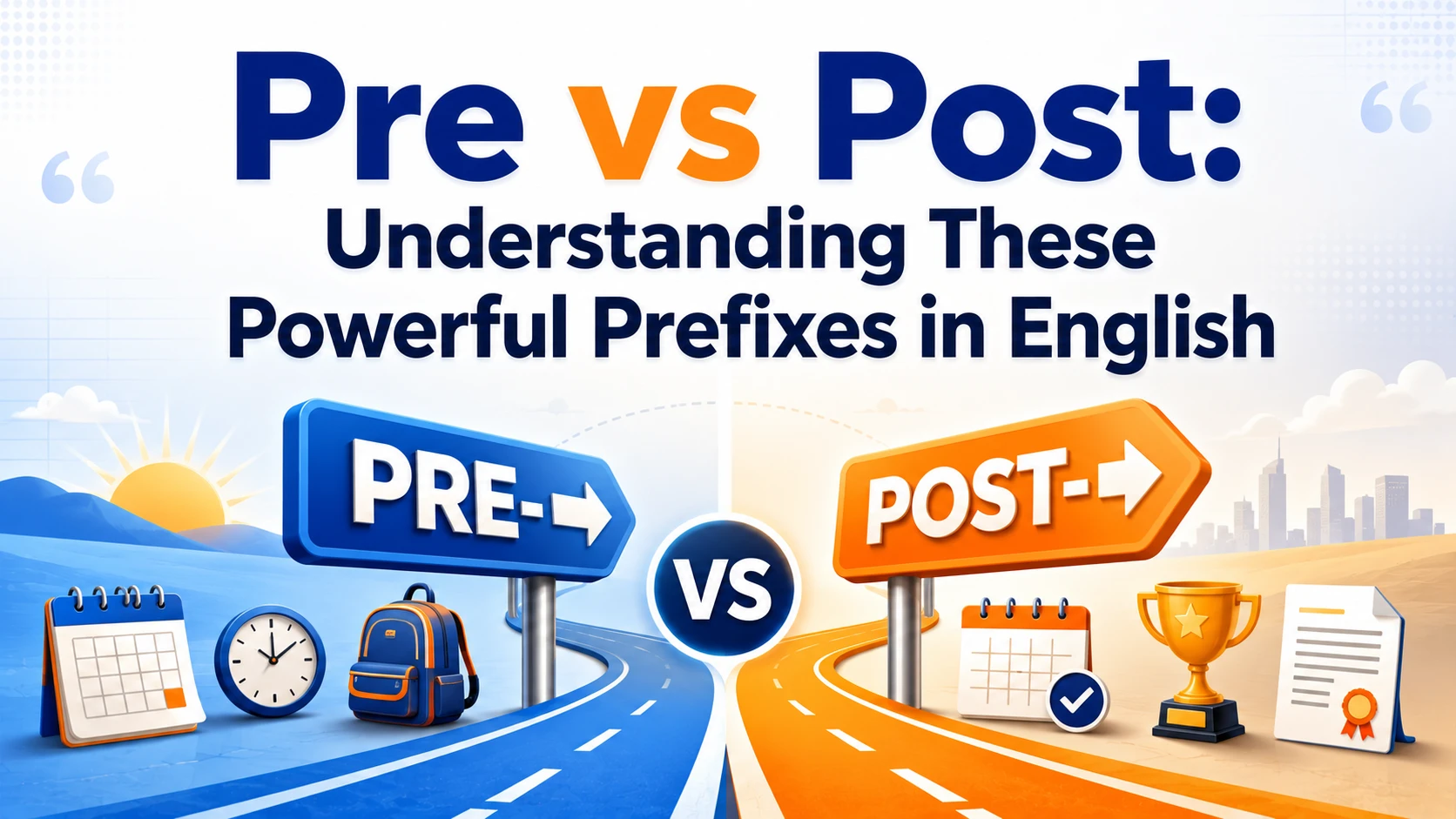
Pre vs post is one of the most fundamental concepts in English word formation, yet it’s also one of the most misunderstood. These two prefixes may seem small, but they completely change the meaning of the words they modify. Whether you’re reading a medical report, preparing an academic paper, following a fitness plan, or learning English, understanding when to use pre- and post- helps you communicate with greater accuracy and confidence. Since both prefixes relate to time, confusing them can alter the intended meaning of a sentence and lead to misunderstandings in both casual and professional communication.
Prefixes play an essential role in expanding English vocabulary because they add meaning to existing words instead of creating entirely new ones. Among the hundreds of prefixes used in English, pre- and post- are especially common because they appear across a wide range of subjects, including medicine, education, science, business, technology, sports, and everyday conversations. Rather than memorizing every word individually, understanding these prefixes allows you to recognize patterns and interpret unfamiliar vocabulary more easily.
This comprehensive guide explains the meanings of pre and post, explores their origins, demonstrates how they’re used in real-world situations, highlights common mistakes, and provides practical examples to help you master them. You’ll also learn when hyphens are appropriate, how these prefixes function in different industries, and simple techniques that make choosing the correct prefix effortless.
Pre vs Post at a Glance
If you’re looking for a quick answer, here’s the simplest way to understand these prefixes:
- Pre- means before an event, action, or point in time.
- Post- means after an event, action, or point in time.
The prefixes don’t change the core meaning of a word—they simply indicate when something happens.
The Quick Answer
Think of a timeline:
Pre → Main Event → Post
For example:
- Preheat means heating an oven before cooking.
- Postoperative refers to the period after surgery.
- Preseason occurs before a sports season begins.
- Postseason takes place after the regular season ends.
This simple timeline works for nearly every word containing these prefixes.
Pre vs Post Comparison Table
| Feature | Pre- | Post- |
| Meaning | Before | After |
| Indicates | Preparation or an earlier stage | Completion or a later stage |
| Position on a timeline | Before the main event | After the main event |
| Common examples | Prepay, Preview, Preschool | Postgraduate, Postwar, Posttest |
| Primary focus | Anticipation and preparation | Results, recovery, or continuation |
Quick Tip: Whenever you’re unsure, identify the main event first. If something happens beforehand, choose pre-. If it happens afterward, choose post-.
What Do the Prefixes “Pre-” and “Post-” Mean?
Although these prefixes are short, they carry significant meaning because they establish the timing of an action or event. Recognizing their meanings allows you to understand unfamiliar words without consulting a dictionary every time.
The Meaning of “Pre-“
The prefix pre- comes from Latin and means:
- Before
- Prior to
- Earlier than
- In advance
Whenever pre- appears, it signals that something happens before another event.
Common examples include:
- Preheat – heat before cooking.
- Preview – view before the official release.
- Prepay – pay in advance.
- Preschool – education before primary school.
- Preorder – order before a product becomes available.
Although these words belong to different fields, they all share the same underlying concept: something occurs first.
The Meaning of “Post-“
The prefix post- also comes from Latin and means:
- After
- Following
- Later than
- Subsequent to
Instead of preparation, post- indicates that an action or condition occurs after a significant event.
Examples include:
- Postgraduate – education after earning an undergraduate degree.
- Postoperative – occurring after surgery.
- Posttest – an assessment taken after instruction.
- Postwar – relating to the period following a war.
- Postscript (P.S.) – additional writing added after the main message.
The timing changes, but the principle remains the same: the event has already happened.
Why Prefixes Matter in English
Understanding prefixes is one of the fastest ways to improve vocabulary because it helps you recognize meaning instead of memorizing individual words.
For example, if you already know that pre- means “before,” you can often infer the meaning of unfamiliar words like:
- Preauthorize
- Preexisting
- Prearrange
- Precaution
- Precondition
Similarly, recognizing post- helps you understand words such as:
- Postproduction
- Postnatal
- Postdoctoral
- Postmortem
- Postlaunch
Learning prefixes develops stronger reading comprehension, improves spelling, and makes it easier to interpret technical language across multiple disciplines.
Pre vs Post: What’s the Difference?
The difference between pre and post isn’t about spelling or pronunciation—it’s entirely about timing.
Think of every event as having three stages:
- Before it happens
- While it happens
- After it happens
Pre- belongs to the first stage.
Post- belongs to the third stage.
The event itself serves as the reference point.
Meaning Comparison
Suppose the event is an exam.
- Pretest preparation happens before the exam.
- Posttest analysis happens after the exam.
Now consider surgery.
- Preoperative instructions prepare the patient beforehand.
- Postoperative care focuses on recovery afterward.
The root word stays connected to the same event, but the prefix changes when the action takes place.
Timeline Visualization
Before Event Main Event After Event
PRE ─────────────► ● ◄──────────── POST
This mental timeline works in medicine, education, business, sports, science, and everyday communication.
Side-by-Side Comparison
| Situation | Pre- | Post- |
| School | Preschool | Postgraduate |
| Testing | Pretest | Posttest |
| Medicine | Prenatal | Postnatal |
| Sports | Preseason | Postseason |
| Cooking | Preheat | (No common postheat equivalent) |
| Film | Preproduction | Postproduction |
Notice that not every word naturally has both versions. English only forms pre- and post- compounds when they create a meaningful distinction.
How to Use “Pre-” Correctly
The prefix pre- is used whenever something takes place before an important event, process, or deadline. It often signals preparation, planning, prevention, or anticipation.
When “Pre-” Is the Right Choice
Use pre- when referring to:
- Preparation before an activity
- Actions completed in advance
- Conditions that already existed
- Early stages of a process
- Events leading up to another event
For example:
- Preheat the oven before baking.
- Please prepay for your reservation.
- The doctor reviewed the patient’s preexisting condition.
- We scheduled a prelaunch meeting to finalize the product details.
Understanding this pattern helps you choose the correct prefix naturally instead of relying on memorization.
Common Words That Begin with “Pre-“
Education
- Preschool
- Pretest
- Prereading
Business
- Preapprove
- Preorder
- Prepayment
Medicine
- Prenatal
- Preoperative
- Preexisting
Technology
- Preinstall
- Preconfigured
- Preloaded
Each of these words shares the same core idea: something happens before the main event.
Example Sentences Using “Pre-“
- The chef always preheats the oven before baking bread.
- Students completed a pretest before starting the course.
- Customers who preordered the phone received it on launch day.
- The company held a prelaunch meeting to discuss its marketing strategy.
How to Use “Post-” Correctly
While pre- prepares you for what comes next, post- focuses on what happens after an event has already taken place. This prefix is commonly used to describe results, recovery, follow-up actions, evaluation, or later stages of a process. From healthcare and education to business and technology, post- helps place events on a timeline and provides important context.
When “Post-” Is the Right Choice
Use post- whenever you’re referring to:
- Events that occur after something else
- Recovery or follow-up periods
- Evaluations completed after an activity
- Historical periods following major events
- Later stages of a project or process
For example:
- Patients receive postoperative care after surgery.
- Researchers conduct a posttest after an experiment.
- Businesses review post-launch performance after releasing a product.
- Historians study the postwar economy.
Whenever the action happens after the main event, post- is the appropriate prefix.
Common Words That Begin with “Post-“
Education
- Postgraduate
- Posttest
- Postsecondary
Medicine
- Postoperative
- Postnatal
- Postmortem
Business
- Post-launch
- Post-sale
- Postproduction
History and Society
- Postwar
- Postcolonial
- Postindustrial
Although these words belong to different disciplines, they all describe what follows another event.
Example Sentences Using “Post-“
- Nurses monitored the patient during the postoperative recovery period.
- Students completed a posttest to measure their progress.
- The marketing team reviewed post-launch customer feedback.
- Many cities experienced rapid growth during the postwar era.
Pre vs Post in Everyday Life
You don’t need to be studying grammar to encounter pre- and post-. These prefixes appear in everyday conversations, workplace discussions, news articles, and technical documents. Recognizing them helps you understand information more quickly and accurately.
Education and Learning
Schools and universities frequently use these prefixes to describe activities before and after instruction.
Examples include:
- Pretest
- Posttest
- Preschool
- Postgraduate
- Postsecondary education
A teacher may give a pretest before a lesson to assess existing knowledge and a posttest afterward to evaluate what students have learned.
Healthcare and Medicine
Medicine relies heavily on pre- and post- because patient care often follows a structured timeline.
Common examples include:
- Prenatal care
- Preoperative instructions
- Postoperative recovery
- Postnatal care
- Postmortem examination
Each term immediately tells healthcare professionals when something occurs in relation to treatment or a medical event.
Business and Marketing
Businesses also organize projects using before-and-after stages.
Examples include:
- Prelaunch planning
- Preapproval
- Preorder campaigns
- Post-launch analysis
- Post-sale support
A successful product launch doesn’t end when customers make a purchase. Companies often spend weeks analyzing post-launch performance to improve future releases.
Research and Scientific Studies
Researchers frequently compare measurements taken before and after an intervention.
Examples:
- Pretest scores
- Posttest scores
- Pre-intervention data
- Post-intervention analysis
These comparisons help determine whether a treatment, teaching method, or policy has produced meaningful results.
Technology and Software
Technology professionals use these prefixes throughout software development and IT management.
Examples include:
- Preinstallation checks
- Preconfigured systems
- Post-installation setup
- Post-update testing
- Post-deployment monitoring
These stages help reduce errors and ensure systems function correctly before and after implementation.
Social Media and Online Communication
Even social media includes familiar examples.
For instance:
- A pre-launch teaser builds anticipation before a product release.
- A post-event recap summarizes what happened after a conference or webinar.
The prefixes help audiences understand exactly where they are in the timeline.
Should “Pre” and “Post” Be Hyphenated?
One question that frequently confuses writers is whether pre- and post- should always include a hyphen.
The answer is no.
Modern English generally prefers writing many common pre- and post- words as single words. However, certain situations still call for a hyphen to improve readability or prevent confusion.
Words Commonly Written Without a Hyphen
Many established words no longer require a hyphen.
Examples include:
- Preheat
- Preschool
- Preview
- Prepaid
- Postgraduate
- Postwar
- Posttest
- Postscript
These spellings are widely accepted in dictionaries and formal writing.
When a Hyphen Improves Clarity
A hyphen may be appropriate when:
- The root word begins with a capital letter.
- The combination could be confusing without separation.
- A publication’s style guide recommends it.
Examples include:
- Pre-World War II
- Post-2020 trends
- Post-COVID recovery
- Pre-employment screening
In these cases, the hyphen makes the phrase easier to read.
Style Guide Differences
Different editorial style guides occasionally treat prefixes differently.
| Style Guide | General Approach |
| AP Style | Usually omits hyphens unless needed for clarity |
| Chicago Manual of Style | Favors closed compounds once they’re well established |
| APA Style | Uses hyphens selectively to avoid ambiguity |
If you’re writing for a publisher, academic institution, or employer, always follow the required style guide.
Expert Tip: When in doubt, check a current dictionary first. Most modern dictionaries list the preferred spelling of established pre- and post- words.
Common Word Pairs That Use Pre and Post
Some of the clearest examples of these prefixes appear in word pairs. Looking at both versions together makes their meanings easier to understand.
Pretest vs Posttest
A pretest measures knowledge before instruction begins.
A posttest measures what learners know after completing instruction.
Teachers compare the two to evaluate learning progress.
Prenatal vs Postnatal
These medical terms describe different stages surrounding childbirth.
- Prenatal refers to the period before birth.
- Postnatal refers to the period after birth.
Both are essential aspects of maternal and infant healthcare.
Preproduction vs Postproduction
Film, television, and media projects involve multiple stages.
Preproduction includes:
- Scriptwriting
- Casting
- Budget planning
- Scheduling
Postproduction includes:
- Video editing
- Sound design
- Visual effects
- Color correction
Neither stage is more important—they simply occur at different points in the production timeline.
Preworkout vs Postworkout
Fitness enthusiasts often discuss nutrition around exercise.
- Preworkout nutrition provides energy before training.
- Postworkout nutrition supports recovery afterward.
The best choice depends on the body’s needs at each stage.
Preseason vs Postseason
Sports leagues divide their schedules into distinct phases.
| Phase | Purpose |
| Preseason | Preparation and practice before official competition |
| Regular Season | Scheduled competitive games |
| Postseason | Playoffs and championship competitions after the regular season |
Recognizing these stages makes sports reporting and discussions much easier to follow.
Common Mistakes When Using Pre and Post
Most mistakes involving pre- and post- aren’t grammar problems—they’re context problems. Writers often understand that one means “before” and the other means “after,” yet still choose the wrong prefix because they haven’t identified the main event. Learning these common errors will help you use both prefixes naturally and accurately.
Choosing the Wrong Prefix
The most frequent mistake is selecting a prefix based on guesswork instead of the timeline.
For example:
❌ The doctor discussed postoperative instructions before the surgery.
✅ The doctor discussed preoperative instructions before the surgery.
Similarly:
❌ Students completed a posttest before the lesson began.
✅ Students completed a pretest before the lesson began.
Always ask yourself: What is the reference event? Once you’ve identified it, the correct prefix usually becomes obvious.
Forgetting the Time Relationship
Many learners focus on the object instead of the sequence of events.
Consider these examples:
- Prelaunch meeting → held before releasing a product.
- Post-launch review → conducted after the product is released.
The subject remains the same, but the timeline changes.
Incorrect Hyphenation
Another common mistake is adding hyphens everywhere or removing them when they’re needed.
Incorrect:
- Pre-school (in most modern contexts)
- Post graduate
- Pre existing
Preferred modern forms:
- Preschool
- Postgraduate
- Preexisting
However, a hyphen is still appropriate in certain situations, such as:
- Pre-World War II
- Post-COVID recovery
- Pre-election survey
Checking a reliable dictionary or following your required style guide is the safest approach.
Assuming Every Word Can Take Either Prefix
Not every English word naturally forms both pre- and post- versions.
For example:
- Preview is common.
- Postview is not.
Likewise:
- Postmortem is a standard medical term.
- Premortem exists in some specialized fields, such as business risk analysis, but it’s far less common and depends on context.
Understanding established usage is just as important as knowing the meanings of the prefixes.
Expert Tip: Prefixes create meaningful words only when the resulting term is recognized and widely accepted in English.
How to Choose Between Pre and Post Every Time
Instead of memorizing hundreds of vocabulary words, follow a simple decision-making process. Professional editors and technical writers often rely on context rather than memory, and you can do the same.
Ask the “Before or After?” Question
Start with the simplest question:
Does this happen before or after the main event?
If it’s before, choose pre-.
If it’s after, choose post-.
This approach works in almost every situation.
Identify the Main Event
Sometimes the event isn’t immediately obvious.
For example:
Postgraduate
What is the reference event?
The completion of an undergraduate degree.
Everything after that point is considered postgraduate.
Breaking words into timelines makes them easier to understand.
Check Whether the Word Already Exists
English doesn’t automatically create opposite versions of every word.
Before using an unfamiliar combination:
- Check the current dictionary.
- Confirm the spelling.
- Verify that it’s commonly used.
This prevents awkward constructions that sound logical but aren’t standard English.
Use a Timeline as a Final Check
If you’re still uncertain, draw a simple mental timeline.
Preparation → Main Event → Follow-Up
PRE ● POST
Visualizing the sequence often resolves confusion immediately.
Real-World Examples of Pre vs Post in Context
Understanding prefixes becomes much easier when you see them applied in realistic situations.
Medical Appointment Timeline
Imagine a patient scheduled for surgery.
Before the operation, the hospital provides:
- Preoperative instructions
- Pre-admission testing
- Pre-surgery consultations
After surgery, attention shifts to:
- Postoperative care
- Post-surgery medication
- Postoperative rehabilitation
The patient’s needs change, and the prefixes reflect each stage of the medical journey.
Product Launch Timeline
Businesses also organize projects around clear before-and-after phases.
Before launch
- Prelaunch marketing
- Preorders
- Pre-release testing
- Prelaunch meetings
After launch
- Post-launch customer support
- Post-launch updates
- Post-launch performance analysis
- Post-launch surveys
Separating these stages helps teams manage projects more effectively.
Academic Assessment Timeline
Schools frequently use both prefixes during evaluations.
| Stage | Example |
| Before instruction | Pretest |
| During instruction | Lessons and activities |
| After instruction | Posttest |
Comparing pretest and posttest results allows educators to measure learning progress and adjust teaching strategies when necessary.
Fitness Training Schedule
Athletes often structure their routines around pre- and post-workout activities.
Pre-workout
- Warm-up exercises
- Hydration
- Light nutrition
- Mental preparation
Post-workout
- Stretching
- Recovery nutrition
- Rehydration
- Muscle recovery
Each stage serves a different purpose, but together they contribute to better performance and reduced injury risk.
Film and Video Production Workflow
The entertainment industry provides another clear example.
| Production Stage | Typical Activities |
| Preproduction | Planning, casting, budgeting, scheduling |
| Production | Filming |
| Postproduction | Editing, sound mixing, visual effects, color grading |
Professionals rarely confuse these terms because every stage has distinct objectives and responsibilities.
Related Prefixes You Should Know
Once you’ve mastered pre- and post-, it’s helpful to recognize other prefixes that express time or sequence. Understanding their differences expands your vocabulary and reduces confusion.
Pre vs Pro
Although they look similar, these prefixes have different meanings.
- Pre- means before.
- Pro- often means supporting, in favor of, or forward.
Examples:
- Prepayment
- Preschool
- Proactive
- Prodemocracy
The prefixes are unrelated despite their similar appearance.
Pre vs Peri
These prefixes are especially important in medicine.
- Pre- means before.
- Peri- means around or surrounding.
Examples:
- Prenatal
- Perinatal
- Perimeter
- Pericardium
Confusing these prefixes can change the meaning of medical terminology.
Post vs After
In many situations, post- and after express similar ideas.
Compare:
- Postoperative care
- Care after surgery
Both communicate the same timeline, but post- creates a more concise and formal expression that’s widely used in technical writing.
Other Time-Related Prefixes
As your vocabulary grows, you’ll encounter additional prefixes that describe timing or sequence.
Examples include:
- Ante- (before)
- Neo- (new)
- Re- (again)
- Ex- (former)
- Mid- (middle)
Recognizing these patterns makes unfamiliar words easier to interpret.
Expert Tips for Mastering English Prefixes
Learning prefixes is one of the most efficient ways to improve both vocabulary and reading comprehension.
Learn Prefixes Instead of Individual Words
Instead of memorizing hundreds of unrelated words, focus on understanding the meaning of common prefixes.
Once you know what pre- means, you’ll recognize dozens of new words without additional study.
Recognize Word Families
Many words belong to the same family.
For example:
- Preheat
- Prepaid
- Preplanned
- Preapproved
Their shared prefix provides an immediate clue about meaning.
Read Across Different Subjects
Medicine, business, science, journalism, and technology all use prefixes extensively.
Reading from multiple fields helps reinforce vocabulary through repeated exposure in different contexts.
Practice Using Real Examples
Create your own sentences using new vocabulary.
For instance:
- We completed a preflight inspection before takeoff.
- Engineers conducted a post-implementation review after deploying the software.
Writing original examples strengthens long-term retention far more effectively than memorization alone.
Conclusion
Understanding pre vs post isn’t about memorizing long vocabulary lists—it’s about recognizing how English expresses time and sequence. Once you identify the main event, choosing the correct prefix becomes straightforward: pre- points to what happens beforehand, while post- describes what follows. This simple principle applies across medicine, education, business, technology, sports, and everyday communication, making these prefixes some of the most practical building blocks in English. One final actionable tip: whenever you encounter an unfamiliar word, separate the prefix from the root and ask whether the action occurs before or after the key event. A common mistake to avoid is assuming every word can naturally take both prefixes. Many cannot. Learning established usage alongside the meanings of pre- and post- will help you write more accurately, expand your vocabulary, and communicate with greater confidence.
FAQs
Q1. Is “pre” always used to mean “before”?
Yes. In standard English, pre- consistently indicates that something happens before another event or point in time. The specific context may vary, but the underlying meaning remains the same.
Q2. Does “post” always mean “after”?
In almost every modern English context, post- means after or following an event. It commonly appears in medicine, education, history, business, and technical writing to indicate a later stage.
Q3. Should I write “pretest” or “pre-test”?
Most modern dictionaries prefer pretest as one word. However, some organizations or style guides may use pre-test for clarity. When writing professionally, follow the style guide required by your employer, publisher, or institution.
Q4. Can every word have both a pre and post version?
No. Some words naturally pair with both prefixes, such as pretest and posttest, while others exist only in one established form. Always confirm that a word is recognized rather than assuming both versions are standard.
Q5. Why are “pre” and “post” so common in technical writing?
Technical fields value precision and efficiency. Prefixes like pre- and post- communicate timing in a single word, making medical reports, research papers, engineering documents, and business communications more concise and easier to understand.