
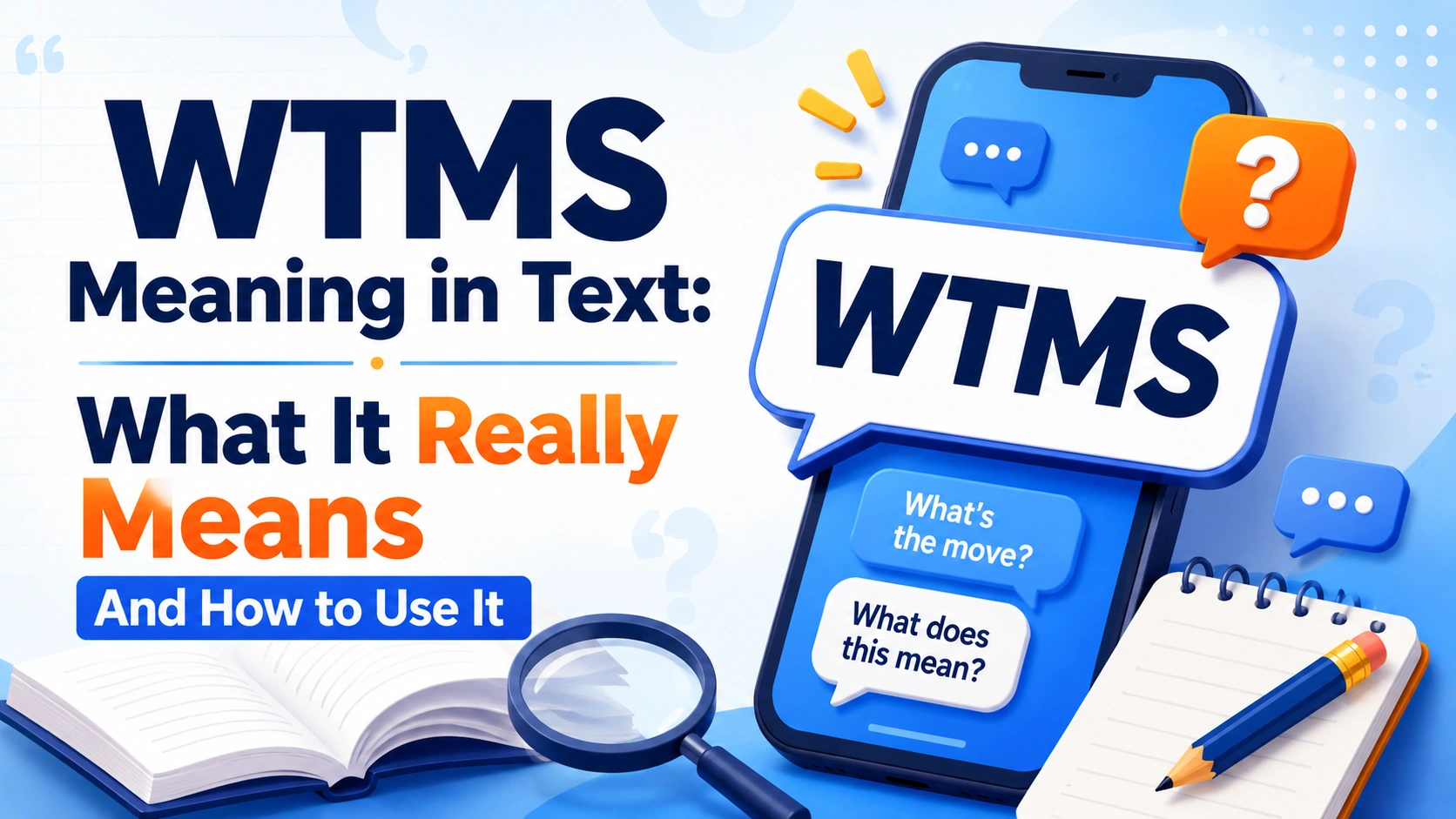
WTMS meaning in text is usually connected with the casual phrase “What’s the move?”—a shorthand way of asking what the plan is, what is happening next, or what someone wants to do. However, WTMS is not a standardized abbreviation with one universally recognized definition, so context matters. Online sources also document competing interpretations, which is one reason the acronym can be confusing.
If someone sends “WTMS tonight?”, they are most likely asking about plans: What are we doing tonight? If the surrounding conversation is about something unclear, however, a similar-looking abbreviation may be intended differently. This guide explains the strongest modern interpretation, shows how the phrase works in real conversations, compares it with related slang such as WTM, WYD, WYA, and LMK, and explains when it is better to use plain English.
Understanding WTMS is less about memorizing four letters and more about reading the situation around them. You will learn how tone, punctuation, relationship, and conversation topics can change the way an abbreviation is understood, how to respond naturally, and why copying slang from social media without understanding its context can sometimes create awkward messages.
Quick Answer: What Does WTMS Mean in Text?
In current informal texting usage, WTMS is commonly used for “What’s the move?” It is essentially asking:
- What’s the plan?
- What are we doing?
- What’s happening next?
- Where are we going?
- What should we do?
The phrase “what’s the move?” itself is older than the acronym. In informal speech, “the move” can mean the next plan or action. Slang references document this use as a way of asking what someone is doing next or what the group should do.
WTMS at a glance
| Question | Answer |
| Most likely meaning | “What’s the move?” |
| Basic idea | Asking about the plan or next activity |
| Tone | Casual, relaxed, conversational |
| Typical setting | Friends, group chats, DMs, informal social media |
| Formal? | No |
| Always one fixed meaning? | No |
| Best way to interpret it | Check the surrounding conversation |
Quick tip: If WTMS appears alongside a time, day, event, or invitation—such as “WTMS Friday?”—the “What’s the move?” interpretation is especially natural.
What Does WTMS Stand For?
The most useful way to understand WTMS is to separate the acronym from the underlying phrase.
WTMS → “What’s the move?”
Here, “move” does not necessarily mean physically moving somewhere. In casual speech, “the move” can mean the plan, decision, activity, or next step.
For example:
“We finished the movie. WTMS?”
The sender is not asking whether somebody should literally move. They are asking something closer to:
“What should we do now?”
That distinction is important because a literal reading of “move” can make the expression seem strange.
Why does “the move” mean “the plan”?
Informal English often turns ordinary nouns into broader expressions. In “What’s the move?”, move refers metaphorically to the next action. Slang references describe the phrase as asking what is happening next, what the plan is, or what someone intends to do.
So these sentences can communicate nearly the same idea:
- What’s the plan?
- What are we doing?
- What should we do next?
- What’s the move?
- WTMS?
The difference is mainly register and style. WTMS is much more informal than the first three options.
WTMS Meaning Depends on Context
This is where many explanations of texting slang become too simplistic.
An acronym does not carry tone independently. The surrounding message supplies much of the meaning.
Consider:
“We’re free after 7. WTMS?”
That strongly suggests planning.
Now compare:
“You said the schedule changed. WTMS?”
That message is less clear. The sender may be asking what the new plan is, but they could also be using a different interpretation of the abbreviation. In that situation, context—not the letters alone—should guide your interpretation.
Four clues that help decode WTMS
1. Look at the topic
If the conversation is about:
- weekend plans,
- going somewhere,
- meeting friends,
- an event,
- food,
- entertainment,
- what to do next,
then “What’s the move?” is a strong interpretation.
2. Look at the words around it
Compare:
“WTMS tonight?”
with:
“WTMS after the game?”
Both naturally suggest a plan.
3. Check the punctuation
- “WTMS?” looks like a direct question.
- “WTMS 😂” may feel more playful.
- “WTMS??” can communicate greater urgency, surprise, or excitement.
Punctuation does not create a new dictionary definition, but it can change the social tone.
4. Consider who sent it
A close friend can use slang that would sound unusual coming from a teacher, manager, customer, or unfamiliar person.
That is why understanding slang requires both linguistic context and social context.
How People Actually Use WTMS in Text Conversations
WTMS is most useful when the sender wants to move a conversation from “What’s happening?” toward “What are we going to do?”
Making plans
A: “I’m free after 6.”
B: “WTMS?”
Meaning: What should we do?
Asking about a group plan
A: “Everyone’s free Saturday.”
B: “WTMS?”
Meaning: So what’s the plan for Saturday?
Suggesting that someone decide
A: “I don’t care where we go.”
B: “WTMS then?”
Meaning: Okay, what should we choose?
Asking what happens next
A: “The event ends at 9.”
B: “WTMS after?”
Meaning: What are we doing afterward?
Responding to boredom
A: “I’m bored.”
B: “WTMS?”
Meaning: What do you want to do?
The important point is that WTMS usually opens the door to a plan. It does not necessarily contain a plan itself.
WTMS Examples by Tone
The same abbreviation can feel different depending on how it is written.
| Message | Likely tone | What it communicates |
| WTMS? | Neutral/casual | What’s the plan? |
| WTMS tonight? | Direct | What are we doing tonight? |
| WTMS 👀 | Playful/curious | So… what’s happening? |
| WTMS 😂 | Lighthearted | What should we do? |
| WTMS after class? | Practical | What are we doing afterward? |
| WTMS then? | Decision-oriented | What’s the next step? |
| WTMS this weekend? | Social | What are the weekend plans? |
Does WTMS sound flirty?
Not by itself.
Someone might use WTMS while talking to a person they like, but the abbreviation itself generally communicates planning or asking about the next move, not romance.
For example:
“WTMS after school?”
could simply mean:
“What are you doing after school?”
The relationship and surrounding conversation determine whether anything more is intended.
Expert recommendation: Don’t assign romantic meaning to ordinary slang without additional evidence from the conversation.
WTMS on Snapchat, TikTok, Instagram, and Other Platforms
- WTMS can be understood similarly across informal digital communication because its basic purpose does not depend on one particular app.
WTMS on Snapchat
In a casual Snapchat conversation, WTMS can naturally appear when friends are deciding what to do.
“Everyone’s free tonight, WTMS?”
The expected answer could be a place, activity, or suggestion.
WTMS on TikTok
A TikTok comment or DM may use WTMS in response to content that prompts people to make plans.
For example:
“Who’s free this weekend? WTMS?”
The phrase still points toward what the group should do next.
WTMS on Instagram
Instagram DMs and story replies often use conversational shorthand.
“You’re downtown? WTMS?”
Depending on the conversation, this can mean something like:
“What’s the plan?”
WTMS in WhatsApp or ordinary texting
Group chats are particularly suited to this kind of abbreviation because several people may be coordinating the same activity.
“Saturday is open for everyone. WTMS?”
A reply might be:
“Food first, then a movie?”
WTMS on Discord or online communities
The phrase can also fit informal online groups when people are deciding what to do next.
However, not every appearance of WTMS on every platform automatically means the same thing. There is no platform-wide rule that assigns one official definition to the acronym.
WTMS vs. WTM: What’s the Difference?
This is one of the most important distinctions to understand.
WTM is a well-established abbreviation for “What’s the move?” in texting and social media. Slang references also list other meanings for WTM, including “What’s the matter?” and “Whatever that means.”
WTMS is less standardized.
That means you should not automatically assume the final S has one universally accepted expansion.
Why the confusion happens
Internet slang is not regulated like standard vocabulary. People can create abbreviations within friend groups, fandoms, gaming communities, or social circles. A form that makes perfect sense to one group may be unfamiliar to another.
That is why some online sources give WTMS meanings such as:
- “What’s the move?”
- “What’s the move, sis?”
- clarification-related expansions,
- or other niche interpretations.
These should not all be treated as equally established.
For example, some recent slang pages explicitly define WTMS as “What’s the move?”, while others provide entirely different expansions.
Best practice: When an acronym is not standardized, distinguish between a common interpretation and a possible niche interpretation. Do not present every internet-generated expansion as an established definition.
WTMS vs. Similar Texting Slang
WTMS belongs to a larger family of short, informal expressions used to keep conversations moving.
| Slang | Common meaning | Main purpose |
| WTMS | “What’s the move?” in common current usage | Ask about the plan/next activity |
| WTM | “What’s the move?” among other possible meanings | Ask about plans |
| WYD | “What are you doing?” | Ask about someone’s current activity |
| WYA | “Where are you at?” | Ask someone’s location |
| WSP | “What’s up?” | Greeting/check-in |
| LMK | “Let me know” | Request information later |
| HMU | “Hit me up” | Ask someone to contact you |
These expressions overlap, but they are not interchangeable.
WTMS vs. WYD
WYD asks what someone is doing.
“WYD?”
WTMS asks what the plan or next move is.
“WTMS?”
Someone could answer both with the same information, but the questions are slightly different.
WTMS vs. WYA
WYA focuses on location.
“WYA?”
WTMS focuses on plans.
“WTMS?”
A person could be at home and still have an interesting answer to WTMS.
WTMS vs. WTM
These are much closer.
WTM is commonly documented as “What’s the move?”, while WTMS appears to be a less standardized extension or variant in online use.
If someone uses WTMS and you are unsure why they added the S, the safest approach is to read the entire conversation rather than inventing a precise expansion.
When Should You Use WTMS?
WTMS works best when speed, familiarity, and informality are more important than maximum clarity.
Good situations
Use it when:
- chatting casually with friends,
- talking in an informal group chat,
- discussing weekend plans,
- deciding what to do next,
- responding to a friend’s invitation,
- communicating with people who already understand the slang.
Example
“We’re all free after dinner. WTMS?”
That sounds natural in an informal conversation.
Why it works
The abbreviation is efficient. It communicates a fairly broad question without requiring a full sentence.
Instead of:
“What do you think we should do after dinner?”
someone can simply write:
“WTMS?”
The trade-off is obvious: shorter does not always mean clearer.
When Should You Avoid WTMS?
Avoid it whenever the reader could reasonably misunderstand the message or when the situation calls for polished language.
Professional emails
Instead of:
“WTMS for the meeting?”
write:
“What should we do about the meeting?”
Formal school communication
Instead of:
“WTMS?”
write:
“Could you clarify what you mean?”
Messages to unfamiliar people
If you do not know whether the other person understands the abbreviation, plain English is safer.
Important conversations
When accuracy matters, avoid unnecessary shorthand.
A useful rule is:
The more important the message, the less you should rely on ambiguous slang.
That principle applies far beyond WTMS.
How to Reply When Someone Says WTMS
If WTMS means “What’s the move?”, the easiest response is to give a plan or suggest one.
If you already have a plan
“Let’s grab food around 7.”
If you want to suggest something
“Movie tonight?”
If you’re undecided
“Not sure yet. What are you thinking?”
If you want them to decide
“Your call 😂”
If you don’t want to make plans
“I’m probably staying home tonight.”
The best reply depends on whether the sender is asking for information, inviting you somewhere, or simply opening a conversation.
How to Decode WTMS When the Meaning Is Unclear
Use this simple decision process.
| Question | If yes | What to consider |
| Is the conversation about plans? | Strong clue | “What’s the move?” is likely |
| Is a time/date mentioned? | Strong clue | Probably asking about an activity |
| Is the person asking what happens next? | Strong clue | Planning interpretation fits |
| Is the message about an unclear statement? | Possible ambiguity | Ask for clarification if needed |
| Does the sender use unusual slang frequently? | Context matters | Their personal usage may differ |
| Does the abbreviation still make no sense? | Don’t guess | Ask what they mean |
The safest clarification
If you genuinely cannot tell, simply ask:
“What do you mean by WTMS?”
There is nothing awkward about that. Digital slang is informal and inconsistent by nature.
Common Misunderstandings About WTMS
Misconception 1: WTMS has one official definition
It does not. Informal texting acronyms are not standardized in the same way as conventional vocabulary.
Misconception 2: WTMS always means “What’s the move?”
That is the most useful current interpretation for casual planning contexts, but online sources document conflicting expansions.
Misconception 3: The S must always represent the same word
Not necessarily. Users sometimes extend acronyms creatively, especially in informal communities.
Misconception 4: WTMS automatically means someone wants to meet you
Not necessarily.
It can simply mean:
“What’s the plan?”
The sender may be asking about a group activity rather than inviting you personally.
Misconception 5: Slang is always appropriate if it is popular online
Popularity does not equal suitability. Audience and purpose still matter.
Why Texting Slang Can Be Hard to Interpret
Text removes many signals available in face-to-face conversation.
When someone speaks, you can hear:
- emphasis,
- hesitation,
- sarcasm,
- excitement,
- concern,
- humor.
A four-letter message cannot communicate all of those things directly.
That is why punctuation, emojis, surrounding words, and conversation history become useful clues.
Consider:
“WTMS?”
versus:
“WTMS 😂”
versus:
“WTMS??”
The core question may remain the same, but the emotional presentation changes.
This is one reason experienced texters rarely interpret slang in isolation. They read the whole conversational exchange.
Is WTMS Professional?
Generally, no.
WTMS belongs to informal digital communication. Even when a colleague understands it, using slang in a professional message can make your writing feel unnecessarily casual.
Better professional alternatives
| Informal WTMS-style message | Clearer professional alternative |
| “WTMS for tomorrow?” | “What is the plan for tomorrow?” |
| “WTMS?” | “What should we do next?” |
| “WTMS about the meeting?” | “What should we do about the meeting?” |
| “WTMS after the call?” | “What are the next steps after the call?” |
The professional alternative is not necessarily longer by much, but it removes ambiguity.
Why “What’s the Move?” Became Useful Slang
The phrase works because it compresses several questions into one.
When someone says “What’s the move?”, they may be asking:
- What are we doing?
- Where are we going?
- Who is coming?
- What happens next?
- Has anyone made a decision?
- Is there a plan?
That flexibility makes the phrase useful in social conversation.
The underlying expression has also existed in informal speech before its acronymic forms became common online. User-generated slang references dating back years document “what’s the move?” as a question about what happens next or where people should go.
However, there is not strong evidence for a single authoritative “birth date” for WTMS itself. Claims that it definitely originated on one particular app or in one specific year should therefore be treated cautiously.
A Practical Rule for Using WTMS Correctly
Think of WTMS as a context-dependent shortcut, not a formal vocabulary item.
Before sending it, ask yourself:
- Does the person know this slang?
- Am I talking about plans or the next step?
- Could they reasonably interpret the abbreviation differently?
- Is this conversation informal?
- Would a full sentence be clearer?
If the answers point toward casual conversation, WTMS can work.
If not, write the full question.
Expert tip: Good digital communication is not about using the most slang. It is about choosing the shortest wording that remains clear to the person reading it.
Conclusion:
The WTMS meaning in text is most naturally understood as “What’s the move?” when it appears in a casual conversation about plans, activities, or what happens next. But WTMS is not a standardized abbreviation, and conflicting interpretations exist online, so context remains essential.The smartest approach is to look beyond the four letters. Check the topic, surrounding words, punctuation, relationship, and purpose of the conversation. WTMS works well among people who already share the same informal vocabulary, but it is a poor substitute for clear language when the message is professional or important.One final actionable tip: if WTMS appears alongside a plan, date, event, or activity, try reading it as “What’s the move?” first. A common mistake to avoid is treating every internet abbreviation as having one permanent definition. In online language, context is often the real dictionary.
FAQs
Q1. What does WTMS mean in text messages?
WTMS is commonly understood in casual texting as “What’s the move?”, meaning “What’s the plan?” or “What are we doing next?” However, WTMS is not standardized, so the surrounding conversation should always be considered before assuming a specific meaning.
Q2. Is WTMS the same as WTM?
Not exactly. WTM is a widely documented abbreviation for “What’s the move?” and can also have other meanings depending on context. WTMS is less standardized, so adding the final S does not have one universally accepted expansion.
Q3. Does WTMS mean “What’s the move, sis”?
Some online sources use that expansion, particularly in highly informal social-media contexts. However, it should be treated as a variant rather than a universal definition. If the conversation clearly concerns plans, the simpler “What’s the move?” interpretation is usually more useful.
Q4. Can WTMS be used at work?
It is better to avoid WTMS in formal workplace communication. Even if colleagues understand it, phrases such as “What’s the plan?” or “What are the next steps?” are clearer and more professional, especially in emails, reports, client messages, or important instructions.
Q5. What should I do if I don’t understand WTMS?
Don’t guess if the context is unclear. Ask the sender “What do you mean by WTMS?” or respond with a short clarification question. Because informal acronyms can develop different meanings within different communities, asking is more reliable than assuming.