
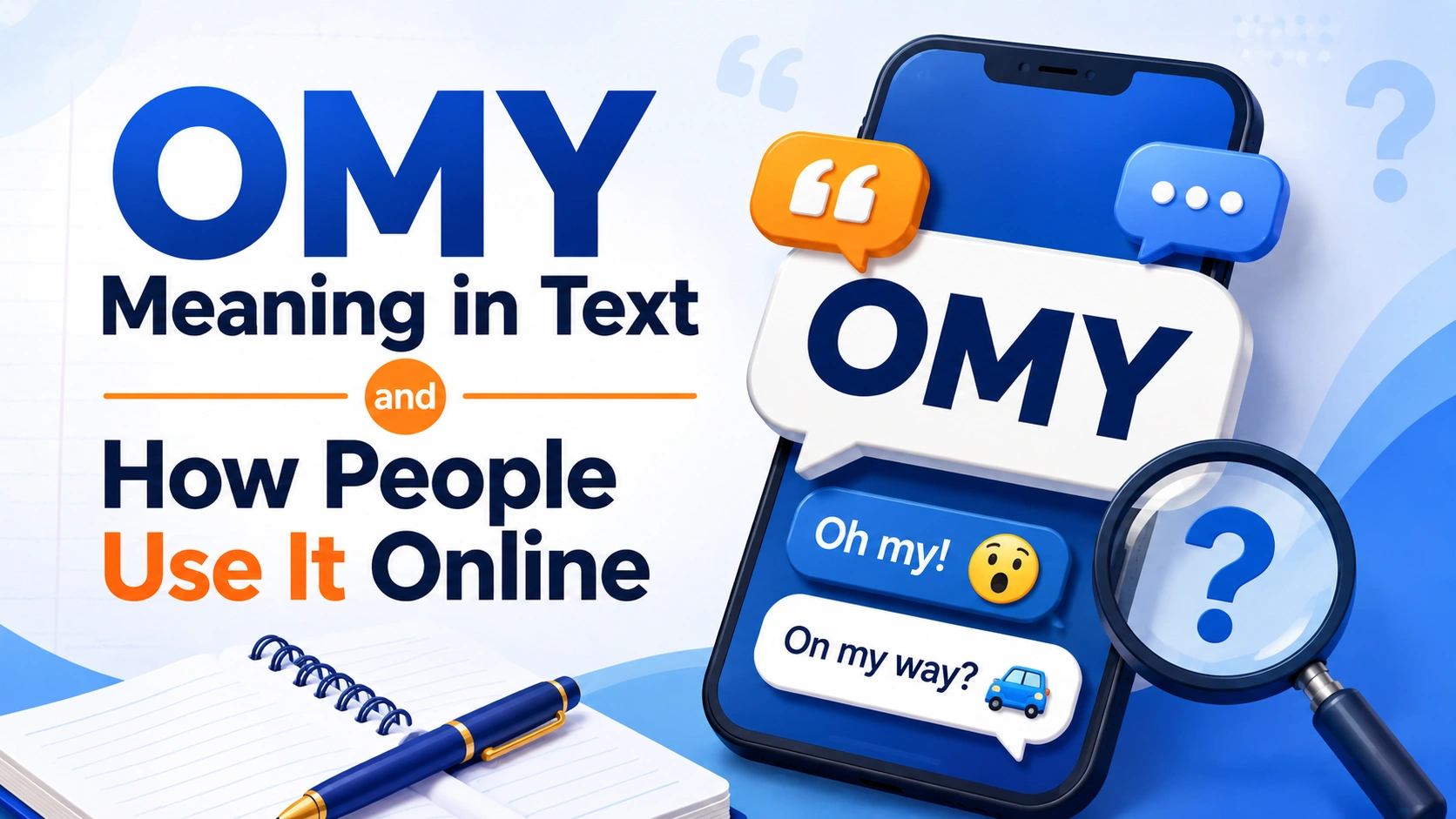
OMY meaning in text is not as straightforward as it first appears. In current online usage, “OMY” can be interpreted as “Oh my” in an emotional reaction, while some people use or interpret it as “On My Way.” The important distinction is that these meanings do not have equal support or the same level of recognition. Established texting references consistently document OMW as the standard abbreviation for “On My Way,” while recent online slang sources disagree about OMY itself.
That disagreement explains why a message such as “OMY 😭” can be confusing. If someone is reacting to surprising news, a photo, or a funny video, “Oh my” may fit naturally. If the conversation is about meeting somewhere, however, a sender may intend “On My Way,” even though OMW is the much more established shorthand for that phrase. Reading the surrounding conversation is therefore more reliable than assigning OMY one permanent definition.
This guide separates documented usage from assumptions, explains why OMY is sometimes confused with OMW and OMG, and shows how context, punctuation, emojis, platform, and relationship can affect interpretation. You’ll also see realistic examples, a practical decoding method, professional alternatives, common mistakes, and answers to the questions people most often have about this unusual three-letter abbreviation.
Quick Answer: What Does OMY Mean in Text?
In casual online communication, OMY can mean “Oh my”, particularly when it appears as an emotional reaction to something surprising, amusing, impressive, or unexpected. Some contemporary slang sources also list “On My Way” as an interpretation, but that use is much less standardized than OMW, which is widely documented for “On My Way.”
A useful rule is:
If OMY reacts to something, “Oh my” may be intended. If it appears in a conversation about going somewhere, “On My Way” may be intended—but OMW is the clearer abbreviation.
OMY at a glance
| Question | Best answer |
| Can OMY mean “Oh my”? | Yes, especially as an emotional reaction. |
| Can people use OMY for “On My Way”? | Some do, but it is less standardized. |
| What is the established abbreviation for “On My Way”? | OMW. |
| Is OMY universally defined? | No. |
| Does the platform determine the meaning? | No; context matters more. |
| Is OMY formal? | No. It belongs to informal digital communication. |
What Does OMY Stand For?
Unlike highly established abbreviations such as OMW, OMY does not have one universally accepted expansion in texting.
One common interpretation is:
OMY = “Oh my”
Here, OMY functions as a short emotional expression. It can convey surprise, admiration, disbelief, amusement, or mild shock.
For example:
“OMY, that was unexpected.”
The writer is essentially saying:
“Oh my, that was unexpected.”
Another interpretation found on contemporary slang websites is:
OMY = “On My Way”
That interpretation is understandable because the first three letters on my way can naturally produce OMY. However, OMW is the established texting abbreviation for “On My Way.” Multiple references identify OMW with that meaning, including Dictionary.com, Slang.net, PC.net, and Wiktionary.
So it is important not to present OMY and OMW as equally standardized.
Why this distinction matters
Internet slang is created and modified by users rather than controlled by a single authority. A person can shorten a phrase in a way that makes sense to them, and their friends may understand it perfectly.
That does not automatically make the abbreviation widely recognized.
This is the key difference between:
- A documented, established abbreviation
- A plausible shorthand
- A personal abbreviation
- A community-specific expression
OMY can fall into the latter categories depending on the conversation.
Is OMY the Same as “On My Way”?
Not reliably.
Some current websites describe OMY as “On My Way,” but established abbreviation references overwhelmingly use OMW for that phrase.
The distinction becomes especially useful when you need to communicate something practical.
Suppose someone asks:
“Are you coming?”
If you reply:
“OMW.”
The intended meaning is clear: On My Way.
If you reply:
“OMY.”
The recipient might understand what you mean, but they could also wonder whether you intended “Oh my.”
Why does the confusion happen?
The phrase on my way naturally produces the letters O-M-W, but someone unfamiliar with the conventional abbreviation might shorten it differently.
There is also a visual reason for confusion. OMY and OMW look almost identical, with only the final letter changing.
That tiny difference can have a significant effect on interpretation.
Which one should you use?
If you mean “On My Way,” use OMW.
It is:
- More established
- More recognizable
- Less ambiguous
- Better supported by major slang/reference sources
- Easier for unfamiliar readers to understand
Practical rule: If the goal is clarity rather than experimentation, OMW is the better choice for “On My Way.”
OMY vs. OMW vs. OMG
These three abbreviations are easy to mix up visually, but their functions are different.
| Abbreviation | Common meaning | What it does | Example |
| OMY | “Oh my” in some contexts | Expresses a reaction | “OMY, that’s surprising!” |
| OMW | “On My Way” | Gives an arrival/travel update | “OMW now.” |
| OMG | “Oh my God” / related variants | Expresses strong surprise or emotion | “OMG, I didn’t expect that!” |
OMW is particularly well established. Dictionary.com describes it as an abbreviation for “on my way,” including use for moving toward a goal or event, while Wiktionary lists “on my way” and “oh my word” as meanings.
OMY vs. OMG
OMY can resemble the beginning of OMG, especially when typed quickly.
But the emotional force is not necessarily identical.
For example:
“OMY, that is beautiful.”
can work as a softer reaction.
Whereas:
“OMG, that is unbelievable!”
is a more established internet expression for strong surprise.
The important point is not to assume that OMY is simply a typo for OMG. The surrounding conversation should determine whether the sender intended a reaction, a travel update, or something else.
How Context Changes the Meaning of OMY
Context is the most important tool for interpreting ambiguous slang.
The same three letters can produce different interpretations depending on what came before them.
1. Look at the conversation topic
If someone sends:
“OMY 😭”
after showing you a ridiculous video, an emotional reaction such as “Oh my” makes more sense.
But:
“OMY, almost there”
is more likely to be interpreted as an attempt at “On My Way.”
Even then, OMW would be clearer.
2. Look at nearby words
A surrounding phrase can effectively explain the abbreviation.
Compare:
“OMY, I can’t believe that happened.”
with:
“OMY to your house.”
The first behaves like an exclamation. The second appears to describe movement.
3. Check punctuation
Punctuation can reveal how the sender expects the message to sound.
| Message | Likely effect |
| OMY | Neutral or ambiguous |
| OMY! | Stronger reaction |
| OMY 😭 | Emotional or humorous reaction |
| OMY?? | Confusion or surprise |
| OMY, almost there | Could suggest “On My Way” |
Punctuation does not establish a dictionary definition, but it supplies useful pragmatic clues.
4. Consider emojis
Emojis can make an ambiguous abbreviation easier to interpret.
“OMY 😂”
is more likely to be a reaction than an arrival announcement.
“OMY 🚗”
could suggest movement, although the writer may still be using the abbreviation unusually.
5. Consider the sender
People develop personal texting habits.
A friend who routinely invents abbreviations may use OMY differently from someone who normally uses established internet shorthand.
That is why the sender’s usual style can sometimes be more informative than a generic slang dictionary.
How OMY Is Used in Text Messages
There is no single universal pattern for OMY. Its interpretation depends heavily on whether it is functioning as an emotional reaction or an attempted movement update.
Emotional reaction
“OMY, that ending!”
Meaning:
“Oh my, that ending!”
The writer is reacting to something unexpected.
Surprise
“OMY, you actually did it!”
The abbreviation expresses astonishment.
Admiration
“OMY, this looks amazing.”
Here it works as an expressive opener.
Attempted travel update
“OMY, give me five.”
A sender might intend:
“On my way, give me five [minutes].”
But OMW would communicate this more clearly.
Group-chat use
In a group conversation, ambiguity becomes more important because several people may interpret the same shorthand differently.
For example:
Sam: “Are you coming?”
Alex: “OMY”
Sam: “You mean on your way?”
That follow-up may be necessary precisely because OMY is not as standardized as OMW.
OMY Meaning on Social Media and Messaging Platforms
OMY does not receive a completely different definition simply because it appears on Instagram rather than in a text message.
However, the type of communication on each platform can influence which interpretation feels more natural.
OMY on Instagram
In a comment or reaction, an expressive meaning such as “Oh my” can fit naturally.
For example:
“OMY 😭 this is hilarious.”
In a private DM about meeting someone, a sender could use OMY to mean “On My Way,” but OMW would be clearer.
OMY on TikTok
Reaction-based comments create a natural environment for short emotional expressions.
“OMY 😭”
could simply communicate surprise or amusement.
A viewer does not necessarily need a complete sentence because the video itself provides the missing context.
OMY on Snapchat
Private, fast-paced messaging can encourage shorthand. If friends are coordinating plans, however, OMW is still the clearer way to communicate “On My Way.”
OMY on WhatsApp
WhatsApp conversations can range from family chats to informal group planning. That makes context particularly important.
“OMY, look at this 😂”
strongly suggests a reaction.
“OMY to the café.”
suggests that the sender is attempting to communicate movement.
OMY in ordinary texting
Traditional SMS and modern messaging have the same basic issue: the abbreviation does not come with an automatic definition.
The recipient interprets it using the information surrounding it.
Is OMY Positive, Negative, or Neutral?
OMY itself does not have a fixed emotional tone.
When used as “Oh my,” it can express several emotions.
Positive
“OMY, this is gorgeous!”
The writer is impressed.
Negative or concerned
“OMY, what happened?”
The writer may be worried.
Surprised
“OMY! I didn’t know that.”
The writer is astonished.
Humorous
“OMY 😂 what did you just send me?”
The tone is playful.
This demonstrates why a slang abbreviation should not be interpreted solely from its letters. Tone comes from the entire message.
OMY Examples in Real Conversations
Friend-to-friend conversation
Mia: “Did you see that video?”
Noah: “OMY 😭”
Mia: “I know! I wasn’t expecting that.”
Here, OMY works as an emotional reaction.
Planning conversation
Mia: “Are you coming to the game?”
Noah: “OMY.”
Mia: “You mean you’re on your way?”
This illustrates the ambiguity.
Social-media reaction
Creator: “I tried this recipe for the first time.”
Comment: “OMY 😂”
The video or post supplies the context, making an emotional reaction plausible.
Family conversation
Parent: “We’re leaving in ten minutes.”
Student: “OMY.”
If the sender intends “On My Way,” the message may be understood from context, but OMW would be more conventional.
Ambiguous example
“OMY?”
With no surrounding context, this is difficult to decode confidently.
That is the most important lesson: some abbreviations cannot be interpreted accurately in isolation.
OMY Meaning From a Girl vs. From a Guy
There is no standard definition of OMY based on the sender’s gender.
If a girl sends OMY, the abbreviation does not automatically have a different meaning from when a guy sends it.
What matters more is:
- What was being discussed?
- Was the conversation about plans?
- Was the person reacting to something?
- Were emojis used?
- What is the sender’s normal texting style?
- What is the relationship between the people?
Avoid reading hidden meaning into ordinary slang
A common mistake is assuming that an abbreviation has a romantic or personal meaning simply because it came from someone the recipient likes.
For example:
“OMY 😂”
does not inherently mean flirting.
Likewise:
“OMY, I’m almost there.”
does not contain a secret romantic message.
The relationship may affect tone, but it does not create a new dictionary definition.
Common Reasons People Misunderstand OMY
Mistake 1: Assuming OMY always means “On My Way”
This is the biggest practical problem.
While some current sources use OMY for “On My Way,” OMW is the established form.
Mistake 2: Treating one website’s definition as universal
Internet slang references often disagree. A recent search shows OMY described as “Oh my” by some sources and “On My Way” by others.
That disagreement is itself useful evidence: OMY is not standardized enough to support absolute claims.
Mistake 3: Confusing OMY with OMG
The abbreviations look similar, but they serve different functions.
Mistake 4: Ignoring context
A standalone OMY is inherently less informative than:
“OMY, that was crazy!”
or:
“OMY to the store.”
Mistake 5: Using ambiguous slang when clarity matters
If you are communicating an arrival time, “OMW” or “I’m on my way” is much better.
Is OMY an Official Internet Slang Term?
There is no central organization that officially approves texting abbreviations.
Digital slang develops organically through:
- repeated user behavior,
- online communities,
- social media,
- messaging,
- gaming,
- pop culture,
- personal communication.
That means an abbreviation can be real and understandable without being standardized.
This distinction is important for language articles because claiming that every internet abbreviation has one fixed definition can be misleading.
For OMY, available sources currently show inconsistent definitions. Some identify it with “Oh my,” while others present “On My Way” as a primary meaning.
By contrast, OMW has much stronger consistency across reference sources for “On My Way.”
Other Possible Meanings of OMY
Not every appearance of OMY online is necessarily texting slang.
Three-letter combinations can also function as:
- Initials
- Names
- Organization abbreviations
- Brand or project identifiers
- Community-specific shorthand
- Personal abbreviations
This is why searching an acronym without context can produce misleading results.
For a text-message question, the relevant meanings are the ones that make sense inside the conversation. A technical abbreviation from an unrelated industry should not automatically replace the conversational interpretation.
How OMY Fits Into Modern Digital Communication
Texting abbreviations exist partly because digital conversation rewards speed and compactness.
Historically, SMS imposed technical constraints that encouraged shortened messages. Modern messaging platforms generally offer far more room, but shorthand remains popular because it can make conversation feel:
- Faster
- More casual
- More expressive
- More conversational
- More like spoken language
The broader category is often called SMS language, texting language, or internet shorthand. Common examples include LOL, IDK, BTW, IMO, and OMW.
OMY illustrates a different side of digital language: not every abbreviation becomes standardized.
Sometimes users understand an unconventional shortening because the context makes it obvious. Other times, ambiguity causes a more conventional form to win.
That helps explain why OMW is safer than OMY for “On My Way.”
When You Should Use OMY
Use OMY only when the context makes your intended meaning reasonably clear.
Good situations
- Casual conversations
- Friendly DMs
- Informal group chats
- Social-media reactions
- Conversations where the recipient already understands your shorthand
Better practice
If you’re using OMY as “Oh my,” adding context can make the emotional meaning obvious:
“OMY, I wasn’t ready for that 😂”
If you’re trying to say “On My Way,” use:
“OMW, see you soon.”
That tiny change substantially improves clarity.
When You Should Avoid OMY
Ambiguous slang is a poor choice when misunderstanding could cause a problem.
Avoid it in:
- Formal emails
- Applications
- Academic writing
- Customer communication
- Important instructions
- Time-sensitive arrangements
- Messages to people unfamiliar with your texting style
For example, if someone needs to know whether you have actually left, this:
“I’m on my way and should arrive in about 10 minutes.”
is much clearer than:
“OMY.”
The extra words are worth using when precision matters more than speed.
Better Alternatives When Clarity Matters
| What you want to say | Casual | Clearer option |
| You are traveling there | OMW | “I’m on my way.” |
| You are almost there | “Almost there” | “I’m almost there.” |
| You want to know the plan | “What’s the plan?” | “What are we doing next?” |
| You are surprised | OMY! | “Oh my!” / “Wow!” |
| You need clarification | “Huh?” | “What do you mean?” |
There is nothing inherently wrong with shorthand. The goal is to match the amount of shorthand to the situation.
How to Respond When Someone Says OMY
Your response should depend on the meaning you infer.
If it clearly means “Oh my”
You can respond naturally:
“I know 😂”
or:
“Right? I wasn’t expecting it either.”
If it seems to mean “On My Way”
You might say:
“Okay, see you soon!”
If you are unsure
Ask:
“Do you mean ‘Oh my’ or ‘On My Way’?”
That may sound overly precise in a casual conversation, so a softer option is:
“What do you mean by OMY?”
If the timing matters
Do not rely on assumptions.
Ask:
“Are you already on your way?”
A clear question is better than guessing when someone is waiting for you.
A Simple Method for Decoding Unfamiliar Text Slang
When you encounter OMY or another unfamiliar abbreviation, use this six-step approach.
Step 1: Read the whole message
Never interpret an acronym alone if the rest of the sentence is available.
Step 2: Identify the topic
Is the conversation about:
- travel?
- plans?
- news?
- Humour?
- a photo?
- an argument?
- an invitation?
The topic narrows the possibilities.
Step 3: Check the previous message
Often the answer is sitting immediately before the abbreviation.
Step 4: Look for punctuation and emojis
These provide clues about emotional intent.
Step 5: Compare it with established abbreviations
If the sender appears to mean “On My Way,” remember that OMW is the conventional form.
Step 6: Ask when uncertainty matters
There is no prize for guessing correctly when a simple clarification would prevent a misunderstanding.
Best practice: Treat unfamiliar slang as a context problem, not a vocabulary test.
Is OMY Still Popular?
It is difficult to make a precise popularity claim for OMY because there is no reliable universal dataset showing how often the abbreviation is used across private messages, social platforms, and regional communities.
Search results do show that websites continue to publish explanations of OMY in 2026, but the definitions remain inconsistent. Recent sources describe both “Oh my” and “On My Way,” while established references remain much more consistent about OMW meaning “On My Way.”
So the most defensible conclusion is:
OMY exists in contemporary online usage, but it is less standardized and less predictable than OMW.
That distinction is more useful than claiming OMY is universally popular or universally obsolete.
Conclusion:
The OMY meaning in text cannot be reduced to one universally accepted definition. In contemporary casual communication, “Oh my” is a meaningful interpretation, particularly when OMY appears as a reaction. Some people also use it to mean “On My Way,” but that usage is less standardized. For that phrase, OMW remains the established and clearer abbreviation across multiple reference sources.The smartest way to interpret OMY is to examine the conversation, surrounding words, punctuation, emojis, and sender’s habits rather than relying on the acronym alone. If you’re writing the message yourself, choose the form your reader is most likely to understand.One final actionable tip: use OMW when you specifically mean “On My Way,” and reserve OMY for contexts where its intended meaning is obvious. A common mistake to avoid is treating every three-letter abbreviation as universally standardized. Online language evolves through real usage, and sometimes the context is more reliable than the acronym itself.
FAQs
Q1. What does OMY mean in text?
OMY can mean “Oh my” when used as an emotional reaction to something surprising, funny, or impressive. Some people also use it for “On My Way,” but that interpretation is less standardized. If the context is about travel, OMW is the clearer abbreviation.
Q2. Does OMY mean “On My Way”?
It can, but OMY is not the standard abbreviation for that phrase. Established texting references consistently identify OMW as “On My Way.” If you want to tell someone you are traveling to their location, OMW or the full phrase is less ambiguous.
Q3. What is the difference between OMY and OMW?
OMW has a well-established meaning: “On My Way.” OMY is more ambiguous and can be interpreted as “Oh my” or, in some online usage, “On My Way.” For clear arrival updates, OMW is the better choice.
Q4. What does OMY mean on Instagram?
There is no Instagram-specific official definition of OMY. In a reaction comment, “Oh my” may fit naturally, particularly when paired with emojis. In a private planning conversation, someone might intend “On My Way,” but the surrounding messages should determine the interpretation.
Q5. Is OMY appropriate for professional communication?
Generally, no. Because OMY has competing interpretations, it can create unnecessary ambiguity in professional settings. If you mean “On My Way,” write “I’m on my way” or provide an estimated arrival time. Clear language is preferable when accuracy matters.