

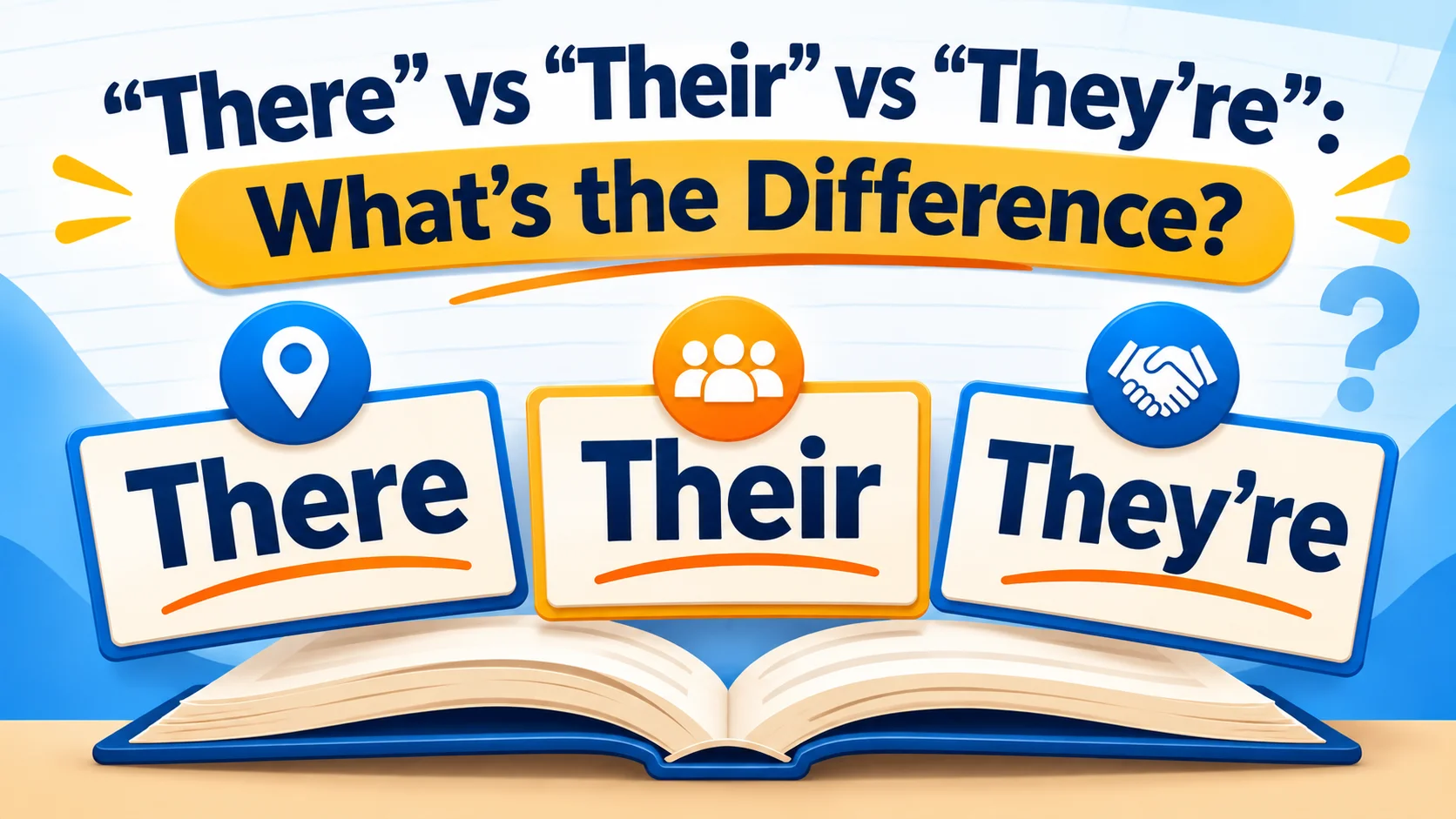
There, their, and they’re are three English words that sound exactly alike but communicate very different ideas. Choosing the wrong one can change a sentence’s meaning or make otherwise polished writing look careless. The distinction becomes easier when you understand their grammatical roles: there identifies a place or introduces the existence of something, their indicates possession or association, and they’re is a contraction of they are. Although the words are homophones, they are not interchangeable. Each has a specific purpose, and recognizing that purpose is the key to using them correctly.
The confusion often appears in everyday sentences. Someone might write their going to school when they mean they’re going to school, or use there instead of their when describing someone’s belongings. These mistakes are understandable because the three words share the same pronunciation, particularly in ordinary conversation. However, spelling alone is not the best way to distinguish them. Paying attention to sentence structure, meaning, and grammatical function provides a much more dependable solution, especially when writing quickly.
This guide explains there vs. their vs. they’re through straightforward definitions, practical examples, grammatical comparisons, and common expressions. You’ll learn how there works in sentences that introduce existence, why their can refer to one person as well as multiple people, and when they’re is appropriate in formal and informal writing. We’ll also examine related words such as theirs and they are, correct frequent spelling mistakes, and practice choosing the right form. By the end, you’ll have a practical method for making the correct choice without relying on guesswork.
There vs Their vs They’re: What’s the Difference?
The difference between these three words comes down to what you want your sentence to communicate.
- There refers to a location or introduces the existence or presence of something.
- Their is a possessive determiner showing that something belongs to or is associated with someone.
- They’re is a contraction of they are.
Consider these sentences:
- There is a new bookstore near our school.
- The students forgot their textbooks.
- They’re planning to visit the bookstore tomorrow.
All three words sound alike, but their meanings are completely different.
| Word | Meaning | Grammatical function | Example |
| There | In that place; indicates existence | Adverb or introductory existential word | There is a problem. |
| Their | Belonging or relating to them | Possessive determiner | Their house is nearby. |
| They’re | They are | Subject and verb contraction | They’re waiting outside. |
The quickest way to remember the difference:
- If you mean they are, write they’re.
- If you mean belonging to them, write their.
- If you mean a place or the existence of something, write there.
This simple distinction resolves most everyday spelling problems.
What Does There Mean?
There is commonly used as an adverb referring to a place. It can also introduce a sentence that tells readers or listeners that something exists or is present.
Its meaning depends on how it functions in a sentence.
For example:
- Your notebook is over there.
- There are several reasons to learn English.
- I visited the library, but nobody was there.
The first and third sentences refer to a location. The second introduces the existence of several reasons.
Understanding these two main uses is essential because not every sentence containing there refers to a physical place.
There as an Adverb of Place
The most familiar use of there is to identify a particular location.
It generally answers the question where?
Examples:
- Please put the books over there.
- My grandparents live there.
- We visited the museum and spent several hours there.
- The teacher is standing there near the classroom door.
- I left my umbrella there yesterday.
In these sentences, there helps readers identify where an action happens or where someone or something is located.
It can refer to:
- A nearby or distant location.
- A place already mentioned.
- A location understood from the conversation.
- A figurative position or situation.
For example, consider this exchange:
Person A: Where did you leave the documents?
Person B: I left them over there, beside the printer.
The word there points to a specific location without requiring the speaker to repeat its full description.
There to Show That Something Exists
Another important use of there is to introduce the existence or presence of something.
This grammatical construction is known as existential there.
Examples:
- There is a message on your desk.
- There are five students in the classroom.
- There was a problem with the electricity.
- There will be an important announcement tomorrow.
In these sentences, there does not identify a particular physical location. Instead, it introduces something that exists, appears, or happens.
The noun or noun phrase that follows helps determine whether the verb should be singular or plural in standard written English.
There Is vs. There Are
This distinction is particularly important in everyday writing.
| Expression | When to use it | Example |
| There is | Before a singular noun or an uncountable noun | There is a book on the desk. |
| There are | Before a plural noun | There are three books on the desk. |
| There was | Past tense with a singular noun or uncountable noun | There was a delay. |
| There were | Past tense with a plural noun | There were several delays. |
| There will be | Future existence or occurrence | There will be a meeting tomorrow. |
A common mistake is writing there is before a plural noun in formal writing.
Incorrect: There is several reasons for the delay.
Correct: There are several reasons for the delay.
The verb should agree with the noun being introduced, not simply with the word there.
There in Common Expressions
There also appears in many established expressions used in everyday English.
| Expression | Meaning | Example |
| There you go | Used when giving or showing something | There you go; your receipt. |
| There you are | Used when finding someone or presenting something | There you are! I’ve been looking for you. |
| There it is | Used when identifying or finding something | There it is, beside the window. |
| There is no doubt | Expresses certainty | There is no doubt that she worked hard. |
| There seems to be | Suggests that something appears to exist | There seems to be a mistake. |
| Been there | Indicates previous experience | I’ve been there before. |
These expressions are worth learning because their meanings are often different from the literal meaning of there as a location.
There vs. Here: What’s the Difference?
Both words can identify locations, but they refer to different positions.
- Here generally means the place where the speaker is or a nearby location.
- There generally means another location, often one farther away or already identified.
Examples:
- Come here and look at this picture.
- Put your shoes over there.
- I live here, but my parents live there.
The distinction depends on the speaker’s perspective.
A location can be here for one person and there for someone speaking from another place.
What Does Their Mean?
Their is a possessive determiner used to show that something belongs to, relates to, or is associated with someone or something referred to as they.
Examples:
- The students submitted their assignments.
- My neighbors renovated their kitchen.
- The children forgot their lunchboxes.
- The employees discussed their responsibilities.
Unlike there, which often introduces a location or existence, their connects a noun to the person or group associated with it.
Their to Show Ownership or Possession
The most common use of their is to indicate ownership.
It usually appears immediately before a noun or a phrase containing a noun.
Examples:
- They parked their car outside.
- The students opened their books.
- The family decorated their house.
- The players collected their equipment.
In each example, their identifies who owns or possesses something.
However, possession does not always mean legal ownership.
For instance, in the sentence “The students completed their examination,” the word their identifies the examination associated with the students. It does not mean they legally own the examination paper.
Their to Describe Relationships and Associations
Their can also describe connections, responsibilities, characteristics, and shared experiences.
Examples:
- The teachers discussed their responsibilities.
- The employees celebrated their achievements.
- The children enjoyed their holiday.
- The company announced their new policy.
These sentences demonstrate that the word is not limited to physical belongings.
It can identify anything associated with a person or group.
Their With Singular They
One important feature of modern English is that their can refer to one person.
Although many learners first encounter their as a plural possessive word, singular their is also established in standard English.
It is commonly used when:
- A person’s gender is unknown.
- A person’s gender is irrelevant to the sentence.
- Someone uses they/them pronouns.
Examples:
- Someone left their notebook in the classroom.
- Every student should bring their identification card.
- Alex said their appointment had been rescheduled.
- The new employee introduced their qualifications.
Consider this example:
“Someone called while you were away, but they didn’t leave their name.”
The word someone refers to one unidentified person. Nevertheless, their is grammatically appropriate.
This usage is especially helpful because it allows writers to avoid awkward constructions when a person’s gender is unknown or unspecified.
Their vs. His or Her
Traditionally, writers sometimes used his or her when referring to an individual whose gender was unknown.
For example:
“Every student should bring his or her notebook.”
However, singular their provides a natural alternative:
“Every student should bring their notebook.”
Both constructions can be grammatically acceptable, but singular their is widely accepted in contemporary standard English.
It is also useful when referring to someone who specifically uses they/them pronouns.
Writing recommendation: Use the form that fits your audience, context, and the person’s stated pronouns. Avoid assuming that their must refer to multiple people.
What Does They’re Mean?
They’re is a contraction of the two words they are.
The apostrophe indicates that some letters have been omitted to create a shorter form.
For example:
- They are waiting outside.
- They’re waiting outside.
Both sentences communicate exactly the same meaning.
Unlike there and their, they’re does not indicate a place or possession. It combines a subject pronoun with a form of the verb be.
They’re as a Subject-Verb Contraction
In most sentences, they’re introduces an action, condition, or description involving the subject they.
Examples:
- They’re preparing for their examinations.
- They’re working on a new project.
- They’re waiting for the bus.
- They’re excited about the holidays.
- They’re discussing the results.
In each example, you can expand they’re into they are without changing the basic meaning.
This replacement test is one of the most reliable ways to identify the correct word.
They’re Before Adjectives and Noun Phrases
The contraction can introduce descriptions as well as noun phrases.
Examples:
- They’re excellent students.
- They’re very helpful.
- They’re the people we invited.
- They’re responsible for organizing the event.
Notice that they’re does not always need to be followed by an action word ending in -ing.
It can also introduce an adjective or a noun phrase.
They’re in Questions and Everyday Conversations
They’re is common in spoken English, messages, and informal writing.
Examples:
- They’re coming with us, aren’t they?
- Do you know if they’re available tomorrow?
- I heard they’re moving to another city.
- They’re not interested in joining the meeting.
In questions, the contraction may appear within a larger sentence.
For example:
“Do you think they’re ready?”
Here, they’re still means they are.
They’re vs. They Are: Which Should You Use?
Both forms are grammatically correct.
The main difference is stylistic.
| Situation | Preferred form | Example |
| Everyday conversation | They’re | They’re waiting outside. |
| Text messages | They’re | They’re almost here. |
| Informal articles | Either | They’re ready for the trip. |
| Formal academic writing | They are, when a more formal tone is desired | They are responsible for the findings. |
| Emphasis | They are | They are the people we need. |
Contractions are not automatically incorrect in formal writing. Their suitability depends on the publication, institution, and style guide.
If a school assignment or professional document requires a particularly formal tone, spelling out they are may be the safer choice.
There vs. Their vs. They’re: Key Differences Explained
The three words become much easier to distinguish when you compare their grammatical roles rather than focusing only on their spelling.
Compare Their Meanings and Grammatical Functions
| Feature | There | Their | They’re |
| Meaning | Location or existence | Possession or association | They are |
| Grammatical role | Adverb or introductory existential word | Possessive determiner | Contraction |
| Apostrophe | No | No | Yes |
| Usually followed by | A location, verb, or noun phrase | A noun | An adjective, noun phrase, or verb phrase |
| Replacement test | In that place / existence | Belonging to them | They are |
| Example | There is a shop nearby. | Their shop is nearby. | They’re opening a shop. |
How to Identify the Correct Word by Its Sentence Position
Sentence structure can provide useful clues when the intended meaning is not immediately obvious.
1. Look for a noun following the word.
If the word indicates ownership and appears before a noun, their may be correct.
Example:
“They brought their laptops.”
Here, their identifies whose laptops are being discussed.
2. Check whether the sentence needs a verb.
If the sentence needs the meaning they are, use they’re.
Example:
“They’re preparing dinner.”
Expanded version:
“They are preparing dinner.”
3. Check whether the sentence introduces something or identifies a place.
If the word indicates a location or introduces existence, use there.
Examples:
- The restaurant is over there.
- There are several restaurants nearby.
Remember that sentence position alone is not always sufficient. Meaning and grammatical structure should work together.
Why the Apostrophe Matters
The apostrophe is an important spelling clue.
They’re contains an apostrophe because it is a contraction of they are.
However, their does not require an apostrophe because it is already a possessive determiner.
Similarly, there does not need an apostrophe.
Compare:
- They’re bringing their books over there.
- Incorrect: Their bringing there books over they’re.
Apostrophes can indicate omitted letters in contractions or possession in certain noun constructions. However, possessive determiners such as their do not follow the same apostrophe pattern as ordinary possessive nouns.
How to Remember the Difference Between There, Their, and They’re
Memorizing three separate definitions can work, but a practical replacement method is more reliable when writing complete sentences.
1. Use the “They Are” Test for They’re
Whenever you’re unsure whether to write they’re, replace it with they are.
If the sentence still makes sense, they’re is correct.
Example:
“They’re going to the library.”
Replace the contraction:
“They are going to the library.”
The sentence remains correct.
Now consider:
“Their going to the library.”
Replacing their with they are reveals the problem:
“They are going to the library.”
The original sentence should therefore use they’re.
2. Use the Ownership Test for Their
Ask yourself whether the word shows something belonging or relating to someone.
You can mentally replace their with belonging to them.
Example:
“They forgot their bags.”
The intended meaning is that the bags belong to or are associated with them.
Another example:
“Their teacher is absent today.”
The word identifies the teacher associated with the students.
This test also works with singular their when referring to one person.
3. Use the Location or Existence Test for There
Ask whether the sentence identifies a place or introduces something that exists.
Examples:
- The library is over there.
- There is a library near my house.
The first identifies a location. The second introduces the existence of a library.
If neither possession nor they are makes sense, there may be the correct choice.
4. Follow the Three-Second Decision Rule
Use this simple decision process whenever you are editing a sentence.
| Ask yourself | If yes, choose |
| Does the sentence mean “they are”? | They’re |
| Does the word show ownership or association? | Their |
| Does it identify a location or introduce existence? | There |
For example:
“_____ going to leave _____ bags over _____.”
- Going to leave = they are going to leave → They’re
- Bags belonging to them → their
- Location → there
Correct sentence:
“They’re going to leave their bags over there.”
This is a particularly effective example because it demonstrates all three words in a single sentence.
There, Their, and They’re in Real-Life Sentences
Definitions become more useful when you see how the words appear in everyday communication.
✅Examples Using There
- There is a new café near the railway station.
- I left my notebook over there.
- There are several students waiting outside.
- We stayed there during our summer holiday.
- There seems to be a problem with the printer.
- Is anyone there?
- There will be a meeting after lunch.
Examples Using Their
- The children packed their schoolbags.
- My neighbors invited us to their wedding.
- The employees completed their training.
- The students submitted their projects.
- Everyone should bring their own water bottle.
- The players celebrated their victory.
- The customers expressed their concerns.
Examples Using They’re
- They’re preparing for the school competition.
- They’re waiting for their parents.
- They’re interested in the new course.
- They’re already on their way.
- They’re planning a family celebration.
- They’re the students who won the award.
- They’re working on an important assignment.
Sentences That Use All Three Words Together
The best way to understand the difference is to examine sentences in which all three words appear naturally.
Example 1:
“They’re leaving their bags over there.”
- They’re = They are.
- Their = Bags belonging to them.
- There = A particular location.
Example 2:
“They’re taking their books because there is an examination tomorrow.”
- They’re = They are taking.
- Their = Books associated with them.
- There = Introduces the existence of an examination.
Example 3:
“They’re meeting their friends where there is a new restaurant.”
- They’re = They are meeting.
- Their = Friends associated with them.
- There = Introduces the existence of a restaurant.
These examples demonstrate why the three spellings cannot be used interchangeably, even when they appear close together.
Common Mistakes When Using There, Their, and They’re
Most errors occur because writers choose a word based on how it sounds rather than what it means.
Here are some common mistakes and their corrections.
Mistake 1: Using Their Instead of There
Incorrect
Their are three books on the desk.
Correct
There are three books on the desk.
The sentence introduces the existence of three books. It does not describe ownership, so there is required.
Mistake 2: Using There Instead of Their
Incorrect
The children forgot there lunchboxes.
Correct
The children forgot their lunchboxes.
The sentence identifies whose lunchboxes were forgotten. Because it expresses possession or association, their is correct.
Mistake 3: Using There Instead of They’re
Incorrect
There going to the library.
Correct
They’re going to the library.
The sentence means “They are going to the library.” Therefore, the contraction they’re is necessary.
Mistake 4: Writing Their’s Instead of Theirs
Incorrect
That notebook is their’s.
Correct
That notebook is theirs.
Theirs is an independent possessive pronoun. It does not require an apostrophe.
Compare:
- That is their notebook.
- That notebook is theirs.
The first uses a possessive determiner before a noun. The second uses a possessive pronoun without a following noun.
Mistake 5: Confusing They’re With Their in the Same Sentence
Sometimes writers need both words in one sentence.
Incorrect: There bringing there own equipment.
Correct: They’re bringing their own equipment.
The first word is a contraction of they are. The second identifies whose equipment is being brought.
Mistake 6: Assuming Their Only Refers to Multiple People
Incorrect assumption: Their can only describe belongings shared by a group.
Correct understanding: Their can also refer to one person through singular they.
Example:
“Someone left their jacket in the classroom.”
The sentence refers to one unidentified individual, so singular their is appropriate.
Related Words That Are Easy to Confuse With There, Their, and They’re
Understanding a few related words will help you avoid additional mistakes.
Their vs. Theirs
Both words express possession, but they have different grammatical functions.
Their is a possessive determiner that appears before a noun.
Examples:
- Their house is beautiful.
- Their teacher is helpful.
- Their plans have changed.
Theirs is a possessive pronoun that can stand independently without a following noun.
Examples:
- That house is theirs.
- The decision was theirs.
- The blue bags are theirs.
| Their | Theirs |
| Possessive determiner | Possessive pronoun |
| Usually appears before a noun | Stands independently |
| Their car is outside. | The car is theirs. |
| Their idea was excellent. | The idea was theirs. |
There vs. Their vs. Theirs
These three words can appear in sentences with different grammatical purposes.
- There: Indicates location or existence.
- Their: Identifies possession before a noun.
- Theirs: Expresses possession independently.
Examples:
- The students are standing there.
- Their classroom is on the second floor.
- The classroom is theirs.
They’re vs. Their
The difference is particularly important when both words appear in the same sentence.
Compare:
- They’re visiting their grandparents.
- They’re bringing their own food.
- They’re discussing their plans.
In each example, they’re means they are, while their indicates possession or association.
There vs. Here vs. Where
These three words are related because they can refer to locations.
| Word | Meaning | Example |
| There | In or at that place | Your bag is over there. |
| Here | In or at this place | Your bag is here. |
| Where | At or in what place | Where is your bag? |
A useful way to remember them is to think of the speaker’s perspective:
- Here: The speaker’s location.
- There: Another identified location.
- Where: A question about location.
Practice Exercise: Choose There, Their, or They’re
Now test your understanding with these 15 sentences.
Fill in each blank with the correct word: there, their, or they’re.
- ______ going to visit the museum tomorrow.
- The students forgot ______ homework.
- ______ are several books on the table.
- Please put your shoes over ______.
- ______ planning to organize a family celebration.
- The children decorated ______ classroom.
- I think ______ is a mistake in this report.
- Everyone should bring ______ own notebook.
- ______ waiting outside the school.
- The neighbors invited us to ______ house.
- ______ is no reason to worry.
- The players are celebrating ______ victory.
- ______ going to leave ______ bags over ______.
- Someone left ______ umbrella near the entrance.
- Do you know if ______ available this afternoon?
Answers and Explanations
| No. | Correct answer | Explanation |
| 1 | They’re | Means they are going to visit. |
| 2 | Their | Shows that the homework belongs to or is associated with the students. |
| 3 | There | Introduces the existence of several books. |
| 4 | There | Identifies a location. |
| 5 | They’re | Means they are planning. |
| 6 | Their | Shows possession or association. |
| 7 | There | Introduces the existence of a mistake. |
| 8 | Their | Singular their refers to each individual student. |
| 9 | They’re | Means they are waiting. |
| 10 | Their | Indicates the neighbors’ house. |
| 11 | There | Introduces the existence of a reason. |
| 12 | Their | Shows that the victory belongs to or is associated with the players. |
| 13 | They’re / their / there | They are leaving bags belonging to them at a location. |
| 14 | Their | Singular their refers to an unidentified person. |
| 15 | They’re | Means they are available. |
Learning tip: For additional practice, take a few sentences from your own writing and apply the three replacement tests. This helps you recognize the correct word in real contexts rather than relying only on memorized examples.
Conclusion:
Choosing correctly between there, their, and they’re becomes much easier when you focus on meaning rather than pronunciation. Remember that there identifies a location or introduces existence, their expresses possession or association, and they’re means they are. These distinctions apply whether you’re writing a school assignment, sending a message, or preparing a professional document. One final actionable tip: Read your sentence again and replace they’re with they are whenever you’re uncertain. Then check whether their indicates ownership and whether there expresses location or existence. A common mistake to avoid is assuming that similar-sounding words can share the same spelling. In English, understanding a word’s grammatical job is often the quickest route to accurate writing.
FAQs
Q1. Why Do There, Their, and They’re Sound the Same but Have Different Spellings?
These words are homophones, meaning they share the same pronunciation but have different meanings and spellings. English spelling preserves distinctions that pronunciation does not always reveal. Context and grammatical function therefore determine which word belongs in a sentence.
Q2. Is It Their Going or They’re Going?
The correct expression is they’re going because it means they are going. The word their indicates possession and normally appears before a noun. For example, “They’re going to their school” correctly uses both words for different purposes.
Q3. Can Their Be Used for a Single Person?
Yes. Singular their is accepted in contemporary standard English. It can refer to someone whose gender is unknown, someone whose gender is irrelevant to the discussion, or an individual who uses they/them pronouns. For example, “Someone forgot their phone.”
Q4. Is There Always a Place-Related Word?
No. Although there commonly identifies a location, it also introduces existence in sentences such as “There are several options.” This grammatical construction is called existential there. In these sentences, the word does not identify a specific physical place.
Q5. Is It Their’s or Theirs?
Theirs is the correct spelling. It is an independent possessive pronoun and does not require an apostrophe. For example, write “That notebook is theirs,” not “That notebook is their’s.” The possessive determiner their also has no apostrophe.