

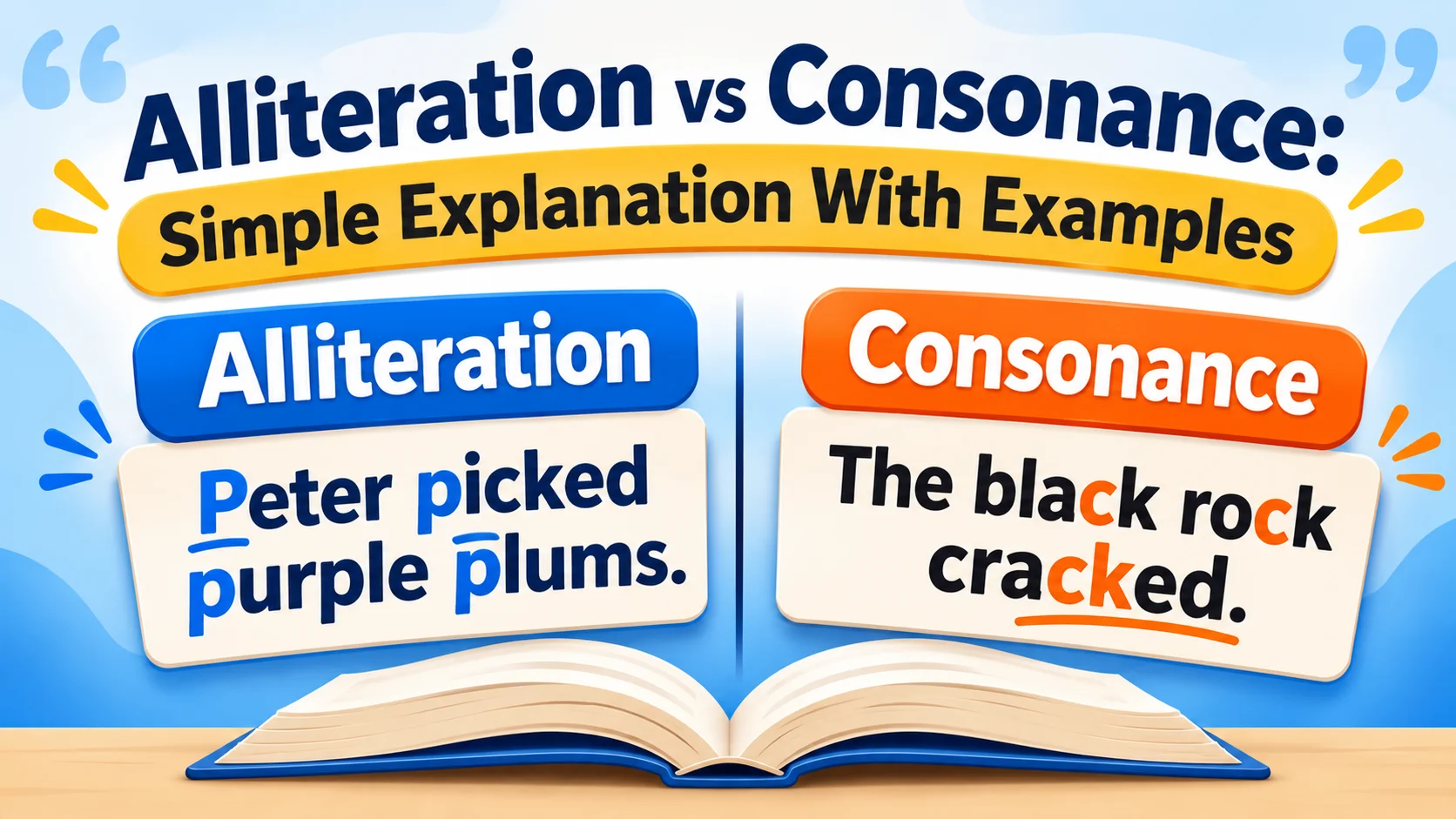
Alliteration vs consonance can be confusing because both literary devices rely on repeated consonant sounds. The difference becomes much easier to understand when you pay attention to where those sounds appear. Alliteration generally repeats consonant sounds at the beginnings of nearby words or stressed syllables, while consonance repeats consonant sounds anywhere within nearby words, including their middles and endings. For example, silver stars shine uses alliteration, while the black rock cracked uses consonance. Both create noticeable sound patterns, but they work in different ways.
These techniques appear in poetry, stories, speeches, advertising, song titles, and everyday expressions. Writers use them to shape rhythm, emphasize particular words, create a memorable phrase, or give a passage a distinctive sound. You may recognize alliteration immediately in a tongue twister, yet overlook consonance because its repeated sounds are not always at the beginning of words. Understanding the distinction helps you identify literary devices more accurately and appreciate how writers use sound to make language more expressive.
In this guide, you will learn the definitions, rules, similarities, and differences between alliteration and consonance, with straightforward examples and explanations. You will also discover how these devices compare with assonance and rhyme, why pronunciation matters more than spelling, and how to identify sound patterns in a poem or sentence. Whether you are learning literary terminology for the first time, preparing for an English assignment, or improving your creative writing, you will have a practical method for recognizing and using these devices confidently.
Quick Answer: What Is the Difference Between Alliteration and Consonance?
The main difference is the position of the repeated consonant sound.
- Alliteration is the repetition of the same initial consonant sound in nearby words or stressed syllables. Example: Mia makes marvelous music.
- Consonance is the repetition of consonant sounds in nearby words, whether those sounds occur at the beginning, middle, or end. Example: The black rock cracked.
The two devices can overlap. Alliteration is commonly treated as a specific type of consonant-sound repetition, while consonance is the broader term for repeated consonant sounds in different positions.
| Feature | Alliteration | Consonance |
| Definition | Repetition of initial consonant sounds | Repetition of consonant sounds in nearby words |
| Sound position | Usually at the beginning of words or stressed syllables | Beginning, middle, or end |
| Main focus | Repeated opening sounds | Repeated consonant sounds in a phrase |
| Example | Busy bees buzz. | The black rock cracked. |
| Common uses | Tongue twisters, slogans, poetry, titles | Poetry, prose, rhythm, and sound patterns |
Easy way to remember: Alliteration focuses on repeated opening consonant sounds. Consonance can happen wherever the repeated consonant sound appears.
What Is Alliteration? Definition, Meaning, and Examples
Alliteration is a literary device in which nearby words repeat the same initial consonant sound. Writers use it to create rhythm, draw attention to particular words, and make phrases more memorable.
Consider this sentence:
Peter picked purple peppers.
The words Peter, picked, purple, and peppers begin with the same /p/ sound. That repeated opening sound makes the sentence an example of alliteration.
Alliteration is especially common in poetry, advertising slogans, children’s stories, speeches, and playful expressions. It can make language sound rhythmic, catchy, or deliberately dramatic.
How Does Alliteration Work?
Alliteration works through the repetition of an opening consonant sound across nearby words. The repeated sound may occur in consecutive words or across a short phrase.
For example:
- Friendly frogs float: Repetition of the /f/ sound.
- Silly snakes slide: Repetition of the /s/ sound.
- Bright birds build: Repetition of the /b/ sound.
- Clever cats climb: Repetition of the /k/ sound.
The words do not have to begin with the same letter. What matters is the sound they produce.
For example, phone and fun both begin with the /f/ sound, even though their first letters differ. Used together in a phrase such as funny phone calls, they create alliteration.
Does Every Word Need to Start With the Same Sound?
No. Alliteration does not require every word in a sentence to share the same initial sound.
Consider:
The little bird boldly crossed the bridge.
The words bird and boldly repeat the /b/ sound. The other words do not need to participate for the phrase to contain alliteration.
In longer writing, alliteration may appear in selected words rather than throughout every sentence. This usually produces a more natural effect.
Examples of Alliteration in Sentences
Here are several original examples with the repeated sounds identified.
| Example | Repeated sound | Explanation |
| Clever children create colorful cards. | /k/ | Several nearby words begin with the same sound. |
| Wild winds whipped the windows. | /w/ | The repeated /w/ sound creates a noticeable rhythm. |
| Sally sells soft scarves. | /s/ | The opening consonant sound repeats. |
| Gentle giants gathered together. | /dʒ/ | The words begin with the same consonant sound. |
| Bright balloons bounced above us. | /b/ | The repeated opening sound connects the words. |
Notice that the focus is on pronunciation, not simply the appearance of the first letter.
Alliteration in Poetry, Literature, and Everyday Language
Writers use alliteration for several practical reasons.
1. To create rhythm
Repeated opening sounds can give a line a steady, flowing quality. This is especially useful in poetry, where sound contributes to the reading experience.
2. To make phrases memorable
A phrase such as Busy bees buzz is easy to recognize because its repeated sound creates a clear pattern.
3. To add emphasis
Alliteration can draw attention to important words. A writer might use repeated sounds in a heading, slogan, or key sentence to make it stand out.
4. To create a particular atmosphere
Repeated sounds can contribute to a passage’s mood. However, no consonant has one universal emotional meaning. Its effect depends on the words, rhythm, and surrounding context.
Alliteration works best when it feels natural. Forcing several words together simply because they share an initial sound can make a sentence awkward.
What Is Consonance? Definition, Meaning, and Examples
Consonance is the repetition of consonant sounds in nearby words. Unlike alliteration, the repeated sounds do not have to appear at the beginnings of words. They can occur in the middle or at the end.
For example:
The black rock cracked.
The words black, rock, and cracked share the final /k/ sound. This repeated consonant sound creates consonance.
Consonance is widely used in poetry and creative writing because it can connect words through sound without requiring them to begin alike.
How Does Consonance Work?
Consonance occurs when the same consonant sound appears in multiple nearby words. The repeated sound may be found in different positions.
There are three useful patterns to recognize.
1. Consonance at the End of Words
This is one of the easiest patterns to identify.
Example:
The tick-tock of the clock.
The /k/ sound repeats at the ends of the highlighted words, creating a noticeable sound pattern.
Another example:
The wind bent the brand of the tree.
The repeated /d/ sound connects the words.
2. Consonance in the Middle of Words
The repeated consonant sound can also appear inside words.
Example:
The batter was buttered.
The /t/ sound is repeated within the words. The pattern is audible even though the words do not share the same opening sound.
3. Consonance at the Beginning of Words
Repeated initial consonant sounds can also be described as consonance.
Example:
Silver sails silently.
The repeated /s/ sound appears at the beginning of each word. This is clearly alliteration, but it also involves consonant repetition.
This overlap explains why alliteration and consonance are closely related.
Examples of Consonance in Sentences
| Example | Repeated sound | Position |
| The black rock cracked. | /k/ | Mostly at the ends of the highlighted words |
| The swift raft drifted away. | /ft/ | End of words |
| A silent bell fell. | /l/ | Middle and end |
| The wind moved the sand. | /d/ | End of words |
| The batter hitthe matt. | /t/ | Within and at the ends of words |
These examples demonstrate why consonance is not limited to one word position. The repeated sound is the important feature.
Consonance in Poetry and Prose
Consonance gives writers another way to control the sound of language.
In poetry, a repeated consonant can connect words across a line, support a rhythm, or reinforce a particular image. In prose, it can make a sentence more distinctive without making the repetition as obvious as a tongue twister.
For example:
The soft drift of dust crossed the field.
The repeated /f/ and /t/ sounds contribute to the sentence’s sound texture. A writer may use such patterns deliberately, although not every repeated consonant in ordinary writing is necessarily a meaningful literary device.
Expert tip: When analyzing consonance, do not stop after checking the first letters. Read the entire phrase aloud and listen for recurring consonant sounds throughout the words.
Alliteration vs Consonance: Key Differences Explained
The two devices share a foundation: both involve the repetition of consonant sounds. Their main distinction concerns where that repetition occurs.
1. Position of the Repeated Sound
Alliteration generally focuses on initial consonant sounds in nearby words or stressed syllables.
Example:
Tiny turtles travel together.
The repeated /t/ sound begins the main words.
Consonance has a wider range. The repeated consonant can appear at the beginning, middle, or end.
Example:
The black rock cracked.
The repeated /k/ sound occurs toward the ends of the words.
2. Purpose and Effect
Both devices can make language more musical and memorable, but writers may use them differently.
- Alliteration often makes a phrase immediately noticeable. It is useful for slogans, headings, character names, and playful expressions.
- Consonance can create subtler sound connections. It is particularly useful when a writer wants repeated sounds without making every word begin alike.
Neither device automatically creates a specific mood. Their effects depend on the words and the context in which they appear.
3. How to Identify Each Device
Use this quick decision guide:
| What you notice | Likely device |
| Nearby words repeat the same initial consonant sound | Alliteration |
| Consonant sounds repeat in the middle or at the ends of words | Consonance |
| The same initial consonant sound repeats and other consonants also recur | Both may apply |
| Vowel sounds repeat | Assonance |
| Words share matching ending sounds | Rhyme may apply |
4. Similarities Between Alliteration and Consonance
Despite their differences, alliteration and consonance have several things in common:
- Both are sound devices used in language and literature.
- Both rely on repeated consonant sounds.
- Both can create rhythm and emphasize particular words.
- Both appear in poetry, prose, advertising, and everyday expressions.
- Both should be identified by listening to pronunciation rather than relying only on spelling.
The important point is that these categories can overlap. They are not always separate boxes into which every phrase fits neatly.
Is Alliteration a Type of Consonance?
Alliteration and consonance are closely connected, and alliteration can be understood as a specific form of consonant-sound repetition.
However, literary terminology often treats them as separate devices because they emphasize different patterns.
Think of consonance as the broader category: it includes repeated consonant sounds in different positions. Alliteration focuses specifically on repeated initial consonant sounds.
Consider these examples:
Alliteration:
Fresh flowers filled the field.
The /f/ sound begins several nearby words.
Consonance without alliteration:
The black rock cracked.
The /k/ sound repeats, but the words do not all begin with that sound.
Both alliteration and consonance:
Bright birds brought branches.
The repeated /b/ sound creates alliteration. The phrase also contains a broader pattern of repeated consonant sounds, so it can be discussed as consonance.
For school assignments, follow the terminology used in your textbook or teacher’s instructions. If a question asks specifically for alliteration, identify the repeated initial sound rather than giving only the broader label of consonance.
Why Sound Matters More Than Spelling
One of the most common mistakes when identifying literary sound devices is looking at letters instead of listening to sounds.
English spelling is not always consistent. Different letter combinations can produce the same sound, while the same letter can represent different sounds in different words.
Different Letters Can Produce the Same Sound
Consider:
- Phone and fun: Both begin with the /f/ sound.
- City and cycle: Both begin with the /s/ sound.
- Kite and cat: Both begin with the /k/ sound.
These pairs can participate in alliteration when used in a suitable phrase because the initial sounds match.
For example:
Funny phones fascinate families.
The /f/ sound repeats even though the spelling patterns are not identical.
The Same Letter Can Represent Different Sounds
The letter combination ch illustrates this clearly:
- Chair begins with the /tʃ/ sound.
- Chemistry begins with the /k/ sound.
Although the spelling begins with the same two letters, the initial sounds differ. Therefore, these words do not automatically create alliteration.
Accents and Pronunciation Variations
Pronunciation can vary between speakers and English varieties. In some cases, a sound pattern may be more noticeable in one accent than another.
When analyzing a poem or passage:
- Use the pronunciation appropriate to the text or speaker.
- Read the words aloud.
- Identify the actual consonant sounds.
- Avoid assuming that identical spelling always means identical pronunciation.
Remember: Literary sound devices are based on what readers hear, not merely what they see on the page.
Alliteration vs Consonance vs Assonance: What’s the Difference?
Alliteration and consonance are often taught alongside assonance because all three involve repeated sounds. The main difference is that assonance focuses on vowels rather than consonants.
What Is Assonance?
Assonance is the repetition of similar vowel sounds in nearby words.
For example:
The rain in Spain.
The repeated vowel sound in rain and Spain creates assonance.
Another example:
The light of the fire.
The similar vowel sounds connect the words.
Assonance is common in poetry because vowel repetition can create a smooth, musical quality.
Comparison Table: Alliteration, Consonance, and Assonance
| Literary device | Sound repeated | Typical position | Example |
| Alliteration | Initial consonant sound | Beginning of nearby words or stressed syllables | Peter picked purple plums. |
| Consonance | Consonant sound | Beginning, middle, or end | The black rock cracked. |
| Assonance | Vowel sound | Within nearby words | The light of the fire. |
Can a Sentence Have Alliteration, Consonance, and Assonance Together?
Yes. A phrase can contain several sound patterns at once.
For example:
Bright birds glide beside the silent stream.
Depending on pronunciation, the phrase contains repeated initial consonant sounds, recurring consonants in other positions, and similar vowel sounds.
When analyzing such a sentence, identify each pattern separately. Do not assume that finding alliteration means there cannot also be consonance or assonance.
Alliteration vs Consonance vs Rhyme
Rhyme is another literary sound device, but it works differently from consonance.
Rhyme generally involves matching or similar sounds at the ends of words, usually including the final stressed vowel and any sounds that follow it.
For example:
Light and night rhyme because their ending sounds match.
Consonance, by comparison, focuses on repeated consonant sounds. Two words can share a final consonant sound without rhyming.
Consider:
- Luck and rock: Both end with the /k/ sound, but they do not rhyme.
- Light and night: These words rhyme because their ending sound patterns match.
| Device | What it repeats | Example |
| Alliteration | Initial consonant sounds | Wild winds whistle. |
| Consonance | Consonant sounds in nearby words | The black rock cracked. |
| Assonance | Vowel sounds | The light of the fire. |
| Rhyme | Matching or similar ending sound patterns | Light and night. |
A useful distinction is that rhyme involves a broader matching sound pattern at the end of words, while consonance can involve just a repeated consonant.
How Writers Use Alliteration and Consonance
Writers do not use sound devices simply to decorate sentences. Repetition can serve a practical purpose when it supports meaning, rhythm, or emphasis.
Creating Rhythm and Musicality
Repeated sounds can influence how a phrase flows when spoken.
For example:
Soft snow settled silently.
The repeated /s/ sound creates a noticeable pattern that supports the sentence’s quiet imagery.
Consonance can also give a line a rhythmic quality without repeating the opening sound of every word.
Making Words and Phrases Memorable
Alliteration is especially useful in titles, slogans, and names because repeated opening sounds make phrases easy to recognize.
Examples include:
- Fresh Food Friday
- Creative Cooking Club
- Bright Ideas Begin
Businesses, publishers, and content creators sometimes use alliteration to make names or headings more distinctive.
Creating Mood and Atmosphere
Sound patterns can support the atmosphere of a passage.
For example:
The wind whispered through the willows.
The repeated /w/ sound contributes to the sentence’s flowing quality and reinforces its imagery.
However, it would be inaccurate to claim that a particular consonant always creates a specific emotion. The effect depends on the complete phrase, its meaning, and how it is read.
Adding Emphasis and Connecting Ideas
Repeated consonants can link important words, helping a writer draw attention to a particular image or idea.
In a poem, a sound might recur across several lines, connecting images that are related in meaning. In prose, a short alliterative phrase can make an important point more noticeable.
Using Sound Devices Without Overdoing Them
Too much repetition can make writing sound forced.
For example:
Peter’s purple puppy proudly pranced past the purple playground.
This is playful, but the repeated /p/ sound may distract from the meaning if the sentence appears in serious writing.
A better approach is to:
- Use repetition where it supports the message.
- Choose words that sound natural together.
- Read sentences aloud before publishing.
- Remove unnecessary repeated words.
- Prioritize clarity over cleverness.
How to Identify Alliteration and Consonance in Any Sentence or Poem
You do not need advanced knowledge of phonetics to recognize most examples. A careful reading and a simple identification process are usually enough.
A Simple Step-by-Step Method
Step 1: Read the phrase aloud.
Pronunciation makes repeated sounds easier to hear. Do not rely only on the written letters.
Step 2: Listen for repeated consonant sounds.
Notice whether the same consonant sound appears in more than one nearby word.
Step 3: Check the beginning of each word.
If the repeated consonant sound occurs at the beginning of nearby words or stressed syllables, you may have alliteration.
Step 4: Check the middle and ends.
If the consonant sound repeats elsewhere in the words, the pattern may be consonance.
Step 5: Consider whether more than one device applies.
A phrase can demonstrate alliteration and consonance at the same time.
How to Analyze Sound Devices in a Poem
When studying poetry, look beyond isolated words. Consider how sound repetition contributes to the whole line or passage.
For example:
The tall trees trembled in the twilight.
You can identify the repeated /t/ sound in tall, trees, trembled, and twilight. This is alliteration.
A strong literary analysis should then explain its effect in context. ✅Does the repetition connect the words? Does it make the line more rhythmic? Does it draw attention to the image?
Avoid writing that a sound pattern automatically creates a particular emotion. Explain what the repetition does in that specific passage.
How to Answer Alliteration and Consonance Questions in Exams
For schoolwork or literary analysis, use this simple structure:
- Name the device: Identify alliteration or consonance.
- Quote the example: Select the relevant words.
- Identify the sound: State which consonant repeats.
- Explain its position: Mention whether it appears at the beginning, middle, or end.
- Describe its effect: Explain how it contributes to rhythm, emphasis, or meaning in context.
For example:
The phrase “wild winds whistle” uses alliteration because the /w/ consonant sound repeats at the beginning of several nearby words. This repetition gives the phrase a noticeable rhythm.
This is stronger than simply writing, “The sentence uses alliteration.”
Common Mistakes When Confusing Alliteration and Consonance
Even readers who understand the definitions can make mistakes when identifying sound devices.
Mistake 1: Treating Alliteration and Consonance as Identical
They are related, but they do not describe exactly the same pattern. Alliteration focuses on initial consonant sounds, while consonance covers repeated consonant sounds in different positions.
Better approach: Check where the sound occurs before naming the device.
Mistake 2: Looking at Letters Instead of Pronunciation
Words may begin with different letters but share the same sound. The opposite can also happen: identical letters may represent different sounds.
Better approach: Read the phrase aloud and identify the actual sound.
Mistake 3: Assuming Consonance Only Occurs at Word Endings
End-position repetition is common, but consonance is not limited to the ends of words.
Better approach: Listen to the entire word, including its beginning and middle.
Mistake 4: Confusing Consonance With Assonance
Consonance repeats consonant sounds. Assonance repeats vowel sounds.
Better approach: Ask whether the recurring sound is a consonant or a vowel.
Mistake 5: Calling Every Repeated Sound Alliteration
A repeated consonant sound does not automatically create alliteration. Its position matters.
Better approach: Look for repetition at the beginnings of nearby words or stressed syllables.
Practice: Can You Identify Alliteration or Consonance?
Try these examples to see whether you can recognize the different sound patterns. Some contain more than one device.
Identify the Sound Device
- Funny foxes followed the farmer.
- The black rock cracked.
- The light of the fire.
- Bright birds brought berries.
- The clock ticked through the night.
- Sally sang a soft song.
- The wind bent the sand.
- Green leaves covered the garden.
Answers and Explanations
| No. | Answer | Explanation |
| 1 | Alliteration | The /f/ sound repeats at the beginning of nearby words. |
| 2 | Consonance | The /k/ sound recurs near the ends of the words. |
| 3 | Assonance | Similar vowel sounds connect light and fire. |
| 4 | Alliteration and consonance | The /b/ sound repeats at the beginnings of several words. |
| 5 | Consonance | Repeated consonant sounds contribute to the sound pattern. |
| 6 | Alliteration | The /s/ sound begins with several nearby words. |
| 7 | Consonance | The /d/ sound recurs at the ends of wind and sand. |
| 8 | Alliteration | The /g/ sound appears at the beginning of green, garden, and the relevant stressed words do not all need to participate. |
The most important lesson from this exercise is to identify the repeated sound first and name the device second. That simple habit prevents many common mistakes.
Conclusion:
Understanding alliteration vs consonance becomes straightforward once you focus on the position of repeated sounds. Alliteration emphasizes initial consonant sounds in nearby words, while consonance includes repeated consonant sounds at the beginning, middle, or end. Both devices enrich writing by creating rhythm, connecting words, and making phrases more memorable. They can also overlap, so context and pronunciation matter when identifying them. One final actionable tip: whenever you analyze a sentence or poem, read it aloud and mark the consonant sounds you hear repeating. A common mistake to avoid is judging a sound device by spelling alone. The strongest analysis explains not only which device appears but also how its sound pattern contributes to the writing. Once you develop that habit, recognizing literary sound devices becomes much easier.
FAQs
Q1. Can alliteration occur in the middle of a sentence?
Yes. Alliteration does not have to appear at the beginning of a sentence. It can occur anywhere, provided nearby words or stressed syllables repeat the same initial consonant sound. For example, “She bought bright blue balloons” contains alliteration within the sentence.
Q2. How many words are needed to create alliteration?
There is no universal minimum rule, but alliteration is usually demonstrated through two or more nearby words that repeat an initial consonant sound. Three or more repeated words can make the pattern easier to recognize, especially in beginner examples and classroom exercises.
Q3. Is consonance used only in poetry?
No. Although consonance is common in poetry, it can also appear in prose, advertising, speeches, song titles, and everyday expressions. Writers may use it intentionally to create rhythm or emphasis, even when the writing is not formally poetic.
Q4. Can repeated vowel sounds and consonant sounds appear together?
Yes. A phrase can contain assonance and consonance simultaneously because vowel and consonant sounds can repeat within the same group of words. Writers often combine several sound patterns naturally, so identifying one device does not rule out another.
Q5. What is the easiest way to remember alliteration and consonance?
Remember the word alliteration as a pattern that commonly focuses on initial sounds, while consonance covers repeated consonant sounds in different positions. Reading examples aloud is more reliable than memorizing definitions alone, particularly when spelling and pronunciation do not match.