

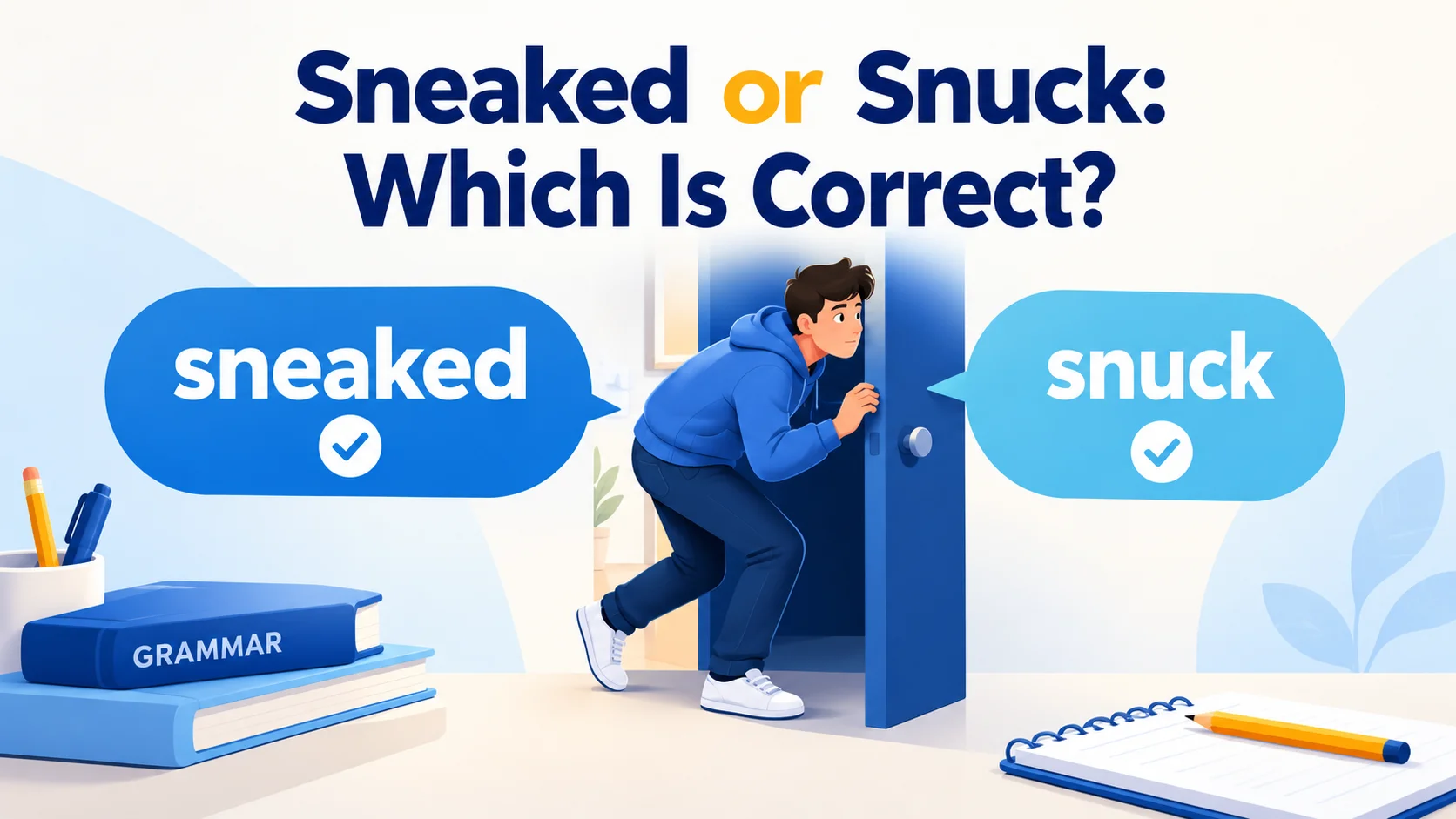
If you have ever paused while writing, sneaked or snuck, you are not alone. Both forms are grammatically correct, and both are used as the past tense and past participle of sneak. The difference is not what they mean but how they developed and how writers choose between them. Sneaked follows the familiar pattern of adding -ed to a verb, while snuck is an established irregular alternative. You can use either to describe someone moving quietly, leaving unnoticed, or doing something secretly, although audience expectations and writing style may influence your choice.
The distinction becomes more interesting when you consider American and British English, formal writing, everyday conversation, and the way English verbs change over time. Some people strongly prefer sneaked because it follows a regular pattern; others naturally say snuck and use it in published writing. Neither preference makes the other form automatically wrong. Understanding the difference helps you choose wording that sounds natural without mistaking a personal or editorial preference for a grammatical rule. It also explains why dictionaries recognize both forms, even when speakers do not use them equally often.
In this guide, you will learn what sneaked and snuck mean, how to use them in different tenses, and why the irregular form became established. You will also see examples involving everyday situations, professional writing, fiction, and figurative expressions. A practical comparison table will help you make a quick decision, while the usage tips will show when consistency matters more than choosing one form over the other. By the end, you should be able to select sneaked or snuck confidently, explain your choice, and recognize the difference between a genuine grammatical error and a variation in accepted English usage.
Quick Answer: Sneaked vs. Snuck at a Glance
| Feature | Sneaked | Snuck |
| Is this correct? | Yes | Yes |
| Verb pattern | Regular | Irregular |
| Simple past | She sneaked away. | She snuck away. |
| Past participle | She has sneaked away. | She has snuck away. |
| Meaning | To move or act secretly | To move or act secretly |
| Regional association | Common in British and American English | Particularly associated with American English |
| Best use | A neutral choice across many contexts | Natural in conversation and widely accepted writing |
The essential rule: Sneaked and snuck generally mean the same thing. Choose the form that suits your audience and context, and follow any style guide that applies to your writing. Cambridge Dictionary lists sneaked and, especially in US usage, snuck as forms of the verb sneak.
What Does Sneaked Mean?
Sneaked is the regular past-tense and past-participle form of sneak. The verb describes moving somewhere quietly or secretly, taking something somewhere without attracting attention, or doing something discreetly.
For example:
- The cat sneaked into the kitchen while everyone was eating.
- Maya sneaked out of the meeting a few minutes early.
- I sneaked a glance at the clock.
- A small mistake sneaked into the final report.
The word does not always imply wrongdoing. Someone might sneak up on a friend to surprise them, sneak a peek at a gift, or sneak a little extra time into a busy schedule. The common idea is that an action happens discreetly or without being noticed.
How to Use Sneaked in a Sentence
The easiest way to understand sneaked is to see how it works with different sentence patterns.
1. Moving without being seen
The fox sneaked through the garden and disappeared behind the shed.
Here, sneaked describes quiet, careful movement.
2. Leaving without attracting attention
Jordan sneaked out before the presentation ended.
The sentence emphasizes an unnoticed departure, not necessarily a dishonest one.
3. Doing something discreetly
He sneaked a quick look at the notes on his desk.
In this example, the person looks at something without wanting others to notice.
4. Describing a gradual or figurative change
Doubt sneaked into her mind as the discussion continued.
Doubt does not literally walk anywhere. The verb creates an image of a thought appearing gradually or almost unnoticed.
5. Bringing something into a place secretly
They sneaked snacks into the cinema.
Here, sneaked takes a direct object, snacks, and describes the act of bringing them in discreetly.
These examples show why sneaked works in both literal and figurative contexts. It is not restricted to physical movement.
Why Is Sneaked Considered a Regular Verb Form?
English regular verbs usually form their simple past and past participle by adding -ed or -d to the base form. For example:
- walk → walked
- open → opened
- decide → decided
- sneak → sneaked
This makes sneaks predictable. If you already know the usual pattern for regular verbs, you can form it without learning a special spelling.
However, a regular form does not have to be the only accepted form. English contains verbs with competing regular and irregular forms. Sneak is one of them: alongside sneaking, speakers also use snuck.
What Does Snuck Mean?
Snuck is an established irregular past-tense and past-participle form of sneak. It has the same basic meaning as sneaked: to move, enter, leave, look, or act secretly or discreetly.
Consider these examples:
- The children snuck downstairs after everyone had gone to bed.
- She snuck out before anyone could ask her another question.
- Someone snuck into the office after closing time.
- An unexpected fee snuck into the budget.
- I snuck a look at the schedule before the meeting began.
Each sentence could be used instead without a meaningful change in its basic meaning.
How to Use Snuck in a Sentence
Snuck is particularly familiar in American English and is common in everyday speech. It also appears in published writing, including journalism and fiction. Its use is not limited to casual conversation.
Here are examples of how it works in different settings.
In conversation
I snuck out for a short walk during the break.
The sentence sounds natural in informal conversation, particularly for many American English speakers.
In a story
The detective snuck through the side entrance while the others waited outside.
The irregular form keeps the narrative moving without changing the meaning.
In workplace writing
A duplicate entry snuck into the spreadsheet during the update.
This is understandable and grammatical, although an editor might prefer slipped into the spreadsheet or was inadvertently added in a formal report.
In figurative expressions
The deadline snuck up on us.
This familiar expression means that a deadline arrived sooner than expected or seemed to approach unnoticed.
Is Snuck a Real Word or Just Slang?
Yes, snuck is a recognized English verb form. It is not simply a slang error or a mistaken attempt to use sneak in the past tense.
The confusion comes partly from the way people learn grammar. Students are often taught that regular verbs take -ed, so sneaked may look more logical. But English also has irregular verbs such as stick → stuck and strike → struck. Over time, speakers can extend familiar patterns to other verbs.
Snuck was once more likely to be criticized as nonstandard, but modern dictionary descriptions recognize it as an established alternative. The American Heritage Dictionary’s usage note documents its growing acceptance among educated speakers.
That does not mean every editor prefers it. A word can be grammatically accepted while still being less preferred in a particular publication or context. Correctness and editorial preference are related, but they are not the same thing.
What Is the Difference Between Sneaked and Snuck?
The main difference is how the two forms are constructed and how people prefer to use them. Their core meaning is the same.
Meaning: Do Sneaked and Snuck Mean the Same Thing?
In most contexts, yes. Compare these pairs:
- The child sneaked into the garden.
- The child snuck into the garden.
Both describe the child entering the garden secretly.
- A typo sneaked into the article.
- A typo snuck into the article.
Both suggest that the typo appeared in the article without being noticed during editing.
Neither form inherently suggests greater secrecy, more deliberate wrongdoing, or a different degree of stealth. If a sentence seems more casual with snuck, that impression comes from usage and style—not a separate dictionary meaning.
Grammar: Regular vs. Irregular Verb Forms
The two forms follow different patterns:
- Regular form: sneak → sneaked → sneaked
- Irregular form: sneak → snuck → snuck
The first form follows the standard -ed pattern. The second uses a different past-tense form.
Both can appear in the simple past and in perfect tenses.
| Grammatical construction | With sneaked | With snuck |
| Simple past | He sneaked out. | He snuck out. |
| Present perfect | He has sneaked out. | He has snuck out. |
| Past perfect | He had sneaked out. | He had snuck out. |
| Future perfect | He will have sneaked out. | He will have snuck out. |
Notice that the form stays the same after has, have, had, and will have. In these constructions, sneaked and snuck function as past participles.
A common mistake is to assume that snuck can be used only in simple past sentences. It can also appear in perfect-tense constructions: They had snuck through the back entrance before the doors were locked.
American English vs. British English
Regional usage helps explain why some readers instinctively prefer one form.
Sneaked is well established in both American and British English. Snuck is particularly associated with American English, where it has become widely accepted. However, it also appears in writing from other English-speaking regions. The distinction is a matter of tendency, not a strict geographical boundary.
A 2014 study published in English Today examined the changing use of snuck and sneaked in British and American English. It described snuck as a newer competitor to the original form, sneaked, and investigated how the two forms have developed across varieties of English.
The practical lesson is simple: do not assume that a British writer cannot use snuck, or that an American writer must use it. Individual speakers, editors, and publications differ.
Tone and Formality: Which One Sounds More Natural?
Some readers perceive sneaked as more traditional or neutral and snuck as more conversational. That perception can influence an editor’s choice, but it does not establish a universal rule that one is formal and the other informal.
Consider the following situations:
- Everyday conversation: “I snuck out to get some fresh air.” This may sound natural to many American speakers.
- A narrative: “She sneaked through the empty corridor.” Either form can fit, depending on the writer’s voice.
- Academic writing: “The analysis revealed that an error had sneaked into the data.” This is grammatical; the writer may choose another phrasing if the field or style guide favors greater precision.
- A formal incident report: “An unauthorized entry occurred after closing time.” A more direct construction may be preferable because it emphasizes the event rather than the manner of movement.
The last example illustrates an important editing principle: sometimes the best choice is neither sneaked nor snuck. When precision matters, a more specific verb or a clearer sentence may communicate the facts better.
Sneaked or Snuck: Which One Should You Use?
There is no universal winner. Use the form that suits the situation, while keeping your audience and any applicable style requirements in mind.
In Everyday Conversation
Choose the form that sounds natural in your variety of English. If you commonly say snuck, there is no general grammatical reason to avoid it. If sneaked is the form you normally use, there is no need to switch.
For example, both of these sound natural to many English speakers:
- “We sneaked a look at the decorations.”
- “We snuck a look at the decorations.”
The surrounding sentence does not need to change.
In Academic and Professional Writing
For essays, reports, business documents, and research papers, consistency and clarity matter more than enforcing an imaginary rule that only one form is correct.
Use this checklist:
- Check whether your institution or publisher has a style guide.
- Follow the publication’s established preference if it specifies one.
- Use the same form consistently when there is no reason to vary it.
- Consider replacing the verb if a more precise expression would improve the sentence.
- Do not mark snuck as a grammatical error simply because you were taught the regular form.
For example, a report might say, “An incorrect value sneaked into the spreadsheet.” That sentence is grammatically sound. If the report needs to identify an accidental data-entry problem precisely, “An incorrect value was entered into the spreadsheet” may be clearer.
In Fiction, Dialogue, and Creative Writing
Creative writing gives you more freedom to reflect a character’s natural speech. A character’s regional background, age, and conversational habits can influence whether sneaked or snuck feels more authentic.
For example:
“I snuck downstairs to see whether the guests had arrived,” Liam whispered.
Another narrator might write:
She sneaked down the stairs, careful not to wake anyone.
Both are valid. You do not need to standardize every character’s dialogue to the same form, although the narrator’s own voice should generally remain consistent unless a change is deliberate.
Is Sneaking the Safer Choice If You Are Unsure?
Sneaked can be a practical default if you are writing for a broad international audience or prefer the traditional regular form. It is widely recognized and avoids potential objections from readers who dislike the irregular variant.
But remember the distinction: choosing sneaked as a cautious editorial preference does not make snuck incorrectly. If your audience readily uses snuck, or your publication accepts it, you can use it confidently.
Common Mistakes When Using Sneaked and Snuck
Both forms are accepted, but writers can still make mistakes when interpreting their grammar or applying them in a sentence.
Mistake 1: Assuming Snuck Is Always Wrong
This is the most common misconception. Snuck is an established irregular form, not automatically a grammatical error.
Incorrect assumption: “I must change snuck to sneaked because all past-tense verbs take -ed.”
Better understanding: Regular verbs often take -ed, but English also has irregular verbs. Snuck is an accepted alternative to sneaking.
Mistake 2: Treating the Forms as Different in Meaning
A writer might assume that sneaking means moving quietly while snuck means doing something dishonestly. That distinction is not inherent in the words.
Compare:
- The dog sneaked into the kitchen.
- The dog snuck into the kitchen.
Both sentences describe the same action. If the writer wants to emphasize dishonesty, secrecy, or intention, that meaning must come from the surrounding context.
Mistake 3: Confusing Simple Past and Past Participle
Both forms can be used as past participles, especially after has, have, or had.
| Sentence | Why it works |
| She sneaked past the desk. | Sneaking is the simple past. |
| She snuck past the desk. | Snuck is the simple past. |
| She has sneaked past the desk. | Sneaked follows as a past participle. |
| She has snuck past the desk. | Snuck follows as a past participle. |
The mistake is not choosing one form over the other; it is misunderstanding how the verb works in the sentence.
Mistake 4: Changing Forms Without Considering Editorial Consistency
Switching between sneaked and snuck is not automatically ungrammatical. However, unexplained variation can distract readers, particularly in formal writing.
Suppose a report is sneaked in three paragraphs and then changes to snuck without a stylistic reason. An editor might standardize the form simply to keep the prose consistent.
Practical fix: Choose a form that suits the audience, then use it consistently unless the context justifies a change.
Sneaked and Snuck in Real-Life Examples
The examples below show how the forms work across literal movement, everyday actions, and figurative language.
Examples About Moving Quietly or Secretly
- The cat sneaked under the table to avoid the vacuum cleaner.
- The cat snuck under the table to avoid the vacuum cleaner.
- We sneaked through the side gate before the rain began.
- We snuck through the side gate before the rain began.
Each pair has the same basic meaning. The choice depends on the writer’s preferred form and audience.
Examples About Leaving or Entering Unnoticed
- The visitor sneaked out before the host could say goodbye.
- The visitor snuck out before the host could say goodbye.
- Someone sneaked into the building after the office closed.
- Someone snuck into the building after the office closed.
These sentences focus on entering or leaving without attracting attention. The surrounding context determines whether the action is harmless, secretive, or improper.
Examples of Figurative Usage
The verb sneak can describe things that are not literally moving.
- A feeling of uncertainty sneaked into the discussion.
- A feeling of uncertainty snuck into the discussion.
- A typo sneaked into the final version.
- A typo snuck into the final version.
- The holidays sneaked up on us.
- The holidays snuck up on us.
In these examples, the verb suggests that something appeared or approached gradually, unexpectedly, or without being noticed.
Examples in Different Tenses
| Tense or form | Example |
| Base form | I sometimes sneak a look at the schedule. |
| Simple past | I sneaked a look yesterday. |
| Simple past | I snuck a look yesterday. |
| Present perfect | I have sneaked a look before. |
| Present perfect | I have snuck a look before. |
| Past perfect | I had sneaked out before the meeting began. |
| Past perfect | I had snuck out before the meeting began. |
The base form sneak is used in the present tense and after auxiliaries such as will or do. The past forms sneaked and snuck work in both simple past and perfect constructions.
The History of Sneaked and Snuck
The history helps explain why the two forms coexist. Sneaked follows the regular pattern of English verbs, while snuck developed as an alternative that resembles the past-tense pattern of other irregular verbs.
The American Heritage Dictionary traces snuck to the nineteenth century as a regional American variant of sneaked. Its usage note explains that the form probably developed by analogy with verbs such as stick and stuck. It also documents the form’s growing acceptance over time.
Why Did Sneak Develop an Irregular Form?
English does not remain perfectly uniform. Speakers sometimes extend familiar patterns from one verb to another. For instance, snuck resembles the pattern found in stick → stuck and strike → struck, even though sneak traditionally forms its past tense with -ed.
Linguists study such changes by looking at how words appear in speech and writing over time. A 2014 study in English Today examined the development of snuck alongside sneaked in British and American English, showing how a newer form can compete with an older one.
The important point is that a form’s history does not determine whether it is acceptable today. A word may begin as a regional or disputed variant and later become widely recognized. Current dictionary treatment and real usage are more useful guides than the assumption that every verb must follow one pattern.
Quick Tips for Remembering Sneaked vs. Snuck
Use these reminders when editing your own writing:
- Remember the regular pattern: Sneak → sneaked follows the familiar -ed rule.
- Recognize the irregular alternative: Snuck is also accepted.
- Keep the meaning in mind: The two forms generally mean the same thing.
- Consider your audience: Regional habits can influence which form sounds more natural.
- Follow house style: If a publisher, teacher, or organization specifies a preference, use it.
- Prioritize clarity: If neither form fits the tone of a formal sentence, consider a more precise alternative such as entered quietly, left unnoticed, or was added inadvertently.
Test Your Knowledge: Sneaked or Snuck?
Choose the form that best completes each sentence. In every item below, both sneaked and snuck can generally work; the exercise tests whether you recognize their grammatical use rather than whether you can guess a single supposedly correct answer.
Choose the Correct Form
- The puppy ___ into the bedroom while we were away.
- She had ___ a glance at the notes before the meeting.
- Someone ___ out of the building just before the alarm sounded.
- A spelling error had ___ into the final draft.
- The children ___ downstairs to get a glass of water.
Answers and Explanations
- Sneaked or snuck — Both work as the simple past of sneak.
- Sneaked or snuck — Both can serve as past participles after having.
- Sneaked or snuck — Either form describes leaving unnoticed.
- Sneaked or snuck — Both work in this figurative expression.
- Sneaked or snuck — Both are acceptable in this sentence.
The useful lesson is not to memorize one answer for every situation. It is to recognize that the forms are alternatives and choose according to context and style.
Conclusion:
The choice between sneaked or snuck is simpler than it first appears: both are accepted forms of sneak, and neither is universally more correct than the other. Sneaked follows the regular -ed pattern, while snuck is an established irregular form, especially familiar in American English. Both can describe secret movement, discreet actions, and figurative developments, and both work as past tense and past participle.One final actionable tip: Before choosing a form, consider who will read your writing. If a publisher or institution has a style guide, follow it; otherwise, use the form that sounds natural and fits your audience. A common mistake to avoid is correcting snuck simply because it does not follow the regular verb pattern. English includes many accepted variations. Good writing depends on using them thoughtfully, not forcing every verb into the same grammatical mold.
FAQs
Q1. Is Sneaked or Snuck Correct?
Both sneaked and snuck are correct forms of the verb sneak. Sneaked follows the regular past-tense pattern, while snuck is an established irregular alternative. Both can function as past tense and past participle, so your choice depends on context and preference.
Q2. Is Snuck Grammatically Correct in Formal Writing?
Yes, snuck is an accepted verb form, although some editors may prefer sneaked in formal documents. Check your organization’s style guide if one applies. Without a specific restriction, using snuck does not automatically make a sentence grammatically incorrect.
Q3. Is Sneaked More Common in British English?
Sneaked is well established in British English, while snuck has a particularly strong association with American English. However, these are broad usage tendencies, not strict rules. Writers in Britain and other English-speaking regions may use snuck, depending on their habits and audience.
Q4. What Is the Past Participle of Sneak?
Both sneaked and snuck can serve as the past participle of sneak. For example, you can write “She has sneaked outside” or “She has snuck outside.” Both constructions are accepted, and neither form is restricted to the simple past tense.
Q5. Can I Use Sneaked and Snuck Interchangeably?
Generally, yes. Sneaked and snuck are interchangeable in meaning when describing the same secretive or discreet action. However, regional preferences, an editor’s requirements, and the tone of your writing may influence the choice. In a single document, consistency is often helpful.