

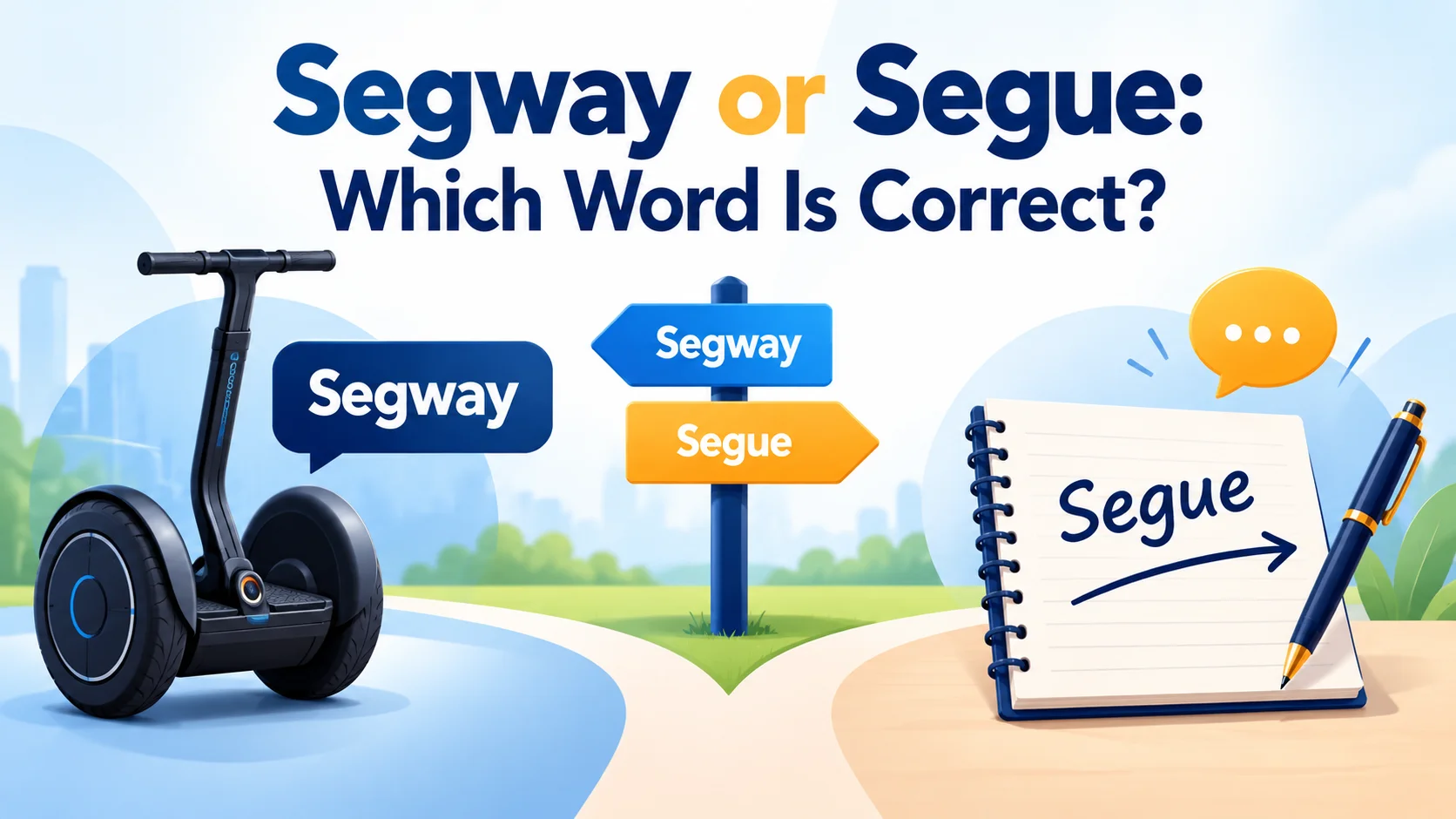
The difference between Segway or segue comes down to meaning, not pronunciation. Both words sound the same, but they serve very different purposes in English. A segue describes a smooth transition from one topic, idea, scene, or activity to another, while a Segway refers to a transportation brand and its associated personal transporters. Confusing them can create awkward sentences, especially in professional emails, essays, presentations, and articles. Once you understand what each word represents, choosing the correct spelling becomes straightforward—even when you have only heard the word spoken aloud.
The confusion is understandable because segue has an unexpected spelling. Many readers encounter it in writing long before they feel comfortable using it themselves. Since Segway looks more like the way both words sound, it can seem like the obvious spelling for a change of subject. However, English spelling does not always follow pronunciation, and familiar-looking words are not necessarily interchangeable. The distinction matters when describing a speaker moving between ideas, a podcast transitioning to a new segment, or a tourist riding a branded personal transporter.
In this guide, you will learn the meaning of segue and Segway, how to pronounce them, and when each belongs in a sentence. You will also discover the correct forms segued and segueing, understand when to capitalize Segway, and see how the words work in everyday and professional contexts. Practical examples, a comparison table, common-error corrections, and a short practice exercise will help you remember the difference. By the end, you will be able to select the right spelling based on context rather than guessing from sound.
Segue vs. Segway: The Key Differences
The easiest way to distinguish these words is to look at what the sentence describes. Segue is about a transition; Segway is a brand name. Their identical pronunciation does not make them interchangeable.
| Feature | Segue | Segway |
| Core meaning | A smooth transition | A personal transportation brand |
| Part of speech | Noun and verb | Proper noun |
| Capitalization | Usually lowercase | Capitalized when referring to the brand |
| Past tense | Segued | Not normally used as a verb for transitions |
| Common setting | Conversations, writing, music, presentations | Transportation, products, guided tours |
| Example | “She segued into the next topic.” | “They toured the park on a Segway.” |
The distinction is supported by standard dictionaries, which define segue as both a noun and a verb describing a smooth transition.
The official company website identifies Segway as a personal transportation brand.
A quick decision guide
Ask yourself what you are trying to describe:
- A change in subject? Use segue.
- A smooth transition between songs or scenes? Use segue.
- A branded personal transporter? Use Segway.
- A different type of scooter or transporter? Use the appropriate generic product name.
For example, “The host made a segue into the next segment” describes a transition. “The host arrived on a Segway” describes transportation. The surrounding sentence makes the intended meaning clear.
What Does “Segue” Mean?
A segue is a smooth movement from one thing to another. It can describe a change in a conversation, a shift between sections of an article, a transition between scenes in a film, or the way one musical passage flows into the next.
The word can function as either a noun or a verb, so it appears in several sentence structures.
“Segue” as a noun
As a noun, segue names the transition itself. It is especially useful when the connection between two subjects matters.
Examples:
- “The final paragraph provides a natural segue into the recommendations.”
- “Her experience working abroad was a useful segue into the discussion about international business.”
- “The presenter used a question as a segue to the next section.”
- “The last song creates a gentle segue into the closing track.”
Notice that a segue does more than indicate that one thing happens after another. It often suggests that the transition feels connected, logical, or uninterrupted.
A paragraph that links a problem to its solution can provide a segue. So can a speaker who finishes discussing customer feedback and then introduces the changes the company plans to make.
“Segue” as a verb
As a verb, segue means to move smoothly from one subject, activity, scene, or situation to another. It is often followed by a preposition such as into or from.
Examples:
- “The discussion segued into a review of next year’s goals.”
- “After introducing the problem, the writer segues into possible solutions.”
- “The documentary segues from historical footage into present-day interviews.”
- “The conversation segued from weekend plans to university applications.”
The verb is useful when you want to describe the transition as an action rather than name the transition itself.
Compare these sentences:
- Noun: “The anecdote was a good segue into the main topic.”
- Verb: “The speaker segued from the anecdote into the main topic.”
Both are correct. Choose the structure that fits the sentence naturally.
How to create a good segue in writing
Using the word segue does not automatically make a paragraph flow well. A genuine transition needs a logical connection between the ideas.
Consider this example:
Abrupt version:
“Our customer satisfaction scores improved this quarter. The company will now introduce a new training program.”
The statements may both be relevant, but their relationship is not immediately obvious.
Improved version:
“Our customer satisfaction scores improved this quarter, highlighting the value of consistent service. The next step is to build on that progress through a new training program.”
The second version explains the relationship between the results and the proposed action. The reader can follow the reasoning without having to infer the connection.
When editing your own work, ask:
- What idea has the reader just encountered?
- What idea comes next?
- What connects them?
- Does that connection need to be stated explicitly?
Sometimes a single linking sentence is enough. Other times, the best segue is simply a clear sentence that explains why the next section follows.
What Does “Segway” Mean?
Segway is a brand name associated with personal transportation devices. The word is commonly recognized in connection with self-balancing transporters, although the company’s product range also includes other types of vehicles and mobility products.
When you mean the brand, write Segway with a capital S.
Examples:
- “The tour company offers a guided Segway tour.”
- “The visitors learned how to use the Segway before setting off.”
- “The article compares several Segway products with other personal transportation options.”
The important point is that Segway identifies a brand, whereas segue describes a transition.
Is Segway a generic word for any scooter?
No. A brand name should not automatically replace the general name for an entire category of products.
If you mean a particular Segway-branded product, use Segway. If you mean an electric scooter from an unspecified manufacturer, write electric scooter. Depending on the device, terms such as personal transporter may also be appropriate.
For example:
- Brand-specific: “The rental company provides Segway devices.”
- Generic: “The rental company provides electric scooters.”
These sentences do not necessarily describe the same type of vehicle. Choosing the right product term improves accuracy and prevents readers from assuming that a particular brand is involved.
Should “Segway” always be capitalized?
Use Segway when referring to the brand. Use segue in ordinary writing when referring to a transition.
| Sentence | Correct? | Why |
| “That is a useful segue into the next point.” | Yes | Segue means a transition. |
| “That is a useful Segway into the next point.” | No, for the intended meaning | The brand name does not mean a transition. |
| “We rented a Segway for the tour.” | Yes | The sentence refers to the brand. |
| “We rented a segue for the tour.” | No, for the intended meaning | Segue does not name the vehicle. |
Capitalization can also depend on sentence position and title style. For example, Segue may begin with a capital letter at the start of a sentence without becoming a brand name.
How to Spell “Segue” Correctly
The unusual spelling can cause problems when you need to use the word in different grammatical forms. The safest approach is to learn its common forms rather than guess from pronunciation.
Is it “segued” or “segwayed”?
The standard past tense is segued, not segwayed, when describing a transition.
- Present: “The presenter segues into the next topic.”
- Past: “The presenter segued into the next topic.”
- Past participle: “The presenter has segued into the next topic.”
The same spelling applies whether the transition happens in a meeting, a conversation, a film, or a piece of music. Oxford and Cambridge dictionaries list segued as the past-tense form.
Incorrect: “The host segwayed into the audience questions.”
Correct: “The host segued into the audience’s questions.”
The incorrect form is tempting because Segway is pronounced the same way, but spelling the verb with -way changes it into a different word.
Is it “segueing” or “seguing”?
Segueing is a well-established spelling of the present participle. Some dictionaries also record segueing, so it is too absolute to claim that the shorter spelling never occurs.
For polished general writing, segueing is a straightforward choice because it preserves the recognizable spelling of segue.
Examples:
- “The speaker is segueing into the final part of the presentation.”
- “The film keeps segueing between past and present.”
- “The conversation was segueing toward a more personal subject.”
The practical lesson is to avoid segwaying when you mean transitioning between ideas. If you want a simple way to avoid uncertainty, you can also rephrase the sentence:
- “The discussion is moving into a new topic.”
- “The film transitions between past and present.”
Can “segue” be used with “into,” “from,” and “to”?
Yes. These prepositions can all work, depending on what you want to express.
- Segue into: emphasizes the next subject or stage.
- Segue from: identifies the starting point of the transition.
- Segue to: identifies the next subject or destination.
Examples:
- “The article segues into a discussion of common mistakes.”
- “The presenter segued from the budget review to the project schedule.”
- “The final scene segues to the opening image.”
The choice depends on the sentence, not on a rigid rule that one preposition is always correct. When the transition involves both a starting point and a destination, from … to … can make the relationship especially clear.
How to Use “Segue” in Different Contexts
The word is useful in more than formal essays. It appears in spoken presentations, creative work, conversations, and media production. However, a word that is precise in one setting may feel unnecessarily elaborate in another.
In essays, articles, and blog posts
A segue can connect paragraphs, sections, or stages of an argument.
For example, an article about the causes of poor sleep might move from explaining screen habits to discussing evening routines. A sentence that connects the two subjects helps the reader understand why the next section matters.
Useful approach:
- End one section with a point that leads naturally to the next.
- Explain the relationship when it is not obvious.
- Avoid adding transition phrases simply to make the writing sound sophisticated.
You do not need to write “This provides a segue into the next section” every time you change topics. Often, a direct transition is clearer.
In speeches, meetings, and presentations
Spoken segues help an audience follow the structure of a presentation. They can connect an earlier observation to a new topic without making the shift feel arbitrary.
For example:
“We’ve looked at the customer feedback. Now let’s examine what those comments tell us about our next product update.”
The speaker does not need to use the word segue aloud. The transition itself is what matters.
For meetings, the best segues are usually short. People need to know why the next agenda item follows, not hear a long explanation of the transition.
In podcasts, films, and music
In creative contexts, segue can describe a change between audio segments, scenes, songs, or musical passages. The transition may be designed to feel continuous rather than interrupted.
Examples:
- “The podcast segues from the interview into a short analysis.”
- “The closing shot segues into the next scene.”
- “The final track segues directly into the opening of the next song.”
This use is particularly close to the word’s musical history. The term originated as a direction in musical scores indicating that what follows should begin without a break. Its meaning later expanded to transitions in other contexts.
In everyday conversation
People also use segue informally:
- “That’s a good segue into what I wanted to ask.”
- “Speaking of travel, that gives me a segue into my holiday plans.”
- “How did we segue from schoolwork to cooking?”
It is a perfectly usable word in conversation, but it may sound more formal or self-conscious than necessary in a casual exchange. Depending on the audience, move on to, lead into, or switch to may sound more natural.
The aim is not to use the most sophisticated word available. It is to communicate the connection clearly.
Common Segue and Segway Mistakes—and How to Fix Them
Most mistakes happen when writers rely on sound instead of meaning. These examples show how to correct the spelling without changing the intended message.
Mistake 1: Using “Segway” for a change of subject
Incorrect: “That is a perfect Segway into our next discussion.”
Correct: “That is a perfect segue into our next discussion.”
The sentence describes a transition between subjects, so segue is the right word.
Mistake 2: Using “segue” for the transportation device
Incorrect: “We took a segue tour around the historic district.”
Correct: “We took a Segway tour around the historic district.”
Use the brand name when the tour specifically involves Segway devices. If the tour uses a different type of transporter, identify that product accurately instead.
Mistake 3: Writing “segwayed” for the past tense
Incorrect: “The presenter segwayed into a new topic.”
Correct: “The presenter segued into a new topic.”
The verb form comes from segue, so its past tense is segued.
Mistake 4: Capitalizing “segue” unnecessarily
Incorrect in ordinary sentence use: “The interview offered a Segue into the subject.”
Correct: “The interview offered a segue into the subject.”
Use lowercase segue unless capitalization is required by sentence position or a title’s style.
Mistake 5: Treating Segway as a generic product category
Potentially misleading: “Everyone should use a Segway to get around the city.”
If you mean personal transportation generally, a more accurate version might be:
“Some people use electric scooters or other personal transporters to get around the city.”
Use Segway when the brand is specifically relevant, rather than as a catch-all term for every device.
Memory Tricks for Remembering Segue vs. Segway
A good memory trick should help you make the decision quickly, not add another complicated rule to remember.
Connect “segue” with a smooth transition
Think of segue as a word that helps one idea follow another. That connection also fits its Italian origin: segue means “it follows.”
Remember:
- Segue = a shift in ideas, subjects, scenes, or activities.
- Segway = a brand associated with personal transportation.
Use the meaning test
Before choosing the spelling, pause and ask:
Am I describing a transition or a product?
If the answer is a transition, use segue. If it is the brand, use Segway. If it is a different product, use its correct name.
This approach is more dependable than trying to remember which spelling looks right. Since the two words sound alike, pronunciation cannot settle the question.
Practice: Can You Choose the Correct Word?
Choose the word or form that correctly completes each sentence.
- The host used a natural ___ to introduce the next segment.
- The tourists rented a ___ for their guided ride.
- The speaker ___ from the introduction into the main argument.
- The conversation is ___ into a discussion of future plans.
- The article uses the final paragraph as a ___ into its recommendations.
Answer key
- Segue — It names the transition between segments.
- Segway — It refers to the transportation brand.
- Segued — This is the standard past tense of segue.
- Segueing — This is a widely accepted present participle of segue.
- Segue — The paragraph creates a connection to the next part of the article.
If you missed an answer, return to the meaning of the sentence rather than memorizing the entire example. Once you recognize whether the sentence describes a transition or a branded product, the correct spelling becomes much easier to identify.
Conclusion:
The difference between Segway or segue becomes simple once you focus on meaning. Use segue when an idea, conversation, musical passage, or scene moves smoothly into another. Use Segway when referring to the transportation brand. Their identical pronunciation explains the confusion, but it does not make the spellings interchangeable.One final actionable tip: Before submitting an email, essay, presentation, or article, check whether the sentence describes a change in subject or a physical product. That quick review can catch the mistake before it reaches your reader. Remember the standard verb forms, too: segue, segued, and segueing are useful choices when describing transitions.A common mistake to avoid is choosing a spelling because it looks closer to the way the word sounds. In this case, context is the more reliable guide. The right word makes your meaning clear—and good writing should always make the reader’s job easier.
FAQs
Q1. Is “segue” the correct word for changing the subject?
Yes. Segue is the correct word when describing a smooth change from one subject to another. It can be used as a noun, as in “a segue into the next topic,” or as a verb, as in “the discussion segued into another issue.”
Q2. Are “segue” and “Segway” pronounced the same?
Yes. In standard English, both are pronounced /ˈsɛɡ.weɪ/, roughly “SEG-way.” They are homophones, meaning they sound alike but differ in spelling and meaning. Because speech alone cannot distinguish them, choose the spelling by considering the sentence’s context.
Q3. Is it “segwayed” or “segued”?
Segued is the standard past-tense form when describing a transition. For example, “The speaker segued into the next section.” Segwayed is not the standard spelling for this meaning because it incorrectly borrows the transportation brand’s spelling.
Q4. Is “segue” too formal for everyday conversation?
No. Segue is acceptable in casual conversation, particularly when discussing how one subject leads to another. However, it can sound slightly formal in some situations. Expressions such as “move on to,” “lead into,” or “switch to” may feel more natural in relaxed conversation.
Q5. Should “Segway” always be capitalized?
Capitalize Segway when referring to the brand. The ordinary word segue is usually lowercase, except when it begins a sentence or follows a title’s capitalization rules. In professional writing, preserving this distinction helps readers recognize whether you mean a transition or a branded product.