

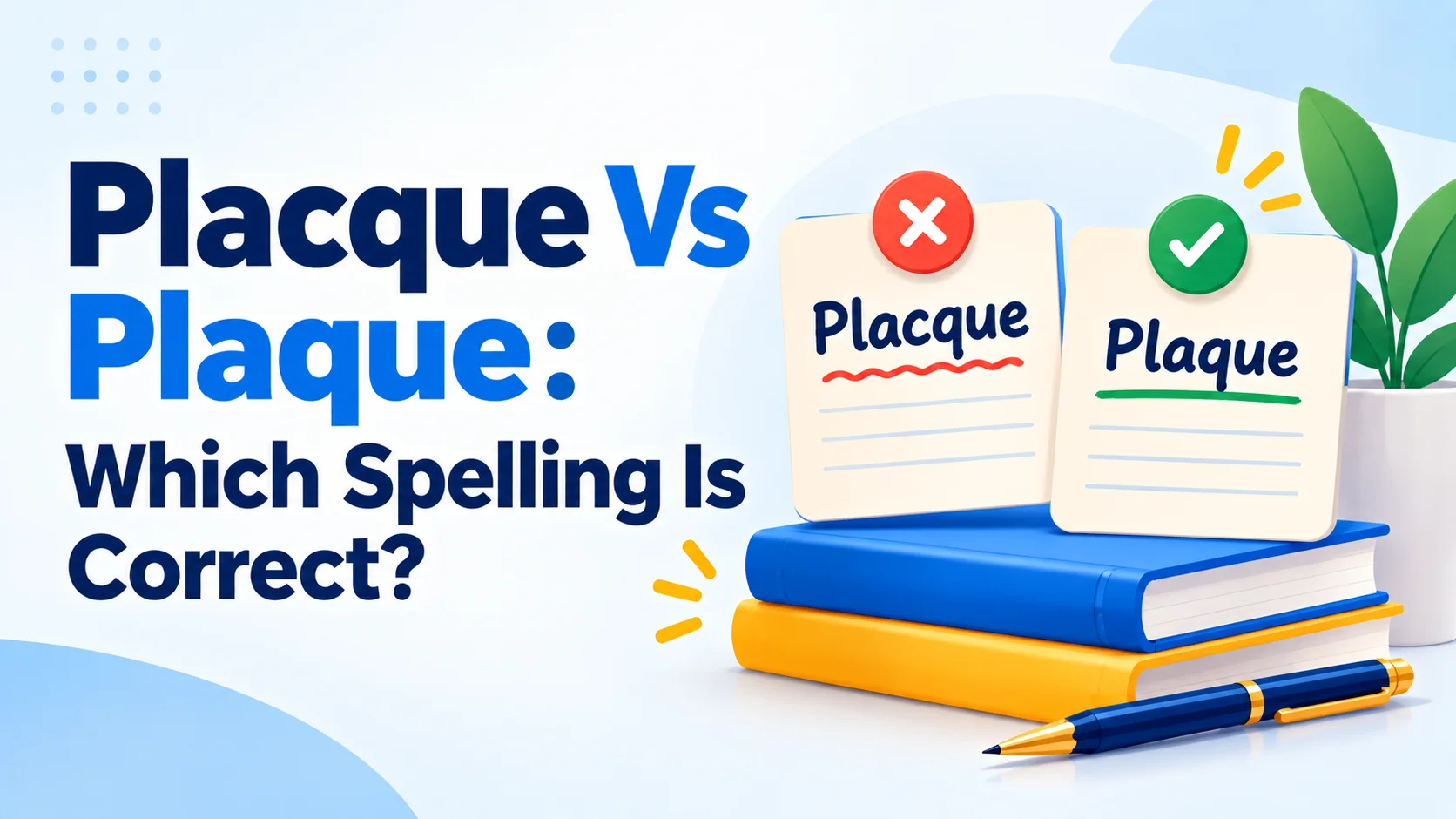
Placque vs. plaque is a spelling question that looks deceptively simple because the two forms differ by only one letter. If you are writing about an award, memorial, dental health, or a medical condition, however, choosing the standard spelling matters. The correct form in modern standard English is plaque. Placque is generally treated as a misspelling rather than an alternative spelling. Once you know that distinction, the choice becomes straightforward. The interesting part is understanding why plaque appears in such different contexts and how to use it naturally in each one.
The word plaque has several meanings, but its spelling does not change with the meaning. It can describe a flat commemorative or decorative tablet, such as one attached to a historic building; a sticky bacterial film on teeth; or a localized buildup or raised area in certain medical contexts. Cambridge Dictionary records these major senses and gives different pronunciations for British and American English. The American pronunciation is /plæk/, while British English may use /plɑːk/ or /plæk/.
This guide explains placque vs. plaque from the perspective of real-world English usage. You will learn which spelling to choose, why the extra c is tempting, how plaque differs from related words such as plate and tartar, and how to use the word correctly in sentences. You will also see examples from awards, history, dentistry, medicine, workplace writing, and academic contexts, followed by a quick reference guide and practical FAQs.
Quick answer: Plaque is the standard spelling. In ordinary English writing, use plaque, not placque.
Placque vs. Plaque: The Quick Answer
The correct spelling is plaque.
Plaque is generally considered a misspelling of plaque in standard modern English. It does not represent a separate meaning that you should substitute when talking about awards, memorials, dental deposits, or medical plaques. A dictionary entry for placque in Wiktionary explicitly labels it a misspelling of plaque, while Cambridge Dictionary gives plaque as the standard English entry.
| Form | Standard spelling? | Typical meaning | Recommendation |
| plaque | Yes | Commemorative tablet, dental deposit, medical plaque | Use it |
| placque | No, in ordinary standard English | Usually an attempted spelling of plaque | Avoid it |
So, if you are wondering whether to write “award placque” or “award plaque,” choose award plaque. If you mean the substance that forms on teeth, write dental plaque. The same spelling applies in both cases.
What Does “Plaque” Mean?
Plaque is a noun with several established meanings. Its exact sense depends on the context surrounding it.
Cambridge Dictionary groups its meanings into three useful categories: a flat object carrying writing or information, a substance that forms on teeth, and a specialized medical raised area or buildup inside the body.
Plaque as a Commemorative or Decorative Object
A plaque can be a flat piece of metal, stone, wood, plastic, or another material containing writing, usually attached to a wall, door, monument, or other surface.
For example:
- The museum installed a commemorative plaque outside the entrance.
- A brass plaque identifies the building’s historical significance.
- The university unveiled a plaque honoring the retiring professor.
In this sense, plaque is closely associated with recognition, remembrance, identification, and historical information.
Plaque in Dentistry
In dentistry, dental plaque is a soft, sticky substance that accumulates on teeth and contains bacteria and bacterial derivatives. The American Dental Association defines plaque as a soft, sticky substance that accumulates on teeth and is largely composed of bacteria and bacterial derivatives.
For example:
Regular oral hygiene helps remove dental plaque before it hardens.
The important spelling point is unchanged: it is plaque, never placque.
Plaque in Medicine
In medical terminology, plaque can describe a localized raised area or buildup of material. Cambridge gives examples involving arterial plaque and plaques associated with certain diseases.
For general readers, the safest approach is to let the surrounding medical terminology provide the meaning:
- arterial plaque
- plaque formation
- plaque buildup
- plaques in tissue
The word itself does not tell you exactly what kind of plaque is being discussed.
Is “Placque” a Correct English Word?
For the ordinary English word discussed here, plaque is the form you should use.
The extra c in placque does not create a different standard English meaning. If you are writing a sentence about a memorial tablet, award, dental buildup, or medical deposit, changing plaque to placque is simply a spelling error.
There is one useful qualification: historical dictionaries and historical documents can preserve older spellings that are no longer standard. For example, the Académie Française’s historical dictionary records placque in earlier French editions before later editions used plaque. That historical evidence should not be confused with modern standard English spelling.
For contemporary English writing, the practical rule remains simple:
Write a plaque.
Why “Placque” Looks Plausible
Misspellings often survive because they look believable.
The sequence pla-que is visually unusual, and writers may instinctively insert another c before the q. The resulting placque still looks like it could be a legitimate word.
Pronunciation makes the problem worse because you cannot hear the spelling when someone says the word aloud. The sound gives you no reliable reason to choose between plaque and placque.
This is why memorizing the standard written form is more useful than trying to spell the word phonetically.
Why Do People Confuse “Placque” and “Plaque”?
Several factors can contribute to the confusion.
The Extra “C” Feels Natural
English contains many words with unusual combinations involving c, q, and u, so writers sometimes assume plaque should contain another consonant.
But spelling patterns are not always predictable. The fact that another word contains a double consonant does not mean plaque should.
Pronunciation Does Not Reveal the Spelling
Cambridge lists the American pronunciation as /plæk/ and British pronunciations as /plɑːk/ and /plæk/. Neither pronunciation makes the written sequence plaque obvious to someone encountering the word for the first time.
The Word Appears in Several Fields
A learner may first encounter plaque in dentistry and later see it on a historical building or an award.
That can make the word feel more complicated than it really is. The meaning changes with context, but the spelling does not.
Plaque Pronunciation: How Do You Say It?
In American English, plaque is pronounced /plæk/.
It sounds approximately like “plak.”
In British English, Cambridge gives /plɑːk/ as well as /plæk/.
The final -que does not create a separate syllable. This is important for English learners because the written form may initially suggest a longer pronunciation than the word actually has.
Does “Placque” Have a Different Pronunciation?
Not in the way the spelling mistake is normally intended.
When someone writes placque, they usually mean plaque and would pronounce it accordingly. The extra c is therefore not a useful pronunciation distinction; it is simply an unnecessary letter.
Where Does the Word “Plaque” Come From?
The English noun plaque entered English in the 19th century from French plaque, meaning a metal plate or coin. Etymological evidence traces the word further through Flemish or Middle Dutch forms associated with ideas such as a disk, patch, or stain.
The historical development helps explain why the modern meanings seem unrelated at first.
The word originally referred to something flat or plate-like. English later developed specialized uses for deposits or localized areas of material. EtymOnline dates the arterial sense to the late 19th century and the dental sense to the end of that century.
The important lesson for spelling is not the entire etymological history. It is this:
Plaque is an established loanword with an established spelling.
Trying to reconstruct its spelling from modern English pronunciation is therefore likely to produce the wrong result.
The Different Meanings of “Plaque” Explained Clearly
Plaque as an Award
An award plaque is a physical object presented to someone as recognition of an achievement, contribution, service, or accomplishment.
Examples include:
- employee recognition plaques
- academic achievement plaques
- sports award plaques
- service recognition plaques
- community awards
Example:
The organization presented Elena with a plaque recognizing her years of volunteer service.
A plaque does not have to be made from one particular material. What makes it a plaque in this context is its function as a flat recognition or commemorative object.
Plaque as a Memorial or Historical Marker
A memorial plaque commemorates a person, event, group, or place.
You may see plaques:
- on historic buildings
- near monuments
- in museums
- at schools and universities
- in public spaces
- at sites associated with notable people
A blue plaque, for example, is a familiar British cultural institution used to mark buildings associated with notable individuals. Cambridge specifically includes blue plaque as a recognized expression.
Example:
A small plaque on the wall explains the building’s connection to the city’s history.
Plaque in Dentistry
Dental plaque is a bacterial film that accumulates on teeth. The American Dental Association explains that plaque can harden into tartar when it is not removed.
This gives us an important vocabulary distinction:
Plaque and tartar are related, but they are not synonyms.
The ADA describes plaque as a soft film of bacteria and tartar as a hard mineral deposit that forms when plaque hardens.
Plaque in Medicine
Medical writing uses plaque in specialized ways. For example, arterial plaque refers to a buildup associated with blood vessel walls, while other medical fields may use plaque for localized areas or deposits.
Cambridge also records medical uses involving plaques in brain tissue and other parts of the body.
For language learners, the key point is that plaque is a legitimate medical term, not merely a word for an award or sign.
Plaque vs. Plate: What’s the Difference?
Plaque and plate overlap conceptually because both can describe something flat, but they are not interchangeable in every situation.
| Word | Typical meaning | Example |
| Plaque | A flat object carrying an inscription or a localized deposit/substance | “The building has a commemorative plaque.” |
| Plate | A broad, flat object with many possible functions | “The laboratory used a metal plate.” |
A memorial tablet is naturally called a plaque, not simply a plate.
Likewise, plate has many meanings unrelated to plaque, including tableware, metal sheets, printing surfaces, and scientific objects.
The distinction is therefore one of established usage, not merely physical shape.
Plaque vs. Tartar: A Common Dental Confusion
These terms are closely related but describe different things.
| Term | What it means | Typical context |
| Dental plaque | A soft, sticky bacterial film on teeth | Oral health |
| Tartar | Hardened mineralized plaque | Oral health |
The American Dental Association explains that plaque can harden into tartar, which is much harder and requires professional cleaning for removal.
So these sentences are not equivalent:
- “The dentist found a plaque.”
- “The dentist found tartar.”
Both words can occur in the same conversation, but they identify different stages or forms of dental buildup.
How to Use “Plaque” Correctly in a Sentence
The easiest way to master the word is to see it in natural contexts.
✅Examples About Awards
- The company presented each employee with an award plaque.
- She received a plaque for outstanding community service.
- The coach displayed the team’s championship plaque in the office.
✅Examples About Memorials and History
- A memorial plaque was placed outside the historic building.
- The plaque identifies the house as an important local landmark.
- Visitors stopped to read the commemorative plaque.
Examples About Dentistry
- The dentist explained how dental plaque forms.
- Brushing helps remove plaque from the surface of the teeth.
- The hygienist discussed ways to control plaque buildup.
Examples About Medicine
- The report discusses the relationship between arterial plaque and cardiovascular disease.
- Researchers studied plaque formation in the affected tissue.
- The doctor explained the medical terminology in plain language.
Notice that the word itself remains unchanged. Context does the work of identifying the meaning.
Plaque in Everyday, Professional, and Academic Writing
Everyday Conversation
In everyday English, plaque is usually easy to understand when the surrounding words provide context.
“Did you see the plaque outside the old theater?”
The listener can infer that the speaker means a physical marker.
Workplace Writing
In professional communication, precision matters because plaques are often associated with formal recognition.
The department will present a commemorative plaque to the retiring director.
Using placque in a sentence like this would make the document look poorly proofread.
Academic Writing
Academic texts may use plaque in historical, dental, biological, or medical contexts.
For example:
The researchers examined factors associated with dental plaque formation.
Here, dental plaque is preferable to simply plaque because the modifier makes the technical meaning immediately clear.
Professional Emails
A natural email might say:
We have ordered an engraved plaque for the award ceremony.
Or:
Please confirm the wording that should appear on the commemorative plaque.
The spelling remains plaque in both cases.
Common Collocations With “Plaque”
Learning collocations is one of the easiest ways to make the correct spelling automatic.
Recognition and Historical Collocations
- award plaque
- commemorative plaque
- memorial plaque
- brass plaque
- bronze plaque
- engraved plaque
- historic plaque
- plaque honoring someone
- plaque commemorating an event
Dental and Medical Collocations
- dental plaque
- plaque buildup
- plaque accumulation
- plaque formation
- arterial plaque
- plaque deposits
A useful learning strategy is to memorize plaque as part of a phrase, rather than as six isolated letters.
Placque vs. Plaque: Correct and Incorrect Examples
| Incorrect | Correct | Explanation |
| The school gave her a placque. | The school gave her a plaque. | Plaque is the standard spelling. |
| The dentist discussed dental placque. | The dentist discussed dental plaque. | The dental term is plaque. |
| They installed a memorial placque. | They installed a memorial plaque. | The commemorative object is a plaque. |
| The report discusses arterial placque. | The report discusses arterial plaque. | The medical term is plaque. |
| He received an engraved placque. | He received an engraved plaque. | The award object uses a plaque. |
The Simple Rule
If you mean the standard English word for a commemorative tablet, dental deposit, or medical plaque, spell it “plaque”—with one C.
Common Mistakes With Plaque
Adding an Extra C
The central spelling error is:
placque ❌
instead of:
plaque ✅
There is no need to double the c.
Confusing Plaque With Tartar
In dental contexts, these words have different meanings. Plaque is the soft bacterial film; tartar is hardened plaque.
Confusing Plaque With Plate
Although both words can describe something flat, their established uses differ. A commemorative tablet is normally a plaque, while plate has a much broader range of meanings.
Assuming Plaque Always Refers to Teeth
A reader who has learned the word primarily through dentistry may overlook its other common meanings.
Remember:
award plaque → memorial plaque → dental plaque → medical plaque
The spelling stays the same.
Overexplaining the Meaning When Context Already Makes It Clear
Not every use requires a definition.
For example, “The museum unveiled a commemorative plaque” is already clear. Adding an unnecessary explanation of what a plaque is can make otherwise simple writing feel awkward.
Good writing uses enough context to clarify the meaning without stopping the reader unnecessarily.
How to Remember the Spelling of Plaque
Use the One-C Rule
The simplest memory aid is:
PLAQUE = one C
Do not turn it into:
PLACQUE = two Cs
The extra c adds nothing to the pronunciation or meaning.
Learn Common Phrases
Instead of memorizing only the isolated word, learn:
- award plaque
- memorial plaque
- commemorative plaque
- dental plaque
- plaque buildup
- arterial plaque
Seeing the same spelling across several meanings reinforces the correct form.
Remember the “PLA + QUE” Shape
Think of the word as:
PLA + QUE = PLAQUE
The ending -que is part of the spelling. There is no additional c before the q.
Is Plaque Spelled Differently in British and American English?
No. The standard spelling is plaque in both British and American English.
The pronunciation can vary. Cambridge lists /plɑːk/ and /plæk/ for British English and /plæk/ for American English.
So this is not a case like colour/color or centre/center, where regional spelling conventions produce different standard forms.
You should not treat placque as a British spelling of plaque.
When Should You Use “Plaque”?
A quick context guide makes the choice easy.
| Situation | Correct term | Example |
| Award | plaque | She received an award plaque. |
| Memorial | plaque | A memorial plaque marks the site. |
| Historical marker | plaque | The building has a historic plaque. |
| Dentistry | plaque | The dentist explained dental plaque. |
| Medical writing | plaque | The report mentions arterial plaque. |
| Formal writing | plaque | Use the standard spelling in reports and essays. |
Whenever you are tempted to type placque, stop and check whether you simply mean plaque. In ordinary modern English, that is almost certainly the form you need.
Frequently Confused Words Related to Plaque
Plaque vs. Plate
A plaque is commonly an inscribed or commemorative flat object; a plate is a much broader term for a flat object or surface.
Plaque vs. Tartar
In dentistry, plaque is a soft bacterial film, while tartar is hardened mineralized plaque.
Plaque vs. Patch
A medical plaque can describe a localized area or raised region, but patch is a much broader everyday word. They should not automatically be substituted for each other in technical writing.
Plaque vs. Medal
A medal is typically a small object designed to be worn, displayed, or awarded as a distinction. A plaque is generally a flat tablet or panel, often displayed on a wall or presented as recognition.
Practice: Can You Choose the Correct Spelling?
Fill in the Blank
- The university unveiled a commemorative ______.
- The dentist explained how dental ______ forms.
- The athlete received a championship ______.
- The report discusses arterial ______.
Answers: plaque, plaque, plaque, plaque.
✅Correct the Spelling
Correct these sentences:
- The museum installed a historical placque.
- The dentist discussed dental placque.
- She received an engraved placque for her service.
Correct versions:
- The museum installed a historical plaque.
- The dentist discussed dental plaque.
- She received an engraved plaque for her service.
Context Challenge
Identify the meaning of plaque in each sentence:
- “The plaque was mounted beside the entrance.” → Commemorative or informational object
- “The dentist discussed plaque buildup.” → Dental substance
- “The study examined plaque formation.” → Medical or biological context
The spelling never changes.
Quick Reference: Plaque Cheat Sheet
| Question | Answer |
| Correct spelling? | Plaque |
| Is “placque” standard? | No, generally not |
| Part of speech? | Usually a noun |
| American pronunciation? | /plæk/ |
| British pronunciation? | /plɑːk/ or /plæk/ |
| Award meaning? | A recognition or commemorative tablet |
| Historical meaning? | An inscribed marker or memorial |
| Dental meaning? | A bacterial film that forms on teeth |
| Medical meaning? | A localized buildup or raised area in certain contexts |
| British spelling? | Plaque |
| American spelling? | Plaque |
| Main spelling trap? | Adding an extra c |
Conclusion:
The placque vs. plaque question has a straightforward answer: plaque is the standard spelling to use in modern English. What makes the word worth learning, however, is its range of meanings. The same spelling can describe an award or memorial tablet, dental plaque, or a specialized medical buildup. Understanding that flexibility makes the word much easier to recognize and use naturally. One final actionable tip: memorize plaque alongside phrases such as award plaque, memorial plaque, and dental plaque. A common mistake to avoid is adding an unnecessary second c simply because the spelling looks unusual. When in doubt, remember the six-letter form: P-L-A-Q-U-E. One spelling, several meanings, and no extra c needed.
FAQs
Q1. Is “placque” a correct spelling?
Plaque is the standard spelling for the ordinary English word. Placque is generally treated as a misspelling. If you are writing about an award, memorial, dental substance, or medical deposit, use plaque.
Q2. How do you spell plaque correctly?
The correct spelling is P-L-A-Q-U-E. There is only one c. A useful memory aid is to divide it mentally into PLA + QUE rather than inserting an extra consonant before the q.
Q3. What are the main meanings of plaque?
Plaque can mean a flat commemorative or informational tablet, a bacterial film that forms on teeth, or a localized buildup or raised area in certain medical contexts. The surrounding words normally make the intended meaning clear.
Q4. What is the difference between plaque and tartar?
Dental plaque is a soft, sticky bacterial film that accumulates on teeth. Tartar is hardened, mineralized plaque. The American Dental Association distinguishes the two and explains that plaque can harden into tartar.
Q5. Is plaque pronounced differently in British and American English?
Yes, pronunciation can vary. Cambridge gives /plæk/ for American English and /plɑːk/ or /plæk/ for British English. The spelling remains plaque in both varieties.