

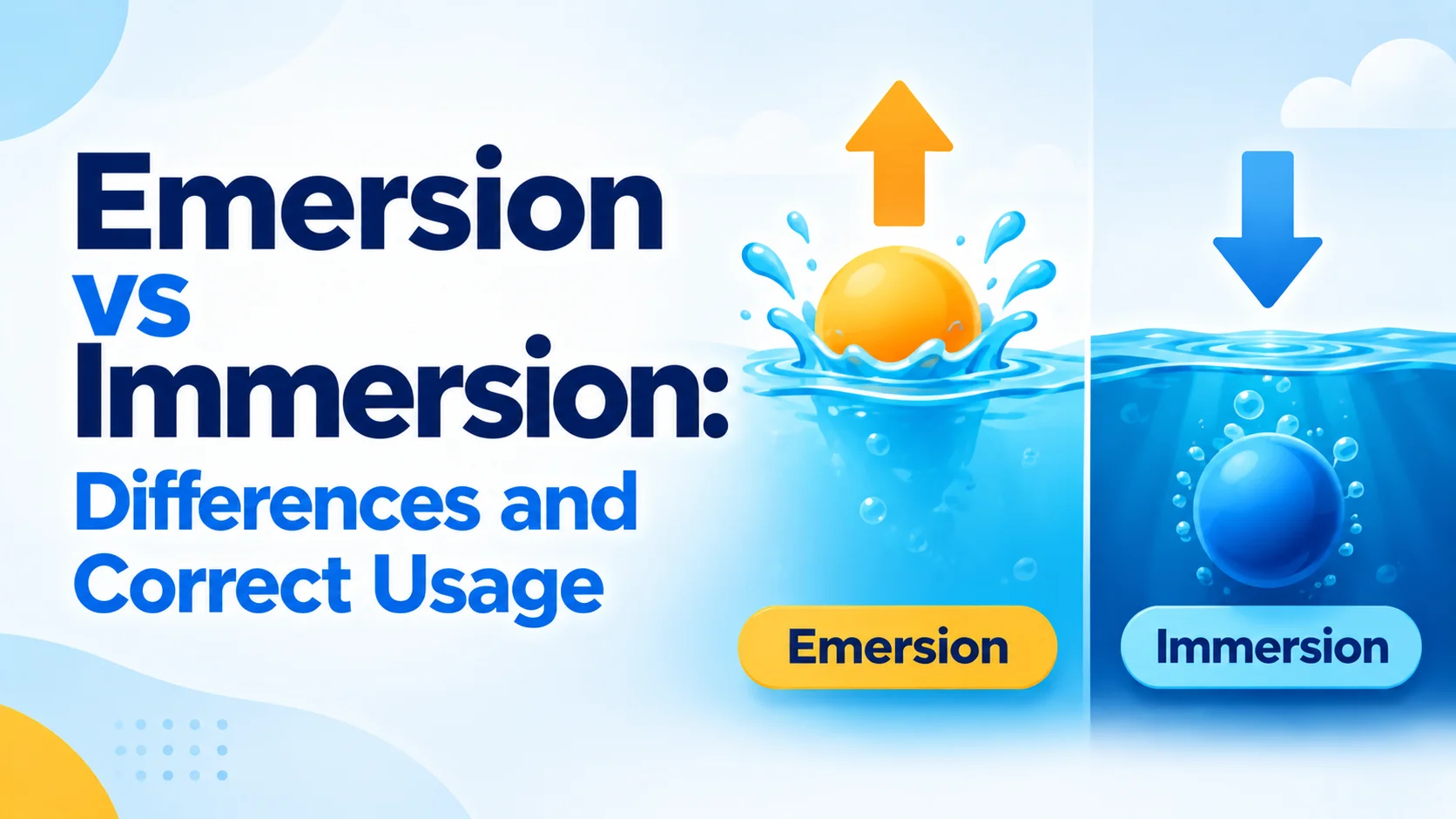
Emersion vs immersion can be confusing because the two words look almost identical and are closely related in meaning. The simplest distinction is directional: immersion describes going into or being surrounded by something, while emersion describes coming out of a submerged, covered, or concealed state. That difference becomes especially useful when you encounter emersion in scientific or astronomical writing, where precision matters more than everyday familiarity. Meanwhile, immersion appears everywhere from language learning and education to gaming, technology, literature, and ordinary descriptions of being underwater. Knowing where each word belongs makes the distinction much easier.
The confusion becomes greater because emersion is considerably less familiar in modern everyday English. A reader may recognize immersion immediately but wonder whether emersion is simply a spelling mistake or an unusual version of emergence. It is neither. Dictionaries recognize emersion as a noun meaning the act of emerging, with specialized astronomical usage referring to the reappearance of a celestial body after an eclipse or occultation. The important point is that an uncommon word can still be perfectly correct when its particular meaning fits the context.
This guide explains emersion, immersion, and emergence side by side, then moves beyond dictionary definitions to show how real writers should choose among them. You will see the difference in water-related situations, astronomy, language learning, education, technology, and figurative writing. You will also learn why immersion works naturally in expressions such as language immersion and cultural immersion, whereas emersion generally remains tied to the idea of emergence or reappearance. By the end, a simple in-versus-out test will help you make the right choice without relying on guesswork.
Emersion vs Immersion: The Quick Difference
The fastest way to separate the two words is to think about direction.
- Immersion = going into something, being placed under something, or becoming deeply involved in something.
- Emersion = coming out of something, especially after being submerged, hidden, or covered.
- Emergence = becoming visible, apparent, known, or developed; it does not necessarily involve prior immersion.
Cambridge defines immersion both as becoming completely involved in something and, in a formal physical sense, putting something completely under the surface of a liquid. Dictionaries such as Collins and Dictionary.com define emersion as an act of emerging and give astronomy as an important specialized context.
Emersion vs Immersion at a Glance
| Feature | Emersion | Immersion |
| Basic idea | Coming out or reappearing | Going in or becoming deeply involved |
| Direction | Outward | Inward |
| Physical meaning | Emerging from water or concealment | Being placed into or under a liquid |
| Figurative meaning | Limited and uncommon | Very common |
| Astronomy | Reappearance after an eclipse or occultation | Entry into an eclipse or occultation |
| Language learning | Not normally used | Language immersion is standard |
| Everyday frequency | Relatively uncommon | Very common |
Quick memory rule: Immersion = in. Emersion = exit.
This is a useful memory aid, but context still matters. Not every use of immersion involves physical movement into water; its figurative sense is one of the word’s most important modern meanings.
What Does Emersion Mean?
Emersion is a noun meaning the act or instance of emerging. In its clearest physical sense, it describes something rising out of a fluid or another covering. It can therefore describe the point at which something that was submerged becomes exposed again.
Dictionary.com gives both a general sense of emerging and an astronomical sense involving the reappearance of a heavenly body after an eclipse, occultation, or transit. Collins likewise identifies emersion as the act or instance of emerging and uses it in astronomy for celestial reappearance.
What Emersion Literally Describes
Imagine a swimmer who has gone beneath the surface and then rises above it.
The downward movement or state of being under the water relates to immersion. The return to the surface can be described as emersion.
For example:
The diver’s emersion marked the end of the underwater observation.
In ordinary conversation, however, most people would probably say:
The diver surfaced.
That difference is important. Correct does not always mean most natural. Emersion is a legitimate technical word, but surfacing may be clearer for a general audience.
Where Emersion Is Most Commonly Used
You are most likely to encounter emersion in:
- Astronomy
- Scientific writing
- Technical descriptions of emerging from water
- Specialized discussions of concealment and reappearance
- Older or formal vocabulary
The word has a long history. Its etymology traces it to Latin ēmersus, the past participle of ēmergere, meaning “to emerge.”
Examples of Emersion
Here are examples that demonstrate the word without making it sound more common than it is:
- The scientist recorded the organism’s emersion from the water.
- The moon’s emersion from the shadow was observed through a telescope.
- The experiment measured the plant’s response after repeated immersion and emersion.
- The object’s emersion from the liquid exposed a previously submerged surface.
Notice that these sentences emphasize a transition from covered or submerged to exposed.
What Does Immersion Mean?
Immersion has a much wider range of modern uses.
Its literal meaning involves putting something completely under the surface of a liquid. Its figurative meaning describes deep involvement, concentration, or absorption in an activity, subject, environment, or experience. Cambridge recognizes both meanings, including immersion in language learning.
Physical Immersion
Physical immersion occurs when something is placed into a liquid so that it is substantially or completely covered.
For example:
The instructions require immersion of the object in water.
Or:
The shells were placed in boiling water for complete immersion.
This is the sense that makes the relationship between immersion and emersion easiest to see.
Figurative and Psychological Immersion
The word does not have to involve water.
You can be:
- immersed in a book
- immersed in research
- immersed in music
- immersed in a culture
- immersed in a project
- immersed in a video game
- immersed in conversation
Cambridge specifically defines immersing yourself in something as becoming completely involved in it.
For example:
Maya immersed herself in Japanese history.
Nobody is suggesting that Maya physically entered a liquid. The sentence describes intense involvement.
That figurative flexibility is one reason immersion is so much more common than emersion.
Emersion vs Immersion: The Core Difference Explained
The words are closely related, but their meanings point in opposite directions when used for physical or technical processes.
Direction of Movement
Think of a swimmer:
Immersion → underwater → emersion
The person enters the water and becomes submerged. That is immersion. Later, the person comes back out. That is emersion.
The distinction can be represented simply:
Immersion = into
Emersion = out of
Starting Point and End Point
Another useful approach is to focus on the change of state.
With immersion, the endpoint is a state of being inside, covered, submerged, or deeply involved.
With emersion, the endpoint is a state of being outside, exposed, visible, or reappearing.
This makes the words particularly useful in contexts where the sequence matters.
Physical vs Figurative Usage
This is where the two words stop behaving like perfect opposites.
Immersion developed an extensive figurative vocabulary. A person can be immersed in a subject, culture, story, language, or hobby.
Emersion does not normally have an equally broad figurative role in contemporary English. Although dictionaries give it a general sense of emerging, it is much more strongly associated with specialized or formal usage.
So it would be misleading to assume:
immersion = in
emersion = out
Therefore every figurative use of immersion has a corresponding use of emersion.
It does not.
Is Emersion the Opposite of Immersion?
In certain physical and technical contexts, yes. The two terms can describe opposite stages of a process.
If an object enters water, it undergoes immersion. If it later comes out, its emersion can be described.
Historical dictionary definitions have explicitly treated emersion as opposed to immersion.
However, calling them complete opposites in every modern context would oversimplify the language.
Consider:
She was immersed in her studies.
The opposite idea might be:
She stopped studying.
It would not normally be:
She experienced an emersion from her studies.
That sentence is technically interpretable but unnatural. Immersion has acquired meanings that are not simply reversed by replacing the initial vowel.
Emersion vs Emergence: The More Important Three-Way Distinction
Many writers who hesitate over emersion are actually trying to choose between emersion and emergence.
These words overlap, but they are not identical.
- Emersion emphasizes coming out of something, especially a submerged or concealed state.
- Emergence has a much broader meaning of appearing, becoming visible, becoming known, or developing.
- Immersion emphasizes entering, being surrounded, or becoming deeply involved.
Compare:
The swimmer’s emersion from the water was recorded.
The emergence of a new species surprised researchers.
The student’s immersion in the language accelerated her practice.
The three words describe different relationships with a state or environment.
Emersion in Science and Technical Language
One reason readers encounter emersion even though they rarely use it themselves is that technical vocabulary often preserves distinctions that ordinary conversation can replace with simpler verbs.
Emersion in Aquatic Contexts
In water-related writing, emersion can describe the process of something becoming exposed after being submerged.
This can be useful when a researcher needs a noun describing the transition itself rather than simply saying that something “came out.”
For general readers, though, surfacing, emerging, or coming out of the water may be more immediately understandable.
Emersion in Diving
A diving context provides one of the clearest conceptual contrasts:
The diver’s immersion began when she entered the water.
Her emersion occurred when she returned to the surface.
The terminology is precise, but ordinary readers may find entering the water and surfacing more natural.
Emersion in Astronomy
Astronomy provides an especially established technical use of emersion.
An astronomical object can disappear from view during an eclipse or occultation and later become visible again. That reappearance is called emersion. Collins and astronomical reference material both identify this specialized sense.
For example:
Astronomers recorded the moon’s emersion from the shadow.
The corresponding event on the way into the hidden state is traditionally described using immersion or ingress, depending on the astronomical context. Collins specifically identifies emersion as the counterpart to astronomical immersion.
This is a good example of why technical vocabulary should not be judged solely by how often it appears in casual conversation.
Immersion in Everyday and Specialized English
Unlike emersion, immersion is highly productive in contemporary English.
Immersion in Language Learning
Language immersion means learning or using a language through sustained exposure and substantial use of that language.
Cambridge explicitly lists immersion as a method of learning a language or skill through using that language or skill rather than relying exclusively on another language.
Examples include:
The school offers an English immersion program.
Living with local speakers gave her greater immersion in Spanish.
The important point is that the learner is being surrounded by the target language, not emerging from it. That is why emersion would be incorrect here.
Immersion in Education
Education can use immersion more broadly to describe intensive involvement in a subject or environment.
For example:
The students spent a week in an immersion program focused on marine science.
The term emphasizes concentrated exposure and participation.
Immersion in Technology and Virtual Reality
Technology has expanded the word’s reach.
You can encounter phrases such as:
- immersive technology
- immersive experience
- immersive environment
- virtual reality immersion
- immersive media
Cambridge defines immersiveness in terms of an experience that seems to surround people and make them feel completely involved.
This is a modern extension of the same underlying idea: the user is metaphorically inside the experience.
Immersion in Gaming and Entertainment
A player can become immersed in a game’s world. A reader can become immersed in a novel. An audience can become immersed in a film.
For example:
The detailed sound design increased the game’s sense of immersion.
Here, immersion has nothing to do with physical water. It describes absorption in an experience.
Cultural Immersion
Cultural immersion refers to deep engagement with another culture through meaningful exposure and participation.
For example:
The students experienced cultural immersion while living with host families.
Simply visiting a foreign country does not automatically guarantee cultural immersion. The phrase generally suggests sustained involvement rather than passive observation.
Emersion vs Immersion in Real Sentences
Seeing the words in parallel is often more useful than memorizing definitions.
Correct Uses of Emersion
- The telescope captured the star’s emersion after the occultation.
- The study examined repeated immersion and emersion of the organisms.
- The object’s emersion from the water revealed its upper surface.
- The astronomer calculated the expected time of emersion.
Correct Uses of Immersion
- The equipment must remain in the solution during immersion.
- She became deeply involved through immersion in French.
- The game is designed to create a strong sense of immersion.
- He spent the afternoon immersed in research.
Side-by-Side Examples
| Intended meaning | Better word | Example |
| Going into water | Immersion | The experiment involved immersion in water. |
| Coming out of water | Emersion | The researchers observed the specimen’s emersion. |
| Deep involvement in study | Immersion | Her immersion in chemistry improved her understanding. |
| Becoming visible after an occultation | Emersion | The telescope recorded the star’s emersion. |
| A new trend becoming established | Emergence | The emergence of the trend was gradual. |
Why Do People Confuse Emersion and Immersion?
The confusion is understandable for several reasons.
Their Spellings Are Nearly Identical
Both contain:
-mersion
Only the initial vowel changes.
That makes them easy to mistype, especially when someone has encountered immersion hundreds of times but emersion only once or twice.
Their Meanings Are Related
Both words can describe a transition involving being covered or uncovered.
That semantic relationship makes the spelling similarity more significant than it would be for two unrelated words.
Emersion Is Much Less Familiar
This is probably the biggest practical source of confusion.
A writer who sees emersion may instinctively think:
“Surely they meant immersion.”
Sometimes that correction would be justified. But not always. In astronomy or a specialized discussion of emergence from water, emersion can be exactly the intended term.
Emersion Sounds Related to Emergence
It is related historically and semantically. Both words involve emerging, and emersion ultimately derives from Latin associated with emerge.
But that does not make them interchangeable.
Common Mistakes With Emersion and Immersion
Mistake 1: Using Immersion for Coming Out of Water
Incorrect for the intended “coming out” meaning:
The diver’s immersion occurred when he surfaced.
If the writer specifically means the act of coming out, emersion is the more precise specialized noun:
The diver’s emersion occurred when he surfaced.
In ordinary prose, however, surfacing is often clearer.
Mistake 2: Treating Emersion as a Spelling Error
The astronomer’s report mentioned the emersion of the star.
This is not automatically a spelling mistake. Emersion is an established astronomical term for reappearance after an eclipse or occultation.
Mistake 3: Replacing Emergence With Emersion
These are not interchangeable in every sentence.
The emergence of artificial intelligence tools changed the industry.
Here, emergence is appropriate because the sentence concerns something becoming established or prominent, not something coming out of a submerged state.
Mistake 4: Using Emersion for Language Learning
The established phrase is:
language immersion
Not:
language emersion
A learner is being deeply exposed to and involved in the target language, so immersion is the natural choice.
Mistake 5: Assuming Every Opposite of Immersion Is Emersion
This is a subtle but important writing error.
If someone says:
I was immersed in a difficult project.
The natural opposite could be:
I stepped away from the project.
It does not need to be emersion. Words are defined by usage and context, not merely by their prefixes.
Emersion vs Immersion vs Emergence
These three words deserve a direct comparison because confusing them can lead to both spelling and meaning errors.
| Word | Main idea | Common contexts | Example |
| Immersion | Going into, being surrounded, or becoming deeply involved | Water, education, languages, culture, media, technology | She became immersed in the language. |
| Emersion | Emerging or reappearing from a covered/submerged state | Technical contexts, astronomy, water | The telescope recorded the star’s emersion. |
| Emergence | Becoming visible, known, established, or developed | General, academic, scientific, social writing | The emergence of a new pattern was unexpected. |
A Practical Test
Ask yourself:
Is something going in?
→ Immersion
Is something coming out of a submerged or concealed state?
→ Emersion
Is something simply appearing, developing, or becoming prominent?
→ Emergence
That three-way test is more reliable than trying to remember the spelling alone.
Emersion and Immersion: Pronunciation
The words are also close in pronunciation.
Cambridge gives emersion as /ɪˈmɜː.ʃən/ in British English and /iˈmɝː.ʒən/ in US English.
For immersion, Cambridge gives /ɪˈmɜː.ʃən/ in British English and /ɪˈmɝː.ʒən/ in US English.
The consonant sound in the middle can therefore vary by pronunciation system, but the initial vowel distinguishes the spelling.
If pronunciation is causing confusion, learn the words as complete units rather than trying to infer spelling from sound.
Word Origins: Why the Words Are So Closely Related
The similarity between emersion and immersion is not accidental.
Emersion comes from Latin ēmersus, associated with ēmergere, “to emerge.”
Immersion has a different historical pathway connected with Latin immersio, meaning a dipping in or putting into. Collins dates the English noun to the Middle English period and traces it to Late Latin.
The historical relationship explains why the modern meanings form such a neat conceptual contrast:
- Immersion: movement or placement inward
- Emersion: movement or appearance outward
Still, etymology is best used as a memory aid, not as a substitute for understanding current English usage.
How to Choose the Correct Word
When editing a sentence, use this process.
Use Emersion When…
Choose emersion when you specifically mean:
- emergence from water or another surrounding substance
- reappearance after being hidden or eclipsed
- a technical process of coming out
- an astronomical reappearance
Example:
The observatory recorded the satellite’s emersion from the occultation.
Use Immersion When…
Choose immersion when you mean:
- being placed under a liquid
- entering or being surrounded by something
- deep involvement in a subject
- intensive language learning
- cultural involvement
- strong engagement with media or technology
Example:
Her immersion in Spanish gave her constant opportunities to practice.
Use Emergence When…
Choose emergence when the idea is broader:
- something becomes visible
- something becomes known
- something develops
- something begins to appear
- a new trend or phenomenon becomes established
Example:
Researchers are studying the emergence of new communication patterns.
When a Simpler Word Is Better
A technically correct word is not always the best editorial choice.
This is especially true of emersion. If your audience is general, ask whether the specialized noun actually improves the sentence.
Instead of:
The swimmer completed his emersion from the lake.
you might write:
The swimmer surfaced.
Instead of:
The object underwent emersion from the liquid.
you might write:
The object emerged from the liquid.
But in an astronomy paper or technical report, emersion may be precisely the term needed.
Expert writing principle: Choose the most precise word that your audience can understand—not the most specialized word available.
That principle prevents two opposite mistakes: using vague language when technical precision matters and using obscure terminology when plain English would communicate better.
Memory Tricks for Emersion vs Immersion
The “IN” Trick
Immersion starts with “im-,” and you can associate it with “in.”
Think:
Immersion = in
Something goes into the water, into an environment, or deeply into an experience.
The “EXIT” Trick
Associate emersion with exiting a submerged state.
Emersion = out
Something emerges from what previously covered or concealed it.
The Water Test
Imagine one object moving through water:
Into the water → immersion
Out of the water → emersion
This is probably the simplest visual memory aid.
The Three-Word Rule
For the hardest cases, remember:
Immersion = in
Emersion = out
Emergence = appearing
If you can identify the direction or type of change, the vocabulary usually becomes much easier.
Quick Reference: Emersion vs Immersion Cheat Sheet
| If you mean… | Use… | Example |
| Going under water | Immersion | The procedure requires immersion in water. |
| Being deeply involved | Immersion | Her immersion in the subject was remarkable. |
| Learning through intensive exposure | Immersion | He joined a language immersion program. |
| Coming out of water | Emersion | The study measured emersion from the water. |
| Reappearing after an occultation | Emersion | The star’s emersion was observed. |
| Becoming visible or established | Emergence | The emergence of the new pattern was gradual. |
| Simply coming to the surface | Surfacing | The diver began surfacing. |
| Becoming visible | Emerging | The bird was emerging from the reeds. |
Conclusion:
The easiest way to remember emersion vs immersion is to focus on direction rather than spelling. Immersion means going into, being surrounded by, or becoming deeply involved in something; emersion describes emerging or reappearing from a submerged, covered, or concealed state. In everyday English, immersion is by far the more versatile word, while emersion is most useful in specialized contexts such as astronomy or precise descriptions of emergence. And when the meaning is simply “becoming visible or developing,” emergence may be the better choice.One final actionable tip: before choosing a word, identify whether your sentence describes going in, coming out, or simply appearing. A common mistake to avoid is assuming that every opposite of immersion must be emersion. Let the meaning and context—not the spelling—make the final decision.
FAQs
Q1. Is emersion a real English word?
Yes. Emersion is an established English noun, although it is much less common than immersion. Dictionaries define it as an act or instance of emerging, with a specialized astronomical sense involving the reappearance of a celestial body after an eclipse or occultation.
Q2. Is emersion the exact opposite of immersion?
In physical or technical contexts, they can describe opposite stages: immersion is entering or being submerged, while emersion is emerging from that state. However, they are not complete opposites in every modern use because immersion also means deep involvement in subjects, cultures, languages, and experiences.
Q3. Is emersion the same as emergence?
Not quite. Emergence is broader, referring to something becoming visible, apparent, known, or developed. Emersion specifically emphasizes emerging from a covered or submerged condition and has a specialized astronomical meaning. Context determines which noun communicates the intended idea most accurately.
Q4. Should I say emersion or immersion in language learning?
Use immersion. Language immersion is the established expression for intensive exposure to and use of a target language. Emersion does not describe this learning approach. The distinction is logical: language immersion involves becoming deeply surrounded by the language rather than emerging from it.
Q5. Why is emersion so much less common than immersion?
The two words developed different practical roles in modern English. Immersion expanded into many everyday figurative contexts, including education, culture, entertainment, and technology. Immersion retained a narrower role centered on emerging or reappearing, particularly in technical and astronomical language.