

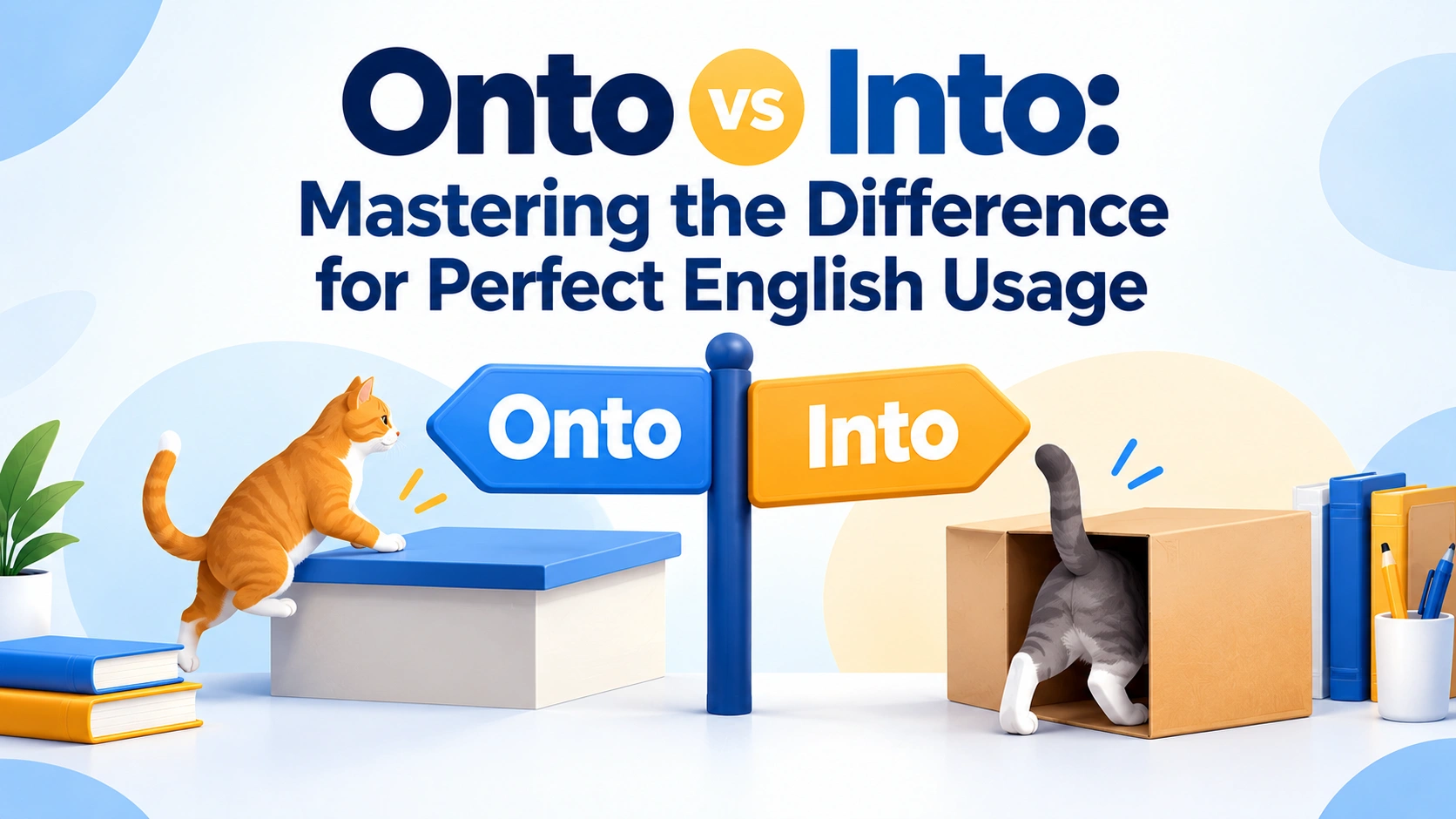
Onto vs into can look like a tiny grammar choice, but the preposition you select can change the picture your sentence creates. She climbed onto the roof describing movement ending on a surface, while she climbed into the attic describing movement ending inside a space. The distinction becomes especially useful when writing about movement, location, transformation, and everyday actions. Once you understand what the destination looks like rather than simply memorizing two definitions, the choice becomes much easier. This guide explains the core rule, the important exceptions, common expressions, confusing word pairs, and practical examples you can apply immediately.
The difficulty is that into and onto are not limited to physical movement. Into can describe transformation, interest, collision, investigation, or division, while onto can introduce a new subject, describe attachment, or mean discovering something useful. That is why a simple “inside versus surface” rule works beautifully for beginners but cannot explain every sentence. Context matters, particularly when a familiar verb is followed by a preposition as part of an established expression. Understanding that broader pattern helps you avoid mistakes that spell-checkers may never catch.
There is another layer worth mastering: onto is not always the same as on to, and into is not always the same as in to. In one sentence, the words function together as a preposition; in another, they perform separate grammatical jobs. The child climbed onto the bed and she went on to explain the answer. Likewise, He walked into the office differently grammatically from He came in to speak with us. By the end of this guide, you will have a practical method for deciding which form fits without relying on guesswork.
Onto vs Into: The Quick Rule
The simplest distinction is:
Into usually shows movement from outside to the inside of something.
Onto usually shows movement toward a position on a surface or object.
Compare:
- The dog ran into the house.
- The dog jumped onto the sofa.
- She poured the juice into the glass.
- She placed the glass onto the tray.
A useful question is:
Where does the moving thing end up?
If it ends up inside, it is usually appropriate.
If it ends up on a surface or position, onto is usually appropriate.
This rule handles a large proportion of everyday cases, but it is not a complete definition. Both words have figurative and specialized uses, so the surrounding verb and meaning still matter.
What Does “Into” Mean?
Into is a preposition that commonly expresses movement toward and inside a place, container, area, or other bounded space. It often signals a change of position: something begins outside and ends up within a space.
For example:
- She walked into the kitchen.
- Put the books into the drawer.
- The children ran into the garden.
- He dropped the coins into his pocket.
The important idea is not necessarily that the destination has four walls. It is that the destination is understood as an interior, enclosed area, or conceptual space.
Into for Movement Inside Something
This is the most familiar use.
- The bird flew into the room.
- He climbed into the car.
- She put the letter into an envelope.
- They jumped into the pool.
Notice the change involved:
outside → inside
That change is what separates into from in.
Compare:
- The children are in the pool. — location
- The children jumped into the pool. — movement
Cambridge similarly distinguishes in for position from into for movement toward an interior. With verbs such as put, fall, and jump, however, both in and into can sometimes be used with little or no difference in meaning.
Into for Transformation
Into can describe one thing becoming another.
- They turned the spare room into an office.
- The caterpillar changed into a butterfly.
- The discussion developed into an argument.
- The company transformed the idea into a product.
Here there is no physical movement into a container. Instead, it marks a change of form, state, role, or result.
This pattern is especially common after verbs such as:
- change
- turn
- transform
- convert
- develop
- translate
- divide
For example, dividing the cake into four pieces describes the result of separating one whole into several parts.
Into for Interest or Enthusiasm
In informal English, be into means to be interested in or enthusiastic about something.
- Maya is really into photography.
- I’m into science fiction.
- He became into cycling after joining the club.
This use is important because the “inside” rule does not help here. The phrase is idiomatic: being into something means being strongly interested or involved in it.
Into for Impact or Collision
Into can also describe movement that results in forceful contact.
- The cyclist crashed into a barrier.
- I walked into the door.
- The ball flew into the window.
The object does not have to contain the thing that hits it. Here, it describes movement toward and contact with something.
That makes this a useful reminder: prepositions describe relationships, not just physical shapes.
Into for “About” or Investigation
In formal and academic English, it can introduce the subject of an investigation or inquiry.
- The committee launched an inquiry into the complaint.
- Researchers conducted a study into language development.
- The report looks into the causes of the problem.
This is another extended meaning in which no literal entry occurs.
What Does “Onto” Mean?
Onto generally describes movement toward a position on a surface, platform, object, or other destination.
- The cat jumped onto the table.
- She stepped onto the stage.
- The child climbed onto the bed.
- He placed the package onto the counter.
The central idea is:
movement → position on something
Cambridge describes onto as showing movement to a position on a surface and also recognizes several extended uses.
Onto for Movement to a Surface
This is the clearest use of the word.
- The leaves fell onto the ground.
- She spilled water onto the floor.
- The rabbit hopped onto the path.
- He climbed onto the roof.
The destination can be a conventional surface, but it does not have to be perfectly flat.
A stage, platform, roof, vehicle, path, or bed can all function as destinations for onto because the subject ends up positioned on them.
Onto for Attachment or Addition
Onto can also describe something being attached or added to another thing.
- The technician fitted the device onto the frame.
- The file was loaded onto the computer.
- The students were added onto the project.
The exact choice may depend on the verb and context. English often uses on and onto with only a small difference, with onto emphasizing movement or the action of putting something in position. Cambridge specifically notes this overlap.
Onto for Changing the Subject
This is a common figurative use that beginners may overlook.
- Let’s move onto the next topic.
- How did we get onto that subject?
- The meeting then moved onto the budget.
Here, onto means moving from one topic to another.
There is no physical surface involved. The word instead expresses a transition to a new subject or stage.
Onto for Discovering Something
In expressions such as be onto something, onto means that someone has discovered or is close to discovering something important.
- I think you’re onto something.
- The researchers may be onto an important clue.
This is a fixed figurative pattern, so trying to apply the physical surface rule would not help.
Onto vs Into: The Core Difference
The most useful way to understand the pair is to focus on the destination relationship.
| Question | Use into | Use onto |
| Where does something end up? | Inside an area or container | On a surface or position |
| Main physical idea | Entry | Movement to a surface |
| Example | She walked into the room. | She stepped onto the platform. |
| Common extended idea | Change or involvement | Transition or attachment |
| Helpful mental image | Outside → inside | Away → on |
Consider these pairs:
- The child jumped into the pool.
- The child jumped onto the diving board.
- She climbed into the car.
- She climbed onto the roof.
- He put the papers into the folder.
- He put the folder onto the desk.
The verb alone does not determine the preposition. The destination does.
Expert tip: When you’re unsure, don’t ask “Which word usually follows this verb?” first. Ask “What relationship am I describing?” That approach works better when a verb can take both into and onto.
Into vs Onto in Everyday Situations
At Home
Everyday objects make the distinction easy to see.
- Put the toys into the box.
- Put the toys onto the shelf.
- The child crawled into the tent.
- The child climbed onto the bed.
A box and tent are treated as spaces that can contain something. A shelf and bed are treated as surfaces or positions.
With Transportation
Transportation provides some of the most useful real-world contrasts:
- She got into the car.
- He got onto the bus.
- They climbed into the van.
- The passengers stepped onto the train.
This reflects how English conceptualizes different vehicles. A car is normally treated as an enclosed space you enter; a bus or train is commonly treated as something you board.
At School or Work
The distinction becomes less literal:
- She went into the meeting room.
- Let’s move onto the next item.
- He got into a detailed discussion.
- The team moved onto a new phase of the project.
Here, into can express involvement, while onto can express progression.
Why Into and Onto Are Commonly Confused
The two words share the same ending and both contain a basic location word plus to. More importantly, learners often focus on the movement verb rather than the destination.
Consider jump:
- jump into the pool
- jump onto the platform
The verb is identical. The destination changes, so the preposition changes.
Another source of confusion is translation. A phrase that uses one preposition naturally in one language may require a different preposition in English. Direct translation therefore becomes unreliable.
A stronger strategy is to learn meaningful patterns, not isolated translations.
The Destination Test
Ask:
- Is the destination an interior or enclosed space?
- Is the destination a surface or position?
- Is the expression figurative?
- Is the word actually part of a larger expression such as be into, move onto, hold onto, or look into?
This four-step check catches most mistakes.
Onto vs On To: One Word or Two?
This is a separate issue from onto vs into.
Onto is a single preposition when it expresses movement or another meaning associated with onto.
- The cat jumped onto the sofa.
- She stepped onto the platform.
But on to consists of two separate words when on and to perform separate grammatical functions.
- She went on to explain the results.
- He passed the message on to his manager.
In went on to explain, on belongs to the expression go on, while to explain is a separate infinitive construction.
Cambridge recognizes onto and on to as forms that can overlap in some contexts, so context and grammatical function matter.
A Useful Test
Look at what follows to.
If to introduces a verb in its base form:
- went on to explain
- continued on to discuss
you likely have on to, not the preposition onto.
If the whole word means movement to a surface:
- jumped onto the table
- climbed onto the roof
use onto.
Into vs In To: Why the Space Matters
The same principle applies to into and in to.
Into is a single preposition:
- She walked into the office.
- He poured the water into the glass.
But in to contains two separate words:
- He came in to help.
- She logged in to the website.
In logged in to the website, in belongs to the phrasal verb log in, while to introduces the destination or object that follows.
Cambridge distinguishes prepositions from particles used in phrasal verbs, which is why analyzing the grammar of the whole expression is more reliable than simply listening for the sound.
Compare These Sentences
| Sentence | Why? |
| She walked into the room. | Into means movement inside. |
| She came in to talk. | In and to have separate functions. |
| He looked into the problem. | Into introduces the subject of an investigation. |
| He logged in to the account. | In is part of log in; to introduces the account. |
Common Mistakes With Onto and Into
Mistake 1: Using Into for a Surface
Incorrect: The cat jumped into the table.
Better: The cat jumped onto the table.
Unless the intended meaning is that the cat entered some internal part of the table, the destination is a surface.
Mistake 2: Using Onto for an Interior
Incorrect: She walked onto the room.
Better: She walked into the room.
A room is normally conceptualized as an interior space.
Mistake 3: Assuming Every “On + To” Becomes “Onto”
It doesn’t.
- She went on to win the competition.
- She climbed onto the stage.
The first contains separate grammatical elements; the second uses a single preposition.
Mistake 4: Treating Into and In To as Spelling Variants
They are not interchangeable.
- He walked into the building.
- He came in to speak.
The first describes movement inside. The second describes someone coming in for a purpose.
Mistake 5: Applying the Surface Rule to Figurative Expressions
You cannot determine every use of onto or into by imagining a physical surface or container.
- I’m really into chess.
- Let’s move onto the next point.
- I think she’s onto something.
- They looked into the issue.
These expressions need to be understood as established meanings or collocations.
A Practical Decision Method for Choosing the Right Form
When proofreading, use this sequence rather than relying on intuition.
Step 1: Find the Destination or Relationship
Identify what follows the preposition.
room, box, car → likely an interior relationship
table, stage, roof → likely a surface relationship
Step 2: Picture the End Result
Imagine a snapshot taken after the movement.
If the subject is inside, choose into.
If it is positioned on, choose onto.
Step 3: Check for a Figurative Meaning
Ask whether the sentence means something other than literal movement.
- get into trouble
- be into music
- move onto another topic
- be onto something
If so, use the established expression rather than forcing the physical rule.
Step 4: Check the Spacing
If you’re considering onto/on to or into/in to, identify the grammatical role of each word.
Quick proofreading rule: Never decide the spacing by pronunciation alone. Read the entire verb phrase.
Real-Life Examples: Into vs Onto
| Context | Into | Onto |
| Furniture | crawl into the bed | climb onto the bed |
| Transport | get into the car | get onto the bus |
| Containers | put it into the box | put it onto the box |
| Buildings | walk into the building | climb onto the roof |
| School | get into a discussion | move onto the next topic |
| Technology | enter into the system | load the file onto the computer |
| Figurative | turn into a problem | be onto something |
Some sentences can sound unusual because the verb itself affects natural collocation. Grammar tells you what is possible; idiomatic usage tells you what sounds normal.
When the Basic Rule Isn’t Enough
Advanced learners sometimes become confused because real English does not always behave like a geometry diagram.
For example, onto can refer to movement toward a road, path, committee, or topic:
- The path leads onto the main road.
- She was elected onto the committee.
- Let’s move onto the next subject.
Likewise, into can describe contact, investigation, transformation, and interest:
- He bumped into a friend.
- They investigated the matter as generally less natural than They investigated the matter, but looked into the matter as standard.
- The plan developed into a larger project.
- She’s really into art.
The expert approach is therefore:
Learn the core spatial rule first, then learn common extended constructions as complete patterns.
That gives you both accuracy and flexibility.
Practice: Choose Into, Onto, In To, or On To
Fill in each blank with into, onto, in to, or on to.
- The boy climbed ___ the roof.
- She walked ___ the kitchen.
- He logged ___ the account.
- The speaker went ___ explain the final point.
- Pour the milk ___ the glass.
- The cat jumped ___ the chair.
- The meeting moved ___ another topic.
- She is really ___ classical music.
- The car crashed ___ a wall.
- He came ___ ask a question.
Answer Key
- onto — the boy ends up on the roof.
- into — the movement is toward the inside of the kitchen.
- in to — log in is the phrasal verb, followed by to.
- on to — go on is followed by the infinitive to explain.
- into — the milk ends up inside the glass.
- onto — the cat ends up on the chair.
- onto — move onto introduces a new topic.
- into — be into means to be interested in something.
- into — the car moves toward and hits the wall.
- in to — came in describes entry, while to ask gives the purpose.
Quick Reference: Into vs Onto vs In To vs On To
| Form | Main function | Example |
| into | Movement inside; transformation; other extended meanings | She walked into the room. |
| onto | Movement to a surface/position; extended meanings | She stepped onto the stage. |
| in to | Separate in + to | He came in to help. |
| on to | Separate on + to | She went on to explain. |
The Four-Word Memory Cue
Inside → into
Surface → onto
Separate grammar → in to / on to
It’s a useful starting point, but always check the meaning of the complete expression.
Expert Tips for Better Usage
- Think about the destination, not just the verb. Jump can take either into or onto depending on where the subject lands.
- Separate location from movement. She is in the room describing position; she walked into the room describing movement.
- Learn common expressions as phrases. Be into, look into, move onto, and hold onto should become familiar patterns.
- Check phrasal verbs before joining words. Log in to and go on to contain separate grammatical elements.
- Don’t overcorrect established usage. English sometimes permits both on and onto, especially when attachment or movement is involved.
- Use a dictionary when the expression is unfamiliar. A reliable learner’s dictionary can show whether a word combination is a preposition, phrasal verb, or fixed expression.
Best practice: If a sentence still feels uncertain after applying the inside/surface test, look at the whole verb phrase, not the preposition in isolation.
Conclusion:
Onto vs into becomes much easier once you stop treating the words as interchangeable movement prepositions. In physical situations, think about the destination: into normally takes something from outside to inside, while onto places it on a surface or position. From there, pay attention to extended meanings such as be into, look into, and move onto. When spacing is the issue, examine the grammar of the whole phrase rather than relying on sound. One final actionable tip: during proofreading, picture where the subject ends up and then check the verb phrase. A common mistake to avoid is forcing the basic surface-versus-container rule onto idiomatic expressions. Good preposition choices come from understanding the relationship, not memorizing isolated words.
FAQs
Q1. What is the easiest way to remember onto vs into?
Use the destination test: into usually means movement toward the inside of something, while onto usually means movement to a surface or position. Then check whether the phrase is figurative. For example, walking into a room contrasts with stepping onto a stage.
Q2. Should I say “get onto the bus” or “get into the bus”?
Get onto the bus is the standard expression when describing boarding a bus. English commonly used for enclosed vehicles such as cars and taxis. The distinction reflects how speakers conceptualize the vehicle and the action, rather than simply whether a vehicle has a roof.
Q3. Is “onto” always one word?
No. Onto is one word when it functions as a preposition, as in The cat jumped onto the table. On to remains two words when on and to have separate grammatical roles, as in She went on to explain the results. Context determines the correct form.
Q4. What is the difference between “into” and “in to”?
Into is a single preposition, as in He walked into the room. It contains two separate words, often because it belongs to a phrasal verb and to begin another phrase: She logged in to the website. Examine the complete verb phrase before choosing.
Q5. Can “into” and “onto” have meanings unrelated to physical movement?
Yes. Into can express transformation, interest, investigation, or collision: turn into, be into, and look into. Onto can signal a topic change or discovery: move onto another issue and be onto something. These established meanings must be learned from context.