

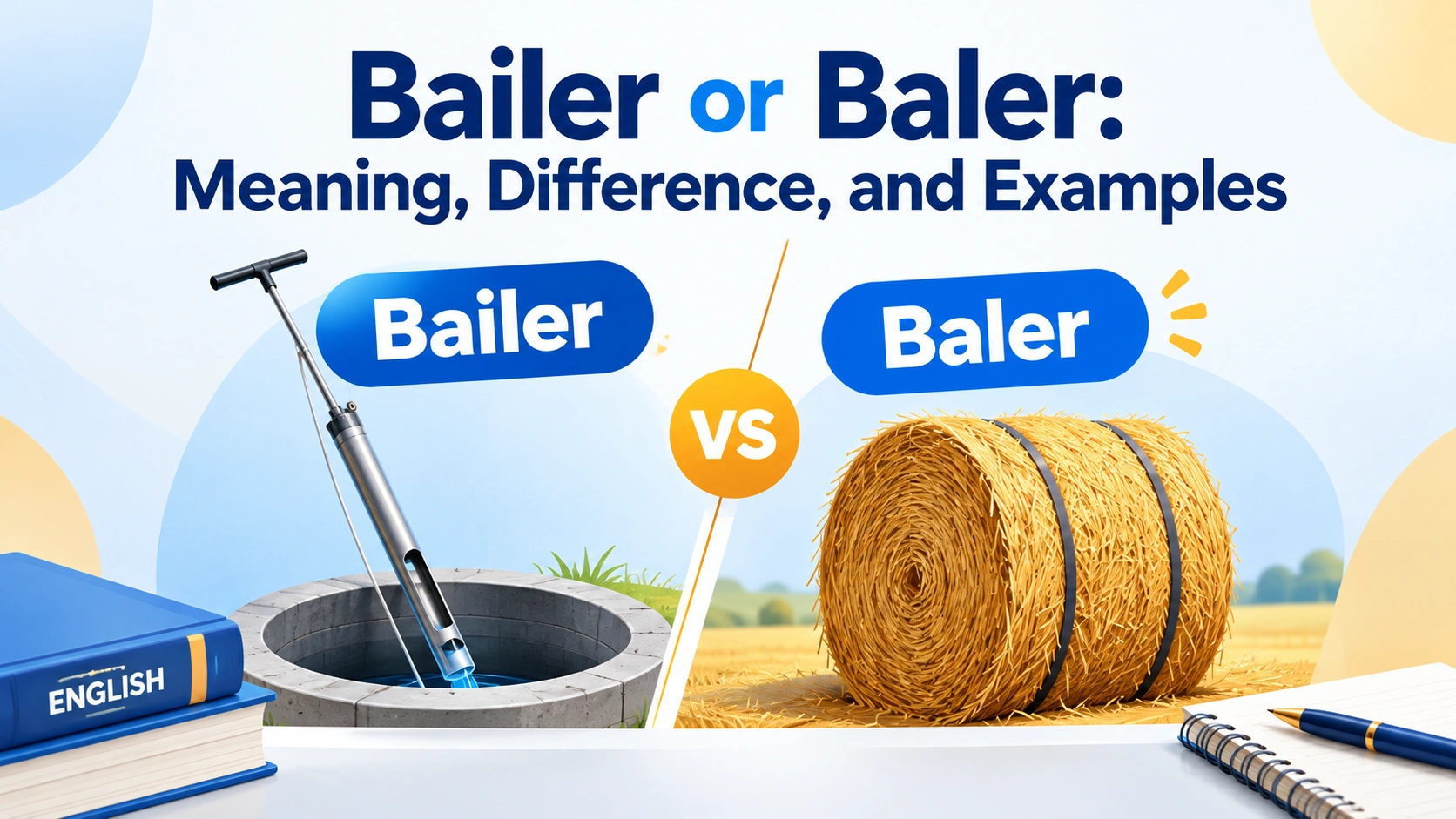
Bailer or baler can be confusing because the two words are pronounced alike in ordinary English, yet they refer to very different things. One is connected with removing water; the other is connected with making compact bundles called bales. The difference is only one letter, but choosing the wrong spelling can completely change the meaning of a sentence. Dictionaries recognize both as legitimate English words: bailer is associated with bail, while baler commonly refers to a machine that makes bales.
The easiest way to separate them is to look at their base words. A bailer comes from bail in the water-removal sense, as in bailing water from a boat. A baler comes from bale, meaning to form material into a tightly bound bundle. This distinction matters in everyday writing as well as in specialized contexts such as boating, agriculture, recycling, waste management, and groundwater sampling.
Once you connect each spelling to its underlying word, the choice becomes much easier. In this guide, you’ll learn what bailer and baler mean, how they differ, where each is used, why they’re so often confused, and how to choose the right one from context. You’ll also see practical sentence examples, a comparison table, common mistakes, and a simple memory trick that works better than memorizing the spellings separately.
Bailer vs. Baler: The Quick Difference
Both bailer and baler are real words. The question is not which spelling is universally correct; it is which word matches the meaning you intend.
- Bailer → comes from bail → something or someone involved in removing water.
- Baler → comes from bale → a machine or person involved in making bales.
For example:
The crew grabbed a bailer to remove water from the canoe.
Here, the relevant verb is bail.
The farmer used a baler to compress the hay.
Here, the relevant verb is bale.
The words are commonly pronounced the same, so you cannot reliably determine the spelling by hearing the word alone. The most dependable approach is to identify the action or object first, then choose the corresponding spelling.
The fastest rule to remember
Bailer = bail = remove water.
Baler = bale = make a bundle.
This rule covers the vast majority of situations in which writers encounter the two words.
What Does “Bailer” Mean?
A bailer is generally a person or device that removes water, particularly from a boat or another confined space. Collins defines bailer as a person or device that removes water from a boat.
The word is formed from the verb bail, in the relevant sense of removing water. A simple hand bailer might be nothing more complicated than a small bucket, scoop, or container used to collect water and throw it overboard.
That makes bailers particularly common in small-boat and emergency-water-removal contexts.
Bailer as a tool
On a small boat, canoe, or similar vessel, a bailer can be a simple manual device for getting unwanted water out.
For example:
We kept a plastic bailer in the canoe in case rainwater collected inside.
The object does not have to be technologically sophisticated. Its defining characteristic is its function: it is used for bailing.
Bailer as a person
Because English commonly forms agent nouns with -er, bailer can also describe someone who performs the action of bailing.
For example:
The crew worked together, with one person acting as the bailer while the others repaired the leak.
This use is less prominent in everyday modern English than the equipment sense, but the word formation is straightforward.
Bailer in specialized environmental work
The word also has a more technical use in hydrogeology and groundwater sampling.
A groundwater bailer is a sampling device used with monitoring wells. EPA guidance describes a bailer as a simple device for collecting samples from monitoring wells, typically consisting of a tube with a check valve that is lowered into the well and then retrieved with a line.
That is an important example because it shows that bailers are not limited to boats. Its underlying idea remains connected to drawing or retrieving liquid.
Expert context clue: If you’re reading an environmental report and see bailer, don’t automatically assume it means a bucket used on a boat. In groundwater work, it can refer to specialized sampling equipment.
Examples of “Bailer” in Sentences
Here are examples showing how the word works in different contexts:
- “The sailor used a bailer to remove water from the small boat.”
- “Keep a bailer within reach when paddling a small canoe.”
- “The crew used a hand bailer after rainwater collected in the vessel.”
- “The emergency kit included a bailer for removing water.”
- “The environmental technician lowered a groundwater bailer into the monitoring well.”
Notice what these examples have in common: the context involves water or liquid, not compressed bundles of material.
What Does “Baler” Mean?
A baler is most commonly a machine that puts material into bales. Cambridge defines a baler as a machine used to put materials such as hay or paper into tightly tied bales.
The underlying word is bale.
A bale is a compact bundle of material, often compressed and secured with something such as twine, wire, or other binding material. The machine that creates that bale is a baler.
This explains why hay baler is correct, not hay bailer.
Baler in agriculture
Agriculture is probably the context in which most readers encounter baler.
Farmers use different types of balers for materials such as:
- Hay
- Straw
- Grass and forage
- Other crop materials
The exact design depends on the crop, desired bale size, storage requirements, and harvesting system. A baler gathers material and compresses it into a manageable form for handling, storage, or transport.
For example:
The farmer used a baler to turn the dried hay into compact bundles.
The word baler works because the machine creates bales.
Baler in recycling
Balers aren’t limited to farms. Recycling facilities and businesses also use balers to compact materials such as cardboard, paper, and certain plastics.
A recycling baler compresses loose material into a more manageable bundle. A recycling resource from ReWorks describes balers as machines that compact and bind waste materials, including newspaper, plastics, and corrugated cardboard, into bales.
For example:
The warehouse installed a cardboard baler to compact discarded boxes.
The same spelling applies because the machine is still producing bales, even though the material is cardboard rather than hay.
How a baler works
The exact mechanism varies by machine, but the general process is simple:
- Loose material enters the machine.
- The material is gathered or positioned inside a chamber.
- Pressure compresses it.
- The compressed material is secured.
- The finished bale is removed.
A cardboard baler, for instance, may use a pressing plate to compact cardboard before the bundle is secured with bands or wire.
The machinery can be quite different from an agricultural baler, but the linguistic principle remains unchanged: bale → baler.
Bailer vs. Baler: Side-by-Side Comparison
| Feature | Bailer | Baler |
| Base word | Bail | Bale |
| Main meaning | Person or device involved in removing water | Machine or person involved in making bales |
| Typical setting | Boats, water removal, environmental sampling | Farming, recycling, waste management |
| Common materials | Water or other liquids | Hay, straw, paper, cardboard, recyclables |
| Typical example | Boat bailer | Hay baler |
| Key question | Is something being removed as water? | Is something being compressed into a bale? |
| Common spelling clue | ai in bail | a in bale |
| Pronunciation | Commonly /ˈbeɪlər/ | Commonly /ˈbeɪlər/ |
The key distinction is therefore meaning, not pronunciation.
The Real Difference Comes From “Bail” vs. “Bale”
Rather than memorizing two isolated nouns, learn the two words they come from.
| Base Word | Meaning | Related Noun | Example |
| bail | Remove water from a boat or space | bailer | “Grab the bailer.” |
| bale | Form material into a compact bundle | baler | “Start the baler.” |
This approach is more reliable because the spelling becomes a consequence of meaning.
Consider these two sentences:
The canoe was filled with water, so we needed a bailer.
The hay had dried, so the farmer brought out the baler.
The surrounding nouns—canoe, water, hay—give you strong contextual clues. But even without those clues, the verbs bail and bale tell you which spelling to use.
Practical tip: When you’re unsure, don’t ask “Which spelling looks right?” Ask “What is the object actually doing?”
How to Choose Between Bailer and Baler
A quick decision process can prevent most errors.
If it removes water, use “bailer”
Think about:
- A canoe taking on water
- A small boat after heavy rain
- An emergency water-removal tool
- A device used to retrieve groundwater
- Someone physically removing water
In these contexts, the underlying action is bailing.
If it makes a bale, use “baler”
Think about:
- Hay
- Straw
- Paper
- Cardboard
- Recyclable material
- Agricultural machinery
- Waste-compression equipment
Here, the underlying action is baling.
A simple decision table
| If you see… | Choose… | Why? |
| Canoe + water | Bailer | It removes water |
| Dinghy + rainwater | Bailer | It is used for bailing |
| Groundwater monitoring well | Bailer | It can retrieve a water sample |
| Hay + farm machinery | Baler | It creates hay bales |
| Straw + harvesting | Baler | It forms straw into bales |
| Cardboard + recycling | Baler | It compresses material into bales |
| Paper + waste management | Baler | It produces compact bales |
Why Are Bailer and Baler So Easy to Confuse?
The biggest reason is pronunciation.
In ordinary English, bailer and baler are pronounced alike. Cambridge gives baler as /ˈbeɪ.lɚ/ in US English and /ˈbeɪ.lə r/ in UK English, while dictionary sources give the corresponding pronunciation for bailer.
That means a listener may hear:
“We need a bayler.”
But hearing the word doesn’t tell you whether the writer means bailer or baler.
This is a classic homophone problem. English has many spelling distinctions that disappear in speech, and this is one of them.
The solution is to reconstruct the meaning from context.
The “AI” vs. “A” trap
People often remember the sound and then spell it based on intuition. That can produce bailers when they mean a farm machine.
But spelling should follow the root:
- bail → bailer
- bale → baler
If you remember the root word, you don’t need to guess.
Real-World Examples: Bailer or Baler?
On a boat
“The canoe started taking on water, so Maya reached for the bailer.”
Correct because the object removes water.
On a farm
“The farmer checked the baler before beginning the hay harvest.”
Correct because the machine creates hay bales.
At a recycling center
“The cardboard was compressed in a large baler.”
Correct because the machine turns loose cardboard into compact bales. Recycling organizations use the term baler specifically for equipment that compacts and binds materials.
During an emergency
“Everyone took turns using the bailer to clear water from the boat.”
Correct because the action is bailing.
During groundwater sampling
“The technician lowered a bailer into the monitoring well to collect a sample.”
Correct because bailer has an established technical meaning in groundwater work. EPA documentation describes these devices as monitoring-well sampling equipment.
Common Mistakes With Bailer and Baler
Mistake 1: Writing “hay bailer”
This is one of the most common errors.
Incorrect:
The farmer bought a new hay bailer.
Correct:
The farmer bought a new hay baler.
The machine makes bales, so its name comes from bale.
Mistake 2: Writing “boat baler”
If you’re talking about equipment used to remove water from a boat, the appropriate word is bailer.
The dinghy carried a manual bailer.
The relevant verb is bail, not bale.
Mistake 3: Choosing the spelling from pronunciation
Because the words sound alike, pronunciation cannot settle the question.
Instead, identify the activity.
Mistake 4: Assuming one word is simply a misspelling of the other
Both spellings can be correct. They are not interchangeable versions of the same word.
A baler and a bailer can both be perfectly valid nouns in the same dictionary, but they describe different functions.
Mistake 5: Ignoring technical context
A reader familiar with boating may associate bailers with water removal. An environmental scientist may encounter bailers as groundwater-sampling equipment. An agricultural worker is far more likely to use balers for farm machinery.
Context determines meaning.
Bailer and Baler: Related Words and Word Forms
Understanding the related forms makes the distinction easier to retain.
Words related to “bail”
In the relevant water-removal sense:
- bail
- bailed
- bailing
- bailer
Example:
The crew was bailing water from the boat.
The bailer was stored beside the emergency equipment.
Words related to “bale”
- bale
- baled
- baling
- baler
- bale
- hay bale
- straw bale
- cardboard bale
Example:
The machine was baling the hay.
The finished bales were ready for storage.
The baler needed maintenance.
Seeing these words together creates a useful pattern:
bail → bailing → bailer
bale → baling → baler
A Note About Other Meanings of “Bail”
There’s one important language detail worth knowing: bail has more than one meaning in English.
For example, bail can refer to the legal arrangement involving release from custody. That meaning is unrelated to the ordinary boating sense discussed in this article.
So don’t assume that every word beginning with bail- relates to removing water.
For the spelling distinction bailer vs. baler, the relevant relationship is:
bail → removing water → bailer
That keeps the explanation precise without mixing unrelated meanings.
A Specialized Use: Groundwater Bailers
A groundwater bailer deserves special attention because it can surprise readers who know the word only from boating.
Environmental professionals may use a bailer to collect groundwater samples from monitoring wells. EPA guidance describes bailers as portable, relatively simple sampling devices that can retrieve water from monitoring wells.
The equipment may look very different from a small boat scoop, but the word makes sense historically and functionally: it is associated with drawing liquid out.
This is also a useful reminder that vocabulary should be learned through meaning and context, not through one fixed picture.
A Simple Memory Trick for Bailer vs. Baler
The most reliable trick is to remember the middle letters through the base word.
For “bailer”
Think:
BAIL → BAILER → WATER
Imagine a canoe with water inside.
For “baler”
Think:
BALE → BALER → HAY
Imagine a machine producing tightly packed hay bundles.
You can make the distinction even shorter:
Bailer takes water out.
Baler puts material into bales.
If you’re proofreading your own writing, replace the questionable noun with its base verb:
- Can you say bail? → bailer
- Can you say bale? → baler
That test is usually faster and more dependable than trying to remember which spelling contains an i.
Bailer vs. Baler: Practical Writing Checklist
Before choosing the word, run through this checklist:
- Is the subject connected to water removal? → bailer
- Is it connected to hay, straw, cardboard, paper, or other bales? → baler
- Can you identify the verb bail? → bailer
- Can you identify the verb bale? → baler
- Are you relying only on how the word sounds? → Stop and check the context.
- Are you writing about agricultural machinery? → baler
- Are you writing about a small-boat water-removal tool? → bailer
- Are you writing an environmental report about groundwater sampling? → Check whether bailer is the established technical term.
This method is especially useful when editing manuals, technical documents, educational material, or workplace writing, where a one-letter spelling error can create unnecessary ambiguity.
Conclusion:
Choosing between bailer and baler becomes straightforward once you stop treating them as competing spellings and connect each one to its base word. Bailer comes from bail and is associated with removing water, whether from a small boat or, in a specialized context, from a monitoring well. Baler comes from bales and commonly refers to machinery that compresses hay, straw, cardboard, paper, or similar materials into bales. The two words may sound identical, but their meanings are not interchangeable. One final actionable tip: when you’re unsure, identify the underlying verb before spelling the noun. A common mistake to avoid is writing bailers for agricultural equipment simply because that’s how the word sounds. Remember: bail → bailer; bale → baler. Once that connection becomes automatic, the spelling choice takes care of itself.
FAQs
Q1. Is “bailer” a real word?
Yes. Bailer is a legitimate English noun. It can refer to a person or device involved in removing water, especially from a boat. In specialized environmental contexts, it can also refer to equipment used to retrieve groundwater samples from monitoring wells.
Q2. Is “baler” the correct spelling for a hay machine?
Yes. Baler is the standard term for a machine that makes bales from hay, straw, or similar material. Cambridge specifically defines it as a machine for putting materials such as hay or paper into bales.
Q3. Are “bailer” and “baler” pronounced the same?
In ordinary English, they are generally homophones, meaning they have the same pronunciation despite different spellings and meanings. Because pronunciation doesn’t distinguish them, writers should use the surrounding context and the underlying words bail and bale to choose the spelling.
Q4. Can a bucket be called a bailer?
Yes, when the bucket or similar container is being used specifically for bailing water. A bailer is defined by its function rather than by one particular physical design. A simple container can serve as a hand bailer on a small boat.
Q5. What is a cardboard baler?
A cardboard baler is equipment that compresses loose cardboard into compact bales that can be secured, stored, handled, and transported more efficiently. Recycling facilities and businesses use balers for cardboard and other materials.