

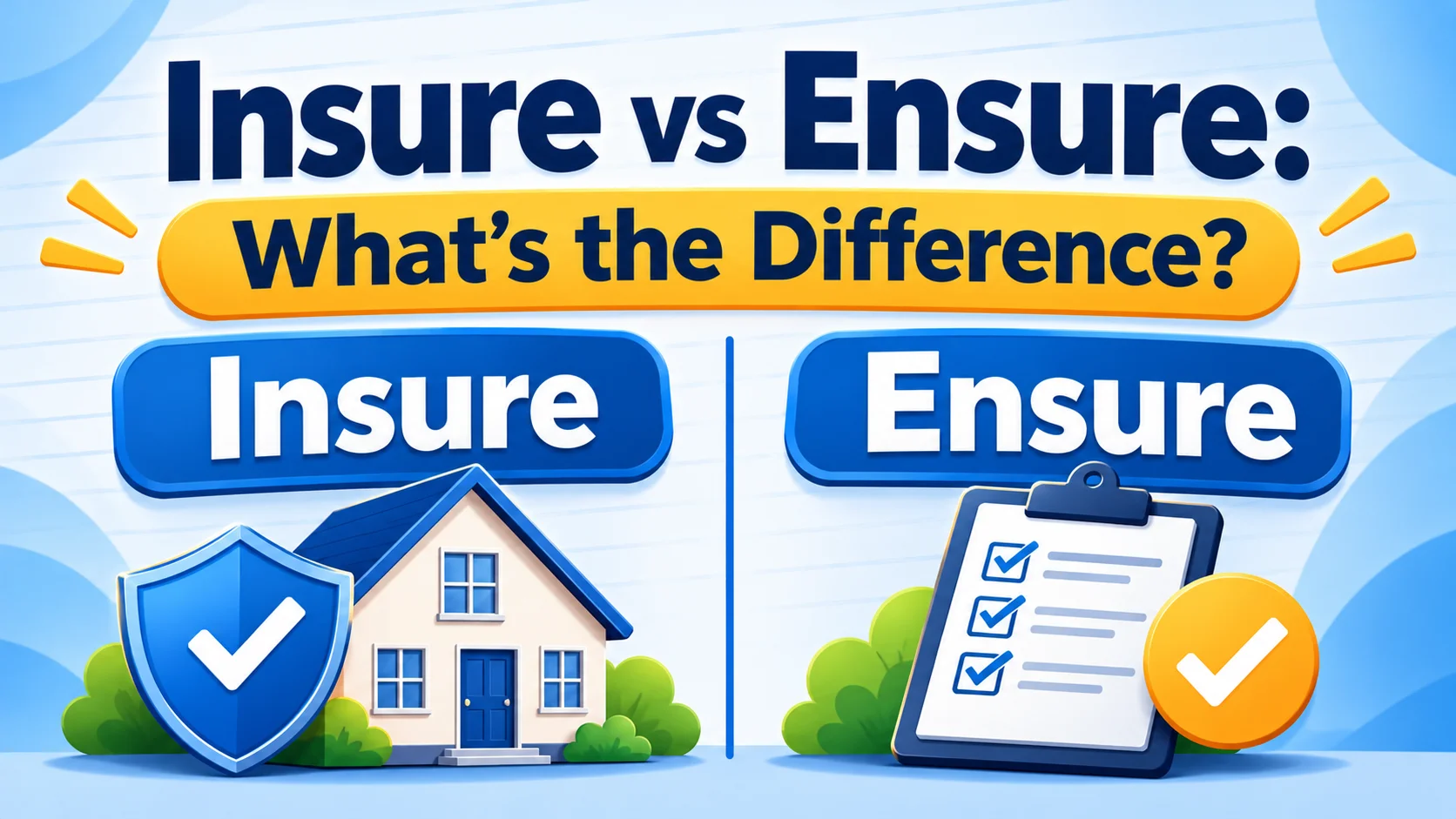
Insure vs. ensure is a common English usage problem because these three verbs look and sound similar, yet they communicate different ideas. Choosing the wrong one can change the meaning of a sentence, particularly in professional writing. For example, you insure a house against financial loss, ensure that its doors are locked, and assure someone that the property is protected. Each word has a distinct purpose, even though all three can relate to certainty, protection, or confidence. Understanding that difference makes it easier to write accurately and avoid awkward word choices.
The confusion often comes from the overlap between insure and ensure. Historically, the two words have sometimes been used with similar meanings, and some dictionaries still acknowledge overlapping senses. In modern everyday and professional English, however, writers generally use insure for insurance coverage and ensure for making something certain. Assure has a different focus: it usually involves communicating with a person to remove doubt or provide confidence. These distinctions are easier to remember when you look at the objects and sentence patterns that naturally accompany each verb.
Whether you are preparing an email, writing a report, studying English, or reviewing an important document, the right choice depends on what you want the sentence to communicate. This guide explains the meaning of each word, shows how to use it in different grammatical structures, and compares common examples side by side. You will also learn how assure differs from reassure, why ensure is not always identical to guarantee, and how to avoid the mistakes that make these words difficult to distinguish.
Insure vs. Ensure: The Quick Difference
The simplest way to distinguish these words is to focus on their main purposes:
- Insure means to protect something financially against specified risks through an insurance policy.
- Ensure means to make certain that something happens or remains true.
- Assure means to tell someone something confidently to remove doubt or worry.
Consider these three sentences:
- We insured our house against fire damage.
- We checked the electrical wiring to ensure the house was safe.
- The agent assured us that our insurance policy was active.
All three sentences involve protection or confidence, but each verb describes a different action.
| Word | Meaning | Main focus | Example |
| Insure | Protect against financial loss through insurance | Insurance coverage | We insure our vehicles. |
| Ensure | Make certain that something happens | An outcome or condition | Please ensure the documents are complete. |
| Assure | Tell someone something to remove doubt | A person receiving reassurance | I assure you that the information is correct. |
Easy memory trick: You insure property, ensure an outcome, and assure a person.
This is a practical guide rather than an inflexible rule for every possible sentence. The important thing is to understand the intended meaning before choosing the verb.
What Does Insure Mean?
Insure means to provide financial protection against particular risks through an insurance arrangement. When you insure something, you arrange coverage under which an insurance company may pay for specified losses or damages according to the policy’s terms.
For example:
- We decided to insure our new car.
- The business insures its equipment against theft.
- You should insure valuable possessions before traveling.
- The homeowner insured the property against certain types of damage.
In each sentence, insure refers to financial protection, not simply making something safe or certain.
When Should You Use Insure?
Use insure when discussing insurance policies, coverage, premiums, or protection against financial loss.
Common situations include:
1. Property insurance
Homeowners and businesses may insure buildings and their contents against covered risks such as fire, theft, or certain forms of damage.
Example: The company insures its warehouse and office equipment.
2. Vehicle insurance
Drivers may insure cars, motorcycles, and other vehicles against risks covered by their policies.
Example: She insured her car before taking it on a long journey.
3. Life insurance
A person may purchase life insurance to provide financial support to designated beneficiaries under the policy’s conditions.
Example: He decided to insure his life to provide financial protection for his family.
4. Travel insurance
Travelers may purchase insurance that covers specified problems, such as certain medical expenses, trip cancellations, or lost baggage.
Example: We insured our trip in case unexpected circumstances forced us to cancel.
5. Business and professional insurance
Businesses may insure property, equipment, or professional activities against particular financial risks.
Example: The consulting firm insures its operations against certain professional liabilities.
Insure in Different Verb Forms
Like other regular English verbs, insure changes form depending on the subject and tense.
| Verb form | Example |
| Insure | We insure our building. |
| Insures | The company insures its vehicles. |
| Insured | They insured the property last year. |
| Insuring | She is insuring her new equipment. |
The related noun is insurance.
- The company provides insurance for its employees.
- We purchased insurance for the vehicle.
Be careful not to confuse insure with ensure simply because their spellings are similar. The noun insurance is a useful clue: if you are discussing an insurance policy or financial coverage, insure is usually the correct verb.
Common Expressions with Insure
These combinations appear frequently in insurance-related writing:
- Insure a vehicle
- Insure a property
- Insure valuable possessions
- Insure against damage
- Insure against financial loss
- Insure a business
- Insure a shipment
For example:
“The company decided to insure its shipment against damage during transportation.”
Here, insure is appropriate because the company is arranging financial coverage for a possible loss.
What Does Ensure Mean?
Ensure means to make certain that something happens, is achieved, or remains in a particular condition. It usually focuses on an outcome rather than an insurance arrangement.
For example:
- Please ensure that all the doors are locked.
- The editor checked the report to ensure accuracy.
- Regular maintenance helps ensure that the equipment works properly.
- The manager introduced new procedures to ensure workplace safety.
In each sentence, someone takes an action to make a desired result more likely or to confirm that a particular condition is met.
When Should You Use Ensure?
Use ensure when discussing steps taken to make something certain or prevent a particular problem.
Common situations include:
1. Ensuring accuracy
Writers, editors, and researchers review information to reduce errors.
Example: The editor checked every figure to ensure the report was accurate.
2. Ensuring safety
Organizations introduce procedures, inspections, and safeguards to reduce risks.
Example: Staff members must follow the instructions to ensure workplace safety.
3. Ensuring quality
Businesses establish standards and review processes to maintain the expected quality of products or services.
Example: The supervisor inspected the finished products to ensure consistent quality.
4. Ensuring compliance
Organizations may introduce checks to help meet legal, regulatory, or internal requirements.
Example: The company updated its procedures to ensure compliance with the relevant regulations.
5. Ensuring that tasks are completed
Managers and team members use reminders, schedules, and follow-ups to make sure responsibilities are fulfilled.
Example: Please ensure that the application is submitted before Friday.
Common Sentence Patterns with Ensure
Understanding how ensure works grammatically makes it easier to use correctly.
Ensure + noun
Use this structure when referring to a condition, quality, or result.
- Ensure accuracy.
- Ensure consistency.
- Ensure safety.
- Ensure compliance.
Example: The revised procedure should ensure consistency across all departments.
Ensure + that-clause
This is one of the most common constructions.
- Ensure that everyone understands.
- Ensure that the figures are correct.
- Ensure that the package arrives on time.
Example: Please ensure that every section of the form is completed.
The word that is often optional in everyday English:
- Please ensure that the documents are signed.
- Please ensure the documents are signed.
Both are grammatical.
Ensure + object + adjective
This construction describes the condition something should be in.
- Ensure the room is clean.
- Ensure the equipment is ready.
- Ensure the information is accurate.
Example: The technician checked the system to ensure the equipment was operational.
Ensure + object + past participle
Use this pattern when referring to something that needs to be completed or done.
- Ensure the forms are submitted.
- Ensure the doors are locked.
- Ensure the documents are signed.
Example: The administrator must ensure that all applications are reviewed.
Does Ensure Mean Guarantee?
Ensure and guarantee can have similar meanings, but they are not always interchangeable.
Ensure often emphasizes taking steps to make a particular result happen.
Guarantee can emphasize a firm promise, commitment, or assurance that something will happen or be provided.
Compare:
- The team introduced additional checks to ensure accuracy.
- The company guarantees that its product meets the stated standard.
The first sentence focuses on a process. The second communicates a promise or commitment.
There is an important limitation: using ensure does not automatically mean that an outcome is completely within your control. A person can take reasonable steps to ensure something, but unexpected circumstances may still interfere.
For example, a company can introduce procedures to ensure timely delivery, but severe weather or other disruptions may prevent the shipment from arriving as planned.
What Does Assure Mean?
Assure means to tell someone something confidently to remove doubt, reduce worry, or give them confidence.
Unlike ensure, which generally focuses on an outcome, assure usually focuses on a person receiving information or reassurance.
For example:
- I assure you that the figures are correct.
- The manager assured the team that their concerns would be considered.
- She assured her parents that she would arrive on time.
- The representative assured the customer that the request had been received.
In these examples, the speaker communicates something intended to make another person feel more confident.
When Should You Use Assure?
Use assure when someone needs confirmation, reassurance, or confidence about a situation.
1. Reassuring someone about a decision
Example: The teacher assured the students that the change would not affect their grades.
2. Confirming information
Example: I can assure you that the figures were checked carefully.
3. Addressing concerns
Example: The manager assured employees that their feedback would be reviewed.
4. Giving someone confidence about a plan
Example: She assured her parents that she had made the necessary arrangements.
5. Responding to a complaint
Example: The customer service representative assured the customer that the issue was being investigated.
The key is that assure involves communication. It tells someone that something is true, will happen, or can be trusted.
Common Sentence Patterns with Assure
Assure + person
Use this structure when identifying the person receiving reassurance.
- I assure you.
- She assured him.
- They assured us.
Example: The director assured the employees.
This sentence is grammatically complete, although adding the information being communicated may make it more useful.
Assure + person + that-clause
This is a particularly common structure.
- I assure you that everything is ready.
- She assured him that the payment had been received.
- They assured us that the meeting would begin on time.
Example: The supplier assured the customer that the replacement would arrive the following week.
Assure + person + of + noun
Use this structure when reassuring someone about a particular quality, fact, or commitment.
- Assure someone of your support.
- Assure someone of your commitment.
- Assure someone of the accuracy of the information.
Example: The company assured its clients of its continued support.
Be assured
This construction is often used in formal communication.
Example: You can be assured of our continued attention to your concerns.
It communicates confidence without directly addressing the person through the active structure I assure you.
Does Assure Mean Reassure?
The words are closely related, but they have a difference in emphasis.
Assure means to tell someone something confidently or remove uncertainty.
Reassure often emphasizes restoring confidence or reducing worry that someone is already experiencing.
Compare:
- I assured the customer that the delivery was scheduled.
- I reassured the customer after the delivery was delayed.
The first sentence focuses on communicating information. The second emphasizes responding to the customer’s concern.
The distinction is not absolute, and the verbs can overlap. However, reassure is often the more natural choice when someone is already anxious or uncertain.
The related noun forms are also different:
- Assurance: A statement or indication that gives confidence.
- Reassurance: Something that restores confidence or reduces worry.
Example: The customer appreciated the manager’s reassurance after the problem was resolved.
Insure vs. Ensure: Key Differences Explained
Now that each word has been considered separately, it is easier to compare them in situations where their meanings might overlap.
Insure vs. Ensure
These are often confused because they look and sound similar.
The modern distinction is straightforward:
- Insure refers to arranging financial protection through insurance.
- Ensure refers to making certain that something happens or remains true.
Compare:
| Insure | Ensure |
| We insured the building against fire. | We installed alarms to ensure the building was safer. |
| The company insures its delivery vehicles. | The company checks its vehicles to ensure they are roadworthy. |
| She insured her valuable equipment. | She checked the equipment to ensure it was working. |
Notice the difference in purpose. Insurance provides financial protection if a covered event occurs. Ensuring something involves taking steps to achieve or maintain a particular condition.
A business might do both:
“The company insured its equipment against damage and introduced regular inspections to ensure it remained in good condition.”
Both verbs are correct because they describe separate actions.
Ensure vs. Assure
The distinction between these two words is especially important in everyday communication.
- Ensure focuses on making a result or condition certain.
- Assure focuses on communicating with a person to give confidence or remove doubt.
Compare:
- Please ensure that the customer receives the correct order.
- Please assure the customer that the order has been dispatched.
In the first sentence, the responsibility is to make sure the correct order is delivered.
In the second, the responsibility is to communicate information to the customer.
A useful test is to ask: Am I making something happen, or am I telling someone something to give them confidence?
If you are making something happen, ensure is generally appropriate. If you are reassuring a person, choose assure.
Insure vs. Assure
These words have different purposes, even though both can relate to protection or confidence.
- Insure provides financial protection against specified risks.
- Assure communicates confidence or reassurance to someone.
Compare:
- The company insured its equipment against theft.
- The company assured its customers that the equipment was secure.
The first describes an insurance arrangement. The second describes a statement intended to reassure customers.
Can Insure, Ensure Be Used Interchangeably?
Generally, no. Their modern meanings are distinct enough that replacing one with another can change the intended message.
Consider these examples:
| Incorrect or unsuitable use | Better wording | Reason |
| Please insure that the report is complete. | Please ensure that the report is complete. | The sentence concerns completing a task. |
| We need to ensure the car against theft. | We need to insure the car against theft. | The sentence concerns insurance coverage. |
| I ensure you that the information is correct. | I assure you that the information is correct. | The speaker is reassuring a person. |
| Please assure that all doors are locked. | Please ensure that all doors are locked. | The instruction concerns a condition that must be met. |
There is a historical reason for some of the confusion: insure and ensure have overlapping histories and have sometimes been used with similar meanings. Some dictionaries recognize broader or overlapping uses.
Nevertheless, the clearest modern approach is to reserve insure for insurance and use ensure for making something certain. This distinction is especially useful in formal and professional writing.
Insure And Ensure in American and British English
Writers sometimes wonder whether these words have different meanings in American and British English.
All three are used in both varieties. The central modern distinctions remain broadly the same:
- Insure relates to insurance coverage.
- Ensure means to make certain.
- Assure means to give someone confidence or remove doubt.
The main complication concerns the historical overlap between insure and ensure. Some established usage references acknowledge that insure has occasionally been used more broadly to mean ensure, particularly in certain contexts.
However, this overlap does not mean the words are equally suitable in every sentence.
For clear writing, especially in business, education, and professional documents, use:
- Insure when discussing a policy or financial protection.
- Ensure when discussing a required result or condition.
- Assure when communicating confidence to a person.
If you are editing a legal or insurance document, follow the terminology used in the relevant policy or organizational style guide. Precision matters because insurance wording can have contractual implications.
Common Mistakes When Using Insure, Ensure, and Assure
Knowing the definitions is helpful, but the real test is applying them correctly in sentences. These are some of the mistakes worth watching for.
1. Using Insure When You Mean Ensure
Incorrect: Please insure that all the details are correct.
Correct: Please ensure that all the details are correct.
The sentence asks someone to check information, not purchase insurance coverage.
2. Using Ensure When You Mean Insure
Incorrect: We should ensure our house against flood damage.
Correct: We should insure our house against flood damage.
The sentence refers to financial protection through an insurance policy.
3. Using Ensure Instead of Assure
Incorrect: I ensure you that the payment has been received.
Correct: I assure you that the payment has been received.
The speaker is communicating information to a person, so assure is the appropriate verb.
4. Using Assure When You Mean Ensure
Incorrect: Please assure that the application is submitted before Monday.
Better: Please ensure that the application is submitted before Monday.
The sentence describes a task that needs to be completed. It does not involve reassuring a person.
5. Leaving Out the Person in Common Assure Constructions
Assure commonly takes a person as its object.
Compare:
- Awkward in ordinary usage: I assure that the figures are accurate.
- More natural: I assure you that the figures are accurate.
The second construction clearly identifies who is receiving the reassurance.
In some contexts, assure can appear in other constructions, but for everyday writing, patterns such as assure someone that and assure someone of something are especially useful.
6. Assuming Ensure Always Means Guarantee
Incorrect reasoning: If I ensure something, its success is absolutely guaranteed.
Better understanding: Ensure means to take steps to make something certain or to establish that a condition is met. It does not eliminate every possibility of failure.
For example, a company may introduce procedures to ensure accurate records, but human error or unexpected technical problems can still occur.
Use the word honestly. Do not imply complete control over an outcome when that control does not exist.
Easy Ways to Remember the Difference
If you regularly confuse these verbs, a simple memory system can help.
The Three-Word Memory Trick
INSURE
Insurance
Think of a car, house, or business protected by an insurance policy.
ENSURE
Establish certainty
Think of a checklist, completed task, or confirmed result.
Ask Yourself One Question Before Choosing
When you are unsure which verb to use, identify what the sentence is trying to communicate.
| Ask yourself… | Choose… | Example |
| Am I arranging financial protection? | Insure | We insure our property. |
| Am I making certain something happens? | Ensure | Ensure the report is submitted. |
| Am I giving someone confidence? | Assure | I assure you that it is ready. |
This quick decision method works well when proofreading emails, reports, assignments, and other everyday writing.
Practice Exercise: Insure vs. Ensure
Test your understanding by choosing the correct word in each sentence.
Fill in the Blanks
Choose insure, ensure, or assure in the correct form.
- The family decided to ______ its new home against fire damage.
- Please ______ that every section of the form is complete.
- I can ______ you that the information has been verified.
- The company ______ its delivery vehicles against theft.
- The teacher checked the answers to ______ accuracy.
- The manager ______ the employees that their concerns would be addressed.
- We need to ______ that the equipment is switched off before leaving.
- The traveler decided to ______ her luggage before the trip.
Correct the Mistakes
Each sentence contains an unsuitable word choice. Rewrite it using the correct verb.
- Please insure that the office is locked before leaving.
- The company ensured its warehouse against fire damage.
- I ensure you that the documents have been received.
- The supervisor asked the team to assure that all safety checks were completed.
Answers and Explanations
Fill in the blanks
- Insure — The home is receiving financial protection through insurance.
- Ensure — The instruction concerns making certain that the form is complete.
- Assure — The speaker is giving a person confidence.
- Insures — The company provides insurance coverage for its vehicles.
- Ensure — The teacher is checking that the answers are accurate.
- Assured — The manager communicated reassurance to the employees.
- Ensure — The goal is to make certain that the equipment is switched off.
- Insure — The traveler is arranging financial protection for the luggage.
Correct the mistakes
- Please ensure that the office is locked before leaving.
- The company insured its warehouse against fire damage.
- I assure you that the documents have been received.
- The supervisor asked the team to ensure that all safety checks were completed.
The most useful clue is the purpose of the action: financial coverage, making something certain, or communicating reassurance.
Conclusion:
The difference between insure, ensure, and assure becomes much easier to recognize when you focus on the action each word describes. Insure concerns financial protection, ensure concerns making an outcome or condition certain, and assure concerns giving someone confidence through communication. One final actionable tip: Before choosing one of these verbs, identify whether your sentence involves an insurance policy, a result that must be achieved, or a person who needs reassurance. A common mistake to avoid is choosing a word simply because it looks or sounds familiar. Similar spelling does not make these verbs interchangeable. Use the right word for the intended meaning, and your writing will be clearer, more precise, and easier for readers to trust.
FAQs
Q1. Is it insure or ensure that something happens?
Use ensure when you mean making certain that something happens or is achieved. For example, “We introduced additional checks to ensure that the work meets our standards.” Use insure when arranging financial protection through an insurance policy.
Q2. Can insure and ensure ever mean the same thing?
Historically, insure and ensure have had overlapping meanings, and some dictionaries acknowledge broader uses of insure. However, modern writing generally distinguishes them: insure refers to insurance coverage, while ensure means making something certain.
Q3. Do you assure someone or ensure someone?
You generally assure someone when communicating something intended to remove doubt or provide confidence. You ensure that something happens when taking steps to achieve a result. For example, assure a customer that an order has shipped, but ensure the correct order is dispatched.
Q4. What are the noun forms of insure, ensure, and assure?
The most familiar related nouns are insurance and assurance. Insurance refers to financial protection, while assurance can mean a confident statement or a feeling of certainty. Ensuring is the usual noun-like form when referring to the act of making something certain.
Q5. What does “rest assured” mean?
Rest assured is an expression used to tell someone they can feel confident about something or stop worrying. For example, “Rest assured, your application has been received.” It is a reassuring expression, not a reference to insurance or a formal guarantee.