

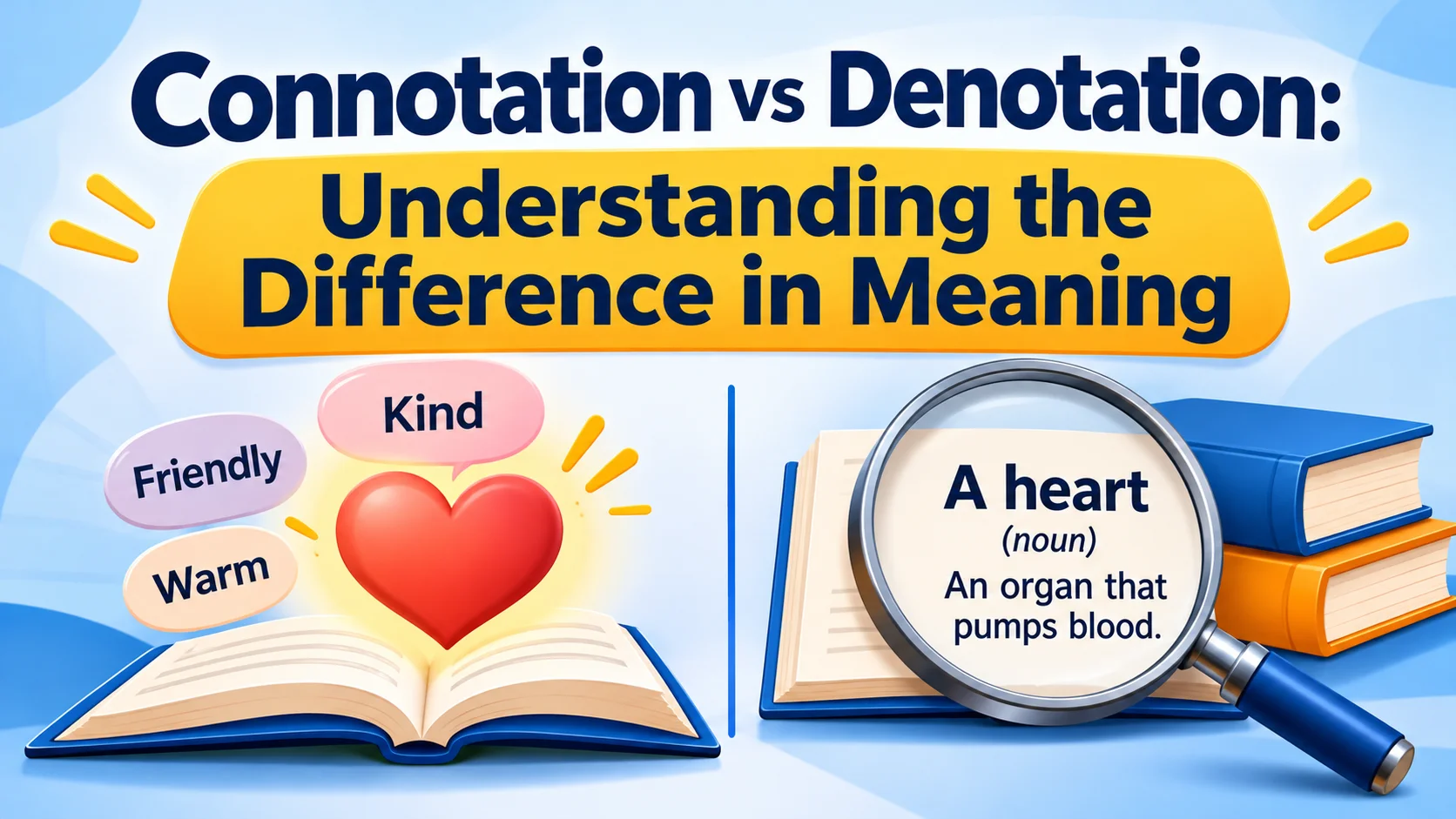
Connotation vs. denotation is a distinction that explains why two words with similar dictionary meanings can create completely different impressions. Consider the words frugal and cheap. Both can describe someone who spends little money, but they do not usually communicate the same attitude. Calling someone frugal may suggest sensible financial habits, while calling that person cheap can imply unwillingness to spend even when necessary. The difference is not simply vocabulary; it involves the relationship between literal meaning, emotional associations, and context. Understanding this distinction helps you recognize what words communicate beyond their basic definitions.
Every word has a particular meaning, but readers and listeners often interpret it through their experiences, expectations, and cultural backgrounds. This is where connotation becomes especially important. A word may suggest approval, criticism, affection, fear, or neutrality without explicitly expressing any of those feelings. Meanwhile, its denotation provides the basic meaning that allows people to understand what is being discussed. Recognizing both layers makes it easier to interpret conversations, analyze literature, evaluate persuasive language, and avoid misunderstandings when choosing words for different audiences.
Whether you are writing an academic essay, preparing a professional presentation, creating a story, or having an everyday conversation, the words you select influence how your message is received. A technically accurate word may still create an unintended impression. This guide explains what connotation and denotation mean, how they differ, and how context influences their interpretation. You will also explore positive, negative, and neutral associations, practical word comparisons, literary examples, common mistakes, and techniques for choosing vocabulary that communicates exactly what you intend.
What Is Denotation? Understanding a Word’s Literal Meaning
Denotation is the direct, established meaning of a word. It refers to what a word identifies or describes, rather than the feelings or personal associations it might create.
In simple terms, denotation answers the question: What does this word literally mean?
For example, the denotation of snake is a type of elongated, legless reptile. The word identifies an animal with particular physical characteristics. That definition remains recognizable whether someone likes snakes, fears them, or considers them interesting.
Similarly:
- Home: A place where someone lives.
- Child: A young human being.
- Inexpensive: Not costing much money.
- Confident: Having confidence in oneself or one’s abilities.
- Rose: A flowering plant belonging to the genus Rosa.
These definitions communicate basic information without requiring the reader to interpret an emotional attitude.
How dictionaries establish denotative meaning
Dictionaries are useful references for understanding denotation because they record established word meanings and explain how words function in different contexts.
However, a word can have more than one denotation. For example, bright can describe strong light, vivid color, or someone who is intelligent.
Consider these sentences:
- The room is bright.
- She is a bright student.
The word has different established meanings in these examples. A dictionary helps identify the relevant sense, while the sentence provides the context needed to interpret it.
Practical insight: When analyzing a word, establish its intended dictionary meaning first. Otherwise, you may mistake a figurative use or emotional association for its literal definition.
Why denotation matters in clear communication
Denotation is particularly important when accuracy matters more than emotional impact.
It plays an essential role in:
- Academic writing: Explaining concepts using established definitions.
- Scientific communication: Describing observations and technical processes.
- Legal documents: Expressing obligations and conditions precisely.
- Instructions: Making directions easy to understand.
- Journalism: Reporting events without introducing unnecessary personal judgments.
For instance, a news report stating that a building was damaged communicates a basic fact. Describing it as devastated may suggest a much greater degree of destruction.
The second word carries stronger implications, so it should only be used when the circumstances justify it.
What Is Connotation? Understanding the Associations Behind Words
Connotation refers to the feelings, ideas, attitudes, and associations that a word suggests beyond its literal definition.
It answers a different question: What does this word make the reader or listener think or feel?
Consider the word home. Its basic denotation is a place where someone lives. However, it may also suggest:
- Comfort
- Family
- Safety
- Belonging
- Childhood memories
These associations are not part of the basic physical definition. They develop through personal experiences, cultural traditions, and common language usage.
Similarly, snake denotes a reptile, but it can carry negative associations involving dishonesty or betrayal when used metaphorically to describe a person.
Connotation gives language additional layers of meaning. It helps explain why selecting one word instead of another can change the tone of an entire sentence.
Positive connotation
A positive connotation occurs when a word creates a favorable, approving, or pleasant impression.
Examples include:
| Word | General meaning | Positive association |
| Generous | Willing to give | Kindness and consideration |
| Determined | Firmly committed | Persistence and dedication |
| Frugal | Careful with spending | Financial responsibility |
| Confident | Self-assured | Competence and belief in oneself |
| Vintage | From an earlier period | Character and historical appeal |
Consider the difference between these sentences:
- She is frugal with her money.
- She is careful about how she spends her money.
Both communicate financial restraint, but frugal often suggests a positive habit of avoiding unnecessary expenses.
Positive connotations are particularly useful in appreciative descriptions, encouraging messages, professional recommendations, and persuasive writing.
Negative connotation
A negative connotation occurs when a word suggests something unfavorable, critical, unpleasant, or disapproving.
Examples include:
| Word | General meaning | Negative association |
| Arrogant | Having an exaggerated sense of superiority | Excessive pride |
| Cheap | Low in price or unwilling to spend | Poor quality or stinginess |
| Nosy | Excessively interested in others’ affairs | Intrusiveness |
| Stubborn | Unwilling to change one’s position | Inflexibility |
| Childish | Showing immature behavior | Lack of maturity |
Compare:
- He is determined to finish the project.
- He is stubborn about finishing the project his way.
Both describe persistence, but the second sentence suggests that the person may be unwilling to consider other approaches.
Negative connotations can be appropriate when expressing criticism or identifying undesirable behavior. The important point is to ensure that the emotional implication reflects what you actually intend to communicate.
Neutral connotation
A neutral connotation occurs when a word communicates information without creating a particularly strong positive or negative impression in a given context.
Examples include:
- Residence
- Purchase
- Inexpensive
- Observant
- Persistent
For example:
- The family purchased a new house.
- The family bought a new house.
Both sentences communicate a straightforward transaction. Neither word necessarily introduces a strong emotional judgment.
However, neutral language is not always completely free of associations. Even seemingly objective words can develop particular impressions depending on their audience and context.
Why connotations differ between people and cultures
Not everyone interprets words in exactly the same way.
Connotations can be influenced by:
- Personal experience: Someone who associates a particular animal with a childhood memory may interpret its name differently from someone who fears it.
- Cultural background: Traditions, beliefs, and social conventions influence the associations attached to words.
- Historical usage: Words can develop new implications as society and language change.
- Social context: A word may sound friendly among close friends but disrespectful in a professional conversation.
- Tone and delivery: Sarcasm, emphasis, and surrounding expressions can change how a word is received.
For this reason, connotation should not always be treated as a fixed label. Positive, negative, and neutral associations are useful general categories, but actual interpretation depends on usage.
Connotation vs. Denotation: What Is the Difference?
The fundamental difference is that denotation communicates a word’s literal meaning, whereas connotation communicates its associated ideas and feelings.
A word’s denotation tells readers what it identifies. Its connotation influences how they interpret or emotionally respond to it.
Consider rose.
- Denotation: A flowering plant belonging to the genus Rosa.
- Connotation: Love, romance, beauty, affection, or celebration.
The literal meaning identifies the plant. The associations explain why roses frequently appear in romantic messages, celebrations, and symbolic descriptions.
Connotation vs. denotation comparison table
| Feature | Denotation | Connotation |
| Definition | Literal or established meaning | Associated or implied meaning |
| Main focus | What a word identifies | What a word suggests |
| Nature | Conventional and dictionary-based | Emotional, cultural, and contextual |
| Purpose | Communicates basic information | Influences tone and interpretation |
| Stability | Generally more stable | More likely to vary |
| Influences | Established language usage | Experience, culture, history, and context |
| Example | Rose: a flowering plant | Rose: romance or affection |
Can two words have the same denotation but different connotations?
Yes. This is one of the clearest ways to understand the difference.
Words can refer to similar things while communicating different attitudes toward them.
Consider these pairs:
- Frugal vs. cheap: Both can describe spending little money, but frugal often suggests sensible financial management, while cheap may imply stinginess.
- Curious vs. nosy: Both involve interest in information, but nosy suggests an intrusive interest in other people’s affairs.
- Confident vs. arrogant: Both relate to self-belief, but arrogant suggests an exaggerated sense of superiority.
- Childlike vs. childish: Both relate to qualities associated with children, but childlike can suggest innocence, while childish often implies immaturity.
These distinctions matter because a writer can communicate the same general information while creating a very different impression.
Can a word have both positive and negative connotations?
Absolutely. Some words have associations that change depending on how they are used.
Take ambitious:
– “She is an ambitious student who works hard toward her goals.”
Here, ambitious suggests determination and motivation.
– “His ambitious plans left no room for anyone else’s priorities.”
In this context, the word may suggest excessive self-interest.
The word itself has not changed. The surrounding information influences the reader’s interpretation.
Examples of Connotation vs. Denotation in Common Word Choices
The easiest way to recognize connotation is to compare related words. The following examples show how vocabulary can communicate similar basic ideas while creating different impressions.
1. Slim vs. skinny
Both words can describe someone with a relatively small body size.
- Slim: Often carries a favorable or complimentary association.
- Skinny: Can suggest being unusually thin and may sound critical or unflattering.
Examples:
- The tailor recommended a slim design for the suit.
- The character was described as skinny in the novel.
The distinction depends on context, and neither word should automatically be treated as a judgment about someone’s health or appearance.
2. Frugal vs. cheap
Both words can describe someone who spends relatively little money.
- Frugal: Suggests careful spending and avoiding unnecessary expenses.
- Cheap: Can suggest unwillingness to spend money, or that something is low in quality.
Examples:
- Maria is frugal and compares prices before buying anything.
- The landlord was too cheap to repair the broken equipment.
The first description suggests sensible behavior. The second expresses criticism.
3. Confident vs. arrogant
Both words relate to how people view their abilities or importance.
- Confident: Suggests self-assurance and belief in one’s abilities.
- Arrogant: Suggests an exaggerated sense of superiority.
Examples:
- The candidate gave a confident presentation.
- The candidate sounded arrogant when dismissing other people’s ideas.
The distinction is especially useful in professional writing because the choice can influence how a person’s behavior is perceived.
4. Curious vs. nosy
Both words describe an interest in learning information.
- Curious: Generally suggests a healthy desire to discover or understand something.
- Nosy: Suggests excessive or intrusive interest in matters that do not concern the person.
Examples:
- The curious student asked questions about the experiment.
- The nosy neighbor kept asking about the family’s private business.
One word presents curiosity as a positive quality; the other criticizes how that interest is expressed.
5. Vintage vs. old-fashioned
Both words can refer to things associated with an earlier period.
- Vintage: Often suggests historical character, distinctive style, or collectible appeal.
- Old-fashioned: Can suggest traditional charm or something that no longer seems modern.
Examples:
- She decorated the room with vintage furniture.
- He preferred an old-fashioned approach to communication.
Notice that old-fashioned is not always negative. In a sentence about traditional values or classic design, it may communicate admiration.
6. Politician vs. statesman
These words both relate to people involved in government and political leadership, but their associations differ.
- Politician: A person engaged in politics, generally a descriptive term.
- Statesman: A political leader often associated with wisdom, experience, and public service.
Examples:
- The politician addressed the proposed legislation.
- The respected statesman helped negotiate a national agreement.
Calling someone a statesman generally communicates a more favorable judgment than simply identifying that person as a politician.
7. Childlike vs. childish
These words demonstrate how closely related vocabulary can communicate contrasting evaluations.
- Childlike: Often suggests innocence, openness, curiosity, or playfulness.
- Childish: Usually suggests immaturity or behavior inappropriate for someone’s age.
Examples:
- Her childlike curiosity made the science museum exciting.
- His childish reaction disrupted the discussion.
The difference lies in the attitude expressed, not simply the connection with childhood.
More examples of words with different connotations
| More favorable association | Less favorable association | Shared general idea |
| Frugal | Cheap | Careful spending |
| Confident | Arrogant | Self-belief |
| Curious | Nosy | Interest in information |
| Slim | Skinny | Relative body size |
| Determined | Stubborn | Persistence |
| Vintage | Old-fashioned | Connection with the past |
| Childlike | Childish | Qualities associated with children |
| Economical | Stingy | Limiting expenditure |
| Assertive | Aggressive | Forceful expression |
| Relaxed | Lazy | Low activity or effort |
These pairs are illustrative rather than exact dictionary synonyms. Some have overlapping meanings, while others describe related qualities. Their purpose is to demonstrate how word choice can change the attitude communicated by a sentence.
How Context Changes a Word’s Connotation
A word does not always carry the same emotional association in every sentence. Context can strengthen, weaken, or even reverse the impression it creates.
The same word can communicate different attitudes
Consider aggressive.
- The company adopted an aggressive marketing strategy to reach new customers.
- The customer became aggressive when the employee refused the request.
In the first sentence, the word may suggest an energetic or ambitious business approach. In the second, it describes hostile behavior.
Similarly, traditional can communicate admiration for established customs or criticism of resistance to change.
This is why interpreting words in isolation can lead to mistakes.
How surrounding words influence interpretation
Words rarely operate independently. Adjectives, verbs, and other expressions help readers understand the intended attitude.
Compare:
- She made a bold decision to launch her business.
- She made a reckless decision to launch her business.
Both sentences describe a decision involving risk. However, bold suggests courage, while reckless suggests poor judgment.
The surrounding sentence also matters. If the business launch succeeds, readers may interpret the decision as courageous. If it causes avoidable problems, the same decision may be described as reckless.
How audience and cultural background affect meaning
A word that sounds ordinary in one community may carry a different association elsewhere.
For example, terms associated with family roles, age, social class, or regional identity may be interpreted differently across cultures.
Professional writers should consider:
- Whether the audience recognizes the intended meaning.
- Whether a word carries an unintended cultural association.
- Whether the wording sounds respectful in the relevant setting.
- Whether a neutral alternative would communicate the same information more clearly.
Practical recommendation: When writing for an international audience, favor clear, widely understood language over expressions that depend heavily on local cultural associations.
When a positive word can sound negative
Even words with generally favorable associations can become critical through sarcasm or excessive emphasis.
For example:
“That was a very interesting decision.”
Depending on the speaker’s tone and the surrounding conversation, interesting may express genuine curiosity or indirect criticism.
Written communication can make this especially difficult because readers cannot hear the speaker’s voice.
When the intended attitude matters, choose precise words rather than relying on expressions that could be interpreted in multiple ways.
Why Connotation and Denotation Matter in Writing and Communication
Understanding both types of meaning helps writers do more than avoid grammatical errors. It allows them to control tone, communicate accurately, and anticipate how an audience may interpret a message.
Choosing words that create the right tone
Tone is the attitude conveyed through language. Connotation is one of the tools that helps establish it.
Consider a manager describing an employee:
- “She is persistent when solving problems.”
- “She is stubborn when solving problems.”
The first sentence presents persistence as a strength. The second suggests difficulty accepting alternative approaches.
Neither description is automatically correct. The appropriate choice depends on the employee’s actual behavior and the writer’s intended evaluation.
Making professional and academic writing more precise
Professional communication benefits from vocabulary that is both accurate and appropriate.
For example:
| Less suitable wording | More precise alternative | Why the change helps |
| The product is cheap. | The product is inexpensive. | Avoids implying poor quality. |
| The employee is nosy. | The employee asks frequent personal questions. | Describes the behavior more specifically. |
| The proposal is crazy. | The proposal is highly unconventional. | Replaces an imprecise judgment with a clearer description. |
| The results were amazing. | The results exceeded expectations. | Communicates a more specific evaluation. |
This does not mean writers should eliminate emotional vocabulary. Instead, they should choose words that match the evidence and purpose of the communication.
Creating emotional impact in storytelling
Fiction writers use connotation to influence how readers perceive characters, settings, and events.
Compare:
- The old house stood at the end of the road.
- The abandoned house stood at the end of the road.
Both sentences describe a house that has existed for some time. However, abandoned suggests neglect, loneliness, or mystery.
A small vocabulary change can establish a different atmosphere without requiring a longer description.
Avoiding misunderstandings in everyday conversations
A word can be factually accurate but socially inappropriate.
For example, describing a colleague as inexperienced may be more constructive than calling the person incompetent, particularly when the actual issue is a lack of training.
Similarly:
- “You are being careful” may sound encouraging.
- “You are being overcautious” may sound critical.
Understanding connotation helps speakers consider not only what they want to say but also how their words may affect the listener.
Using connotation in persuasive and marketing language
Advertisers and marketers frequently select words for their associations.
Consider these examples:
- Pre-owned instead of used.
- Exclusive instead of restricted.
- Economical instead of cheap.
- Classic instead of old.
These alternatives can influence how consumers perceive a product or service.
However, emotional appeal should not replace accurate information. Calling a low-quality product premium does not make it premium.
Good persuasive writing uses positive associations without misrepresenting the facts.
How Authors Use Connotation in Literature
In literature, words often communicate more than their literal meanings. Authors carefully select vocabulary to shape atmosphere, reveal character traits, develop themes, and guide readers’ interpretations.
Creating mood and atmosphere
Writers can describe similar environments using different words to establish different moods.
Consider these examples:
- A quiet forest surrounded the village.
- A silent forest surrounded the village.
- An eerie forest surrounded the village.
All three sentences describe a forest with little or no sound, but their associations differ.
Quiet may suggest peace. Silent can emphasize the absence of sound. Eerie creates a sense of discomfort or mystery.
The setting remains broadly similar, but the reader experiences it differently.
Developing characters through descriptive language
Character descriptions often rely on connotation.
Compare:
- The young man was ambitious.
- The young man was greedy.
- The young man was determined.
All three words may describe someone strongly motivated to achieve something, but they communicate different judgments about that motivation.
An author can influence whether readers admire, distrust, or criticize a character through such choices.
Using connotation to establish symbolism
Some words acquire symbolic associations through repeated use in literature and culture.
For example:
| Word or image | Literal meaning | Common symbolic associations |
| Light | Visible illumination | Knowledge, hope, truth |
| Darkness | Absence of light | Fear, uncertainty, mystery |
| Home | A place of residence | Belonging, security, family |
| Winter | A season | Endings, hardship, stillness |
| Spring | A season | Renewal, growth, beginnings |
These associations are not universal rules. An author may deliberately challenge them. Darkness, for example, can represent peaceful solitude rather than fear.
How connotation contributes to tone and theme
An author’s tone reflects the attitude expressed toward the subject, while a theme is a broader idea explored through the work.
Connotation can support both.
A writer describing a city as vibrant creates a different impression from one describing it as chaotic. The choice may reveal the narrator’s attitude and support a broader theme about urban life.
Connotation and denotation in poetry
Poets often depend on the relationship between literal and associated meanings.
A word such as journey denotes travel from one place to another, but it can also suggest personal growth, change, or the passage of life.
When a poet describes a character’s journey, readers may interpret it both literally and symbolically.
This layered meaning is one reason individual word choices deserve close attention when analyzing poetry.
How to Identify Connotation and Denotation in a Sentence
You do not need advanced linguistic knowledge to distinguish these concepts. A simple process can help you analyze unfamiliar words and evaluate your own writing.
Step 1: Identify the literal definition
Start by determining what the word means in the sentence.
If necessary, consult a reliable dictionary to identify its relevant sense.
For example, persistent means continuing firmly despite difficulty or opposition.
Step 2: Examine the associations
Ask yourself what impression the word creates.
Does persistent suggest dedication, determination, or an unwillingness to give up? Or does the context make it sound excessive?
Think about the emotional response a typical reader might have, while remembering that individual interpretations can differ.
Step 3: Replace the word with a close alternative
Substitute a related word and examine whether the sentence’s tone changes.
For example:
- The salesperson was persistent.
- The salesperson was pushy.
The first may communicate determination. The second suggests excessive pressure.
The substitution test reveals differences that a dictionary definition alone may not explain.
Step 4: Consider the audience and situation
A word that works well in a casual conversation may be unsuitable for an academic report.
Ask:
- Who will read or hear this sentence?
- What impression do I want to create?
- Could the word sound more critical than intended?
- Is there a clearer or more neutral alternative?
A worked example: Understanding the word stubborn
Consider this sentence:
“The stubborn student continued working on the difficult problem.”
Denotation: Stubborn describes someone unwilling to change their position or behavior.
Connotation: It often suggests inflexibility or an unreasonable refusal to change.
Context: The student continues working despite difficulty. In this situation, determined might communicate the intended positive quality more accurately.
Revised sentence:
“The determined student continued working on the difficult problem.”
The literal description has changed slightly, but the overall impression is more encouraging.
Common Mistakes When Understanding Connotation and Denotation
Even when readers know the definitions, several misconceptions can lead to incorrect interpretations.
1. Assuming connotation and denotation mean the same thing
They are related but not interchangeable.
Denotation identifies the established meaning of a word. Connotation involves the additional associations connected with it.
A word can have a straightforward denotation while carrying strong emotional implications.
2. Believing every synonym has the same connotation
Synonyms may share a central meaning without communicating the same attitude.
For example, confident, self-assured, and arrogant all relate to how someone views their abilities, but their associations differ.
A thesaurus can help identify alternatives, but writers should examine each word’s tone before substituting it.
3. Assuming all connotations are universal
A word may have different associations across communities, generations, and cultures.
Do not assume that every reader will respond to a word in exactly the same way.
When writing for a diverse audience, consider whether your vocabulary relies on cultural knowledge that readers may not share.
4. Treating every word as either positive or negative
Not every word carries a strong emotional association.
Many words are relatively neutral in ordinary usage. Others can be positive or negative depending on context.
For example, traditional can suggest stability and continuity or resistance to change.
5. Ignoring context when interpreting a word
A single word rarely tells the complete story.
Consider bold:
- A bold design may be visually striking.
- A bold accusation may be daring or inappropriate.
- A bold decision may be courageous or unnecessarily risky.
The surrounding sentence determines which interpretation makes sense.
6. Confusing connotation with figurative language
Connotation and figurative language are connected, but they describe different things.
Connotation concerns the associations a word carries.
Figurative language uses words in nonliteral ways, such as metaphor, simile, and personification.
For example:
“Her heart was stone.”
This is a metaphor. The word stone also carries associations of hardness or emotional coldness.
The two concepts can work together, but they are not identical.
Connotation vs. Denotation: Practice Exercises
Use these exercises to check whether you can recognize literal meanings and emotional associations in different contexts.
Exercise 1: Identify the denotation
Choose the literal meaning of the bold word.
- The frugal family avoided unnecessary expenses.
- The vintage clock was displayed in the museum.
- The curious child examined the unusual object.
- The confident speaker addressed the audience.
- The childish argument interrupted the discussion.
Exercise 2: Identify the connotation
Classify the bold word as generally positive, negative, or neutral in each context.
- She is generous with her time.
- He was nosy about his colleague’s personal life.
- The company purchased inexpensive equipment.
- The athlete remained determined despite the setback.
- The manager described the proposal as unconventional.
Exercise 3: Choose the more appropriate word
Select the word that best communicates the intended meaning.
- The student was (curious / nosy) about how the experiment worked.
- The family was (frugal / cheap) and carefully planned its budget.
- The speaker sounded (confident / arrogant) while presenting the research.
- The character displayed (childlike / childish) wonder when seeing the ocean.
- The company adopted an (economical / stingy) approach to resource management.
Answer key with explanations
✅Exercise 1
- Frugal: Careful about spending money.
- Vintage: From an earlier period, often valued for its age or style.
- Curious: Eager to learn or discover something.
- Confident: Having belief in one’s abilities.
- Childish: Showing immature behavior.
Exercise 2
- Generous: Positive.
- Nosy: Negative.
- Inexpensive: Generally neutral.
- Determined: Positive.
- Unconventional: Context-dependent; it can be positive or negative.
Exercise 3
- Curious.
- Frugal.
- Confident.
- Childlike.
- Economical.
The important lesson is that the best word is not always the one with the closest dictionary definition. It is the one that accurately communicates the intended meaning and attitude.
Conclusion:
Understanding connotation vs. denotation changes how you read, write, and communicate. Denotation gives words their established meanings, while connotation explains the feelings and associations that influence how those words are received. Both matter because accurate communication depends on more than dictionary definitions. One final actionable tip: When choosing an important word, check its literal meaning, consider its emotional associations, and read the complete sentence from your audience’s perspective. A common mistake to avoid is treating synonyms as perfectly interchangeable; similar definitions do not guarantee similar impressions. Whether you are writing an essay, describing a character, or preparing a professional message, thoughtful vocabulary makes your meaning clearer. Ultimately, effective word choice communicates not only what you mean but also the impression you intend to leave.
FAQs
Q1. What is the main difference between connotation and denotation?
Denotation is a word’s established, literal meaning, while connotation refers to its emotional and cultural associations. For example, home denotes a place where someone lives, but it can connote comfort, family, belonging, and security.
Q2. What are five examples of connotation and denotation?
Consider rose, snake, home, cheap, and childish. Their denotations identify a flower, reptile, residence, low price, and immature behavior, respectively. Their connotations may suggest romance, betrayal, belonging, poor quality, and immaturity.
Q3. Can a word have more than one connotation?
Yes. A word can create different associations depending on context, culture, tone, and audience. For instance, ambitious usually suggests motivation, but it can imply excessive self-interest when describing someone whose goals disregard other people’s needs.
Q4. What are the three main types of connotation?
The three commonly taught categories are positive, negative, and neutral. Positive connotations suggest favorable associations, negative connotations communicate unfavorable impressions, and neutral connotations generally avoid strong emotional judgments. These categories depend on context rather than functioning as permanent labels.
Q5. Is connotation the same as implied meaning?
They are closely related but not identical. Connotation refers to associations attached to particular words, while implied meaning can arise from an entire sentence, statement, or situation. A speaker may imply criticism without using any strongly negative vocabulary.