

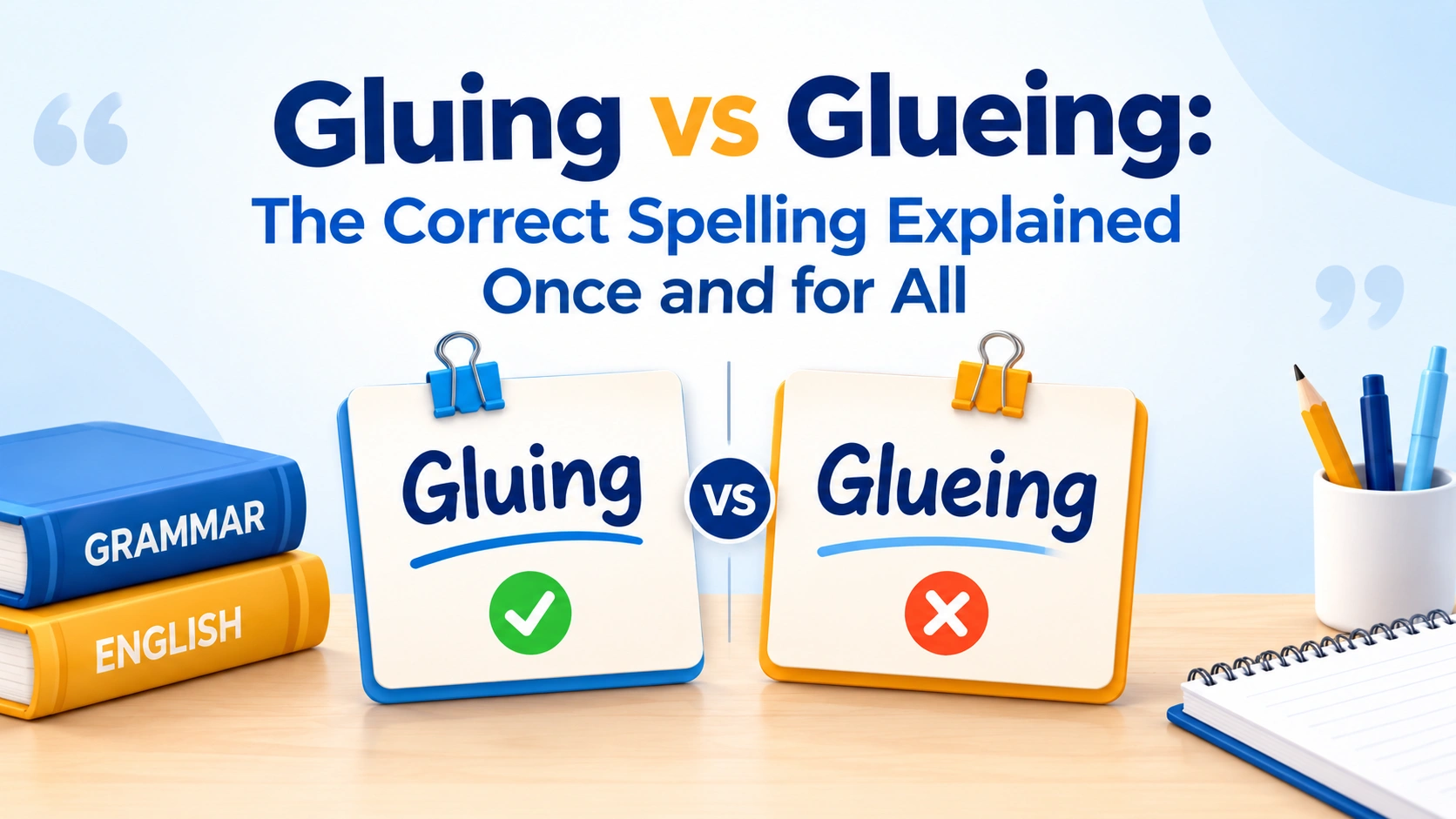
Gluing vs glueing is one of those spelling questions that looks as though it should have an easy answer. After all, the base verb is glue, so why wouldn’t you simply add -ing and write glueing? The catch is that English spelling does not always preserve a word’s base form intact when a suffix is added. Gluing is the spelling you will most commonly want in modern edited English, but there is an important detail: glueing is also recorded as a variant by major dictionaries. Merriam-Webster, for example, gives “gluing also glueing,” while Cambridge lists “glueing or gluing.”
That means the usual internet answer—“gluing is correct and glueing is wrong”—is too absolute. For everyday writing, schoolwork, professional communication, and general-purpose content, gluing is the safest and most familiar choice. But if you encounter glueing in a book, British publication, dictionary, or older text, you have not necessarily found a simple spelling error. The two forms have the same meaning and grammatical function: both are forms of the verb glue, meaning to attach or join something with adhesive. The real question is therefore not merely which form exists, but which spelling is the best choice for your audience and context.
This guide settles the confusion by looking at the grammar behind gluing, the reason the final e disappears, the circumstances in which glueing appears, and the difference between a standard preferred form and an accepted variant. You will also see how the word behaves in sentences, how it compares with similar -ing spellings, and why the familiar “drop the silent e” rule is useful but not completely mechanical. By the end, you should be able to choose gluing confidently, understand why glueing exists, and avoid the bigger mistake of treating every English spelling rule as if it had no exceptions.
Quick Answer: Is It Gluing or Glueing?
Both “gluing” and “glueing” are attested English spellings, but gluing is the better default for most modern writing.
Merriam-Webster lists the verb as:
glued; gluing also glueing
Cambridge similarly gives “glueing or gluing” as the present participle. Collins also records both forms.
So the practical answer is:
- Gluing — preferred, familiar, and an excellent general-purpose choice.
- Glueing — an accepted variant in some dictionary traditions and real-world usage, but less commonly preferred.
- Meaning — identical.
- Pronunciation — essentially the same.
- British vs American English — the difference should not be reduced to a simple “UK = glueing, US = gluing” rule.
The easiest rule to remember
If you are writing a sentence such as:
I am gluing the pieces together.
Gluing is the spelling to choose.
But if you see:
I am glueing the pieces together.
do not automatically assume the writer has invented a nonexistent word. Major dictionaries recognize glueing as a variant.
Gluing vs Glueing at a Glance
| Question | Gluing | Glueing |
| Is it used in English? | Yes | Yes |
| Meaning | Joining or attaching with glue | Same |
| Grammatical form | Present participle/gerund | Present participle/gerund |
| Dictionary status | Established form | Recorded variant |
| Best general-purpose choice | Yes | Usually not the first choice |
| Common in modern writing | Very common | Less common |
| Pronunciation | Same intended word | Same intended word |
| Different meanings? | No | No |
Bottom line: If you need one spelling and do not have a house style telling you otherwise, use gluing.
What Does “Gluing” Mean?
Gluing is the present participle of the verb glue. It describes the action of attaching, joining, or sticking something with glue or another adhesive.
For example:
- She is gluing the photographs into her scrapbook.
- The students are gluing pieces of cardboard together.
- He spent the afternoon gluing the broken model back together.
- The technician is gluing the components into position.
The verb glue itself can be literal or figurative. Merriam-Webster defines it as causing something to stick tightly with or as if with glue. It also records the figurative construction “glued to”, as in someone being glued to a television or seat.
Gluing as a present participle
The -ing form appears naturally after forms of be:
- I am gluing the pieces together.
- She was gluing labels onto the boxes.
- They are gluing the pages into place.
Gluing as a gerund
The same form can act as a noun-like word:
- Gluing requires patience.
- Gluing the pieces took longer than expected.
- His favorite part of the project was gluing the decorations.
The grammatical role changes, but the spelling does not.
Why Does “Gluing” Drop the E?
This is where the spelling becomes interesting.
A common English spelling pattern is that a verb ending in a silent final e loses that e before -ing is added.
Consider:
| Base verb | + -ing | Result |
| make | making | making |
| bake | baking | baking |
| write | writing | writing |
| hope | hoping | hoping |
| use | using | using |
| move | moving | moving |
| glue | gluing | gluing |
So the familiar pattern is:
glue → glu + ing → gluing
That is the reason gluing looks the way it does.
However, this rule explains why gluing is a natural and established form; it does not prove that glueing cannot exist. English spelling conventions sometimes preserve alternative forms, and dictionaries record actual established usage rather than enforcing a single perfectly logical system.
That distinction is important.
The spelling rule is a pattern, not a mathematical formula
It is tempting to learn:
“Every verb ending in e loses the e before -ing.”
That is useful as a starting rule, but English has exceptions and special cases.
For example:
- see → seeing
- agree → agreeing
- flee → fleeing
- free → freeing
You therefore need to recognize patterns plus exceptions, rather than applying the rule mechanically to every word.
Why Does “Glueing” Look So Reasonable?
The confusion is understandable.
When you see the base word glue, your brain naturally wants to preserve the spelling:
glue + ing → glueing
That approach works with some words in English, so the instinct is not completely irrational.
There is another reason the form looks plausible: the final e in glue is visually prominent even though it is not pronounced as a separate sound. A writer may therefore feel that removing it changes too much of the original word.
But English spelling frequently changes when grammatical endings are attached.
Compare:
- love → loving
- drive → driving
- leave → leaving
- create → creating
- argue → arguing
The underlying word remains recognizable even though the final e disappears.
Gluing follows that familiar visual pattern.
Is “Glueing” a Real Word?
Yes. This is the point many simplified spelling articles get wrong.
Glueing is not merely a random typo that nobody recognizes. It is documented as a variant of gluing. Merriam-Webster’s current entry for glue explicitly gives “gluing also glueing,” while its thesaurus similarly identifies glueing as a variant of gluing.
Cambridge also lists “glueing or gluing” as the present participle of glue.
Collins goes further by listing gluing or glueing among the verb forms of glue.
So calling glueing “not a real word” is inaccurate.
The more useful distinction is this:
A word can be legitimate without being the preferred spelling for every audience or publication.
That is exactly what is happening here.
Does that mean you should use “glueing”?
Not necessarily.
For most general-purpose writing, gluing is the more recognizable and conservative choice. It avoids making readers stop and wonder whether the spelling is intentional.
If you are writing for a particular publication, following a dictionary-based house style, or preserving historical wording, however, glueing may be entirely defensible.
Gluing vs Glueing: Are They Different in Meaning?
No.
There is no meaningful difference in definition between the two spellings.
Both describe the act of joining or attaching something with glue.
For example:
She is gluing the paper to the card.
and:
She is glueing the paper to the card.
communicate the same basic idea.
The distinction is primarily orthographic—that is, it concerns how the word is written rather than what the word means.
A useful writing principle
Do not invent a semantic distinction where English does not have one.
You may see people claiming that one form is more technical, more formal, or somehow describes a different kind of adhesive process. There is no good reason to make that distinction. The dictionaries that recognize both forms treat them as variants of the same verb.
American English vs British English: Is “Glueing” a UK Spelling?
This question deserves a more careful answer than “gluing is American and glueing is British.”
That simple division is misleading.
Gluing is used in both American and British English, while glueing also occurs as an accepted variant, particularly in dictionary records and some British-oriented usage. Collins, for example, lists both forms in its British English entry.
Cambridge likewise lists both forms rather than assigning one exclusively to Britain and the other exclusively to America.
What should an international writer use?
If your article, website, assignment, or business document is intended for a broad audience, gluing is usually the easiest choice.
Why?
Because it is:
- familiar to readers in multiple English varieties
- concise
- consistent with the common silent-e spelling pattern
- widely used in modern edited writing
But there is no need to “correct” a British source simply because it contains glueing if that publication or dictionary convention permits the variant.
The important lesson
Do not confuse regional spelling variation with preferred spelling variation.
Some words genuinely divide by region:
- color / colour
- center / centre
- traveling / travelling
Gluing and glueing do not fit neatly into that same US-versus-UK template.
What Major Dictionaries Say About Gluing and Glueing
The dictionary evidence is particularly useful because it prevents an overly simplistic answer.
| Source | Treatment of the forms |
| Merriam-Webster | Lists gluing and glueing as verb forms |
| Cambridge Dictionary | Gives glueing or gluing as the present participle |
| Collins English Dictionary | Lists gluing or glueing among the verb forms |
| Wiktionary | Defines glueing as an alternative spelling of gluing |
Merriam-Webster’s current entry is especially clear: “glued; gluing also glueing.” Cambridge similarly gives both forms. Collins records both as well.
Wiktionary also explicitly describes glueing as an alternative spelling of gluing.
What does this evidence actually tell us?
It tells us two things:
- Gluing is unquestionably established.
- Glueing is also an established variant rather than a word that dictionaries universally reject.
That is a much more accurate answer than declaring one “correct” and the other “wrong” without qualification.
A Note About “Correct” vs “Preferred”
This distinction is useful far beyond this one spelling question.
Language has several different standards:
- Is the form attested?
- Is it recognized by dictionaries?
- Is it common?
- Is it preferred in edited writing?
- Does a particular style guide require it?
Those questions do not always produce the same answer.
For gluing vs glueing, the evidence shows that both forms are attested and dictionary-recognized, while gluing is the stronger general-purpose recommendation.
So if a teacher, editor, employer, or client asks you to use gluing, that is a perfectly sensible editorial preference. It does not necessarily mean glueing is linguistically impossible.
Expert recommendation: When you have no specific house style to follow, choose gluing. When you are following an established publication or dictionary convention that permits glueing, consistency matters more than pretending the variant does not exist.
Gluing in Real Sentences
The best way to understand the word is to see how naturally it works in different contexts.
School and craft projects
- The children are gluing colored paper onto the poster.
- Maya spent an hour gluing the pieces of her model together.
- Be careful when gluing the decorations onto the card.
Home and DIY
- Dad is gluing the loose wooden trim back into place.
- The repair involved cleaning the surface before gluing the broken pieces.
- She was gluing the handle back onto the container.
Art and design
- The artist is gluing photographs onto a large board.
- The students practiced gluing different materials into a collage.
- Accurate placement is important when gluing delicate pieces.
Technical and manufacturing contexts
- The operator checks the surfaces before gluing the components.
- The machine automates the process of gluing several layers together.
- The adhesive must cure properly after gluing.
Figurative usage
English also uses glued metaphorically:
- The audience was glued to the screen.
- He was glued to his phone all afternoon.
Here, glued does not mean literal adhesive. It means unable or unwilling to look away.
Gluing vs Glueing in Different Forms of the Verb
Understanding the complete verb family makes the spelling easier to remember.
| Grammatical form | Example |
| Base form | glue |
| Third-person singular | glues |
| Present participle | gluing / glueing |
| Gerund | gluing / glueing |
| Past tense | glued |
| Past participle | glued |
Examples:
- I glue the pieces together.
- She glues the label onto the box.
- They are gluing the model together.
- Gluing requires patience.
- He glued the broken handle back on.
- The pieces were glued together.
The spelling question concerns the present participle and gerund, not the past tense.
Why “Glued” Does Not Create the Same Confusion
The past tense is straightforward:
glue → glued
Unlike the -ing form, the final e is retained before -d.
Compare:
- glue → glued
- glue → gluing
This is a useful reminder that English suffix rules are suffix-specific.
You cannot simply memorize “the e always disappears when the word changes.” Instead, learn the behavior of the particular suffix:
- glue + d → glued
- glue + ing → gluing or glueing
That distinction explains why the two forms can look inconsistent even though both are grammatically ordinary.
Related “-ing” Spellings That Cause Confusion
The best way to master gluing is to compare it with words that follow similar—or contrasting—patterns.
| Base word | Standard -ing form | What happens? |
| make | making | Final e dropped |
| write | writing | Final e dropped |
| hope | hoping | Final e dropped |
| use | using | Final e dropped |
| move | moving | Final e dropped |
| glue | gluing | Final e dropped |
| see | seeing | e retained |
| agree | agreeing | e retained |
| flee | fleeing | e retained |
| free | freeing | e retained |
This is why the simplistic instruction “always remove the e” can eventually cause new mistakes.
The practical pattern
For many verbs ending in a single silent e, dropping the e before -ing is the normal pattern.
But verbs ending in sequences such as -ee behave differently.
So:
glue → gluing
does not mean:
see → seing
The latter is incorrect because see belongs to a different spelling pattern.
Common Mistakes With Gluing and Glueing
Mistake 1: Saying “Glueing isn’t a word”
This is the biggest factual mistake.
Several major dictionaries recognize glueing as a variant.
Better approach: Say that gluing is the preferred general-purpose form, while glueing is an accepted variant in some dictionary traditions.
Mistake 2: Assuming both spellings must have different meanings
They do not.
Both refer to the action of using glue to attach something.
Mistake 3: Treating the issue as a strict US-versus-UK difference
It is more complicated than that.
Gluing works in both major varieties of English, and glueing also appears in English usage beyond a single region.
Mistake 4: Believing the “drop the e” rule has no exceptions
English spelling rules are full of patterns that require qualification.
See → seeing is an obvious example.
Mistake 5: Assuming dictionary recognition means equal popularity
A dictionary can record a variant without suggesting that both forms are equally common or equally preferable for every situation.
That distinction matters when writing for a broad audience.
When Should You Use “Gluing”?
For most readers, the answer is simple: use gluing.
Choose it when writing:
- school assignments
- essays
- blog articles
- websites
- business communication
- instructions
- product descriptions
- technical documents
- general educational material
- international English content
Why is “gluing” the safer default?
The advantage is not that glueing has no legitimacy. The advantage is reader familiarity.
When a spelling is more familiar, readers process it without interruption. In polished writing, that matters.
Imagine reading:
The machine begins glueing the panels automatically.
A reader can understand it instantly, but some may pause because glueing looks unusual.
Now compare:
The machine begins gluing the panels automatically.
The second version is visually more familiar to many readers.
For a writer who has no reason to prefer the variant, familiarity is a good editorial reason to choose gluing.
When Might “Glueing” Be Appropriate?
There are legitimate situations in which retaining glueing can make sense.
1. Following an established house style
A publication may have its own dictionary or spelling policy.
Follow the organization’s style rather than changing individual words according to personal preference.
2. Quoting or reproducing historical material
If you are discussing an older document, preserve its original spelling when accuracy requires it.
3. Maintaining consistency within a specific source
If a British publication consistently uses glueing, randomly changing one instance to gluing can create unnecessary inconsistency.
4. Reflecting an accepted dictionary variant
If your editorial context permits both forms, glueing can be used deliberately rather than treated as an accidental typo.
The key is intentional consistency.
A Practical Decision Rule for Writers
If you are unsure, use this three-step test:
Step 1: Do you have a required style guide?
If yes, follow it.
Step 2: Are you writing for a general audience?
If yes, gluing is the safest choice.
Step 3: Are you preserving someone else’s wording?
If yes, do not silently change glueing unless your editorial instructions allow you to standardize spelling.
That gives you a practical rule without pretending that English has only one legitimate spelling.
“Gluing” vs “Glueing”: The Expert Verdict
Here is the most accurate way to settle the question:
Gluing is the preferred spelling for most modern general-purpose writing, while glueing is a recognized variant recorded by major dictionaries.
That statement is stronger than simply saying “both are correct,” because it gives the writer useful guidance.
But it is also more accurate than saying “glueing is wrong.”
If you are writing an essay
Use gluing.
If you are writing a professional document
Use gluing, unless your organization’s style guide says otherwise.
If you are writing British English
Gluing remains perfectly usable; you do not need to change it simply because your audience is British. Some British dictionaries and sources also recognize glueing.
If you encounter “glueing”
Do not assume the author has made an obvious spelling error. Check the editorial context.
How to Remember the Preferred Spelling
A useful memory trick is:
Glue loses its final e before -ing: glue → gluing.
Then connect it with familiar examples:
- make → making
- bake → baking
- write → writing
- hope → hoping
- glue → gluing
The important part is not memorizing the mysterious spelling of gluing. It is recognizing the word-formation pattern.
One caution
Do not turn the memory trick into an absolute law.
Remember:
- see → seeing
- agree → agreeing
- flee → fleeing
- free → freeing
Those forms demonstrate why good spelling instruction teaches rules together with their boundaries.
Conclusion:
The simplest answer is gluing, but the complete answer is more interesting. Gluing is the preferred general-purpose spelling, and it follows the familiar pattern of dropping a final silent e before adding -ing. Yet glueing is not simply a nonexistent spelling: major dictionaries such as Merriam-Webster, Cambridge, and Collins record it as a variant. That distinction matters because good language advice should describe how English is actually used, not force a false either-or choice. One final actionable tip: if you are choosing a form without a specific style guide, use gluing. A common mistake to avoid is claiming that glueing can never be correct. The better rule is simple: know the accepted variants, then choose the spelling that best fits your audience and editorial context.
FAQs
Q1. Is “glueing” a spelling mistake?
Not necessarily. Glueing is recorded as a variant of gluing by major dictionaries, including Merriam-Webster and Cambridge. However, gluing is generally the better default for modern general-purpose writing because it is familiar and widely used.
Q2. Why is “gluing” spelled without the e?
Gluing follows a common English spelling pattern in which a verb ending in a final silent e drops that letter before -ing is added. Thus, glue becomes gluing. This is similar to make → making and write → writing.
Q3. Is “glueing” British English and “gluing” American English?
That is an oversimplification. Gluing is used in both American and British English, while glueing is also recorded as a variant. Collins and Cambridge both recognize the two forms rather than establishing a strict US/UK split.
Q4. What is the past tense of “glue”?
The past tense and past participle are glued. For example, “She glued the pieces together.” Merriam-Webster lists glued alongside the present-participle forms gluing and glueing.
Q5. Which spelling should I use in an essay or professional document?
Use gluing unless your teacher, employer, publisher, or house style specifies another convention. It is the clearest general-purpose choice and avoids unnecessary variation. If you are editing an existing source, however, preserve glueing when the original wording needs to remain intact.