

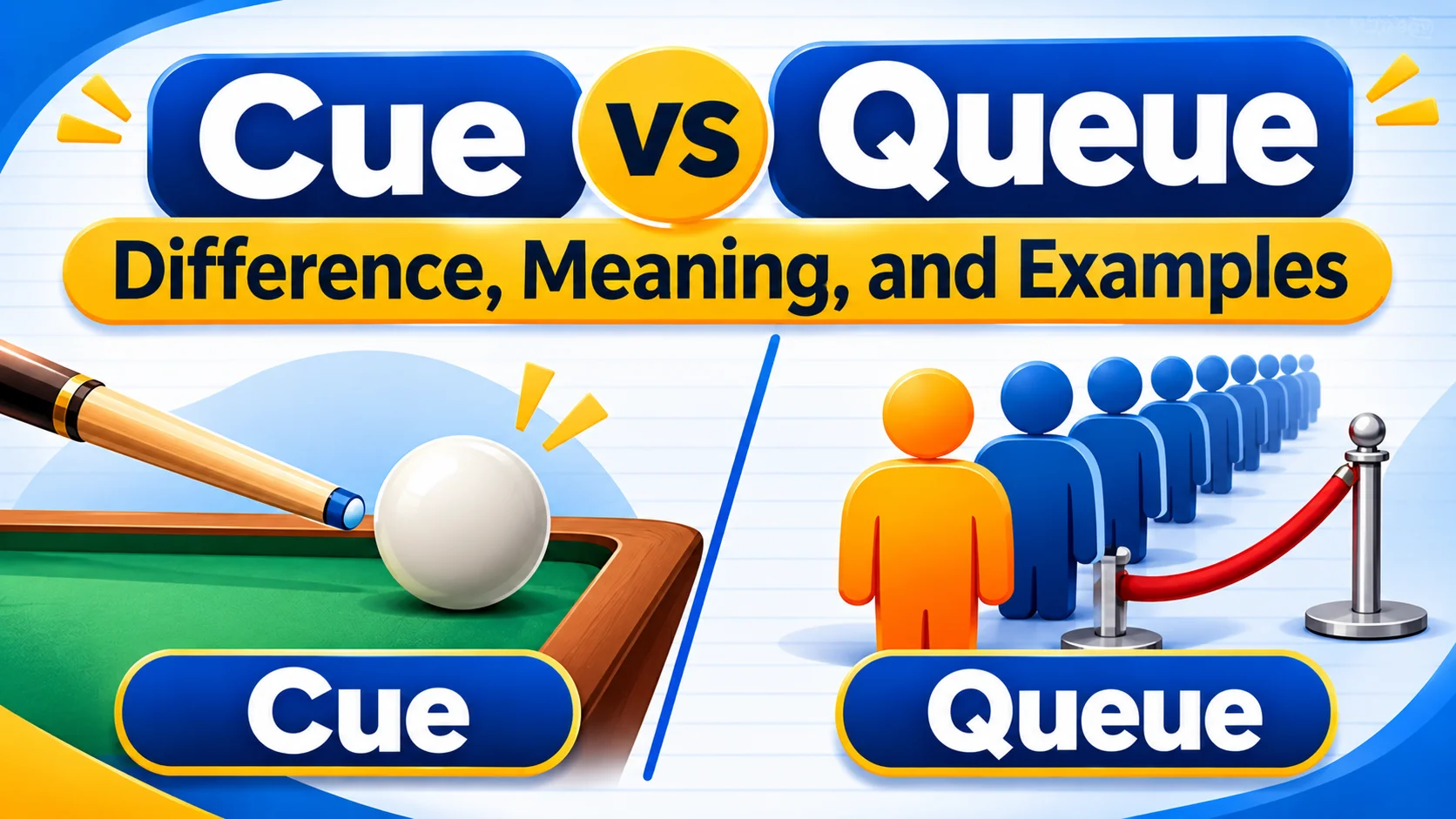
Cue vs queue is a common source of confusion because both words have the same pronunciation but completely different meanings. One refers to a signal or prompt that tells someone when to act; the other describes a line of people or things waiting for their turn. Although the distinction sounds simple, choosing the wrong spelling can change the meaning of a sentence. For example, an actor waits for a cue, while a passenger waits in a queue. Understanding this difference will help you use both words accurately in everyday conversations, professional writing, and more formal contexts.
The confusion becomes even more understandable when you consider that cue and queue are homophones. They sound identical in standard English, yet their spellings offer very different clues about their meanings. Both words can also function as nouns and verbs, which creates additional opportunities for mistakes. You might cue a speaker to begin, for instance, or queue up a series of songs. Their uses extend across theater, communication, computing, gaming, customer service, and ordinary daily activities.
The good news is that you do not need to memorize complicated grammar rules to distinguish them. A simple meaning-based test will usually tell you which spelling belongs in a sentence: are you referring to a signal, or to a waiting line? This guide explains the definitions, grammatical roles, pronunciation, common expressions, and regional differences of both words. You will also find practical sentence examples, comparisons, common mistakes, and a short practice test to help you choose cue or queue confidently.
Cue vs Queue: The Main Difference at a Glance
The main difference between cue and queue is their meaning:
- Cue means a signal, prompt, hint, or indication that tells someone when or how to do something.
- Queue means a line or ordered sequence of people or things waiting for service, access, processing, or their turn.
Consider these examples:
- The actor waited for his cue before entering the stage.
- We joined the queue outside the theater.
In the first sentence, cue refers to a signal that tells the actor when to enter. In the second, queue describes the people waiting to enter the theater.
| Feature | Cue | Queue |
| Main meaning | A signal, prompt, or indication | A waiting line or ordered sequence |
| Pronunciation | /kjuː/ | /kjuː/ |
| Part of speech | Noun and verb | Noun and verb |
| As a noun | A signal or hint | A line or sequence |
| As a verb | To signal or prompt | To arrange or wait in a line |
| Common contexts | Theater, music, communication, sports | Shops, airports, computing, customer service |
| Example | She gave me a cue to speak. | We waited in the queue. |
Quick memory tip: A cue tells you when to do something. A queue tells you who or what is waiting next.
What Does Cue Mean?
The word cue refers to a signal, prompt, hint, or indication that helps someone know when to act or how to respond. It can come from a person, an instruction, a sound, a gesture, or a change in a situation.
For example:
- The director gave the actor a cue to enter.
- Her expression was a cue that she wanted to leave.
- The music provided a cue for the dancers to begin.
A cue does not have to be a formal instruction. Sometimes it is a subtle sign that someone interprets based on the circumstances. A raised hand, a pause in conversation, or a particular musical note can all function as cues.
Cue as a Noun
As a noun, cue usually refers to a signal or indication. Its precise meaning depends on the situation.
1. A Signal to Begin or Perform an Action
In theater, film, television, and public speaking, a cue tells a performer or participant when to speak, move, enter, or begin an activity.
Examples:
- The actor missed his cue and entered the scene late.
- The stage manager gave the performers their final cue.
- The presenter waited for a visual cue before starting.
A cue helps coordinate several people who must perform actions at the right moment. Without clear signals, a live performance or broadcast can become disorganized.
2. A Hint or Indication
A cue can also be a sign that provides information without directly explaining what someone should do.
Examples:
- His silence was a cue that he disagreed with the decision.
- Dark clouds were a cue that rain might be approaching.
- The customer’s hesitation was a cue for the salesperson to explain the product again.
In these examples, the cue is interpreted rather than formally announced. Recognizing such signals is useful in communication because people do not always express their intentions directly.
3. A Prompt in Conversation or Communication
In everyday interactions, a cue may encourage someone to speak, respond, or change their behavior.
Examples:
- Her question was a cue for everyone to share their opinions.
- The teacher gave the students a cue to begin reading.
- I took his comment as a cue to change the subject.
A cue can be verbal, such as a question or instruction, or nonverbal, such as eye contact or a hand gesture.
4. A Cue in Billiards and Pool
In billiards and pool, a cue is the long, tapered stick used to strike the balls. This is a specialized meaning of the noun.
Example:
- He selected a lighter cue before taking his shot.
This use has nothing to do with waiting in a line. It is another meaning of the same word.
Cue as a Verb
As a verb, to cue means to signal, prompt, or give someone an indication to perform an action. It can also mean to prepare or trigger something at the appropriate moment.
Examples:
- The producer cued the opening music.
- The teacher cued the class to start the exercise.
- Please cue the next video after the introduction.
- The lighting technician cued the lights to change.
The verb is particularly common in performance and production settings, where timing matters.
Its common forms are:
| Form | Example |
| Base form | Cue the music. |
| Third-person singular | She cues the next speaker. |
| Past tense | He cued the recording. |
| Present participle | They are cueing the performers. |
| Past participle | The music has been cued. |
Common Expressions and Phrases Using Cue
Several familiar expressions use cue in ways that extend beyond its basic definition.
Take your cue from
This means to follow someone’s example or use their behavior as a guide.
Example: New employees often take their cue from experienced colleagues.
On cue
This means at exactly the expected or appropriate moment.
Example: Just as we mentioned his name, he appeared on cue.
Cue someone in
This means to inform someone about a situation or give them the information they need.
Example: Please cue me in before the meeting begins.
Cue the music
This means to signal that the music should start.
Example: The director nodded to the technician to cue the music.
Cue the applause
This means to prompt an audience to applaud.
Example: The host introduced the guest and cued the applause.
What Does Queue Mean?
A queue is a line or ordered sequence of people, vehicles, or items waiting for their turn. It can describe a physical line, such as passengers waiting at an airport, or a digital sequence, such as documents waiting to be printed.
Examples:
- We stood in a long queue outside the bank.
- A queue of cars formed near the traffic lights.
- The document is waiting in the printing queue.
The central idea is order: people or items are waiting to be served, accessed, or processed.
In British English, queue is especially common when talking about people waiting in line. In computing, it has a more technical meaning that is also widely used in American English.
Queue as a Noun
As a noun, queue describes a waiting line or an organized sequence.
1. A Line of People Waiting
This is the most familiar everyday meaning of queue. People form a queue when they wait for a service, purchase, entrance, or opportunity.
Examples:
- There was a long queue at the ticket counter.
- Please join the queue and wait for your turn.
- The queue outside the restaurant moved slowly.
A queue helps organize people fairly by establishing an order. Instead of everyone approaching a service point at once, each person waits until their turn arrives.
2. A Line of Vehicles
The word can also describe vehicles waiting in an orderly or slow-moving line.
Examples:
- A queue of buses formed outside the station.
- We were stuck in a queue of traffic for half an hour.
- Several cars joined the queue at the tollbooth.
In this context, queue is often associated with congestion, delays, or vehicles waiting to pass through a restricted area.
3. A Sequence of Tasks or Items
A queue does not always contain people. It can refer to a group of tasks, requests, or items arranged to be handled in sequence.
Examples:
- Your application is next in the review queue.
- The printer has three documents in its queue.
- The support team is working through a queue of customer requests.
This meaning is common in workplaces and digital services. It allows tasks to be organized so that they can be processed in a manageable order.
4. A Queue in Computing
In computing, a queue is a data structure used to store items in an ordered sequence. In a standard queue, the first item added is generally the first item removed. This principle is called first in, first out (FIFO).
Imagine a printer receiving three documents:
- Document A enters the queue.
- Document B enters next.
- Document C enters last.
Under the ordinary FIFO rule, the printer processes Document A first, followed by B and then C.
Queues are also used in:
- Operating systems to manage processes.
- Networks to organize data packets.
- Applications to handle incoming requests.
- Messaging systems to hold messages until they can be processed.
Not every technical queue follows strict FIFO ordering. For example, a priority queue processes items according to their assigned priority rather than simply their arrival time. The broader idea remains the same: items are held in an organized structure until they can be handled.
Queue as a Verb
As a verb, to queue means to form a line, wait in a line, or place something into an ordered sequence.
Examples:
- We queued for tickets outside the stadium.
- The passengers queued up at the boarding gate.
- The songs were queued before the party began.
- The files are being queued for processing.
The verb is especially common in British English when describing people waiting for a service. In technology and entertainment, it can describe arranging digital items for later playback or processing.
| Verb form | Example |
| Base form | Queue outside the office. |
| Third-person singular | She queues for the bus every morning. |
| Past tense | They queued for concert tickets. |
| Present participle | We are queuing at the entrance. |
| Past participle | The songs have been queued. |
Common Expressions and Phrases Using Queue
Join the queue
Become part of a line of people waiting.
Example: Please join the queue behind the other customers.
Stand in a queue
Wait in a line.
Example: We had to stand in a queue to collect our tickets.
Queue up
Form a line or arrange items in a sequence.
Example: Visitors queued up outside the museum.
At the front of the queue
In the first position in a waiting line.
Example: The customer at the front of the queue was served first.
Jump the queue
Move ahead of others unfairly instead of waiting for your turn.
Example: The staff member asked him not to jump the queue.
Queue management
The process of organizing waiting lines or sequences to reduce delays and improve service.
Example: The hospital introduced a new queue management system.
Cue vs Queue: Examples in Sentences
The easiest way to understand the difference is to see both words in realistic situations. Pay attention to what each word describes, rather than how it sounds.
Examples of Cue in Sentences
- The actor waited for his cue before walking onto the stage.
- Her smile was a cue that she approved of the suggestion.
- The teacher gave the students a cue to open their books.
- The presenter cued the video at the right moment.
- Take your cue from the instructions provided by the manager.
- The sudden drop in temperature was a cue to bring the plants indoors.
- The singer missed the musical cue and started late.
- His question was a cue for the audience to participate.
- The director cued the background music during the final scene.
- She recognized the warning cues and decided to stop the experiment.
Examples of Queue in Sentences
- We waited in the queue for nearly thirty minutes.
- A long queue formed outside the concert venue.
- Please queue up near the reception desk.
- The passengers joined the queue for passport control.
- My document is next in the printing queue.
- The computer placed the requests in a processing queue.
- Several cars were waiting in a queue at the intersection.
- The customer service team is handling a large queue of complaints.
- She queued the songs before the guests arrived.
- Visitors were asked not to jump the queue.
Sentences That Use Both Cue and Queue
Sometimes both words can appear in the same sentence because they describe different things.
- The actor missed his cue while the audience waited in a queue outside.
- The manager gave the staff a cue to open the doors, and customers began moving forward from the queue.
- A warning light served as a cue for the driver to stop, even though a queue of cars had formed behind him.
- The presenter gave a cue to start the video while the next file waited in the processing queue.
These examples show why the words are not interchangeable. A cue provides information or a signal; a queue organizes people or items waiting for their turn.
Why Are Cue and Queue So Easily Confused?
The main reason is pronunciation. Both words sound exactly alike in standard English, so listeners cannot distinguish them by sound alone.
Cue and Queue Are Homophones
Homophones are words that share the same pronunciation but have different meanings, and often different spellings.
Other examples include:
- There, their, and they’re
- Sea and see
- Right and write
- Flour and flower
Because cue and queue sound the same, writers must rely on meaning and sentence context to choose the correct spelling.
For instance:
- The coach gave the players a cue to begin warming up.
- The players formed a queue outside the equipment room.
Pronunciation alone cannot tell you which spelling belongs in either sentence.
How Are Cue and Queue Pronounced?
Both words are pronounced /kjuː/ in standard English. They begin with the /k/ sound and end with a long /uː/ vowel sound.
The spelling difference does not create a pronunciation difference. You do not pronounce the final letters of queue separately.
Why Does Queue Have So Many Silent Letters?
The spelling of queue reflects its history. English borrowed the word from French, where queue means a tail. The spelling was retained as the word became established in English.
This history explains why the word looks much longer than its pronunciation suggests. The final letters are not spoken as separate sounds.
A useful way to approach the spelling is to remember that queue is a word with a historical spelling, not a word whose letters each represent a separate sound.
Cue vs Queue in British and American English
Both cue and queue are correct in British and American English. Their basic meanings and spellings do not change between the two varieties.
The main difference is how frequently people use queue to describe a physical waiting line.
Is Queue More Common in British English?
Yes. In British English, queue is a standard everyday word for a line of people waiting.
Examples:
- We joined the queue for the bus.
- There was a long queue at the supermarket.
- Please wait in the queue until your number is called.
British speakers also commonly use the verb queue:
- We queued outside the cinema.
- People were queuing for tickets.
What Do Americans Usually Say Instead of Queue?
In American English, line is generally more common when referring to people waiting for something.
Compare these examples:
| British English | American English |
| We stood in the queue. | We stood in line. |
| Join the queue, please. | Get in line, please. |
| There was a long queue. | There was a long line. |
| People were queuing for tickets. | People were waiting in line for tickets. |
Americans still understand and use queue, particularly in computing, technology, and other specialized contexts. It is not an incorrect or exclusively British word.
Does Cue Change Between British and American English?
No. The spelling and main meanings of cue remain the same in both varieties.
For example, a stage cue, a musical cue, and a social cue mean essentially the same thing in British and American English.
The word cue is not replaced by line in American English when it means a signal or prompt.
Cue vs Queue in Different Contexts
The distinction becomes especially useful when you encounter these words in professional or specialized settings.
Cue in Theater, Film, and Music
In performance, a cue helps people coordinate their actions. Actors, musicians, presenters, camera operators, and lighting technicians may all depend on cues.
A cue might be:
- A line spoken by another actor.
- A musical note that signals a change.
- A hand gesture from a director.
- A lighting change that signals an entrance.
- A countdown before a broadcast begins.
For example, a television presenter may wait for the producer’s cue before speaking. The cue ensures that the presenter begins at the correct time.
Queue in Computing and Technology
In technology, a queue is an organized holding area for tasks, data, or requests waiting to be processed.
Common examples include:
- Print queue: Documents waiting to be printed.
- Download queue: Files waiting to download.
- Message queue: Messages waiting to be delivered or processed.
- Job queue: Tasks waiting for available system resources.
- Request queue: Incoming requests waiting for a response.
The important distinction is that a queue manages order and processing, rather than signaling someone to act.
Cue and Queue in Gaming
Both words can appear in gaming, but they refer to different things.
A cue can be a signal that tells a player when to move, attack, respond, or begin an activity.
A queue can be a waiting list for a multiplayer match, game session, or available player slot.
For example:
- The flashing icon was a cue to activate the special ability.
- We waited in the matchmaking queue for five minutes.
In this context, the cue provides information, while the queue determines the order in which players or requests are handled.
Cue in Psychology and Communication
In psychology and everyday communication, a cue is a piece of information that influences how someone interprets a situation or responds to another person.
Examples include:
- Facial expressions that communicate emotions.
- Changes in tone that suggest uncertainty.
- Gestures that indicate when someone should speak.
- Environmental signals that encourage a particular response.
For instance, if someone repeatedly looks at the clock during a conversation, that behavior may be a cue that they need to leave.
The word queue would not fit here unless the situation involved people or items waiting in an organized line.
Common Mistakes When Using Cue and Queue
Most errors happen when writers choose a spelling based on how a word sounds instead of what they intend to say.
1. Using Queue When You Mean a Signal
Incorrect: The teacher gave us a queue to begin the activity.
Correct: The teacher gave us a cue to begin the activity.
Why? The teacher provided a signal or prompt, not a waiting line.
2. Using Cue When You Mean a Waiting Line
Incorrect: We stood in the cue for concert tickets.
Correct: We stood in the queue for concert tickets.
Why? The sentence describes people waiting for their turn.
3. Confusing Queue With Line
In British English, queue is a common word for a waiting line. In American English, line is generally preferred in everyday conversation.
However, the words are not interchangeable in every context. A queue in computing refers to an ordered sequence of tasks, while line has several other meanings, including a written row of text or a boundary.
Choose the word that fits the intended meaning and the variety of English you are using.
4. Assuming Queue Always Refers to People
A queue can contain more than people. It may consist of vehicles, files, messages, requests, or tasks.
For example:
- The email is waiting in the queue.
- The printer has several documents in its queue.
Using cue in either sentence would change the meaning.
5. Forgetting That Both Words Can Be Verbs
Both words can describe actions, but the actions are different.
- Cue: The director cued the actors to begin.
- Queue: The passengers queued outside the terminal.
A useful editing habit is to identify the action in the sentence. If someone is giving a signal, use cue. If people or items are forming or entering a waiting sequence, use queue.
Easy Ways to Remember Cue vs Queue
You can avoid most spelling mistakes with three simple memory techniques.
Remember Cue Through Clue
The word cue can be associated with clue. Both can provide information that helps someone understand what to do or what is happening.
For example, a raised hand can be a cue that someone wants to speak.
Remember Queue as a Line
Think of people standing in a line at a shop, airport, or ticket counter. That waiting line is a queue.
You can also remember the word in its digital sense: a queue holds items until they are processed.
Use the Meaning Test
Before writing either word, ask yourself:
- Does the sentence refer to a signal, hint, or prompt? Use cue.
- Does it refer to a line or sequence of people or things waiting? Use queue.
This test works for both nouns and verbs.
Quick Cue or Queue Practice Test
Choose the correct word to complete each sentence.
- The actor waited for his ______ before entering the scene.
- We joined the ______ outside the ticket office.
- The flashing light was a ______ to stop the machine.
- Several documents are waiting in the printing ______.
- The passengers ______ up near the boarding gate.
- The director ______ the background music.
- Her expression was a ______ that she wanted to leave.
Answers and Explanations
- Cue — It is a signal telling the actor when to enter.
- Queue — It refers to people waiting for tickets.
- Cue — The light provides a warning or instruction.
- Queue — The documents are waiting to be printed.
- Queued — The passengers formed a waiting line.
- Cued — The director signaled for the music to begin.
- Cue — The expression provides an indication of her intention.
If you got these right, you understand the central distinction. If you made a mistake, focus on the meaning of the sentence rather than the pronunciation.
Conclusion:
The difference between cue and queue comes down to what you are describing. A cue is a signal, prompt, or indication that helps someone know when to act. A queue is a line or organized sequence of people or things waiting for their turn. Their identical pronunciation explains the confusion, but their meanings are distinct. One final actionable tip: Before choosing a spelling, replace the word mentally with either signal or waiting line. If the sentence still makes sense with signal, choose cue. If waiting line fits, choose queue. A common mistake to avoid is relying on pronunciation alone. Context, not sound, determines the correct spelling.
FAQs
Q1. What is the main difference between cue and queue?
Cue refers to a signal, prompt, or indication that tells someone when or how to act. Queue refers to a line or ordered sequence of people or things waiting for their turn. Both words sound alike, but their meanings and spellings are different.
Q2. Are cue and queue pronounced exactly the same?
Yes. In standard English, both words are pronounced /kjuː/. They are homophones, meaning they share a pronunciation but have different meanings. The spelling of queue contains several silent letters, while cue has a much shorter spelling.
Q3. Is it cue or queue for a line of people?
Use queue when referring to a line of people waiting. For example, “We waited in the queue for tickets.” In American English, line is more common in everyday conversation, while queue is especially familiar in British English.
Q4. What does “right on cue” mean?
Right on cue means that something happens at exactly the expected or appropriate moment. For example, “Right on cue, the lights went out.” The expression comes from the idea of a signal that tells someone or something when to act.
Q5. Can cue and queue both be used as verbs?
Yes. To cue means to signal or prompt someone to act, as in “The producer cued the music.” To queue means to form a line or arrange items in a sequence, as in “The passengers queued outside.”