

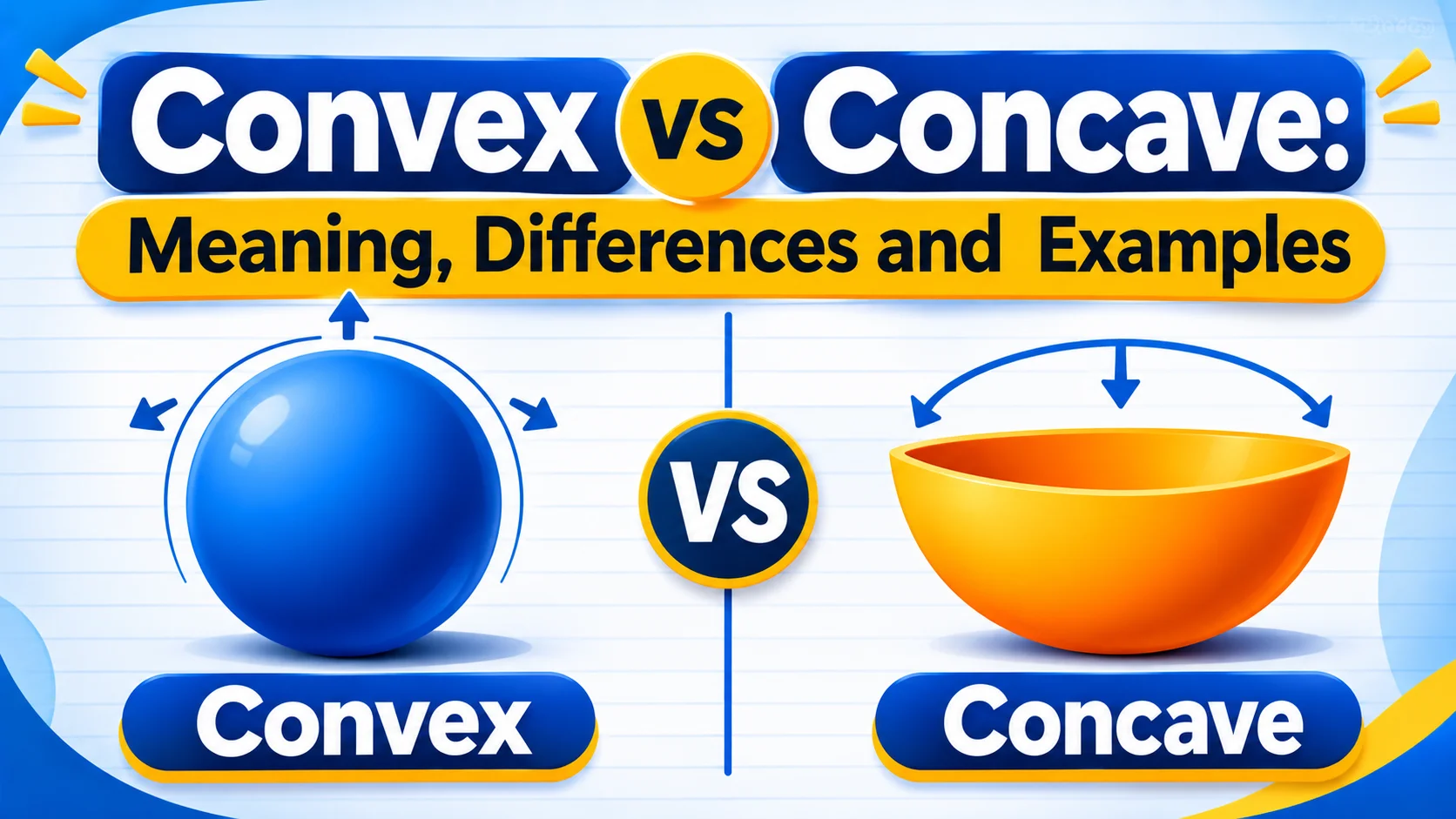
Convex vs. concave is a common point of confusion because both words describe curved shapes, yet they refer to opposite directions of curvature. A surface that bulges outward is convex, while one that curves inward is concave. Neither word is more correct than the other; the right choice depends on the shape or object being described. Although these terms often appear in mathematics and science textbooks, they also apply to familiar objects such as spoons, bowls, mirrors, and lenses. Understanding the distinction makes it easier to describe shapes accurately.
The difference becomes more interesting when these terms appear in specialized subjects. In geometry, convex and concave describe the properties of shapes and polygons. ✅In optics, they explain how lenses and mirrors interact with light. In mathematics, they also describe the behavior of functions and their graphs. These uses share a connection to curvature, but their technical definitions are not always identical to the everyday descriptions. Recognizing the context is essential, particularly when a simple visual explanation is not enough to solve a mathematical or scientific problem.
This guide explains what convex and concave mean, how to recognize each shape, and why the distinction matters in everyday situations and technical subjects. You will also learn how convex and concave polygons differ, how lenses and mirrors behave, and how mathematicians classify functions using these terms. Practical examples, comparison tables, and simple identification techniques will help you remember the difference. Whether you encountered these words in a classroom, an article, a science lesson, or a product description, you will know which term to use and why.
Convex vs. Concave: Which Word Is Correct?
Both convex and concave are correct English words. They are not alternative spellings or interchangeable versions of the same term. Instead, they describe opposite characteristics of a shape or surface.
- Convex describes a shape or surface that bulges outward.
- Concave describes a shape or surface that curves inward or forms a hollow.
For example, the outside of a ball is convex because its surface bulges outward. The inside of a bowl is concave because its surface curves inward.
Consider these sentences:
- The designer gave the product a convex exterior.
- The bowl has a smooth, concave interior.
Both sentences use the correct term because each describes a different direction of curvature.
The choice is not about grammar, spelling preferences, or regional English. It is about identifying the actual shape.
Quick rule: Use convex for an outward bulge and concave for an inward curve.
Convex vs. Concave: Key Differences at a Glance
The easiest way to distinguish these terms is to compare their appearance, geometric properties, and common applications.
| Feature | Convex | Concave |
| Basic meaning | Curves or bulges outward | Curves or bends inward |
| Appearance | Rounded or protruding | Hollow or indented |
| Common example | Outside of a ball | Inside of a bowl |
| Surface shape | Outward-curving | Inward-curving |
| Polygon property | All interior angles are less than 180° | At least one interior angle is greater than 180° |
| Mirror | Outward-bulging reflecting surface | Inward-curving reflecting surface |
| Lens | Generally thicker in the middle | Generally thinner in the middle |
| Mathematical function | Curves upward under the standard convention | Curves downward under the standard convention |
The table provides a useful starting point, but one distinction deserves attention: the meaning of convexity depends on the subject.
For example, a convex polygon is defined using interior points and line segments, not simply by looking at whether its boundary appears rounded. Similarly, a convex mathematical function is classified by an inequality involving function values, not merely by the direction in which a physical object bends.
What Does Convex Mean?
Convex is an adjective describing something that curves or bulges outward. It is used in everyday descriptions of objects as well as in mathematics, geometry, optics, and engineering.
Imagine pressing your finger against the outside of a ball. The surface rises toward you rather than forming a hollow. That outward shape illustrates the everyday meaning of convex.
Convex Definition and Meaning
In ordinary English, convex describes a surface or shape that curves outward.
The word can describe:
- The exterior of a rounded object.
- A lens with an outward-curving surface.
- A mirror whose reflecting surface bulges outward.
- A geometric shape without inward indentations.
In mathematics, the definition is more precise. A set is convex if the straight line segment connecting any two points within the set remains entirely inside that set.
This mathematical definition is important because a shape can look rounded or irregular without necessarily being convex.
What Does a Convex Shape Look Like?
A convex shape has no inward indentation along its boundary in the ordinary two-dimensional geometric sense.
Familiar examples include:
- A filled circle.
- A square.
- A rectangle.
- A regular pentagon.
- The exterior surface of a ball.
A useful way to recognize a convex shape is to imagine connecting two points inside it with a straight line. If every possible connecting segment stays inside the shape, the shape is convex.
This test is more reliable than appearance alone, especially when dealing with irregular polygons.
Convex in Everyday English
Although convex is not especially common in casual conversation, it appears frequently in technical descriptions.
For example:
- A product designer may describe an outward-curving handle as convex.
- An architect may use the term to describe a curved building exterior.
- An optician may explain the shape of a convex lens.
- A mathematician may classify a polygon as convex.
The word is useful whenever a precise description of outward curvature matters.
Convex Examples in Sentences
Here are several examples showing how the word works in different contexts:
- The convex surface of the dome reflected the sunlight.
- The designer created a convex shape for the exterior of the lamp.
- A convex mirror provides a wider field of view.
- The diagram shows a convex polygon with five sides.
- The magnifying glass contains a convex lens.
- The rounded, convex surface made the object easier to identify.
Notice that convex remains an adjective in these sentences. It describes the shape or property of a noun.
What Does Concave Mean?
Concave is an adjective describing something that curves inward, dips below its surrounding surface, or forms a hollow.
Think about the inside of a spoon. Its surface dips inward and can hold liquid. That inward-curving shape is a familiar example of concavity.
Concave Definition and Meaning
In everyday language, concave refers to an inward-curving or hollowed surface.
The term is commonly used to describe:
- The inside of a bowl.
- The inner surface of a spoon.
- An inward-curving mirror.
- A geometric shape with an indentation.
In geometry, a concave polygon has at least one interior angle greater than 180 degrees. It also fails the straight-line segment test used to identify convex shapes.
The technical definition therefore provides a more reliable way to classify complex shapes.
What Does a Concave Shape Look Like?
A concave shape appears to dip inward rather than bulge outward.
Common examples include:
- The inside of a bowl.
- The hollow side of a spoon.
- An inward-curving architectural feature.
- An arrowhead-shaped concave polygon.
- The reflecting surface of a concave mirror.
A concave shape does not have to resemble a deep hole. Even a relatively small inward indentation can make a two-dimensional polygon concave.
Concave in Everyday English
The word concave is particularly useful when describing surfaces that have a hollow or inward-curving structure.
For example:
- A sculptor may create a concave depression in a decorative object.
- An engineer may examine a concave component in a mechanical design.
- An optician may describe a concave lens.
- A science teacher may demonstrate reflection using a concave mirror.
In less technical conversation, people might simply say hollow, curved inward, or indented. However, concave provides a more precise description.
Concave Examples in Sentences
- The spoon has a concave surface that holds liquid.
- The artist carved a concave section into the sculpture.
- A concave mirror can focus parallel light rays.
- The bowl’s concave interior makes it suitable for serving soup.
- The architect incorporated a concave feature into the building’s entrance.
- The geometry lesson included an example of a concave polygon.
As with convex, the word functions as an adjective and describes a particular characteristic of an object or shape.
What Is the Difference Between Convex and Concave Shapes?
The central difference is the direction in which a surface or boundary curves.
A convex shape bulges outward, while a concave shape contains an inward indentation. This distinction is straightforward when examining familiar objects, but it becomes more important when classifying irregular geometric figures.
Outward Curve vs. Inward Curve
Consider the exterior and interior of a spoon.
- The back of the spoon generally has a convex surface.
- The hollow part that holds food has a concave surface.
The same physical object therefore provides examples of both types of curvature.
Another useful comparison is a ball and a bowl:
- A ball’s exterior bulges outward.
- A bowl’s interior curves inward.
These comparisons are useful because they provide a visual reference without requiring advanced mathematical knowledge.
How to Identify a Convex or Concave Shape
For ordinary objects, begin by examining the surface from the perspective relevant to your description.
Ask:
- Does the surface bulge outward?
- Does it form a hollow or dip inward?
- Am I describing the entire object or only one part?
- Is the context everyday language, geometry, or another technical subject?
For mathematical shapes, use the straight-line segment test instead of relying entirely on appearance.
This prevents a common error: classifying a complex shape based only on its general outline.
Can One Object Be Both Convex and Concave?
Yes. An object can contain both convex and concave surfaces.
A spoon is an obvious example. Its back curves outward, while its hollow interior curves inward.
Other manufactured objects may also combine outward-curving and inward-curving sections for practical or decorative reasons.
It is important to identify exactly which surface you are describing. Calling an entire object convex when only one side has an outward curve may be misleading.
Convex and Concave in Geometry and Mathematics
In geometry, convexity and concavity have precise mathematical definitions. A shape is not classified simply by whether it looks rounded, hollow, or curved. Instead, mathematicians examine its interior angles, boundaries, and the relationship between points inside the shape.
Understanding these definitions is particularly useful when working with polygons, coordinate geometry, and mathematical graphs.
What Is a Convex Shape in Geometry?
A geometric shape is convex if every straight line segment connecting any two points inside the shape lies entirely within it.
This is known as the line-segment test.
For example, imagine selecting two points anywhere inside a filled square and drawing a straight line between them. Regardless of which points you choose, the connecting line remains inside the square.
That makes the square convex.
Other examples include:
- Circles and filled disks.
- Triangles.
- Rectangles.
- Regular pentagons.
- Regular hexagons.
A useful property of convex shapes is that they have no inward indentations.
What Is a Concave Shape in Geometry?
A geometric shape is concave when at least one line segment connecting two points inside it passes outside the shape.
This means the shape has an inward indentation.
For example, consider a simple arrowhead-shaped polygon. You can select two points inside the polygon and draw a straight line between them that crosses the empty region created by its inward notch.
That makes the polygon concave.
Concave shapes are not necessarily complicated. Even a relatively simple five-sided polygon can have an inward indentation.
Convex Polygon vs. Concave Polygon
A polygon is a closed, two-dimensional shape formed by straight line segments. Its classification depends on the arrangement of its interior angles and boundaries.
| Property | Convex Polygon | Concave Polygon |
| Interior angles | All less than 180° | At least one greater than 180° |
| Indentations | None | At least one |
| Line-segment test | Always passes | Fails for at least one pair of interior points |
| Diagonals | All remain inside or on the boundary | At least one may extend outside |
| Shape appearance | No inward notches | Has an inward notch |
| Example | Square, rectangle, regular pentagon | Arrowhead-shaped polygon |
Important: A simple polygon has straight sides and does not cross itself. The interior-angle comparison in the table applies to simple polygons.
How to Recognize Convexity and Concavity in Graphs
The terms also describe the curvature of mathematical graphs.
Under the standard convention:
- A convex function has a graph that bends upward.
- A concave function has a graph that bends downward.
For example:
f(x)=x2
This function is convex because its graph forms an upward-opening parabola.
By contrast:
g(x)=-x2
This function is concave because its graph forms a downward-opening parabola.
The second derivative provides a useful test when the function is twice differentiable on an interval.
| Second derivative | Function behavior |
| f”(x)>0 throughout an interval | Strictly convex |
| f”(x)0 throughout an interval | Convex |
| f”(x)<0 throughout an interval | Strictly concave |
| f”(x)0 throughout an interval | Concave |
These conditions are sufficient and, for twice-differentiable functions on an interval, characterize the corresponding convexity or concavity.
A function can also change curvature across different intervals. For example, the function f(x)=x3 is concave on the negative side of zero and convex on the positive side. Its second derivative changes sign at zero.
What Is the Difference Between a Convex and Concave Function?
The distinction is not merely about whether a graph opens upward or downward. It also concerns how the function’s values compare with straight lines connecting points on its graph.
For a convex function, the graph lies below or on the straight line segment joining any two points on the graph.
For a concave function, the graph lies above or on that segment.
Mathematically, for 0t1:
Convex function:
f(tx+(1-t)y)tf(x)+(1-t)f(y)
Concave function:
f(tx+(1-t)y)tf(x)+(1-t)f(y)
These definitions are especially important in optimization, economics, statistics, and machine learning.
For instance, optimization methods often use convex functions because their mathematical structure makes finding a global minimum more manageable.
Convex vs. Concave Lenses: What Is the Difference?
In optics, convex and concave describe the shapes of lenses and help explain how they interact with light.
A lens is a transparent optical element that refracts light as it passes through. Depending on its shape and optical properties, it can bring light rays together or spread them apart.
What Is a Convex Lens?
A convex lens is generally thicker in the middle and thinner near its edges.
It is also called a converging lens because it brings parallel incoming light rays together toward a focal point under ordinary conditions in air.
Common applications include:
- Magnifying glasses.
- Camera lenses.
- Microscopes.
- Telescopes.
- Certain corrective eyeglasses.
A convex lens can produce either a real or virtual image, depending on the position of the object relative to its focal length.
For example, when an object is placed beyond the focal point of a converging lens, the lens can form a real image. When the object is placed closer to the lens than its focal length, it produces a virtual, upright, magnified image.
What Is a Concave Lens?
A concave lens is generally thinner in the middle and thicker near its edges.
It is commonly called a diverging lens because parallel incoming light rays spread apart after passing through it. The rays appear to originate from a virtual focal point on the incoming-light side.
Concave lenses are used in:
- Eyeglasses for correcting myopia (nearsightedness).
- Optical instruments.
- Certain camera and telescope systems.
- Specialized vision-correction equipment.
For a real object in front of an ordinary diverging lens, the image is virtual, upright, and smaller than the object.
Convex Lens vs. Concave Lens: Side-by-Side Comparison
| Feature | Convex Lens | Concave Lens |
| Middle thickness | Thicker | Thinner |
| Edge thickness | Thinner | Thicker |
| Common name | Converging lens | Diverging lens |
| Effect on parallel light | Brings rays together | Spreads rays apart |
| Focal point | Real for a converging lens in air | Virtual for a diverging lens in air |
| Image formation | Real or virtual | Usually virtual for a real object |
| Common application | Magnifying glass | Myopia correction |
How to Identify a Convex or Concave Lens
For common lenses with the usual refractive properties, examine their thickness:
- If the middle is thicker than the edges, the lens is generally convex.
- If the middle is thinner than the edges, the lens is generally concave.
However, this is a basic identification method, not a complete optical law.
A lens’s behavior also depends on its refractive index, the surrounding medium, and the curvature of its surfaces. A lens that converges light in air may behave differently in a medium with a sufficiently high refractive index.
For ordinary classroom examples involving glass or plastic lenses in air, the thickness comparison is a reliable starting point.
Convex vs. Concave Mirrors: How Do They Reflect Light?
Unlike lenses, mirrors work by reflecting light rather than transmitting it through a transparent optical material.
Their curved surfaces determine how reflected light rays travel and what kind of image an observer sees.
What Is a Convex Mirror?
A convex mirror has a reflecting surface that bulges outward.
When parallel light rays strike it, the reflected rays spread apart. They appear to originate from a virtual focal point behind the mirror.
One of its most useful characteristics is its wide field of view.
Convex mirrors are commonly used in:
- Vehicle side mirrors.
- Parking garages.
- Security systems.
- Road intersections.
- Store surveillance areas.
They generally produce images that are:
- Virtual.
- Upright.
- Smaller than the actual object.
For example, a vehicle’s convex side mirror allows a driver to see a wider area behind the vehicle than a comparable flat mirror would show.
However, objects appear smaller and may seem farther away than they really are. This is why vehicle mirrors often carry a warning that objects are closer than they appear.
What Is a Concave Mirror?
A concave mirror has a reflecting surface that curves inward, similar to the inside of a spoon.
It is a converging mirror because parallel incoming light rays reflect toward a focal point in front of the mirror.
Common applications include:
- Shaving mirrors.
- Makeup mirrors.
- Reflecting telescopes.
- Solar concentrators.
- Certain medical examination instruments.
Unlike a convex mirror, a concave mirror can produce different types of images depending on the object’s position.
For example:
- When the object is beyond the focal point, a real image can form.
- When the object is between the focal point and the mirror, the image is virtual, upright, and magnified.
This flexibility makes concave mirrors useful in optical instruments and applications requiring magnification.
Convex Mirror vs. Concave Mirror: Comparison Table
| Feature | Convex Mirror | Concave Mirror |
| Reflecting surface | Bulges outward | Curves inward |
| Effect on parallel rays | Diverges reflected rays | Converges reflected rays |
| Focal point | Virtual, behind the mirror | Real, in front of the mirror |
| Field of view | Wider | Generally narrower |
| Image size | Reduced | May be enlarged, reduced, or unchanged |
| Image orientation | Upright | Upright or inverted |
| Image type | Virtual | Real or virtual |
| Common application | Vehicle mirrors | Shaving mirrors and telescopes |
The most important practical distinction is that convex mirrors provide a wider viewing area, whereas concave mirrors can concentrate reflected light and produce magnified images under suitable conditions.
Convex vs. Concave in Everyday Objects and Real-Life Applications
These terms are not limited to classrooms or scientific equipment. Their principles appear in ordinary products, buildings, and engineered structures.
Understanding the distinction helps explain why designers choose particular curves for specific purposes.
Convex and Concave Shapes in Household Objects
Household objects offer straightforward examples of both types of curvature.
| Object | Convex or Concave? | Reason |
| Outside of a basketball | Convex | Bulges outward |
| Inside of a soup bowl | Concave | Forms an inward hollow |
| Back of a spoon | Convex | Curves outward |
| Inside of a spoon | Concave | Curves inward |
| Magnifying glass | Usually convex lens | Thicker in the middle |
| Ordinary shaving mirror | Concave mirror | Reflecting surface curves inward |
The spoon is particularly useful because it demonstrates how one object can have two different curved surfaces.
Convex and Concave Shapes in Architecture and Design
Architects and product designers use curvature to achieve specific visual and functional effects.
A convex building exterior can create a rounded appearance, change how natural light interacts with the structure, and influence the building’s overall form.
Concave features can create recessed spaces, curved entrances, sheltered areas, or distinctive interior designs.
The choice is not simply aesthetic. Curvature may also affect:
- Structural load distribution.
- Material requirements.
- Drainage and water movement.
- Visibility.
- Manufacturing complexity.
For example, an architect designing a curved entrance may choose a concave section to create a recessed appearance. A convex exterior may be selected to produce a rounded architectural profile.
The correct design depends on the intended function, materials, and engineering requirements.
Convex and Concave in Science and Engineering
The terms have practical applications in several technical fields.
Optical engineering: Lens and mirror curvature influences image formation, focusing, and light distribution.
Mechanical engineering: Curved surfaces can influence how components fit together, move, or distribute contact forces.
Computer-aided design (CAD): Designers use geometric properties to define surfaces, model objects, and analyze shapes.
Mathematical modeling: Convexity and concavity help describe geometric regions, optimize systems, and analyze functions.
In these fields, distinguishing the two terms correctly is important because reversing them can lead to misunderstandings about a component’s shape or behavior.
Common Mistakes When Using Convex and Concave
Although the basic distinction is simple, several misconceptions can cause confusion, particularly when these terms appear in mathematics or science.
Reversing the Meanings of Convex and Concave
The most frequent mistake is confusing the direction of curvature.
Remember:
- Convex = outward bulge.
- Concave = inward hollow.
If you are unsure, compare the object with the outside of a ball or the inside of a bowl.
Assuming Convex Always Means Bigger
Convex does not mean large, thick, or oversized. It describes the direction of curvature.
A small rounded button can have a convex surface, just as a large architectural structure can have a convex exterior.
Similarly, a concave surface does not have to be deep. Even a shallow indentation can be concave.
Confusing Convex and Concave Lenses With Mirrors
Lenses and mirrors use similar shape terminology, but they interact with light differently.
- Lenses refract light: Light passes through the material and changes direction.
- Mirrors reflect light: Light bounces off the reflecting surface.
A convex lens converges parallel light rays in ordinary conditions, and a concave mirror also converges parallel reflected rays. However, their physical mechanisms are different.
This distinction is especially important in physics examinations.
Thinking Every Curved Object Must Be Entirely Convex or Concave
An object can contain multiple surfaces with different curvature.
For instance, the inside of a spoon is concave, while its back is convex. A manufactured component may also have flat, convex, and concave sections.
Always identify the particular surface or region you are describing.
Confusing Concave Functions With Concave Shapes
✅A concave polygon and a concave mathematical function are not the same type of object.
A concave polygon is classified according to its geometric boundary and interior angles. A concave function is classified according to a mathematical inequality or its curvature.
Although the terminology is related, the tests used to identify them are different.
How to Remember the Difference Between Convex and Concave
You do not need to memorize complicated mathematical definitions to understand the basic distinction. A couple of familiar objects provide an effective starting point.
A Simple Visual Memory Trick
Use these two associations:
- Convex: Think of the outside of a ball. It bulges outward.
- Concave: Think of the inside of a bowl. It curves inward.
The association works for everyday descriptions and provides a foundation for understanding more technical examples.
Use Familiar Objects as References
When identifying an unfamiliar surface, compare it with something you already recognize.
| Reference object | Shape | Term |
| Outside of a ball | Bulges outward | Convex |
| Inside of a bowl | Curves inward | Concave |
| Back of a spoon | Curves outward | Convex |
| Hollow side of a spoon | Curves inward | Concave |
This method is particularly useful when learning the vocabulary for the first time.
A Quick Convex vs. Concave Identification Test
Try identifying the following examples before checking the answers.
- The exterior of a football.
- The hollow interior of a ladle.
- A square in geometry.
- An arrowhead-shaped polygon with an inward notch.
- A vehicle’s outward-curving side mirror.
Answers:
| Example | Correct classification | Explanation |
| Exterior of a football | Convex | Its surface bulges outward |
| Interior of a ladle | Concave | Its surface curves inward |
| Square | Convex | Every line segment connecting two interior points stays inside |
| Arrowhead-shaped polygon | Concave | It has an inward indentation |
| Vehicle side mirror | Convex | Its reflecting surface bulges outward |
The exercise illustrates why context matters: the square and arrowhead are classified using geometric properties, while the other examples describe physical surfaces.
Conclusion:
Understanding convex vs. concave becomes much easier when you recognize the direction of curvature. Convex describes an outward bulge, while concave refers to an inward curve or hollow. These terms appear in everyday descriptions, geometry, mathematical functions, optical lenses, and mirrors, but their precise definitions depend on context. One final actionable tip: Whenever you encounter an unfamiliar shape, compare its surface with the outside of a ball or the inside of a bowl before choosing a term. A common mistake to avoid is assuming that every curved object has only one type of curvature. Some objects contain both convex and concave surfaces. The more carefully you examine the particular shape, the more accurately you can describe it.
FAQs
Q1. Is Convex or Concave the Correct Word?
Both are correct English words, but they have opposite meanings. Convex describes an outward-curving shape, whereas concave describes an inward-curving shape. The appropriate word depends on the object, surface, or mathematical property being discussed.
Q2. Is a Circle Convex or Concave?
A filled circle, technically called a disk, is convex because every straight line segment connecting two points inside it remains within the disk. Its circular boundary also has outward convex curvature. A circle is therefore a standard example of a convex geometric shape.
Q3. Can a Shape Be Neither Convex Nor Concave?
Yes. Some shapes have flat or mixed-curvature boundaries, so neither simple description fully captures their appearance. In geometry, however, a set is classified as convex or non-convex. A set that fails the convexity test is technically called non-convex.
Q4. Are Convex and Concave Opposites in Mathematics?
Yes, they describe opposite forms of geometric or functional behavior under standard mathematical conventions. A convex function satisfies the convexity inequality, while a concave function satisfies the reverse inequality. Their second derivatives also have opposite signs when the relevant derivatives exist.
Q5. Why Are Convex Mirrors Used in Vehicles Instead of Concave Mirrors?
Convex mirrors provide a wider field of view, allowing drivers to see more of the area behind and beside their vehicles. They produce smaller, upright virtual images, which helps cover larger viewing areas. Concave mirrors generally do not offer the same wide-angle viewing advantage.