

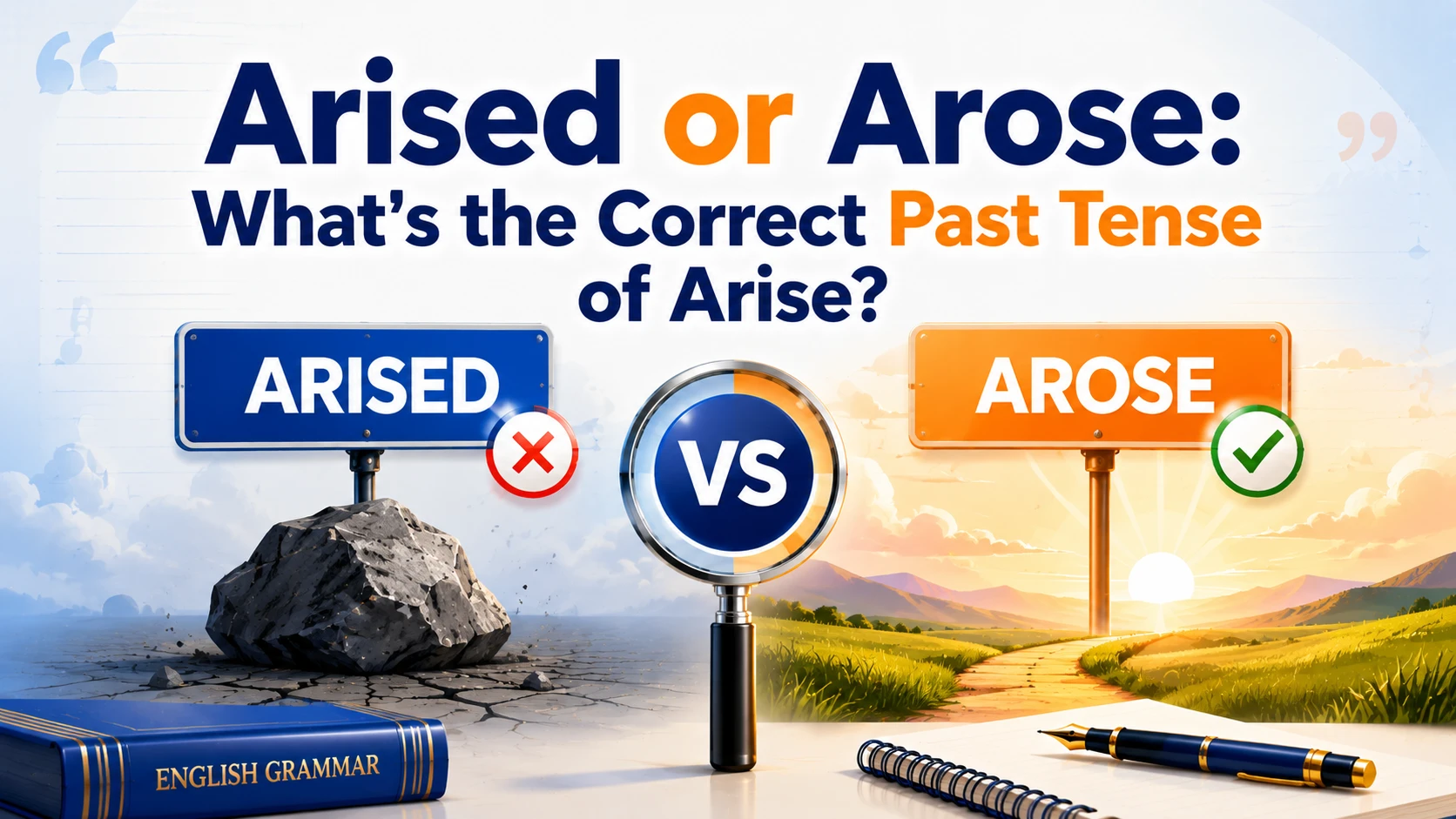
Arised or arose is a question that confuses many English learners because it challenges one of the most familiar grammar patterns. Most regular verbs form the past tense by adding -ed, so it’s natural to assume that arise becomes arised. However, English doesn’t always follow predictable rules. Arise is an irregular verb, meaning its past tense changes to arose, not arised. Understanding this distinction is essential if you want your writing and speech to sound natural, accurate, and grammatically correct in both everyday and professional situations.
Whether you’re writing an email, preparing an academic assignment, or improving your English fluency, using the correct verb form reflects a strong command of grammar. Mistakes involving irregular verbs are among the most common errors made by language learners because they can’t be solved simply by applying standard spelling rules. Instead, they require understanding how English verbs evolved and when each verb form should be used. Once you learn the relationship between arise, arose, and arisen, you’ll avoid a mistake that stands out immediately to native speakers and editors.
This complete guide explains why “arosed” and “arised” are incorrect, how “arose” functions as the simple past tense, and when “arisen” should replace it. You’ll also discover practical grammar rules, common sentence patterns, comparison tables, memory techniques, real-world examples, and expert writing tips that make these verb forms easier to remember. By the end, you’ll know exactly which form belongs in every tense and feel confident using it correctly in formal, academic, business, and everyday English.
Quick Answer: Is It “Arised” or “Arose”?
If you’re searching for a quick answer, here it is:
- ✅ Arose is the correct simple past tense of arise.
- ❌ Arised is not accepted in standard English.
- ✅ Arisen is the past participle, used with helping verbs such as has, have, or had.
The Correct Form at a Glance
| Verb Form | Correct Word | Example |
| Base Form | Arise | Problems often arise unexpectedly. |
| Simple Past | Arose | A disagreement arose during the meeting. |
| Past Participle | Arisen | A misunderstanding has arisen between the teams. |
| Present Participle | Arising | New opportunities are arising every day. |
Key Takeaway: If you’re talking about something that happened in the past without a helping verb, always use “arose.”
Why “Arised” Is Considered Incorrect in Standard English
Many learners instinctively write arised because they’ve learned that adding -ed creates the past tense of most English verbs.
For example:
- Walk → Walked
- Open → Opened
- Finish → Finished
This rule works for regular verbs, but arise belongs to a different category called irregular verbs. These verbs follow historical patterns rather than the standard -ed ending.
As a result:
- ❌ The issue arised yesterday.
- ✅ The issue arose yesterday.
Although arised occasionally appears in informal online writing or learner mistakes, it is not recognized as standard English and should be avoided in academic, professional, and published writing.
A Quick Example You Can Remember
Imagine you’re describing a meeting at work.
Correct:
A problem arose during the presentation.
Incorrect:
A problem arised during the presentation.
The first sentence follows standard English grammar and sounds natural to native speakers. The second immediately signals a grammatical mistake.
Understanding the Verb Arise
Before learning its different forms, it’s helpful to understand what arise actually means. Many people recognize the verb but aren’t entirely sure when it’s appropriate to use it instead of similar words like happen, occur, or develop.
What Does Arise Mean?
The verb arise generally means:
- To happen or occur
- To come into existence
- To develop unexpectedly
- To originate from a situation
- To stand up, in some literary or older contexts
Unlike many everyday verbs, arise often appears in formal, academic, legal, business, and news writing because it conveys the idea that something emerges naturally from an earlier event or condition.
For example:
- Questions often arise during training sessions.
- New challenges may arise as the project grows.
- Opportunities frequently arise when industries change.
In each sentence, arise emphasizes that something develops rather than being deliberately created.
Common Situations Where Arise Is Used
Although arise has a broad meaning, it commonly appears in certain contexts.
You will frequently see it with words such as:
- Problems
- Questions
- Issues
- Difficulties
- Opportunities
- Conflicts
- Concerns
- Disagreements
- Doubts
- Situations
Examples:
- Unexpected expenses arise during construction projects.
- Several important questions arise from the research.
- Technical issues arose shortly after the update.
- New opportunities have arisen for remote workers.
These combinations, known as collocations, occur naturally in fluent English and are worth remembering.
Literal vs. Figurative Meanings of Arise
Most modern uses of arise are figurative, but the verb also has a literal meaning.
| Literal Meaning | Figurative Meaning |
| To stand up | To happen or develop |
| To get out of bed | To emerge from a situation |
| To rise physically | To occur unexpectedly |
Literal example:
The king arose from his throne.
Figurative examples:
A misunderstanding arose between the two departments.
New opportunities have arisen since the company expanded.
Today, the figurative meaning is far more common, especially in business communication, journalism, academic writing, and everyday English.
The Complete Verb Forms of Arise
One of the easiest ways to avoid mistakes like arised is to learn the complete verb family instead of memorizing individual words. Understanding how each form functions makes it much easier to choose the correct tense while speaking or writing.
Present Tense: Arise
The base form arise is used in the present simple, infinitives, and modal constructions.
Examples:
- Problems often arise without warning.
- New questions arise every day.
- Challenges can arise at any stage of a project.
- Why do these issues always arise before deadlines?
This form refers to actions that happen regularly, generally, or habitually.
Simple Past: Arose
When describing a completed action in the past, arose is the only correct choice.
Examples:
- A disagreement arose during the negotiation.
- Several concerns arose after the report was published.
- Unexpected costs arose last month.
- The opportunity arose at exactly the right time.
Notice that no helping verb appears before it arose. That’s one of the easiest ways to recognize when it belongs in a sentence.
Past Participle: Arisen
The past participle arisen is always used with helping verbs such as:
- has
- have
- had
- will have
- may have
Examples:
- A problem has arisen.
- Several questions have arisen since yesterday.
- New evidence had arisen before the investigation ended.
- Similar concerns have arisen in previous studies.
Without a helping verb, arisen is incorrect.
Compare:
- ✅ A problem has arisen.
- ❌ A problem arisen yesterday.
- ✅ A problem arose yesterday.
Present Participle: Arising
The -ing form describes ongoing or continuous actions.
Examples:
- New challenges are arising every week.
- Several concerns are arising among customers.
- We’re discussing issues arising from the policy changes.
- The committee reviewed risks arising from the proposal.
This form commonly appears in formal reports, legal documents, and academic writing because it efficiently modifies nouns and ongoing situations.
Complete Conjugation Table with Examples
| Tense/Form | Verb | Example Sentence |
| Base Form | Arise | Problems arise unexpectedly. |
| Third-Person Singular | Arises | A question arises every meeting. |
| Present Participle | Arising | New concerns are arising daily. |
| Simple Past | Arose | A conflict arose yesterday. |
| Past Participle | Arisen | A conflict has arisen recently. |
Expert Tip: Rather than memorizing arose by itself, learn the complete sequence arise → arose → arisen. Native speakers often remember irregular verbs as a pattern rather than as separate words, making them easier to recall accurately.
Why “Arised” Is Incorrect
One of the biggest grammar mistakes English learners make is assuming that every verb forms its past tense by adding -ed. While this rule works for thousands of English verbs, it doesn’t apply to irregular verbs like arise. That’s why arised isn’t recognized as a correct word in standard English.
Understanding why this mistake happens makes it much easier to avoid—not only with arise, but with dozens of other irregular verbs you’ll encounter.
How Irregular Verbs Break the “-ed” Rule
English verbs fall into two broad categories:
- Regular verbs, which form the past tense by adding -ed
- Irregular verbs, which change form in different ways
Compare these examples:
| Regular Verb | Past Tense |
| Walk | Walked |
| Open | Opened |
| Finish | Finished |
| Start | Started |
Now compare them with irregular verbs:
| Irregular Verb | Past Tense |
| Begin | Began |
| Choose | Chose |
| Speak | Spoke |
| Drive | Drove |
| Arise | Arose |
Notice there’s no predictable spelling rule. These verbs evolved over centuries, which is why memorization and repeated exposure are more reliable than trying to apply a universal grammar rule.
Why Learners Naturally Assume “Arised” Is Correct
The mistake is understandable because English teaches the -ed pattern very early.
Someone who knows:
- work → worked
- answer → answered
- complete → completed
may logically expect:
- arise → arised
But English isn’t always logical. Some of the language’s most frequently used verbs are irregular, including:
- be
- go
- come
- take
- speak
- write
- arise
As these verbs are used so often, their irregular forms became established long before modern grammar rules were standardized.
Other Irregular Verbs That Follow Similar Patterns
Learning alongside similar verbs makes it easier to remember.
| Base Verb | Past | Past Participle |
| Arise | Arose | Arisen |
| Begin | Began | Begun |
| Drink | Drank | Drunk |
| Ring | Rang | Rung |
| Sing | Sang | Sung |
| Speak | Spoke | Spoken |
| Break | Broke | Broken |
Many of these verbs change their internal vowel instead of adding -ed. Recognizing this pattern helps build stronger grammar instincts.
Grammar Tip: Whenever you learn a new irregular verb, memorize all three principal forms together rather than learning only the base verb.
Arised vs. Arose: Side-by-Side Comparison
Although the choice seems simple, many writers still hesitate because both words look plausible. A direct comparison highlights why only one belongs in standard English.
Meaning
Both words are intended to express the past of arise, but only arose actually does so.
- Arose means came into existence, occurred, or developed.
- Arised has no accepted grammatical status in modern standard English.
Grammar
The grammatical distinction is straightforward.
- Arose is the simple past tense.
- Arised is considered a non-standard or incorrect form.
Because English dictionaries, grammar references, and style guides recognize only arose, using arised weakens the credibility of your writing.
Correct Usage
Correct:
- A misunderstanding arose during the discussion.
- Several questions arose after the presentation.
- New opportunities arose from the partnership.
- Unexpected challenges arose overnight.
Common Errors
Incorrect:
- The problem arised yesterday.
- Questions arised during the lecture.
- A conflict arised between the departments.
Simply replacing arised with arose fixes every one of these sentences.
Quick Comparison Table
| Feature | Arose | Arised |
| Standard English | ✅ Yes | ❌ No |
| Past tense of arise | ✅ Yes | ❌ No |
| Accepted in dictionaries | ✅ Yes | ❌ No |
| Suitable for formal writing | ✅ Yes | ❌ No |
| Recommended for learners | ✅ Always | ❌ Never |
Expert Insight: Spell checkers may occasionally fail to catch arised, especially in informal writing platforms. Relying solely on grammar software isn’t enough—understanding the verb pattern is the safer approach.
Arose vs. Arisen: Don’t Mix Them Up
Once learners realize arose is correct, another question usually follows:
When should I use “arisen” instead?
Although these two forms belong to the same verb, they serve different grammatical purposes.
When to Use Arose
Use arose whenever you’re describing a completed action in the simple past tense.
Examples:
- A technical issue arose yesterday.
- An opportunity arose unexpectedly.
- Several objections arose during the debate.
- The misunderstanding arose after the meeting.
A good test is to ask:
“Did the event simply happen in the past?”
If the answer is yes, arose is probably the correct choice.
When to Use Arisen
Use arisen only with a helping verb.
Common helping verbs include:
- has
- have
- had
- will have
- may have
- could have
Examples:
- A problem has arisen.
- Several concerns have arisen recently.
- Difficulties had arisen before the deadline.
- Unexpected questions have arisen during the project.
Without a helping verb, arisen is incomplete.
Examples Showing the Difference
| Correct Sentence | Why It’s Correct |
| A problem arose yesterday. | Simple past tense |
| A problem has arisen. | Present perfect |
| Several issues arose during the meeting. | Completed past action |
| Several issues have arisen since Monday. | Present perfect showing a connection to the present |
Notice how the tense—not the meaning—determines which form belongs in the sentence.
A Simple Rule for Remembering Both Forms
Use this shortcut:
- Yesterday? → Arose
- Has/Have/Had? → Arisen
Examples:
Yesterday a problem arose.
A problem has arisen.
This quick mental check prevents one of the most common irregular verb mistakes.
How to Use “Arose” Correctly in Sentences
Knowing the correct verb form is only the beginning. Skilled writers also understand the situations where they arise.
Talking About Problems or Challenges
One of the most frequent uses of arose involves unexpected difficulties.
Examples:
- A scheduling conflict arose before the event.
- Several legal issues arose during negotiations.
- A misunderstanding arose between the clients.
- Financial concerns arose after the budget review.
Because these situations develop unexpectedly, arose expresses the idea perfectly.
Describing Opportunities or Ideas
Not everything that arises is negative.
Positive developments can also arise.
Examples:
- An exciting opportunity arose during the conference.
- A new partnership arose from the discussion.
- Innovative ideas arose during the brainstorming session.
- A leadership role arose after the promotion.
Using arose here creates a polished, professional tone.
Referring to Questions, Doubts, and Discussions
Academic and professional writing frequently arose with abstract nouns.
Examples:
- Several questions arose after the lecture.
- Doubts arose regarding the results.
- Ethical concerns arose during the research.
- New debates arose following the announcement.
These collocations appear regularly in journals, reports, and news articles.
Using Arose in News, Business, and Academic Writing
Because arose is concise and formal, it’s especially common in professional communication.
Business:
A dispute arose over the contract terms.
Academic:
New research questions arose during data analysis.
News:
Concerns arose after officials released the report.
Legal:
The disagreement arose from differing interpretations of the agreement.
Using arose instead of casual alternatives like came up or happened often produces more precise and professional writing.
Sentence Patterns You Can Use with Arose
Rather than memorizing isolated examples, it’s more effective to learn recurring sentence structures.
Subject + Arose + from + Noun
Examples:
- The confusion arose from poor communication.
- The disagreement arose from a misunderstanding.
- The delay arose from technical difficulties.
This pattern explains the origin of a situation.
Subject + Arose + During + Event
Examples:
- Problems arose during construction.
- Questions arose during the interview.
- Concerns arose during testing.
This structure highlights when something happened.
There + Arose + Noun Phrase
This pattern is more formal but appears frequently in literature, historical writing, and official documents.
Examples:
- There arose a serious dispute between the parties.
- There arose an unexpected opportunity arose.
- There arose considerable public concern.
Common Collocations with Arose
Learning common word partnerships helps your writing sound natural.
Frequently used combinations include:
- problems arose
- issues arose
- concerns arose
- questions arose
- difficulties arose
- opportunities arose
- disagreements arose
- conflicts arose
- doubts arose
- complications arose
These collocations appear consistently across business writing, journalism, academic papers, and professional reports, making them valuable additions to your active vocabulary.
Common Expressions That Use Arise
One of the best ways to master an irregular verb is to learn the expressions native speakers use every day. Rather than memorizing isolated grammar rules, focus on common collocations—words that naturally appear together. This approach improves both your writing and your speaking because you’ll begin to recognize patterns instead of translating word by word.
If the Need Arises
This is one of the most common expressions in professional English. It means “if it becomes necessary.”
Examples:
- If the need arises, we’ll schedule another meeting.
- Additional training will be provided if the need arises.
- Please contact us if the need arises.
You’ll often see this phrase in business emails, contracts, and official documents.
Problems Arise
Because arise frequently describes unexpected situations, it’s commonly paired with problems.
Examples:
- Problems arose during the software installation.
- New problems have arisen since the update.
- Minor issues may arise as the project develops.
Questions Arise
Writers, researchers, and teachers regularly use this expression.
Examples:
- Several questions arose after the presentation.
- Ethical questions have arisen from the study.
- Additional concerns may arise later.
Opportunities Arise
Not everything that arises is negative. Positive developments often arise unexpectedly as well.
Examples:
- A great opportunity arose during the conference.
- New business opportunities have arisen this year.
- Opportunities often arise through networking.
Issues Arise
This collocation is especially common in business and technical writing.
Examples:
- Technical issues arose overnight.
- Legal issues have arisen since the merger.
- If any issues arise, contact customer support immediately.
Real-Life Examples of Arise, Arose, and Arisen
Understanding grammar becomes much easier when you see it in realistic situations. The following examples show how each verb form fits naturally into different types of communication.
Workplace Communication
Professional emails and reports often use arose to explain events objectively.
Examples:
- A scheduling conflict arose before the client meeting.
- Several concerns arose during the planning phase.
- An unexpected opportunity arose after the presentation.
Academic Writing
Researchers often describe findings and observations using arise and its related forms.
Examples:
- Additional research questions arose during data analysis.
- Ethical concerns have arisen regarding the experiment.
- Similar issues may arise in future studies.
Business Reports
Formal reports frequently used arose because it sounds precise and neutral.
Examples:
- Production delays arose because of supply shortages.
- Financial challenges have arisen over the last quarter.
- Operational risks may arise during expansion.
Everyday Conversations
Although slightly more formal than come up, arise still appears in natural conversation.
Examples:
- Something important arose while you were away.
- If anything arises, let me know.
- No problems have arisen so far.
News Headlines
Journalists often choose arose because it’s concise and formal.
Examples:
- Questions Arose After Election Results
- Concerns Arise Over New Regulations
- Legal Dispute Has Arisen Between Companies
Mistakes People Commonly Make with Arise
Most grammar mistakes that arise are predictable. Understanding them helps you avoid errors before they happen.
Writing “Arised” Instead of “Arose”
This is by far the most frequent mistake.
Incorrect:
- The issue arised unexpectedly.
Correct:
- The issue arose unexpectedly.
Remember that arise is an irregular verb, so adding -ed doesn’t work.
Using Arisen Without a Helping Verb
Many learners accidentally replace arose with arisen.
Incorrect:
- A problem arose yesterday.
Correct:
- A problem arose yesterday.
Correct:
- A problem has arisen.
Whenever you use arisen, check whether a helping verb appears before it.
Confusing Rise with Arise
Although related, these verbs don’t always mean the same thing.
Compare:
- Prices rose last month.
- Questions arose after the announcement.
Generally:
- Rise often describes physical movement or increasing amounts.
- Arise usually means to occur, develop, or come into existence.
Mixing Verb Tenses in the Same Sentence
Maintain consistent tense throughout your sentence.
Incorrect:
- Several concerns arose and have confused the committee yesterday.
Better:
- Several concerns arose yesterday.
or
- Several concerns have arisen since yesterday.
Arise vs. Rise: What’s the Difference?
Because these verbs are closely related, they’re frequently confused. However, they aren’t interchangeable.
Differences in Meaning
Arise usually means:
- to happen
- to develop
- to occur
Rise usually means:
- to move upward
- to increase
- to stand
Differences in Grammar
Both verbs are irregular, but they follow different patterns.
| Verb | Present | Past | Past Participle |
| Arise | Arise | Arose | Arisen |
| Rise | Rise | Rose | Risen |
Although similar, their meanings differ significantly.
Example Sentences Compared
Arise
- Questions arose after the lecture.
- Problems have arisen recently.
Rise
- The sun rose at 6:00 a.m.
- Prices have risen again.
Which Verb Should You Choose?
Choices arise when something occurs or develops.
Choose to rise when something moves upward or increases.
Memory Tricks to Never Confuse Arised, Arose, and Arisen
Irregular verbs become much easier to remember when you use simple memory techniques instead of relying on rote memorization.
Learn the Three-Part Verb Pattern
Always memorize the complete sequence:
Arise → Arose → Arisen
Learning all three forms together is far more effective than memorizing individual tenses.
Compare with Similar Irregular Verbs
Notice the shared pattern.
| Base Verb | Past | Past Participle |
| Arise | Arose | Arisen |
| Drive | Drove | Driven |
| Speak | Spoke | Spoken |
| Break | Broke | Broken |
| Choose | Chose | Chosen |
Recognizing these patterns strengthens your understanding of English irregular verbs as a whole.
A One-Minute Recall Technique
Ask yourself these questions:
- Am I talking about the present? → Arise
- Did it happen yesterday? → Arose
- Do I have has, have, or had? → Arisen
This quick check prevents most grammar mistakes.
Quick Checklist Before You Write
Before submitting your work, ask yourself:
- ✅ Did I use arose for the simple past?
- ✅ Did I avoid writing arised?
- ✅ Did I use arisen only with a helping verb?
- ✅ Does the verb tense match the rest of the sentence?
Pro Tip: Reading your sentence aloud often makes irregular verb mistakes easier to notice because incorrect forms usually sound unnatural.
Practice Exercises
Test your understanding with these short exercises.
Choose the Correct Verb Form
Select the correct answer.
- A misunderstanding _____ during the meeting.
- a) arised
- b) arose
- c) arisen
- Several concerns have _____ since the announcement.
- a) arose
- b) arisen
- c) arised
- New opportunities often _____ unexpectedly.
- a) arise
- b) arose
- c) arisen
Fill in the Blank
Complete the sentences.
- A legal dispute ______ after the agreement was signed.
- If you have any questions ______, please contact us.
- Several problems have ______ since Monday.
Correct the Grammar Mistake
Rewrite each sentence correctly.
- The issue arised yesterday.
- Several concerns arisen during the meeting.
- New opportunities arised quickly.
Rewrite the Sentences Using the Right Tense
Convert each sentence as instructed.
- Problems arise unexpectedly. (Simple Past)
- A concern arose yesterday. (Present Perfect)
- Opportunities have arisen recently. (Simple Present)
Answer Key with Explanations
- b) arose — Correct simple past tense.
- b) arisen — Correct past participle after have.
- a) arise — Correct present tense.
Corrected sentences:
- The issue arose yesterday.
- Several concerns arose during the meeting.
- New opportunities arose quickly.
Expert Tips for Using Arise Naturally
Match the Verb Form to the Tense
Before choosing a form, identify whether you’re writing about the present, past, or perfect tense. This simple habit eliminates most mistakes.
Watch for Helping Verbs
If you see has, have, or had, the correct choice is almost always arisen, not arose.
Read Trusted Sources to Reinforce Usage
Reading newspapers, books, academic journals, and reputable websites exposes you to correct irregular verb usage in real contexts, making the patterns easier to remember naturally.
Proofread for Irregular Verb Errors
During editing, pay special attention to verbs. A quick review of irregular forms such as arise, begin, choose, and speak can prevent mistakes that grammar checkers sometimes overlook.
Conclusion
Choosing between arised and arose becomes simple once you understand that arise is an irregular verb. The correct forms are arise (present), arose (simple past), and arisen (past participle). The form arised isn’t accepted in standard English and should be avoided in academic, professional, and everyday writing. Remember that arose describes a completed action in the past, while arisen always follows a helping verb such as has, have, or had. One final actionable tip: memorize the complete sequence → arose → arisen instead of learning each form separately. A common mistake to avoid is using arisen without a helping verb or replacing arose with the incorrect arised. Mastering this one irregular verb will strengthen your confidence with many others.
FAQs
Q1. Is “arised” ever correct in English?
No. Arised isn’t accepted in standard English grammar. The correct simple past tense of arise is arose, while arisen is the past participle. Using the standard forms ensures your writing sounds natural and grammatically accurate.
Q2. Why is the past tense of “arise “arose” instead of “arised”?
Arise belongs to the group of irregular verbs, which don’t form the past tense by adding -ed. Like begin → began and speak → spoke, the verb changes internally, making it the only correct past-tense form.
Q3. What’s the difference between arose and arisen?
Arose is the simple past tense, used without a helping verb, while arisen is the past participle and must be used with verbs such as has, have, or had. The choice depends on the sentence’s tense, not the meaning.
Q4. Can I use arose in formal and academic writing?
Yes. Arose is widely used in academic papers, business reports, legal documents, and news writing because it expresses that a situation, issue, or question developed naturally. It’s an appropriate and professional choice in formal contexts.
Q5. How can I easily remember the correct forms of arise?
Memorize the sequence arise → arose → arisen as a single pattern. Associate arose with completed past actions and arose with helping verbs like has or have. Practicing common collocations such as questions arose or problems have arisen also reinforces correct usage naturally.