

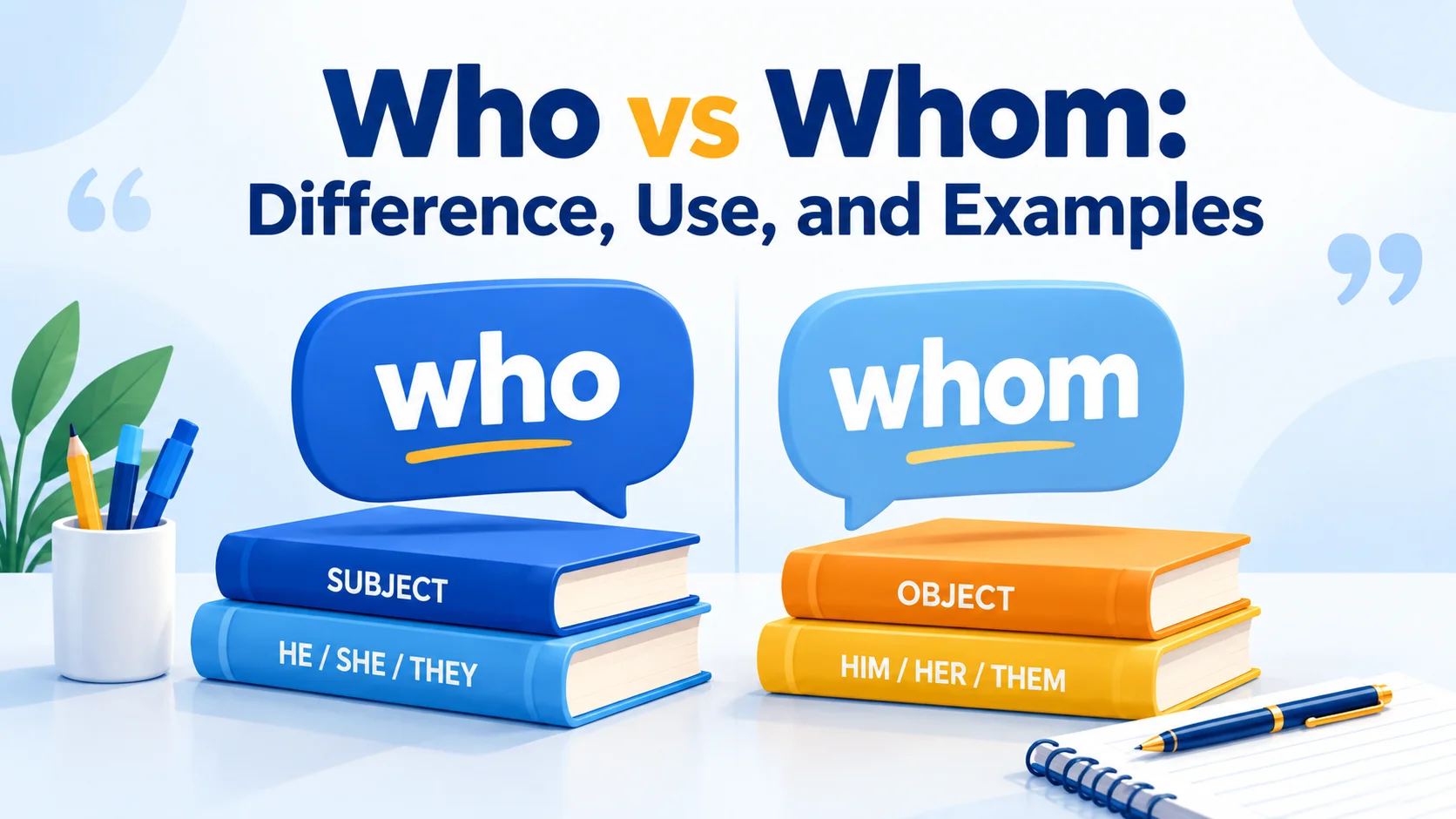
Who vs. whom is a common English grammar challenge because both words refer to people, yet they perform different grammatical roles. Who is used for the subject of a verb, while who is used for the object of a verb or preposition in traditional grammar. Compare “Who called you?” with “Whom did you call?” The first asks about the person performing the action; the second asks about the person receiving it. Understanding this distinction helps you write more accurately in emails, academic assignments, professional documents, and everyday conversations without second-guessing every sentence.
The difficulty is that sentence structure can hide the answer. In “I know who called,” the word who remains correct even though the sentence is not a direct question. In “I know whom she called,” who is correct because it functions as the object of calling. The main clause does not determine the choice; the pronoun’s role inside its own clause does. Once you understand this principle, you can handle direct questions, indirect questions, relative clauses, and prepositional phrases with much greater confidence.
This guide explains the difference between who and whom, shows how to use each word, and introduces a simple substitution test that works in most situations. You will also learn when who is acceptable in everyday English, why who still appears in formal writing, and how to avoid common mistakes. Practical examples, comparison tables, and a short quiz will help you apply the rules rather than memorize isolated sentences. By the end, you should be able to choose the appropriate word based on grammar, context, and tone.
Who vs. Whom: The Quick Answer
The essential difference is grammatical case:
- Who is the subject form? It identifies the person performing an action or functioning as the subject of a clause.
- Whom is the object form. It identifies the person receiving an action or serving as the object of a verb or preposition in traditional grammar.
Consider these examples:
- Who sent the invitation? — The person performed the action of sending.
- Whom did you invite? — The person received the invitation.
- Who is waiting outside? — The person is the subject of the waiting.
- To whom did you send the message? — The pronoun follows the preposition to.
A useful rule of thumb is who = he/she/they and whom = him/her/them. The substitution test will become clearer as we examine real sentences.
One important qualification: in modern conversational English, people frequently use who in places where traditional formal grammar would prefer them. For example, “Who did you invite?” is extremely common. The formal alternative is “Whom did you invite?”
What Is the Difference Between Who and Whom?
When to Use Who
Use who when the pronoun acts as the subject of a verb. The subject is the person or thing the clause is about, often the person performing the action.
Examples:
- Who opened the front door?
- The student who won the competition received a certificate.
- I wonder who will lead the meeting.
- Do you know who is responsible for the report?
In each example, who performs the action or occupies the subject position within its clause.
Notice that who is not limited to direct questions. It can appear in statements, indirect questions, and relative clauses. The grammatical role—not the sentence type—determines whether it is appropriate.
When to Use Whom
Use whom when the pronoun functions as the object of a verb or preposition in traditional grammar.
Examples:
- Whom did the manager hire?
- Whom are you waiting for?
- The researcher whom we interviewed shared her findings.
- With whom did you discuss the proposal?
In the first example, the manager performs the action of hiring, while the person hired is the object. In the third, we are the subject of the interview, and who is its object.
Although it is grammatically useful, it can sound formal in ordinary conversation. The sentence “Who are you waiting for?” is widely used and natural in everyday English.
Who vs. Whom: Comparison Table
| Feature | Who | Whom |
| Grammatical case | Subjective | Objective |
| Main function | Subject of a clause | Object of a verb or preposition |
| Pronoun substitution | He, she, they | Him, her, them |
| Example question | Who called you? | Whom did you call? |
| Relative clause | The person who called | The person whom I called |
| After a preposition | Who are you talking to? | To whom are you talking? |
| Typical style | Natural in formal and informal English | More formal in many contexts |
Remember: The word’s position alone does not determine the answer. You must identify its grammatical function inside the relevant clause.
The Easiest Way to Choose Between Who and Whom
The he/him test is one of the most practical ways to decide which word belongs in a sentence. It works because English distinguishes subject pronouns (he, she, they) from object pronouns (him, her, them).
Step 1: Replace the Person With He or Him
Ask whether the sentence would use he or him if the person’s identity were already known.
If he fits, choose who. If he fits, traditional grammar calls for whom.
Example 1: Who or whom called?
- Answer: He called.
- Correct sentence: Who called?
The person performs the action, so who is correct.
Example 2: Who or whom did you call?
- Answer: You called him.
- Traditional formal choice: Whom did you call?
The person receives the action, so who is the traditional grammatical choice.
Example 3: Who or whom is speaking?
- Answer: She is speaking.
- Correct sentence: Who is speaking?
The person is the subject of his speaking.
Step 2: Try They or Them for Plural References
The same method works with plural pronouns.
| Test sentence | Substitution | Traditional choice |
| Who/whom arrived first? | They arrived first. | Who |
| Who/whom did the coach select? | The coach selected them. | Whom |
| Who/whom will present the results? | They will present the results. | Who |
| Who/whom did the committee contact? | The committee contacted them. | Whom |
This method is especially useful when a sentence contains multiple people and the grammatical roles are not immediately obvious.
Step 3: Identify the Clause Containing the Pronoun
Longer sentences can be misleading because the pronoun may belong to a clause inside another clause.
Compare:
- I know who called.
- I know whom she called.
In the first sentence, who is the subject of the call. In the second, she is the subject of the call, and who is its object.
The main verb know does not control the choice. The pronoun’s role within the embedded clause does.
Practical checklist:
- Find the clause containing who or whom.
- Identify the verb in that clause.
- Determine who performs the action and who receives it.
- Apply the he/him or they/them test.
- Consider the level of formality required.
This approach is more reliable than choosing whichever word sounds more sophisticated.
When to Use Who: Rules and Examples
Who as the Subject of an Action
Use who when asking about the person performing an action.
- Who designed this website?
- Who left the lights on?
- Who wants to join the discussion?
- Who will deliver the presentation?
The same rule applies when who appears in a statement rather than a question:
- I know who designed this website.
- She asked who left the lights on.
The sentence structure changes, but the subject role remains the same.
Who After Linking Verbs
Who also appears in questions involving linking verbs such as be and seem.
Examples:
- Who is at the door?
- Who is responsible for the decision?
- Who seems ready to begin?
- Who was the first person to respond?
In these sentences, who identifies the subject. Do not choose whom simply because the sentence sounds formal or contains a form of be.
Who in Relative Clauses
A relative clause adds information about a noun, often identifying a particular person.
Examples:
- The employee who answered the phone was helpful.
- Anyone who finishes early may leave.
- She is the teacher who helped me.
- We thanked the volunteers who organized the event.
In each relative clause, who performs the action: answered, finishes, helped, or organized.
A useful editing technique is to isolate the relative clause. Ask, “Who answered the phone?” The answer is the employee. Because the pronoun is the subject of the answer, use who.
Who in Indirect Questions
An indirect question reports or embeds a question within a larger sentence.
Examples:
- Do you know who called?
- I wonder who will lead the project.
- Can you tell me who is waiting outside?
- She asked who had approved the request.
The word who is correct when it functions as the subject inside the embedded question. The presence of phrases such as “Do you know” or “I wonder” does not automatically call for whom.
When to Use Whom: Rules and Examples
Whom as the Direct Object of a Verb
A direct object receives the action of a verb.
Examples:
- Whom did you invite to the ceremony?
- Whom did the committee select?
- Whom are they interviewing?
- Whom did the teacher praise?
In each example, someone performs the action, and who refers to the person affected by it.
Traditional formal grammar favors them in these sentences. In casual conversation, however, speakers commonly use who: “Who did you invite?” This difference in style is important when deciding how to edit a sentence.
Whom as an Indirect Object
An indirect object identifies the person who receives something or benefits from an action.
Examples:
- Whom did you give the keys to?
- Whom should we send the documents to?
- Whom did the company award the contract to?
The final preposition to is natural in ordinary English. In more formal writing, the sentence can be restructured:
- To whom did you give the keys?
- To whom should we send the documents?
- To whom did the company award the contract?
The second versions place the preposition before whom, creating a more formal tone.
Whom After a Preposition
Traditional grammar uses whom as the object of a preposition.
Examples:
- To whom should I address the letter?
- With whom did you travel?
- For whom was the announcement intended?
- From whom did you receive the message?
- About whom were they speaking?
This construction is common in formal correspondence, official documents, and some academic writing. It can sound stiff in casual conversation, so choose it when the tone and structure call for it.
Whom in Relative Clauses
Use whom when the pronoun is the object inside a relative clause, particularly in formal writing.
Examples:
- The colleague whom I called was unavailable.
- The author whom we interviewed answered every question.
- The applicant whom the panel selected accepted the offer.
The subject of each relative clause is I, we, or the panel. The person referred to by whom receives the action.
In many cases, the pronoun can be omitted:
- The colleague I called was unavailable.
- The author we interviewed answered every question.
- The applicant the panel selected accepted the offer.
These forms are natural and grammatical in English because the relative pronoun is an object. Omitting it can make a sentence less formal and more fluid without sacrificing clarity.
Who vs. Whom in Questions and Complex Sentences
The trickiest examples are often not those with difficult vocabulary. They are sentences where the pronoun’s grammatical role is buried inside a longer construction.
Direct Questions: Who Called vs. Whom Did You Call?
Compare these sentences:
- Who called the client?
- Whom did the client call?
In the first, who performs the action of calling. In the second, the client performs the action, and who refers to the person called.
The same pattern applies to other verbs:
- Who invited Sam?
- Whom did Sam invite?
- Who interviewed the applicants?
- Whom did the applicants interview?
The key is to identify the relationship between the verb and the person being asked about.
Indirect Questions: Who Won vs. Whom the Judge Selected
Indirect questions can contain either form:
- I know who won.
- I know whom the judge selected.
- Tell me who is coming.
- Tell me whom you chose.
Do not let the opening phrase distract you. In “I know whom the judge selected,” the pronoun is the object of selection. In “I know who won,” it is the subject of won.
Compound Constructions
Some sentences contain embedded clauses that make the grammatical relationship harder to see.
Consider:
- Who do you think will lead the project?
- Whom do you think the manager will select?
In the first, who is the subject of will lead. In the second, the manager is the subject of will select, and who is its object under traditional formal grammar.
A helpful strategy is to temporarily remove the introductory phrase:
- Who will lead the project?
- The manager will select whom.
Once the underlying clause becomes visible, the correct form is easier to identify.
Can You Use Who Instead of Whom?
Yes. Who is widely used in everyday English in many object positions where traditional formal grammar would use them. That does not mean the distinction has no value. It means real-world usage depends partly on register, sentence structure, and audience.
Why Who Is Common in Modern English
English speakers often prefer simpler constructions in conversation. As a result, sentences such as these are common:
- Who did you invite?
- Who are you talking to?
- The person who I met yesterday was friendly.
In traditional formal grammar, who may be preferred in the first and third examples because the pronoun functions as an object. The second example places the preposition at the end, a common and natural feature of English.
For everyday communication, these uses of who are widely understood and generally sound more conversational.
When Whom Is the Better Choice
Choose whom when it improves grammatical precision or suits the context, especially:
- After a preposition placed before the pronoun: “To whom should I address the letter?”
- In formal correspondence that follows traditional grammatical conventions.
- In carefully edited prose where the objective form is expected.
- When discussing grammar or explaining the difference between subject and object pronouns.
Avoid adding them merely to make a sentence sound impressive. An unnecessarily formal construction can make simple communication harder to read.
Is Whom Becoming Obsolete?
Whom is less common in many informal contexts, but it has not disappeared from English. It remains established in formal writing, prepositional phrases, and conventional expressions such as “To whom it may concern.”
Its usefulness depends on context. You may naturally say “Who did you speak to?” while choosing “To whom did you speak?” in a formal letter. Both are recognizable English constructions, but they differ in tone and traditional grammatical form.
How to Use “To Whom It May Concern” Correctly
Meaning and Grammar
“To whom it may concern” is a conventional greeting used when writing to an unknown or unspecified recipient. It often appears in reference letters, verification documents, formal inquiries, and other correspondence where the reader’s identity is not known.
The word who is used because it follows the preposition to.
Example:
“To Whom It May Concern:
This letter confirms that the applicant completed the required training.”
The expression is grammatically established and remains appropriate in certain formal situations.
When to Use It—and When to Choose Something Else
The phrase can be useful when a document may be read by different people or departments. However, it can also feel impersonal.
When possible, consider more specific greetings:
- Dear Hiring Manager
- Dear Admissions Committee
- Dear Customer Support Team
- Dear [Department Name]
A named recipient is often the clearest choice when you know who will read the letter. Use the traditional expression when the recipient genuinely cannot be identified or when the document’s purpose calls for a general formal greeting.
Common Who vs. Whom Mistakes
| Mistake | Better choice in traditional grammar | Why |
| Who is coming to the meeting? | Who is coming to the meeting? | The pronoun is the subject of is coming. |
| The person who I called answered. | The person whom I called answered. | The pronoun is the object of called; who is also common in everyday usage. |
| To whom should I send this? | To whom should I send this? | The pronoun follows the preposition to in a formal construction. |
| I know who won the award. | I know who won the award. | The pronoun is the subject of won. |
Mistake 1: Choosing Whom Because a Sentence Sounds Formal
Incorrect: Whom is responsible for the report?
Correct: Who is responsible for the report?
The sentence may appear in a formal meeting or document, but who is still the subject of is responsible. Formality does not override grammatical role.
Mistake 2: Assuming Every Question Requires Whom
Questions can ask about either a subject or an object.
- Who contacted the supplier?
- Whom did the supplier contact?
The first asks who performed the action; the second asks who received it. A question mark does not determine the pronoun.
Mistake 3: Ignoring the Embedded Clause
Incorrect: I know who won the award.
Correct: I know who won the award.
The pronoun is the subject of won. The main clause “I know” does not make it an object.
Mistake 4: Treating Every Use of Who as an Error
In casual English, “Who did you meet?” and “The person who I met” are extremely common. A formal editor may prefer those in those object positions, but automatically changing everyone can make prose unnecessarily stiff.
Editing tip: Correct genuine grammatical problems, but consider the audience and register before changing an established conversational construction.
Who vs. Whom Examples in Everyday and Professional English
Everyday Conversation
- Who wants to order lunch?
- Who did you see at the library?
- Who are you waiting for?
- Whom did you invite? (Grammatical in traditional usage, but often formal in conversation.)
In casual settings, clarity and naturalness usually matter more than choosing the most formal possible construction.
School and Academic Writing
- The student who submitted the assignment early received feedback first.
- The researcher whom the professor interviewed presented the findings.
- The lecturer explained who would lead the discussion.
- The report identifies whom the committee consulted.
Academic writing benefits from consistent grammatical choices. However, the goal is not to use them as frequently as possible; it is to construct clear, accurate sentences.
Business Emails and Formal Documents
- Who will oversee the project?
- The consultant whom we hired will review the proposal.
- To whom should I send the signed agreement?
- The department confirmed who was responsible for the update.
A direct question such as “Who will oversee the project?” is entirely appropriate in a professional email. Use whom when its grammatical role and the level of formality support that choice.
Who vs. Whom Practice Quiz
Choose the form that best fits each sentence. For questions where everyday usage differs from traditional formal grammar, select the traditional grammatical form.
- _____ called the office this morning?
- _____ did the committee choose for the role?
- Do you know _____ is organizing the event?
- With _____ did you discuss the proposal?
- The colleague _____ I emailed replied this morning.
- _____ present the findings?
- The candidate _____ the panel interviewed arrived early.
- _____ are you waiting for?
- I wonder if _____ sent the package.
- To _____ should the application be addressed?
Answers and Explanations
| No. | Answer | Explanation |
| 1 | Who | The person performs the action of calling. |
| 2 | Whom | The committee performs the action of choosing; the person is the object. |
| 3 | Who | The pronoun is the subject of organizing. |
| 4 | Whom | The pronoun follows the preposition with. |
| 5 | Whom | The pronoun is the object of email in traditional grammar. |
| 6 | Who | The person performs the action of presenting. |
| 7 | Whom | The panel interviews the candidate. |
| 8 | Whom, traditionally | The pronoun is the object of for; “Who are you waiting for?” is common in conversation. |
| 9 | Who | The pronoun is the subject of sent. |
| 10 | Whom | The pronoun follows the preposition to. |
Use any incorrect answers as a guide to what you need to review. If you struggle with indirect questions, focus on identifying the clause containing the pronoun. If prepositional phrases are difficult, practice replacing the person with him or her.
Conclusion:
The difference between who vs. whom becomes manageable once you focus on grammatical function instead of sentence position or formality. Use who for a subject and whom for an object in traditional grammar. The he/him substitution test provides a quick way to check your choice, even in indirect questions and relative clauses. Remember, too, that modern English frequently uses who in everyday object constructions, so context matters when editing or writing for a particular audience. One final actionable tip: read the clause containing the pronoun on its own and identify who performs the action. A common mistake to avoid is choosing them simply because it sounds more professional. Accurate writing is not about using the most formal word; it is about making the relationship between ideas clear. With practice, the right choice becomes much easier.
FAQs
Q1. What Is the Easiest Way to Remember Who vs. Whom?
Use the he/him test. If you can replace the person with he or she, use who. If he or she fits, traditional grammar calls for whom. For example, “He called” gives you “Who called?” while “I called him” gives you “Whom did I call?”
Q2. Is It “Who Did You Speak To” or “Whom Did You Speak To”?
Both forms occur in English. “Who did you speak to?” is natural in everyday conversation. Traditional formal grammar prefers “Whom did you speak to?” or “To whom did you speak?” The second option places the preposition before the pronoun and generally sounds more formal.
Q3. Is “Who I Met” Grammatically Correct?
“Who I met” is widely used in everyday English, although traditional formal grammar prefers “whom I met” because the pronoun is the object of met. For casual communication, who is common. In carefully edited formal prose, consider the audience and the style guide you follow.
Q4. Should I Always Use Whom in Academic or Professional Writing?
No. Professional writing does not require them everywhere. Use who when the pronoun is the subject, and consider whom when it is an object in a construction where traditional grammar expects it. Clear, natural wording is more important than making every sentence sound formal.
Q5. Why Do People Use Who Instead of Whom?
Many English speakers prefer who in informal speech, including in object positions. This reflects established patterns of modern English usage, not simply a lack of grammatical knowledge. Whom remains useful in formal writing and after prepositions, particularly when the writer wants a traditional formal style.