

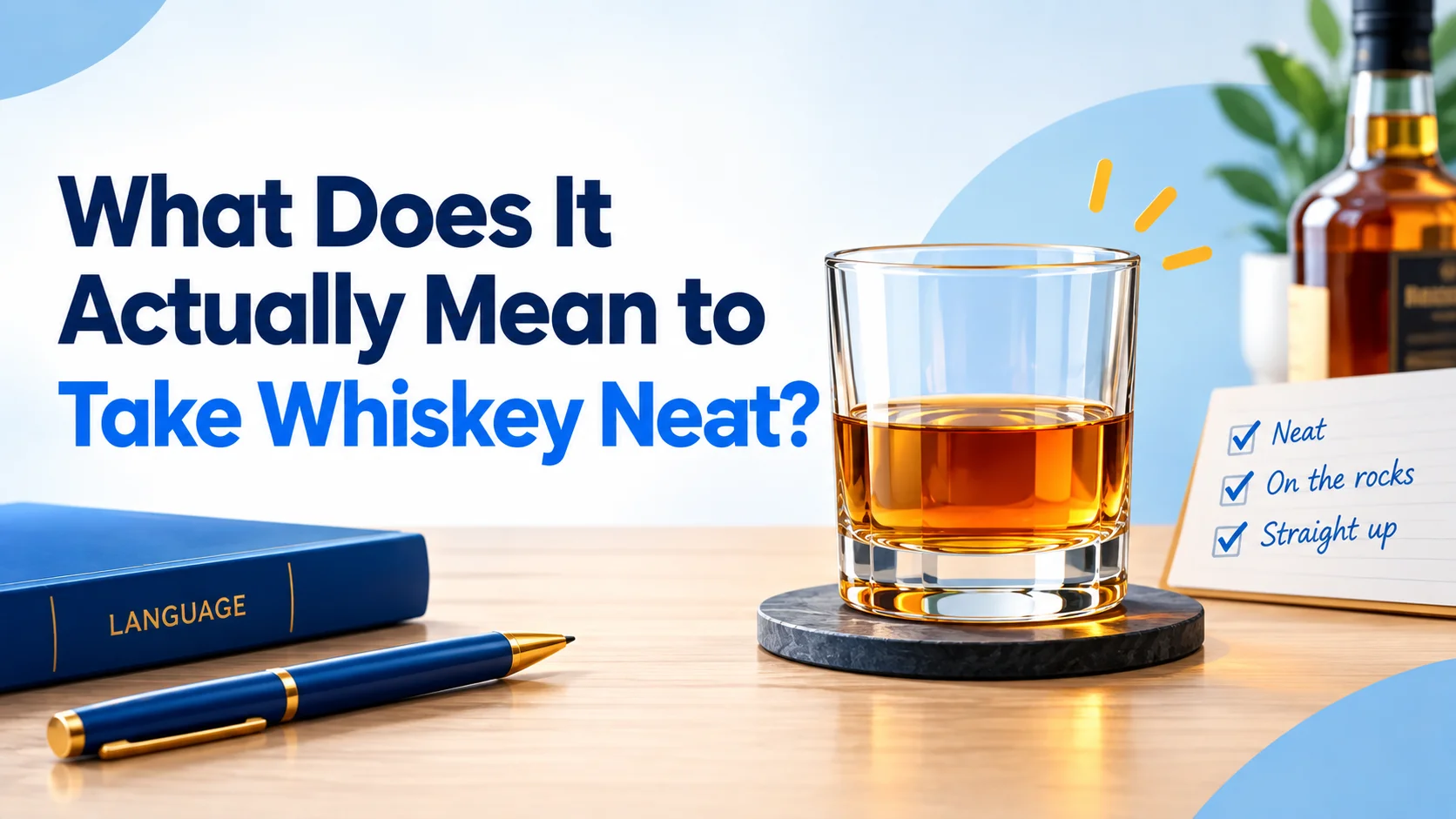
If you have ever encountered the phrase “whiskey neat,” you may have wondered what the word neat actually means. Does it describe the temperature, the quality of the whiskey, the type of glass, or something else entirely? The expression can sound confusing because neat has several meanings in everyday English, but in beverage terminology it has a much more specific meaning.
In simple terms, “whiskey neat” is a serving term. It describes whiskey presented by itself, without ice, water, or another mixer added to it. The word does not tell you how expensive the whiskey is, how old it is, or whether it is considered better than another style of serving. Understanding that distinction makes the phrase much easier to interpret.
This guide explains what taking whiskey neat means from a terminology and language perspective. We will look at the meaning of neat, how it differs from related expressions such as on the rocks and straight up, common misconceptions, and why whiskey terminology can sometimes seem inconsistent. The goal is to make the phrase clear without assuming that every use of the word follows exactly the same convention.
What Does “Whiskey Neat” Mean?
Whiskey neat means whiskey served by itself, with no ice, water, soda, juice, or other mixer added to it.
The important part of the definition is “without added ingredients.” The word neat is therefore describing the way the beverage is presented rather than describing the whiskey itself.
For example, when someone uses neat as a serving term, they are not necessarily saying:
- the whiskey is premium;
- the whiskey is old;
- the whiskey is strong;
- the whiskey is served at a particular temperature;
- The whiskey belongs to a particular country or style.
Those are separate characteristics.
A Simple Definition of Whiskey Neat
A useful plain-English definition is:
Neat = served by itself, without ice, water, or a mixer.
This definition is more useful than interpreting neat according to its everyday meanings such as tidy, orderly, or well-organized.
The expression is therefore similar to other beverage terms that describe presentation. For instance, on the rocks indicates the presence of ice, while with water explicitly indicates added water.
Is “Neat” the Same as “Straight”?
Not necessarily.
This is one of the most confusing parts of whiskey terminology because neat and straight can overlap in casual conversation while having different meanings in particular contexts.
In ordinary serving language, straight can sometimes be used informally to mean a spirit served without a mixer. However, straight also appears in legally defined whiskey categories, such as straight bourbon or straight rye whiskey.
That means the word straight can describe something about the whiskey itself rather than merely describing how it is served.
By contrast, neat primarily functions as a serving description.
| Term | General meaning | What it primarily describes |
| Neat | Served without added ice, water, or mixer | Serving presentation |
| On the rocks | Served with ice | Serving presentation |
| With water | Water has been added | Serving presentation |
| Straight | Can mean without a mixer in casual usage | Context-dependent |
| Straight bourbon | A legally defined category of bourbon | Whiskey classification |
| Up / straight up | Usually chilled and strained in cocktail terminology | Cocktail preparation |
The key lesson is that context matters. A word can have an everyday meaning and a more technical meaning at the same time.
What Does “Neat” Mean in Beverage Terminology?
In beverage terminology, neat generally means that the beverage is presented without additional ingredients.
The word is especially associated with distilled spirits. Instead of describing a cocktail recipe or a combination of ingredients, it describes a relatively simple presentation in which the spirit itself is the central component.
This is why the phrase is different from terms such as:
- mixed;
- diluted;
- chilled;
- shaken;
- stirred;
- on the rocks.
Those words can describe preparation or presentation in different ways.
“Neat” Is a Serving Description
The easiest way to understand the word is to separate the beverage from the serving style.
A whiskey can be:
- bourbon;
- rye;
- Scotch whisky;
- Irish whiskey;
- Japanese whisky;
- another recognized whiskey style;
and still be described as neat based on how it is presented.
Therefore, neat does not identify a particular kind of whiskey.
“Neat” Does Not Mean “High Quality”
Another common misunderstanding is assuming that neat is a synonym for premium.
It is not.
A whiskey can be described as neat regardless of whether it is inexpensive, expensive, young, mature, blended, or single malt, provided that neat is being used in its conventional serving sense.
This distinction is important because language about beverages often mixes quality terms and serving terms.
“Neat” belongs primarily to the second category.
Why Is It Called “Neat”?
The historical development of neat as a beverage term is not as straightforward as some popular explanations suggest.
In older English, neat could carry meanings associated with something being pure, clean, unmixed, or unadulterated. Over time, related uses developed in contexts involving beverages and spirits.
That older sense helps explain why neat became associated with a drink served without additions.
However, it is worth being careful with etymology. The history of individual words can involve several overlapping uses, and simplified explanations sometimes present one supposed origin as if it were definitively established.
For modern readers, the most important point is not a single historical story but the semantic connection:
neat → unmixed or unadorned → served by itself.
Does Neat Whiskey Have to Be Room Temperature?
Not necessarily.
People sometimes treat room temperature as part of the definition of neat, but the central meaning of the term concerns what has been added to the whiskey, not a specific numerical temperature.
A neat serving does not inherently mean:
“This beverage must be exactly room temperature.”
Instead, neat primarily indicates that there is no added ice, water, or mixer.
Temperature can vary because of environmental conditions, storage, handling, and serving circumstances.
This distinction matters because definitions that make room temperature an absolute requirement can make the term sound more rigid than it actually is.
The Core Definition
Think of the distinction this way:
Neat describes additions more directly than temperature.
That is the safest way to understand the terminology without turning a flexible serving expression into an artificial technical rule.
Neat vs. On the Rocks
The clearest comparison is between neat and on the rocks.
The two expressions describe contrasting presentations.
Neat means the whiskey is presented without added ice.
On the rocks means the whiskey is served with ice.
The phrase rocks in this context is a traditional informal term for ice cubes.
| Feature | Whiskey Neat | Whiskey On the Rocks |
| Ice added | No | Yes |
| Water intentionally added | No | Ice can introduce water as it melts |
| Mixer added | No | No mixer is implied |
| Main purpose of term | Describes presentation | Describes presentation |
| Whiskey type specified? | No | No |
| Quality specified? | No | No |
The distinction is therefore quite simple.
Neat and on the rocks are not different types of whiskey. They are different ways of describing how whiskey is presented.
Neat vs. Straight Up
Another expression that frequently causes confusion is straight up.
In cocktail terminology, straight up generally refers to a drink that has been chilled during preparation and then strained before serving, usually without ice remaining in the serving vessel.
That is different from neat.
A neat spirit is defined by the absence of added ice, water, and mixers. Straight up, meanwhile, belongs more strongly to cocktail terminology and describes a preparation and serving process.
| Expression | General idea |
| Neat | Served without added ice, water, or mixer |
| On the rocks | Served with ice |
| Straight up | Chilled during preparation and strained before serving |
| With water | Water is added |
| Mixed | Combined with another beverage or ingredient |
The distinction becomes especially important when discussing cocktails because “straight up” does not simply mean “neat.”
Does Neat Mean Undiluted?
In ordinary terminology, yes, neat indicates that nothing has been intentionally added to the whiskey at the point of serving.
However, the word undiluted should be used carefully.
Whiskey itself contains water and alcohol, along with numerous flavor compounds. Calling a neat serving “undiluted” does not mean the liquid is chemically pure alcohol or that it contains no water whatsoever.
Rather, it means that no additional water or other diluting ingredient has been added as part of the serving presentation.
This is an important distinction between everyday beverage language and scientific terminology.
“No Added Water” Is More Precise
When explaining the phrase to someone unfamiliar with whiskey terminology, “served without added water” is often clearer than simply saying “undiluted.”
The latter can accidentally suggest that the whiskey contains only alcohol, which is obviously not what the term means.
Does Neat Mean Stronger?
The word neat does not itself indicate a particular alcohol concentration.
It describes presentation rather than establishing a specific strength.
Different whiskeys can have different alcohol concentrations, and their labels and classifications provide information that the word neat does not.
Therefore:
Neat ≠ a specific alcohol percentage.
Similarly:
Neat ≠ a specific whiskey type.
And:
Neat ≠ a guarantee of quality.
This is one reason terminology should not be confused with product characteristics.
Can Any Whiskey Be Described as Neat?
Generally, neat can function as a serving description for different kinds of whiskey.
The term itself does not restrict the beverage to one particular whiskey-producing country or style.
For example, the phrase may appear in discussions involving:
- bourbon;
- rye whiskey;
- Scotch whisky;
- Irish whiskey;
- Japanese whisky;
- blended whiskey;
- single malt whisky.
The spelling of whiskey and whisky varies by regional and stylistic convention, but that spelling difference does not fundamentally change the meaning of neat as a serving term.
Whiskey vs. Whisky
This is another useful terminology point.
Whiskey is commonly associated with Irish and American usage, while whisky is commonly used for Scotch and several other traditions.
There are exceptions and regional conventions, so spelling alone should not be treated as a perfect geographical rule.
The word neat can appear alongside either spelling depending on the whiskey tradition being discussed.
Common Misconceptions About “Whiskey Neat”
Because neat is an everyday English word as well as a beverage term, it is easy to misunderstand.
Myth 1: Neat Means Expensive
False.
Neat describes presentation, not price.
An expensive whiskey and a less expensive whiskey can both be described using the word neat.
Myth 2: Neat Means High Quality
False.
The term does not certify quality, craftsmanship, age, or reputation.
Myth 3: Neat Means a Particular Whiskey Type
False.
Bourbon, rye, Scotch, Irish whiskey, and other categories can all be discussed in relation to neat serving terminology.
Myth 4: Neat Always Means Exactly Room Temperature
Not necessarily.
The defining feature is the absence of added ice, water, and mixers, rather than an exact temperature requirement.
Myth 5: Neat and Straight Up Mean Exactly the Same Thing
False.
They can overlap in casual discussions, but straight up has a distinct meaning in cocktail terminology involving chilling and straining.
A Quick Comparison of Whiskey Serving Terms
Understanding the vocabulary becomes easier when the expressions are placed next to one another.
| Term | Basic meaning | Main thing it tells you |
| Neat | Served by itself | No added ice, water, or mixer |
| On the rocks | Served with ice | Ice is present |
| With water | Water added | Water is part of the presentation |
| Mixed | Combined with another beverage or ingredient | Additional ingredients are present |
| Straight | Context-dependent | Can describe serving style or whiskey classification |
| Straight up | Chilled and strained in cocktail usage | Preparation and presentation |
| Cocktail | A mixed beverage category | Multiple ingredients are generally involved |
This table also shows why context matters so much in beverage vocabulary.
A single word can communicate very different information depending on whether it is being used as a serving term, product classification, or cocktail instruction.
Why Whiskey Terminology Can Be Confusing
Whiskey vocabulary developed through different traditions, countries, industries, and everyday speech.
As a result, terminology does not always behave like a perfectly organized scientific classification system.
Some words describe:
- the whiskey itself;
- its production method;
- its geographic or legal category;
- its ingredients;
- its age;
- its presentation;
- its temperature;
- its preparation.
The word neat belongs primarily to the presentation category.
That is why it should not automatically be interpreted as a statement about quality or production.
Everyday Language vs. Technical Language
Another reason for confusion is that beverage terminology often has both informal and technical uses.
For example, straight may be used casually to mean “without a mixer,” while straight bourbon is a specific category with formal requirements.
Similarly, neat has a fairly straightforward serving meaning but can appear in ordinary conversation without people consciously thinking about a formal definition.
Understanding the context in which a word appears is therefore just as important as memorizing its dictionary definition.
How “Neat” Is Used in Everyday English
Outside beverage terminology, neat has several meanings.
It can mean:
- tidy;
- orderly;
- well-organized;
- clean-looking;
- skillful or clever in certain contexts.
For example, someone might describe a handwriting style as neat, or call an idea neat in informal conversation.
But when the word appears directly alongside a spirit or beverage—such as “whiskey neat”—the beverage-specific meaning becomes relevant.
This is a useful example of polysemy, where one word has multiple related or unrelated meanings depending on context.
“Neat” as a Language-Learning Example
For English learners, whiskey neat is an interesting example because the adjective does not behave exactly as a learner might expect.
A learner who knows neat only as “tidy” may initially wonder why it is connected with whiskey.
The answer is that English frequently develops specialized meanings in particular fields.
Other examples include words such as:
- rocks in beverage vocabulary;
- up in cocktail terminology;
- straight in both everyday and technical whiskey language;
- proof as a measurement term;
- finish with tasting vocabulary.
Learning vocabulary through context and collocation can therefore be more effective than memorizing isolated dictionary meanings.
What “Whiskey Neat” Does Not Tell You
The phrase is useful, but it is limited.
By itself, “whiskey neat” does not tell you:
- the brand;
- the age;
- the country of origin;
- the whiskey category;
- the alcohol concentration;
- the price;
- the quality;
- the production method;
- the exact temperature.
It tells you primarily about how the whiskey is being presented.
That distinction is worth remembering whenever you encounter the phrase in a menu, article, conversation, review, or piece of fiction.
Why “Neat” Is Different From a Whiskey Style
A whiskey style is connected to the characteristics and classification of the whiskey itself.
For example, bourbon and Scotch whisky have different production traditions and regulatory frameworks.
Neat, however, does not create a new category of whiskey.
Calling something neat does not transform bourbon into a new whiskey style. It simply describes its presentation.
A useful analogy is the difference between what something is and how something is presented.
The whiskey category answers:
What kind of whiskey is this?
The serving term answers:
How is it being presented?
Those are two different questions.
Conclusion:
The phrase “whiskey neat” is much simpler once you separate serving terminology from whiskey classification. In its conventional sense, neat means that whiskey is presented by itself, without added ice, water, or another mixer. It does not automatically indicate a particular brand, price, age, quality level, whiskey category, or exact temperature.The biggest source of confusion is the relationship between neat, straight, straight up, and on the rocks. These expressions can overlap in casual conversation, but they are not interchangeable in every context. Neat is primarily a serving description, while words such as straight can carry additional technical meanings.So, when you encounter the phrase “whiskey neat,” the simplest interpretation is the best one: it describes how the whiskey is presented, not what kind of whiskey it is.
FAQs
Q1. What does “take whiskey neat” mean?
“Take whiskey neat” means the phrase is referring to whiskey served by itself, without added ice, water, or another mixer. In this context, neat is a serving term rather than a statement about the whiskey’s quality, age, price, or category.
Q2. Does neat whiskey have ice?
No. In the conventional meaning of the serving term, neat indicates that ice has not been added. This distinguishes it from on the rocks, where ice is specifically part of the presentation. The distinction concerns serving terminology rather than the type or quality of whiskey.
Q3. Is neat whiskey the same as straight whiskey?
Not always. Straight can be used informally to describe a spirit without a mixer, but it also appears in specific whiskey classifications such as straight bourbon. Neat more directly describes how a spirit is presented, so the two terms should not automatically be treated as identical.
Q4. Does neat mean whiskey is undiluted?
In everyday serving terminology, it means that no additional water has been intentionally added. It does not mean the whiskey contains no water or that it is chemically pure alcohol. Whiskey itself is a complex mixture containing alcohol, water, and many other compounds.
Q5. Does neat mean a whiskey is high quality?
No. Neat is not a quality rating. It describes a presentation. A whiskey can be described as neat regardless of its price, age, production style, or reputation. Quality judgments require entirely different information and cannot be inferred simply from the word neat.