
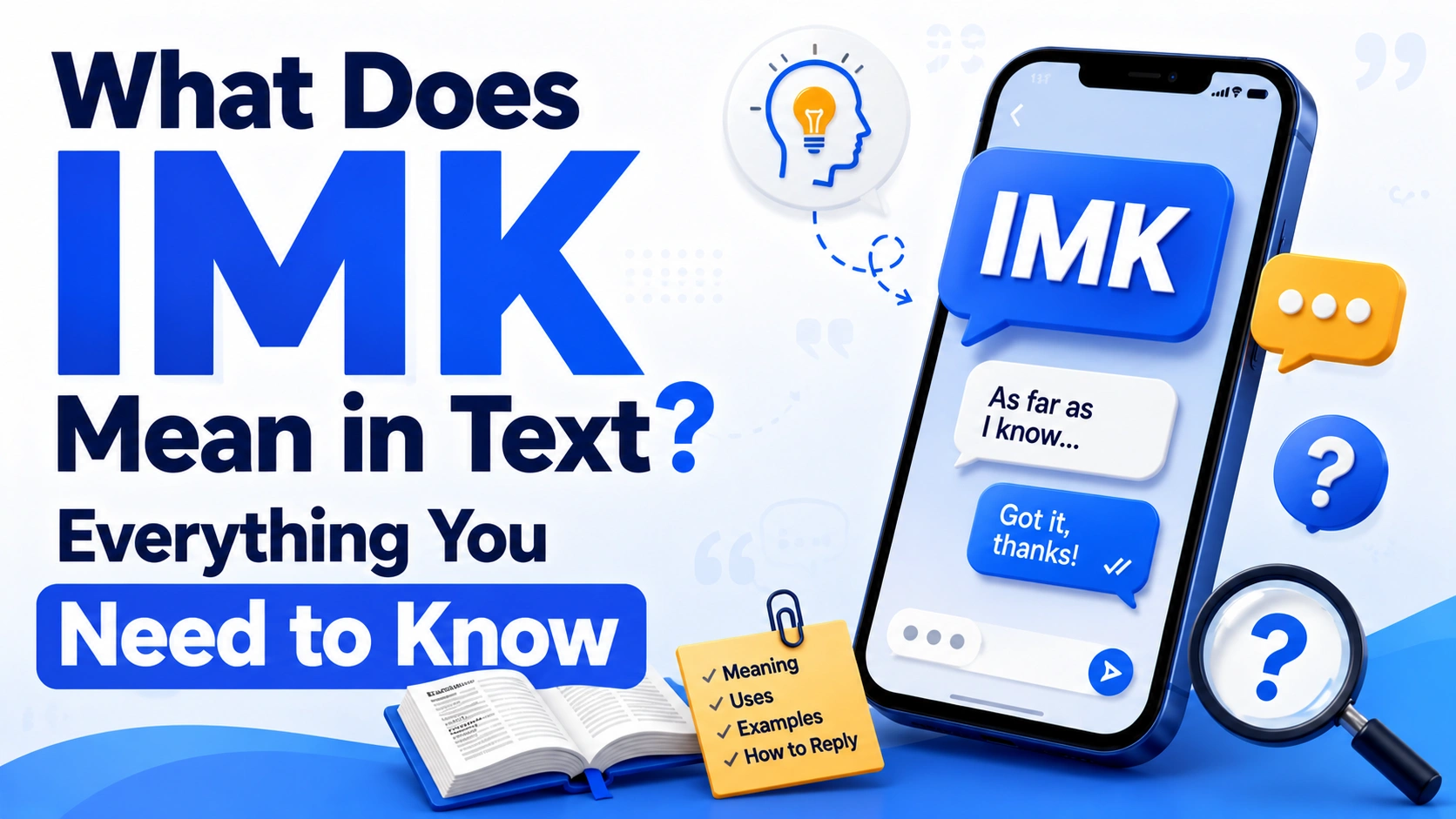
IMK meaning in text is usually “In My Knowledge,” an informal abbreviation people use when sharing information they believe is correct but do not want to present as absolutely certain. In plain English, it is close to “as far as I know,” “from what I know,” or “to my knowledge.” You may encounter IMK in texts, online discussions, comments, and casual chats. The important point is that IMK is not simply another way to say “I know.” It deliberately leaves room for the possibility that the speaker could be mistaken or missing information.
That small distinction matters because the abbreviation changes the confidence and tone of a statement. Compare “The store closes at nine” with “IMK, the store closes at nine.” The first sounds like a definite fact; the second tells you that the sender is relying on their current knowledge. This makes IMK useful when someone wants to answer a question, offer an explanation, correct another person gently, or share information without sounding overly authoritative. It is generally an informal digital expression, not standard formal English.
In this guide, you’ll learn what IMK stands for, how it works in actual conversations, how it differs from IMO, IKR, IDK, and AFAIK, when it sounds natural, and when a clearer phrase is better. We’ll also look at common misunderstandings, professional communication, possible alternate meanings, and practical ways to respond when someone sends you an IMK statement.
IMK Meaning at a Glance
| Question | Answer |
| What does IMK mean? | In My Knowledge |
| Simple meaning | As far as I know / From what I know |
| Type | Informal internet abbreviation or initialism |
| Main purpose | To share information with some qualification |
| Tone | Usually neutral, cautious, and conversational |
| Common setting | Texting, chats, comments, and online discussions |
| Formal English? | Generally no |
| Similar expression | AFAIK — As Far As I Know |
The most important distinction is that IMK qualifies information rather than simply expressing an opinion. That makes its function different from abbreviations such as IMO (“in my opinion”).
What Does IMK Stand For?
IMK stands for “In My Knowledge.”
The phrase communicates something like:
- “As far as I know…”
- “From what I know…”
- “To my knowledge…”
- “Based on what I understand…”
- “As far as I’m aware…”
For example:
IMK, the meeting starts at 10.
The sender is saying that, based on their knowledge, the meeting starts at 10, but they are not guaranteeing that the information is current or completely accurate.
That qualification is the heart of the expression.
Is IMK an Acronym or an Initialism?
Strictly speaking, IMK is better described as an initialism because the letters represent the initial letters of “In My Knowledge” and are normally understood letter by letter rather than pronounced as a single word. Some everyday websites loosely call it an acronym or slang term, so you may see both descriptions.
For a general reader, “internet abbreviation” is the clearest description.
What Does IMK Mean in Text Messages?
In texting, IMK normally introduces information that the sender considers reasonably reliable but not certain.
Consider this exchange:
A: “Is Sarah working today?”
B: “IMK, she was scheduled to.”
The second person is not saying, “I have checked the schedule and know this for certain.” Instead, they are reporting what they understand to be true.
Another example:
A: “Do we have class tomorrow?”
B: “IMK, yeah, unless the schedule changed.”
Here, IMK signals that the answer is based on the sender’s current understanding.
Why Add IMK Instead of Just Giving the Answer?
Because certainty matters.
If you simply write:
“The event starts at 7.”
you sound confident.
If you write:
“IMK, the event starts at 7.”
you communicate:
“That is what I understand, but check if it matters.”
That makes IMK particularly useful when the sender doesn’t want to overstate their knowledge.
What Does IMK Mean in Chat and Social Media?
The underlying meaning generally stays the same across digital platforms. IMK may appear in:
- Private text messages
- Group chats
- Online discussions
- Social media comments
- Forums
- Gaming-related conversations
- Informal messaging
The platform does not normally change the definition. Context changes the interpretation and tone.
For example:
“IMK, that update came out last month.”
could appear in a group chat, comment thread, or forum discussion and still mean essentially the same thing.
Some current slang references describe IMK as appearing across texting and online discussions, while also noting that it is less common than alternatives such as AFAIK.
How IMK Changes the Tone of a Message
One of the most useful ways to understand IMK is to think of it as a confidence marker.
| Without IMK | With IMK |
| “The store closes at 9.” | “IMK, the store closes at 9.” |
| “She moved last year.” | “IMK, she moved last year.” |
| “You need a ticket.” | “IMK, you need a ticket.” |
| “The update is next week.” | “IMK, the update is next week.” |
The versions containing IMK sound less absolute.
That doesn’t necessarily mean the speaker is unsure. They may actually be quite confident. The point is that they are acknowledging the limits of their own knowledge.
Is IMK Rude?
Usually, no.
IMK is generally neutral and can even make a statement feel more considerate because the sender is not presenting their information as unquestionable.
However, tone still depends on the surrounding message.
For example:
“IMK, that’s not how it works.”
could sound corrective or dismissive if the conversation is already tense.
Meanwhile:
“IMK, that’s how the process works, but I could be wrong.”
sounds much more cooperative.
The abbreviation itself is rarely the problem; the surrounding wording carries most of the interpersonal tone.
When People Naturally Use IMK
IMK makes the most sense when someone has some relevant knowledge but isn’t claiming complete certainty.
1. Answering a Question
“IMK, the library closes at 8.”
The sender is providing a useful answer while leaving room for the possibility that the schedule changed.
2. Correcting Someone Politely
“IMK, that feature was removed in the last update.”
This can sound less confrontational than:
“You’re wrong. That feature was removed.”
3. Sharing Information From Memory
“IMK, we already submitted that form.”
The sender is relying on their recollection rather than claiming they have just checked the records.
4. Giving Casual Advice
“IMK, you need to restart it before installing the update.”
In an informal conversation, the qualifier prevents the advice from sounding unnecessarily authoritative.
5. Discussing Something That May Have Changed
“IMK, the deadline is Friday.”
This is particularly useful when information may have been updated.
Expert tip: If the information affects grades, money, appointments, deadlines, safety, or important decisions, don’t treat IMK as verification. It tells you about the sender’s confidence—not whether the information is objectively correct.
Realistic IMK Examples
Here are examples that show how the expression works naturally.
Example 1: Everyday Information
A: “What time does the store close?”
B: “IMK, 9 PM.”
Meaning: As far as I know, it closes at 9 PM.
Example 2: School
A: “Is the assignment due Friday?”
B: “IMK, yeah, but check the class page.”
This is a particularly sensible use because deadlines can change.
Example 3: Group Chat
A: “Did they cancel tomorrow’s meeting?”
B: “IMK, no. It’s still happening.”
Example 4: Social Media Discussion
“IMK, that feature was added in the previous version.”
The commenter is presenting their understanding rather than claiming expert authority.
Example 5: Gentle Correction
A: “I thought the event started at 8.”
B: “IMK, it starts at 7.”
The qualifier softens the correction.
Example 6: When Verification Matters
A: “Is the application deadline still Monday?”
B: “IMK, yes, but I’d check the official page.”
This is stronger communication than simply saying “IMK, Monday,” because it separates personal knowledge from verification.
IMK vs. Similar Texting Abbreviations
IMK is easy to confuse with other short internet expressions because many of them begin with I and are used to qualify statements.
| Term | Meaning | Main Function |
| IMK | In My Knowledge | Qualifies information |
| AFAIK | As Far As I Know | Qualifies information |
| IMO | In My Opinion | Introduces an opinion |
| IMHO | In My Honest Opinion | Introduces an opinion with emphasis on honesty |
| IDK | I Don’t Know | Shows lack of knowledge |
| IKR | I Know, Right? | Shows agreement |
| FYI | For Your Information | Provides information |
| IIRC | If I Recall Correctly | Qualifies a memory |
IMK vs. AFAIK
These are the closest equivalents.
IMK:
“IMK, the event is tomorrow.”
AFAIK:
“AFAIK, the event is tomorrow.”
Both communicate roughly “as far as I know.”
AFAIK is generally the more established and recognizable abbreviation, while IMK may be unfamiliar to some readers.
IMK vs. IMO
This distinction is important.
IMK = knowledge
IMO = opinion
Compare:
“IMK, the movie was released in 2024.”
This presents information the sender believes they know.
“IMO, the movie is overrated.”
This presents a personal judgment.
The two expressions should not automatically be treated as interchangeable.
IMK vs. IDK
These are almost opposites in practical use.
IMK means:
“Here’s what I know.”
IDK means:
“I don’t know.”
For example:
“IMK, the answer is B.”
versus:
“IDK what the answer is.”
IMK vs. IKR
These have completely different functions.
IKR means “I know, right?” and usually expresses agreement or shared frustration.
“That test was ridiculously hard.”
“IKR!”
IMK, by contrast, is normally used to qualify information.
IMK vs. “I Think”
IMK and “I think” can sometimes produce similar practical effects, but they are not identical.
“I think the meeting is tomorrow.”
This sounds like a personal belief or guess.
“IMK, the meeting is tomorrow.”
This emphasizes that the statement is based on the sender’s knowledge or understanding.
The difference is subtle, but useful. “I think” foregrounds uncertainty or belief; IMK foregrounds the source of the information—the sender’s knowledge.
How to Use IMK Naturally
If you want to use IMK yourself, place it where a natural speaker would qualify a statement.
At the Beginning
“IMK, the shop closes at six.”
This is probably the clearest placement.
Before a Clause
“She already submitted it, IMK.”
This can work in casual digital writing, although the beginning position is often clearer.
With an Explicit Qualification
“IMK, that’s the current rule, but double-check.”
This is particularly useful when the information could have changed.
Lowercase or Uppercase?
You may see both:
- IMK
- imk
In casual messaging, capitalization is not important to the meaning. Lowercase forms often fit the relaxed style of texting.
When You Should Not Use IMK
IMK is an informal abbreviation, so there are situations where a full phrase is much better.
Avoid It in Formal Emails
Instead of:
“IMK, the report is due Friday.”
write:
“To my knowledge, the report is due Friday.”
Or, if appropriate:
“According to the current schedule, the report is due Friday.”
Avoid It in Academic Writing
Academic writing normally requires clear, precise language rather than texting shorthand.
Instead of:
“IMK, this theory…”
write a specific evidence-based statement or appropriately qualify the claim.
Avoid It When You Need to Establish a Verified Fact
IMK communicates personal knowledge, not independent verification.
If someone asks:
“Is the deadline definitely tomorrow?”
and you have not checked, saying:
“IMK, yes.”
may be less useful than:
“I believe so, but please check the official notice.”
That distinction is important because an abbreviation should never substitute for verification.
Common Mistakes With IMK
Mistake 1: Treating IMK as a Guarantee
IMK does not mean:
“This is definitely true.”
It means the opposite: this is what I understand to be true based on my knowledge.
Mistake 2: Confusing It With IMO
If you’re expressing an opinion, use IMO, not IMK.
Mistake 3: Using It in Every Message
An abbreviation loses its usefulness when it becomes a verbal tic.
If you’re genuinely certain because you’ve just checked the source, saying “IMK” may unnecessarily weaken the statement.
Mistake 4: Assuming Everyone Knows It
Not every reader will recognize internet abbreviations. IMK is less familiar than some mainstream texting expressions.
If clarity matters, simply write:
“As far as I know…”
Mistake 5: Using It as a Substitute for Evidence
This is the biggest practical mistake.
“IMK, this is the best treatment.”
is not evidence.
“According to the official guidance…”
is a very different kind of statement.
IMK describes your level of personal knowledge; it does not establish authority.
How to Reply When Someone Says IMK
You don’t need a special response just because someone uses IMK. Respond to the information contained in the sentence.
If You Agree
“Yeah, that’s what I thought too.”
If You Want to Confirm
“Got it. I’ll check to make sure.”
If You’re Unsure
“I’m not sure either.”
If You Have Different Information
“I heard something different. Let me check.”
If the Information Is Important
“Thanks. I’ll verify it with the official source.”
This last response is especially useful when the topic involves deadlines, schedules, rules, or anything where being wrong could cause a problem.
Can IMK Have Other Meanings?
Yes. Like many abbreviations, IMK can represent different things outside ordinary texting.
For example, acronym databases list other expansions in academic, organizational, computing, and geographic contexts. One source also lists “I Must Know” as a possible but uncommon interpretation.
However, if you receive a casual message such as:
“IMK, she’s already left.”
The natural interpretation is “In My Knowledge.”
Context should always win.
A three-letter abbreviation can mean something entirely different in a technical document, organization name, airport reference, or specialized field.
Is IMK Still Common in 2026?
IMK is still documented as an informal texting and online abbreviation in 2026, but available references consistently position it as less common than alternatives such as AFAIK.
That matters for practical communication.
You may understand IMK perfectly, but your reader might not. If you’re chatting with friends who regularly use internet shorthand, there is little problem. If you’re communicating with someone unfamiliar with the expression, “as far as I know” is clearer and only takes a few extra words.
Popularity also varies by community. Internet slang isn’t a standardized vocabulary with universal adoption. A phrase can feel normal in one group and unfamiliar in another.
IMK in Professional Communication
A useful rule is simple:
If the message needs to sound polished, write the full phrase.
Instead of:
“IMK, the contract was approved.”
use:
“To my knowledge, the contract was approved.”
Even better, if you can verify it:
“According to the latest records, the contract was approved.”
The second version is stronger because it identifies a source of information, rather than merely describing your personal knowledge.
| Situation | Better choice |
| Friend asks a casual question | IMK |
| Group chat | IMK can work |
| Casual online discussion | IMK can work |
| Message to a teacher | To my knowledge |
| Professional email | To my knowledge |
| Academic writing | State the evidence directly |
| Important factual claim | Verify the source |
| Official communication | Use precise language |
A Simple Decision Rule for IMK
Before using IMK, ask yourself three questions:
- Am I sharing information rather than simply giving an opinion?
- Is this an informal conversation?
- Would I be comfortable leaving room for correction?
If the answer is yes to all three, IMK may fit naturally.
If you’re writing something formal or making an important factual claim, use clearer language instead.
Quick rule: IMK is useful for “This is what I know.” It is not a substitute for “This has been verified.”
Conclusion:
IMK meaning in text is usually “In My Knowledge,” a casual abbreviation used to share information without presenting it as absolutely certain. Its real value is not the three letters themselves but the subtle confidence marker they add: “This is what I understand to be true, but I may not have the complete picture.” That makes IMK useful in relaxed conversations, while AFAIK, “as far as I know,” or “to my knowledge” may be clearer for wider audiences. One final actionable tip: use IMK when the setting is casual and your knowledge is reasonably confident but not fully verified. A common mistake to avoid is treating IMK as proof that something is true. Good communication distinguishes personal knowledge from verified information—and that distinction is more important than any texting shortcut.
FAQs
Q1. What does IMK mean in text?
IMK usually means “In My Knowledge.” It is an informal abbreviation used to introduce information that someone believes is correct based on what they know. In everyday language, it is close to “as far as I know” or “to my knowledge.” It also leaves room for correction.
Q2. Is IMK the same as AFAIK?
They are very similar, because both qualify information with the idea of “as far as I know.” However, AFAIK (“As Far As I Know”) is generally more recognizable. If you’re unsure whether someone will understand IMK, AFAIK or the full phrase is usually clearer.
Q3. Is IMK formal or informal?
IMK is informal. It works naturally in casual texts, group chats, comments, and online conversations. It is better to avoid it in professional emails, academic assignments, official documents, or other situations where polished and explicit wording is expected. Use “to my knowledge” instead.
Q4. Does IMK mean “in my opinion”?
No. IMK and IMO have different meanings. IMK means “In My Knowledge” and qualifies information based on what the sender knows. IMO means “In My Opinion” and introduces a personal judgment or viewpoint. Context can make the distinction especially clear.
Q5. How should I respond when someone uses IMK?
You can respond normally to the information. If you agree, acknowledge it; if you’re uncertain, ask a follow-up question; and if the information is important, verify it independently. IMK tells you that the sender is sharing their knowledge, not that the claim has necessarily been confirmed.